Does Adobe Scene7 (Dynamic Media) Work in China? ICP Footing, Offshore Edges & Cross-Border Metadata
Adobe Scene7 — now Adobe Dynamic Media — delivers images and video over Akamai's globally distributed edge network by default, with no in-country China caching. Adobe's own documentation says China caching is used "only when configured to do so, and delivery domain is backed by an ICP license" — so for a China audience the gate is ICP footing, not speed, with the request metadata reaching offshore edges a cross-border transfer under PIPL. A compliance-first look at the ICP, reachability and cross-border questions, and the lawful in-country delivery path.
Does Adobe Scene7 (Dynamic Media) work in China?
Yes — Adobe Scene7, now Adobe Dynamic Media, reaches mainland China; its scene7.com delivery domains are not blocked at the border, so the honest answer is that availability is not the problem. What decides the China question is licensing footing and cross-border data handling.
By default, Dynamic Media's delivery domains CNAME to "the Akamai CDN edge host" and serve from "globally distributed edge hosts" — offshore of the mainland, with no in-country caching. Adobe documents a China-enabled delivery path, but says it is used "only when configured to do so, and delivery domain is backed by an ICP license." That makes ICP footing the gate — a license the operator must hold, not one Adobe supplies — while the IP, user-agent and referer each China request sends to an offshore edge are personal information handled abroad, a cross-border transfer under PIPL. For a critical information infrastructure operator, the Cybersecurity Law's Article 39 (formerly Article 37) adds an in-country storage duty an offshore edge cannot meet.
21YunBox maps your ICP and cross-border exposure, stands up the ICP-filed in-country footing Adobe's China path requires, and delivers your media in-country in front of the Dynamic Media setup you already run — no rebuild, and never any form of circumvention. Treat the specifics as a risk to confirm with counsel. Our China team can map your exposure with you →
What Adobe Scene7 (Dynamic Media)'s own documentation says about China
| Fact | Primary source |
|---|---|
| By default, Dynamic Media serves media from Akamai's global edge network — offshore of the mainland. Adobe's own CDN reference states that the Dynamic Media "delivery domains are configured as a CNAME to the Akamai CDN edge host," and that "content is delivered through Akamai CDN with globally distributed edge hosts." None of those default hosts sits inside mainland China, so a China visitor is answered from across the border. | Adobe Experience League — CDN domain details for delivery domains in AEM Dynamic Media (experienceleague.adobe.com), retrieved 2026-10-09 |
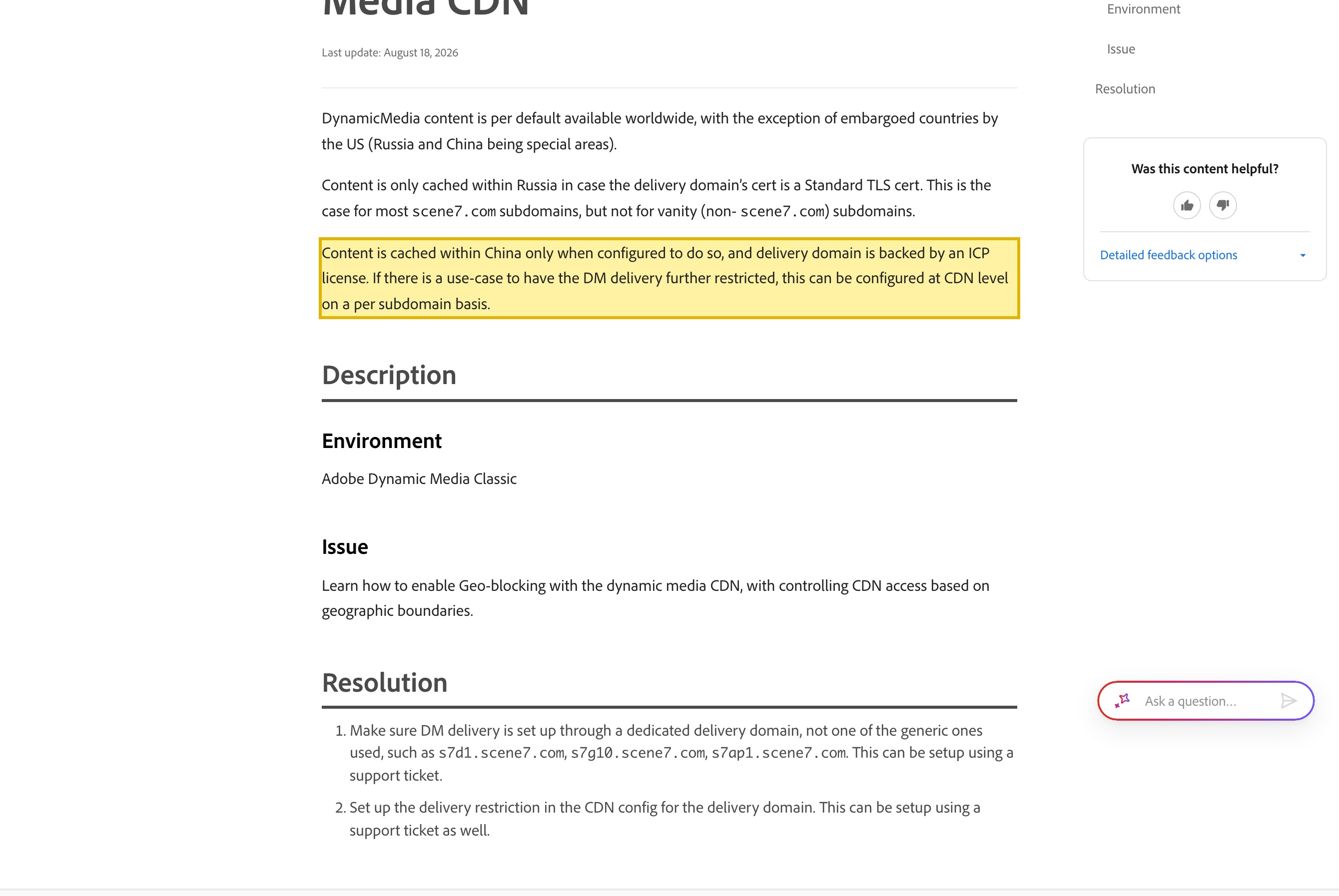
| Adobe's own China delivery path is opt-in and conditioned on an ICP license. Adobe documents that "for China-enabled delivery domains, Dynamic Media uses a China delivery path for in-country content delivery," but that "content is cached within China only when configured to do so, and delivery domain is backed by an ICP license." In-country China delivery is therefore off unless you configure it — and Adobe requires an ICP license the operator must obtain, not one Adobe provides. | Adobe Experience League — Enable Geo-blocking with Dynamic Media CDN; CDN domain details for delivery domains in AEM Dynamic Media (experienceleague.adobe.com), retrieved 2026-10-09 |
| The generic scene7.com domains you start with are the offshore ones. Adobe instructs customers to "make sure DM delivery is set up through a dedicated delivery domain, not one of the generic ones used, such as s7d1.scene7.com, s7g10.scene7.com, s7ap1.scene7.com" — so the default, generic delivery domains are the Akamai-global, non-China-enabled path, and the compliant in-country route is a separate, ICP-backed build. | Adobe Experience League — Enable Geo-blocking with Dynamic Media CDN (experienceleague.adobe.com), retrieved 2026-10-09 |
| Serving the public from inside China needs an ICP filing, and the request data crossing to an offshore edge is governed by PIPL. A public-facing service delivered from inside the mainland must carry an ICP filing (State Council Order No. 292; MIIT Order No. 33) bound to an in-country resource — the license Adobe's China path assumes. And the IP address, user-agent and referer a China visitor sends to a default offshore edge are personal information handled abroad: a cross-border transfer under PIPL (Articles 38–40), a duty that sits with you as the handler. | Personal Information Protection Law of the PRC, Articles 38–40 (cac.gov.cn); State Council Order No. 292; MIIT Order No. 33, retrieved 2026-10-09 |
Sources verified by the 21YunBox compliance team on 2026-10-09.
Whether Adobe Scene7 — the media-rendering and delivery service now folded into Adobe Dynamic Media — “works” in mainland China is a question of licensing and lawful data handling before it is one of speed. Its images and video reach China: the scene7.com delivery domains are not blocked at the border. What the China decision actually turns on is where that media is served from, whether that footing is licensed, and what happens to the request data your China visitors hand to an offshore edge. Adobe answers the first two in its own documentation — and the answer puts an ICP license, not a performance dial, at the center.
By default, Dynamic Media’s delivery domains are a CNAME to Akamai’s edge network and serve from globally distributed edge hosts — none of them inside the mainland unless you take a separate, documented step. And Adobe says that step is conditioned on an ICP license.
Adobe Scene7 (Dynamic Media) in China at a glance
| What decides it | In Adobe's own terms — and China's law |
|---|---|
| What it is | Adobe Scene7, now Adobe Dynamic Media inside Adobe Experience Manager, is the image-and-video rendering and delivery CDN. It serves media from the scene7.com delivery domains (and customer vanity domains) to the pages your users load. |
| Is it reachable from the mainland? | Yes. The scene7.com delivery domains are callable from China and not blocked at the border; Adobe notes DM content is “per default available worldwide,” with China treated as a “special” area. Reachability is not the China question. |
| Where the media is served from | By default the delivery domains CNAME to “the Akamai CDN edge host,” and “content is delivered through Akamai CDN with globally distributed edge hosts.” For a China visitor that means an offshore edge, with no in-country caching. |
| The China delivery path | Adobe documents one — “for China-enabled delivery domains, Dynamic Media uses a China delivery path for in-country content delivery” — but it is opt-in (“cached within China only when configured to do so”) and, in Adobe's words, the “delivery domain is backed by an ICP license,” on a dedicated domain, not the generic ones. |
| ICP footing | Serving media to the public from inside the mainland turns on an ICP filing (State Council Order No. 292; MIIT Order No. 33), bound to an in-country resource. Adobe conditions its own China path on that license but the operator — you — must obtain and hold it. |
| Your China visitors' request data | The IP address, user-agent and referer that reach an offshore edge are personal information handled outside the mainland — a cross-border transfer PIPL governs. Modest in volume, but the handler's duty, not Adobe's. |
By default, the media is served from an offshore, global edge network
Adobe’s own CDN reference is explicit about where the bytes come from. The Dynamic Media “delivery domains are configured as a CNAME to the Akamai CDN edge host,” and “content is delivered through Akamai CDN with globally distributed edge hosts.” Akamai’s edge network is global; none of those default hosts sits inside mainland China. So a China visitor loading a media-heavy page — a product gallery, a zoom viewer, an embedded video — is answered from an edge across the border.
Where a page leans on that media, delivery from offshore can be slow or unstable, and the gallery or viewer that depends on it can degrade or fail to render. That is the reachability half, and for media it is real. But it is the operational half, not the half that decides whether you may lawfully use the service — and this page publishes no first-party China latency figure for Scene7, because the decision turns on licensing and data handling, not on a stopwatch.
Adobe’s own China delivery path is gated on an ICP license
Dynamic Media is not without a China option — but the option Adobe documents is opt-in and licensed. Its CDN reference notes that “for China-enabled delivery domains, Dynamic Media uses a China delivery path for in-country content delivery.” Its geo-blocking article is sharper on the condition: DM content is “per default available worldwide,” but “content is cached within China only when configured to do so, and delivery domain is backed by an ICP license.” And that path runs on a dedicated delivery domain, not the ones you start with — Adobe tells customers to “make sure DM delivery is set up through a dedicated delivery domain, not one of the generic ones used, such as s7d1.scene7.com, s7g10.scene7.com, s7ap1.scene7.com.”
Read together, that is an ICP question wearing a CDN’s clothes. In-country China delivery is off unless you configure it, it needs a dedicated delivery domain, and Adobe conditions it on an ICP license — a filing under State Council Order No. 292 and MIIT Order No. 33 that attaches to an in-country hosting resource and is issued to the operator by Chinese authorities, not supplied by Adobe. “We already run Dynamic Media” does not carry into the mainland on its own: the generic scene7.com domains you begin with are the offshore, Akamai-global ones, and the compliant in-country route is a separate, ICP-backed build you have to stand up.
The request data reaching an offshore edge is a cross-border transfer
There is a data-handling half too, quieter than the licensing one but on the same axis. Every media request a China visitor makes to a default scene7.com edge carries personal information — the visitor’s IP address, user-agent and referer, and the URL of the asset requested. When that request is answered from an edge outside the mainland, that information has been handled offshore, which is a cross-border transfer of personal information under China’s Personal Information Protection Law. The volume is modest next to an analytics or CRM feed, but the duty is the same and it lands on the handler — you, not Adobe: notice, a lawful basis, and one transfer mechanism where the thresholds apply (PIPL Articles 38–40). And for a critical information infrastructure operator, the Cybersecurity Law’s Article 39 (formerly Article 37 — the data-localization provision was renumbered by the 2025 amendment in force January 1, 2026, with its substance unchanged) sets an in-country storage duty that an offshore edge and its logs cannot meet.
This is a risk map, not a verdict: whether you owe an ICP filing, a transfer mechanism, in-country storage, or some combination turns on which delivery domains serve China, the personal data those requests carry, your role as handler, and who your users are — all worth settling with counsel before you rely on it.
The lawful path — map, localize, deliver
There is a way to run Scene7-delivered media for a China audience that stays on the right side of the line, and it has three moves. First, map: our China team works out which of your delivery domains answer China traffic, where Adobe’s offshore default leaves you exposed, and what the ICP and PIPL obligations attach to — the licensing footing, the cross-border handling of request data, and any Article 39 storage duty for your entity. The legal conclusions are settled with counsel; we build the technical picture that feeds them.
Then localize: we stand up the ICP-filed, in-country footing that Adobe’s own China path requires but leaves to you — a licensed delivery presence inside the mainland for the media that serves your China users, so the in-country path has lawful ground to stand on rather than a generic offshore domain.
Then deliver: the 21YunBox Optimizer serves that media in-country, set in front of the Dynamic Media setup you already run — no rebuild, no re-platform, no second codebase. Your authoring, rendering and asset pipeline stay exactly where they are in Adobe; what changes is that your China visitors are answered from a licensed, in-country footing instead of an offshore edge. The result is media that runs legally and compliantly for your users in China. What we never do — and what no one lawfully can — is route around a network restriction or China’s data rules by stealth: 21YunBox neither uses nor suggests circumvention of any kind.
Related reading:
- How to get an ICP filing for China
- Cross-border data transfers under PIPL
- China’s Cybersecurity Law (data localization, Article 39)