What is Tmall Global and how to get started
Tmall Global, also known as 天猫国际, is a cross-border marketplace and the global version of Tmall for foreign brands and merchants without requiring a legal entity in China to sell directly to Chinese consumers.
How does a foreign brand sell on Tmall Global in mainland China?
Yes — and this is the one major Chinese marketplace built for it. Tmall Global accepts an overseas company registration, so you do not need a mainland China legal entity to open a store. The gate you clear instead is qualification — brand and trademark rights, authorized-seller proof — plus China's cross-border retail-import rules and PIPL for your customers' data.
Because Tmall Global is Alibaba's cross-border channel, an offshore seller is the intended merchant, not a workaround: you register with your overseas company and a home-country retail or trading license, and the platform screens your brand qualifications rather than a China business license. What is gated is what you sell and how data moves — your category must sit on China's cross-border e-commerce retail-import list, each sale is treated as an article imported for a buyer's personal use (within a per-transaction and an annual per-person cap, flagged not-for-resale), and the Chinese customer data you handle — including the identity data customs clearance needs — is governed by the cross-border-transfer rules under PIPL. The facts below are the platform's own eligibility rules and the Chinese regulations each one triggers.
None of this is a yes/no verdict — the right store type, qualifications and data path depend on your brand rights, your product categories and where your customer data flows. Our China team can map your Tmall Global path with you →
What a foreign brand must clear to sell on Tmall Global
| Fact | Primary source |
|---|---|
| This is the one Chinese marketplace designed for offshore brands. Tmall Global presents itself as a "cross-border business-to-consumer marketplace" that lets overseas brands reach Chinese consumers "without the need for physical operations in China," offering overseas warehouses and direct-to-consumer fulfillment from outside the mainland. An offshore entity here is not a workaround — it is the intended seller. | Tmall Global / Alibaba merchant announcement (ali-home.alibaba.com), retrieved 2026-10-07 |
| What you actually clear is brand qualification, not a China business license. A China-focused advisory states the rule plainly: "Companies registered outside of mainland China are eligible to participate on Tmall Global," and a brand can operate "without having a physical presence in China." But an applicant must hold "a retail or trading license in the country of origin" and "be the brand owner or authorized agency or possess the purchase voucher," while a flagship store's "products must have the relevant trademark registrations (® or ™)." A non-owner must show "authorization to operate a store" or "evidence of the product source and invoices." Confirm the current document set and trademark jurisdiction with the platform, as these have shifted over time. | Dezan Shira & Associates — China Briefing, "Selling to China Without a Physical Presence: … Tmall Global", retrieved 2026-10-07 |
| Your goods must be on China's cross-border e-commerce retail-import list. Under the governing circular, "all Goods must be included in the 2018 List" of cross-border e-commerce retail imports — a positive list that defines the scope of goods allowed the favorable cross-border treatment, so a category that is not on it cannot be sold through this channel. The list and its supervision rules are issued by China's Ministry of Finance, Ministry of Commerce and the General Administration of Customs. | CMS, "China published new regulations on Cross-border E-commerce Retail Imports" (law-firm analysis), retrieved 2026-10-07; MOF / MOFCOM / GACC Goods List and supervision circular (gov.cn) |
| Sales run under personal-use import rules, not ordinary trade. The circular regulates cross-border e-commerce retail imports as "articles imported for personal use," within a per-transaction cap and an annual per-person cap set by the regulation. Sellers must tell buyers the "Goods are for personal use only and may not be re-sold," and for each order "the transactional, payment and logistics electronic information … must be able to be cross-checked" at customs — so your order, payment and logistics records must reconcile against the purchaser's identity. | CMS, "China published new regulations on Cross-border E-commerce Retail Imports" (law-firm analysis), retrieved 2026-10-07; Circular on Supervision of Cross-border E-commerce Retail Imports and Notice on Improving the Import Tax Policy (gov.cn) |
| Your customers' personal data is governed by PIPL — including the identity data customs clearance requires. Operating a Tmall Global store means handling Chinese buyers' names, addresses, contact details and the identification data cross-border customs clearance relies on. Moving that personal information out of mainland China is a cross-border transfer under PIPL, requiring notice, separate consent and a lawful transfer mechanism (Articles 38–43); a critical-information-infrastructure operator or large-volume handler must store it in China (Cybersecurity Law Article 39 (formerly Article 37) — renumbered from the 2016 Article 37 by the amended law in force 2026-01-01 — and PIPL Article 40). Treat this as exposure to confirm with counsel, not a settled answer. | Personal Information Protection Law (effective 2021-11-01), Articles 38–43 and 40; Cybersecurity Law Article 39 (formerly Article 37) (amended law in force 2026-01-01), cac.gov.cn, retrieved 2026-10-19 |
Sources verified by the 21YunBox compliance team on 2026-10-07.
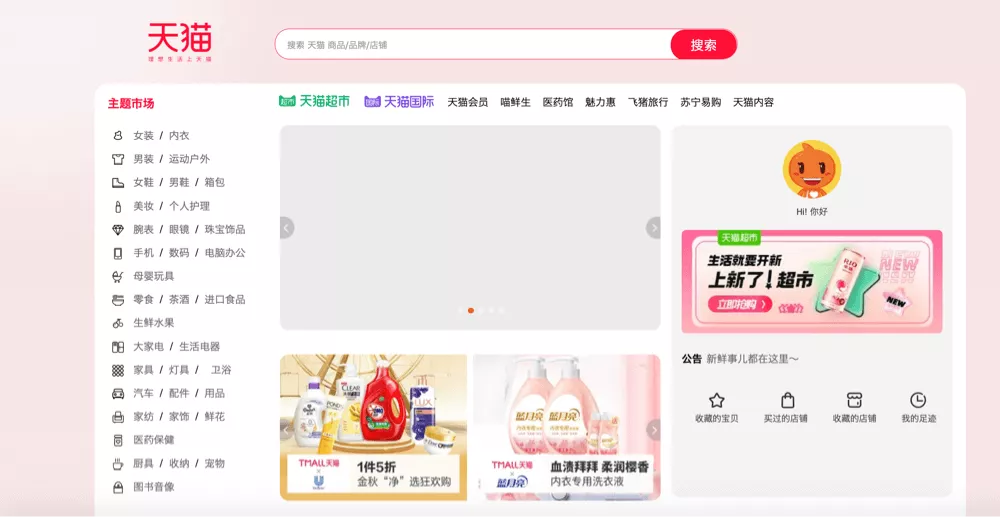
About Tmall Global
Tmall Global, also known as 天猫国际, is a cross-border marketplace and the global version of Tmall for foreign brands and merchants without requiring a legal entity in China to sell directly to Chinese consumers.
Alibaba first introduced Tmall in 2008 as a dedicated B2C platform operated besides Taobao within its consumer e-commerce website. The critical difference between Tmall and Taobao is that Tmall is a B2C platform, but Taobao is C2C. However, only China-registered brands can open stores on Tmall.
Hence in 2014, Alibaba launched Tmall’s global version, “Tmall Global,” as a cross-border marketplace for foreign brands and merchants to sell directly to Chinese consumers, which does not require merchants to have a legal entity in China. Most major foreign brands now have flagship stores on Tmall Global, ranging from old brands like Costco to new brands like Lululemon.
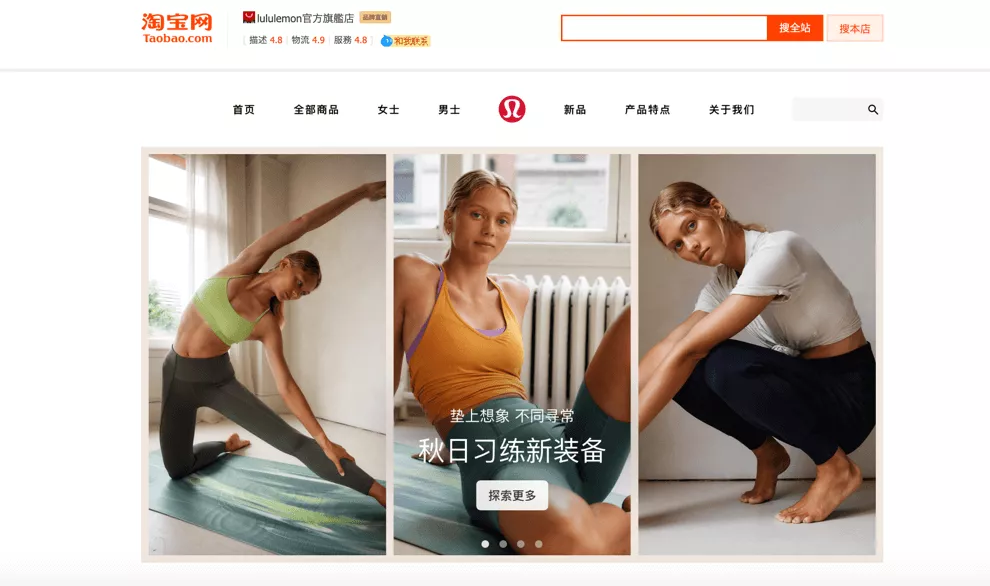
How To Get Started On Tmall Global
Sell on Tmall Global
Tmall Global is available to all overseas businesses and merchants that do not have a business license or legal entity in China.
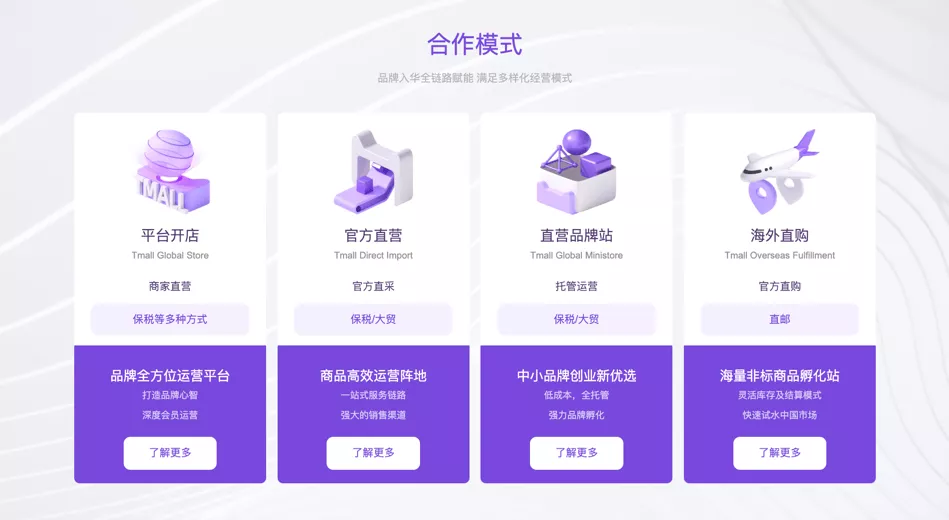
There are four types of stores on Tmall Global:
Tmall Global Store(平台开店)
Merchants can choose their team or a third-party service provider team to operate and manage their Tmall Global Store.
Tmall Direct Import(官方直营)
Get a one-stop service from Tmall Global and enter the bonded warehouse.
Tmall Global Ministore (直营品牌站)
Suitable for Small and medium-sized brands, with low-cost, fully managed brand incubation.
Tmall Overseas Fulfillment (海外直购)
Suitable for non-standard commodities, with flexible inventory and settlement model.
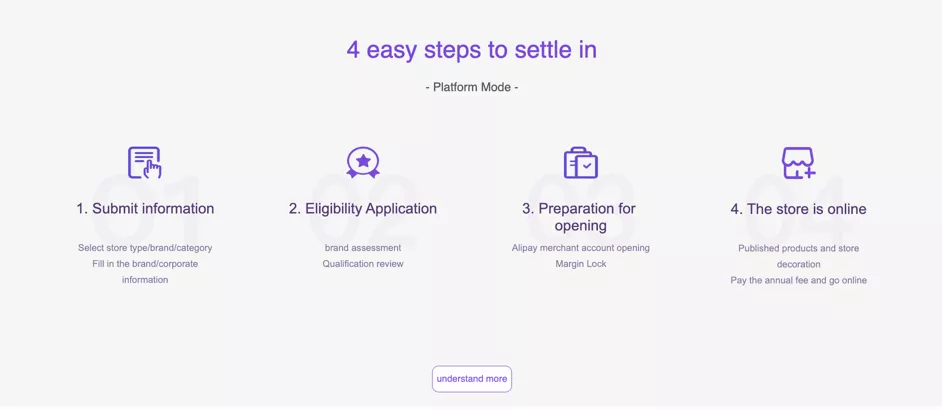
There are 4 steps to open a store on Tmall Global:
Step 1. Select store type/brand/category and submit the brand/corporate information.
Step 2. Wait for approval from Tmall, which usually takes 7 working days.
Step 3. Once approved, complete your store’s information and pay a security deposit and Tmall’s annual fee.
Step 4. List your products and launch your store.
Cost To Sell On Tmall
The fees charged by Tmall Global mainly include three parts: deposit, annual technical service fee, and real-time deduction of technical service fee (commission).
Security deposit: Typically, the deposit is RMB 150,000.
Annual fee: The annual fee amount is based on the first-level category, divided into 30,000 yuan or 60,000 yuan. If the store operates across categories, it will be charged according to the highest annual fee, not superimposed.
Commission: Merchants operating on Tmall Global need to pay a technical service fee based on a certain percentage of their sales, ranging from 2% to 5%, depending on the category.
Please refer to the commission standard for each category here.
Do not have a Chinese entity, Chinese phone number or Chinese ID? We can help!
If you do not have a Chinese entity, Chinese ID, or Chinese phone number, which is essential to get onboard with Tmall Global, 21YunBox is here to help.
We can provide the necessary supporting documents to use Tmall Global and walk you through the process. Meanwhile, we will also bring your company, product, and service into full compliance with Chinese law.
Contact us now to learn more about our solutions for doing business in China legitimately!
RELATED COMPANIES










ARTICLES RELATED TO TMALL GLOBAL
- China Implements Stricter Regulations on Internet Comment Services
- Does reCAPTCHA Work in China? Reachability, Google's Servers & PIPL
- China Cross-Border Data Transfer: What the Regulation Actually Says
- Tips for Businesses Looking to Sell Products in China: How to Start and Where to Start
- What is data privacy?
- Baidu Tieba - build brand reputation and improve search engine optimization in China!
- Why has my app been deleted from Chinese app stores, and how can I fix it?
- 15 Tips on How to Make a Website Load Faster
- Baidu vs Google
- Baidu Wangpan Guide
- How To Create A Little Red Book Brand Account And Store?
- How To Sell Products to China via WeChat?
- How to Publish My Mobile App in China: A Comprehensive Guide
- How to register a .cn domain?
- Trademark registration in China
PARENT COMPANY
Alibaba Group
OWN BY THE SAME PARENT COMPANY
CATEGORIES
eCommerceWESTERN EQUIVALENTS
- Amazon
Ready to Accelerate Your Site in China Legitimately?
Join 21YunBox and the 5,000+ developers and enterprises to use modern deployment technology
Get StartedLaunch Your Site in China with Confidence