What is JD.com and how to get started?
JD.com, also known as Jingdong, is one of the two massive Chinese B2C online retailers by transaction volume and revenue and a significant competitor to Alibaba-run Tmall.
What does a foreign company need to sell on JD.com in mainland China?
A foreign brand does not simply "open a JD store." JD runs two separate doors — its domestic marketplace, which you enter as a China-registered company, and the cross-border JD Worldwide (京东国际) lane, which an offshore brand can use without a mainland entity. Qualifying for the right door is the first gate, not a sign-up form.
To sell on JD's domestic marketplace you are an "e-commerce operator" under Chinese law, so you must register as a market entity — a mainland business license, held by a WFOE, a joint venture or a licensed local partner of record — and JD must verify your identity and category licenses before you trade (PRC E-Commerce Law, Articles 10 and 27). JD Worldwide instead lets a non-mainland company sell imported goods into China, but JD's own rules still pin a China-based registered agent jointly liable for you and require a mainland return address, and your catalog has to sit on the national cross-border import commodities list the customs authority administers. Either way, the customer data you collect is governed by the PIPL. The guide below walks the domestic and global seller steps; the gate above is what decides which one is open to you.
This is a risk map to work through with counsel, not a yes/no — the right door turns on your entity, your product category and where your customer data lives. Our China team can map your path with you →
What a foreign brand must clear to sell on JD
| Fact | Primary source |
|---|---|
| Selling on JD's domestic marketplace makes you an "e-commerce operator" under Chinese law — which turns on a mainland business license, not just an account. The PRC Electronic Commerce Law requires that "e-commerce operators shall complete business registration" — market-entity registration, i.e. a Chinese business license — subject only to narrow exceptions (Article 10), and that platform operators "shall request," verify and record each applicant merchant's identity, address and administrative-license information before listing them (Article 27). For a foreign brand that means a mainland entity — a WFOE or joint venture — or a licensed local partner acting as the registered seller, plus the category qualifications JD reviews. | Electronic Commerce Law of the PRC (effective 2019-01-01), Articles 10 & 27 — NPC official English translation, retrieved 2026-10-07 |
| JD Worldwide (京东国际) is the cross-border import channel that lets an offshore brand sell into China without incorporating onshore. JD's own JD.HK Open Platform specifications apply to merchants whose "place of registration of non-mainland Chinese enterprises must be consistent with the qualifications," accept Hong Kong-registered merchants (who "can fill in the number on the registration document") and an "overseas company registration certificate," and note that "only the mainland ID card number is supported" while a non-mainland legal representative has "no need to fill in the ID number." So the entity that opens the store can be your existing overseas company, selling imported goods rather than operating as a domestic Chinese retailer. | JD.HK Open Platform — Merchant Qualification Specifications (jd.hk, dated Dec 2018), retrieved 2026-10-07 |
| The cross-border door still ties you to a China-based party who shares legal liability — "no mainland entity" is not "no China footprint." JD's own guide states that "using a registered agent's service is required by law for non-Chinese entities," and that the agent supplies "a Chinese legal entity to take joint liability for the international merchant's actions in China" plus "a return address located in China to accept product returns." In other words a China-side party is jointly on the hook for your conduct and your after-sales, even though you never set up a mainland company. | JD Marketplace / JD.HK — Service Providers (registered agent) guide (jd.hk), retrieved 2026-10-07 |
| What you may sell through the cross-border lane is set by customs, not by JD. Cross-border e-commerce retail imports are confined to a national "cross-border e-commerce retail import commodities list" that eight central authorities — including the Ministry of Finance, the Ministry of Commerce and the General Administration of Customs — jointly maintain and periodically revise (the latest adjustment took effect 2022-03-01). A product outside that list cannot clear through this channel, so catalog eligibility is a regulatory question your brand has to clear before it is a merchandising one. | Ministry of Finance et al. Announcement No. 7 of 2022 — adjustment to the cross-border e-commerce retail import commodities list (gov.cn), retrieved 2026-10-07 |
| The customer personal data you handle through JD is governed by China's PIPL — and where it lives is the risk to pin down. If orders, contact details or marketing data flow back to systems outside the mainland, that is a cross-border transfer of personal information under the PIPL (notice, separate consent and a transfer mechanism, Articles 38–43); for a critical-information-infrastructure operator or a large-volume handler, China-collected personal data must be stored in the mainland (Cybersecurity Law Article 39 (formerly Article 37); PIPL Article 40). JD is itself the licensed platform operator, so — unlike running your own China website — you do not file your own ICP for a store; your exposure is the entity, qualification and data duties above. Treat the split as a question for counsel, not a given. | PIPL Articles 38–43 & 40 (cac.gov.cn, official statute); Cybersecurity Law Article 39 (renumbered from the 2016 law's Article 37, effective 2026-01-01); retrieved 2026-10-07 |
Sources verified by the 21YunBox compliance team on 2026-10-07.
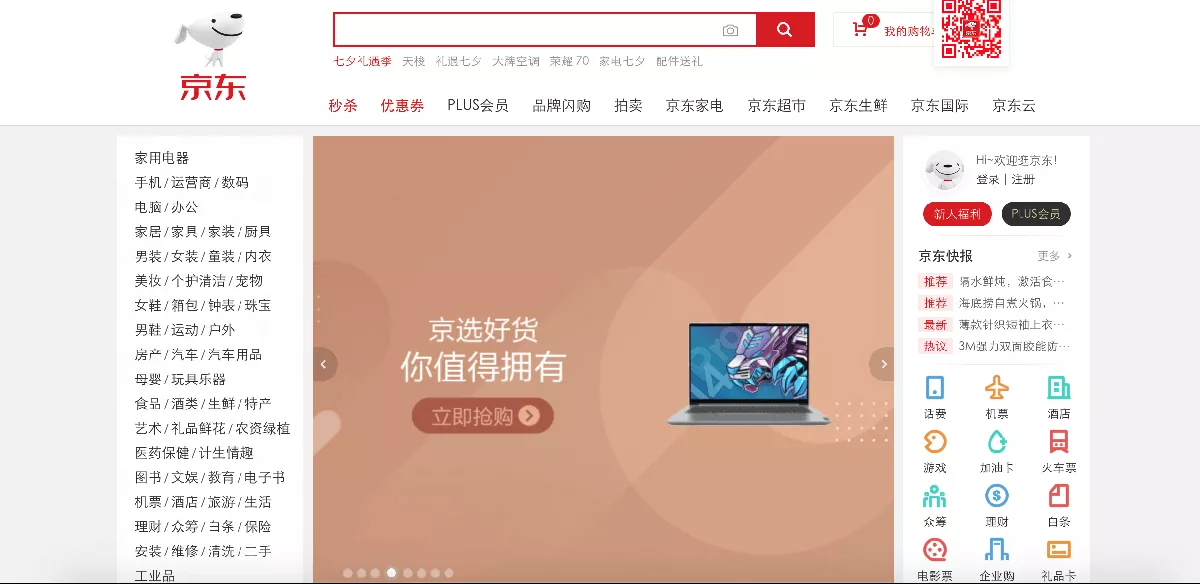
About JD.com
JD.com, also known as Jingdong, is one of the two massive Chinese B2C online retailers by transaction volume and revenue and a significant competitor to Alibaba-run Tmall. It is partly owned by Tencent, which has a 20% stake in the company.
JD is very similar to Amazon, with its vast product offering covering everything from fresh food and apparel to electronics and cosmetics. It has a reputation for quality control, fast next-day delivery, and a 7-day refund policy. As of March 31, 2022, JD has 580.5 million active users.
How To Get Started On JD.com
China-registered merchants may sell on JD.com while offshore merchants may sell on JD Worldwide, both following the steps below:
Step 1: Create a seller account on JD.com
Step 2: Fill in your company information and upload your business license and supporting documents.
Step 3: Fill in the store information, including store type (“POP” Sellers, Suppliers, or Partners), business category, brand name, and the name of the store you wish to use.
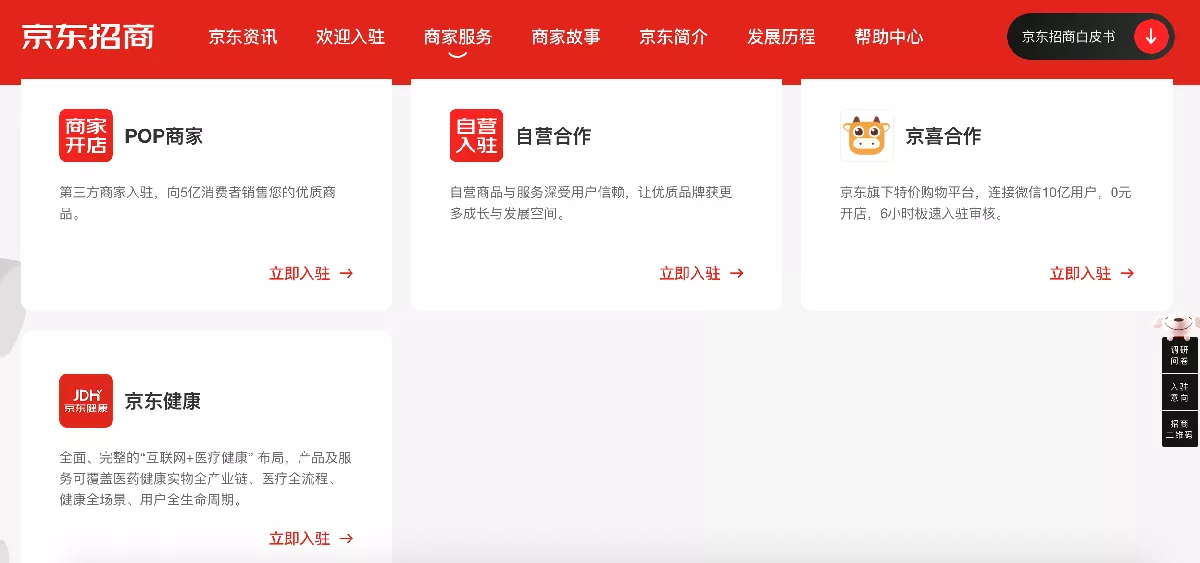
Step 4: Sign the contract and submit the application.
Step 5: Wait to receive verification from JD.com in 6 business days
Step 6: Upload products and connect with operators
You can also refer to JD.com’s seller guide for more specific guidelines.
Cost To Sell On JD.com
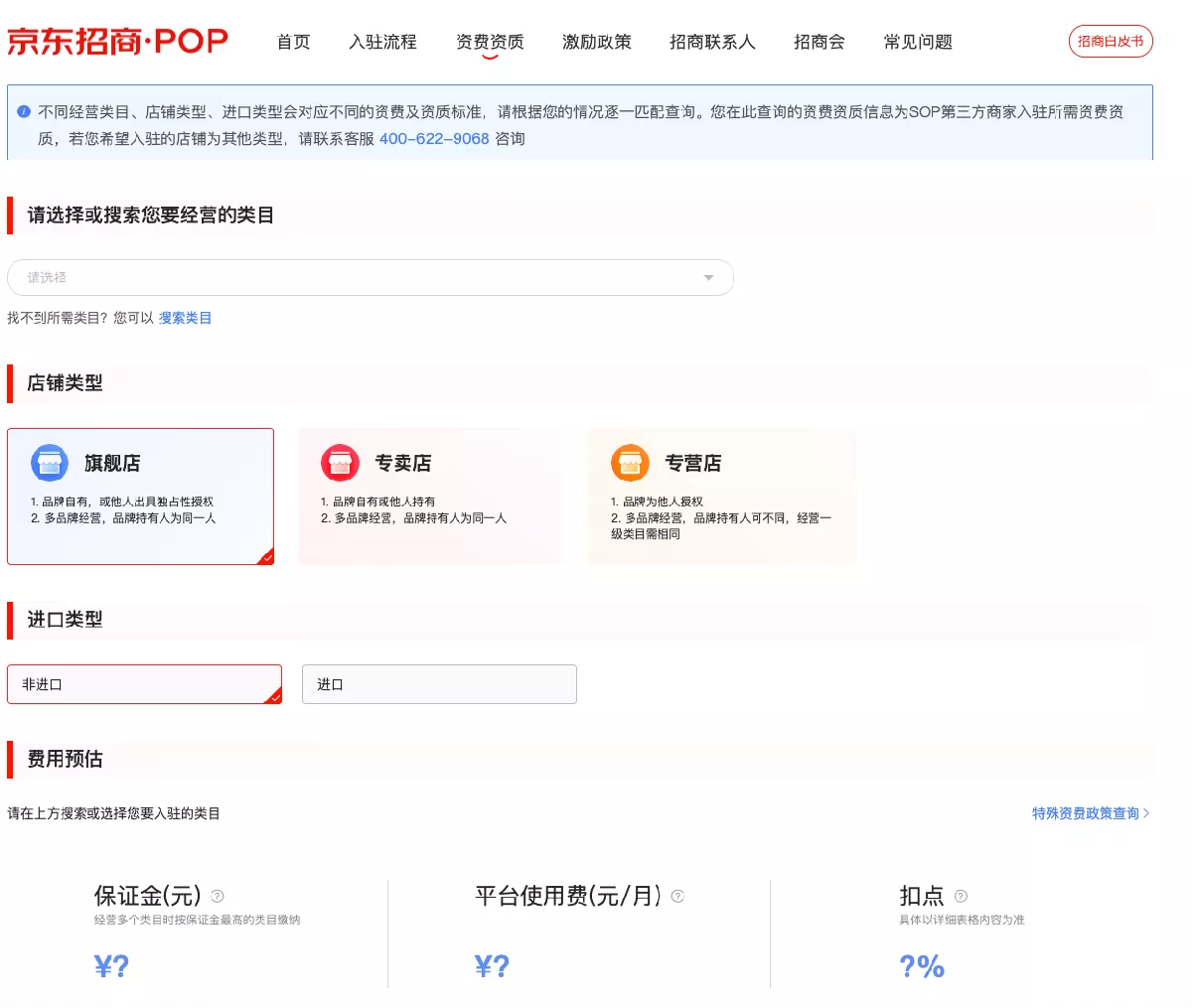
1. Security Deposit
Typically the deposit is 1,000 yuan, but it depends on what category you are selling in. After signing the contract, the deposit must be remitted to the designated account, which can be refunded when the merchant exits the platform.
2. Platform Service Fee
It typically costs 1,000 yuan per month and is paid once a year.
3. Commission
JD.com is a commission-based platform and charges an additional monthly fee determined by your selling category, ranging from 3%-8%.
The total cost varies from category to category. For reference, women fashion sellers would pay RMB ¥30,000 as a security deposit, an 8% commission off of sales, and RMB ¥1,000 per month for platform use; Business travel service providers would pay RMB ¥10,000 for the deposit, an 2% commission off of sales, and RMB ¥500 per month for platform use.
You can also check the cost of your specific category at https://zhaoshang.jd.com/index/qualificate.
Business Requirements To Be A Seller On JD.com
Local merchants
For local merchants, it is required by JD that the registered capital of the merchant’s company must be at least RMB 500,000 yuan and must be established for at least one year.
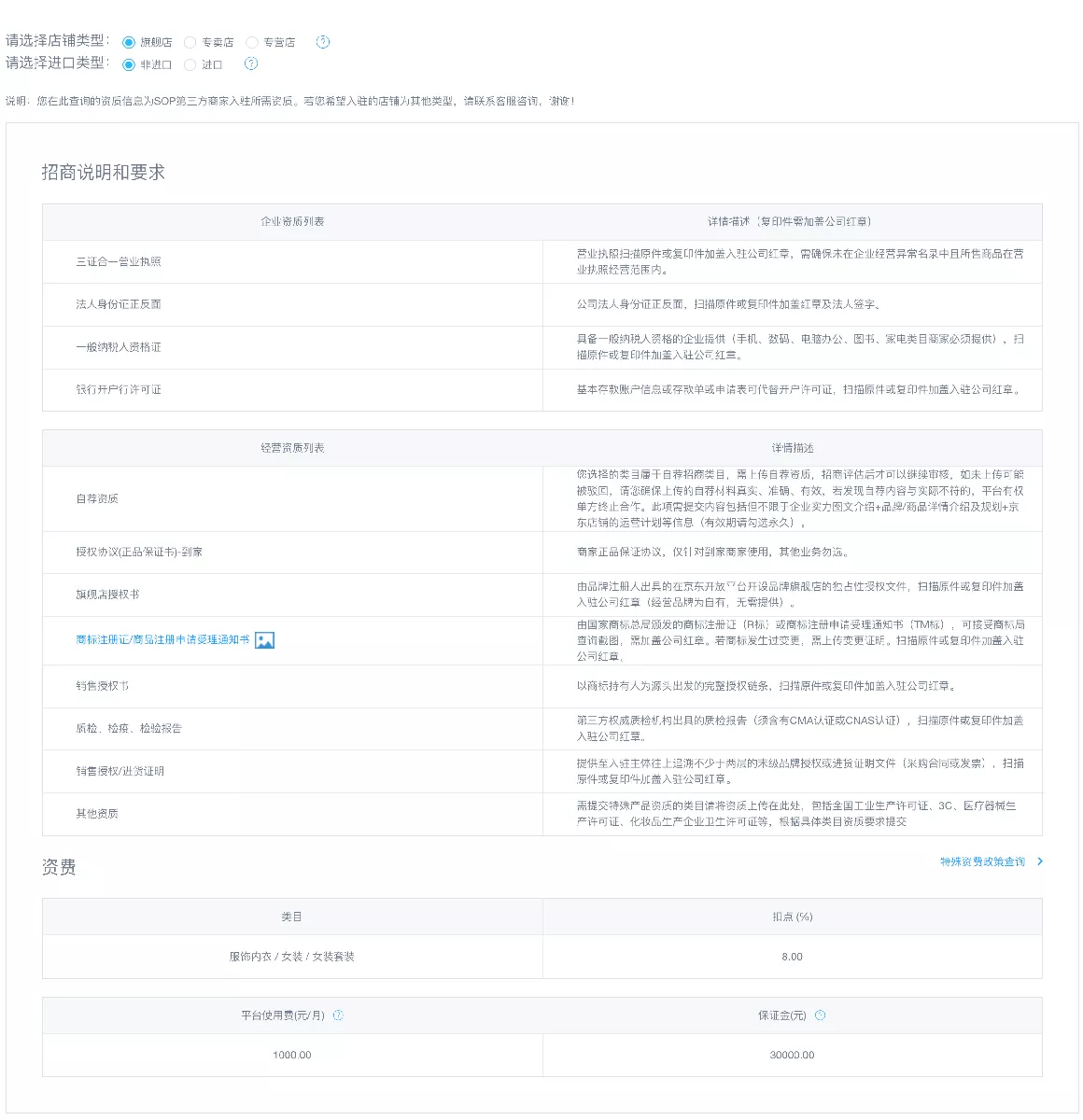
You need to submit:
- Business License
- Chinese ID Card of your legal entity
- Tax documents
- Certificate of a company bank account in China
- Other supporting documents depending on your category
Global merchants
For global merchants, JD prioritizes reputable overseas businesses with offline physical stores, famous brands with no prior exposure in China, or those in Hong Kong, Macau, or Taiwan.
You need to submit:
- Overseas business license
- Business bank account information (in USD)
- Contact info of a legal representative in China
Do not have a Chinese entity, Chinese phone number or Chinese ID? We can help!
If you do not have a Chinese entity, Chinese ID, or Chinese phone number, which is essential to get started on JD.com, 21YunBox is here to help.
We can provide the necessary supporting documents to get started on JD.com and walk you through the process. Meanwhile, we will also bring your company, product, and service into full compliance with Chinese law.
Contact us now to learn more about our solutions for doing business in China legitimately!
RELATED COMPANIES






ARTICLES RELATED TO JD.COM
- China Implements Stricter Regulations on Internet Comment Services
- Does reCAPTCHA Work in China? Reachability, Google's Servers & PIPL
- China Cross-Border Data Transfer: What the Regulation Actually Says
- Tips for Businesses Looking to Sell Products in China: How to Start and Where to Start
- What is data privacy?
- Baidu Tieba - build brand reputation and improve search engine optimization in China!
- Why has my app been deleted from Chinese app stores, and how can I fix it?
- 15 Tips on How to Make a Website Load Faster
- Baidu vs Google
- Baidu Wangpan Guide
- How To Create A Little Red Book Brand Account And Store?
- How To Sell Products to China via WeChat?
- How to Publish My Mobile App in China: A Comprehensive Guide
- How to register a .cn domain?
- Trademark registration in China

PARENT COMPANY
JD.com, Inc
OWN BY THE SAME PARENT COMPANY
CATEGORIES
eCommerceWESTERN EQUIVALENTS
- Amazon
Ready to Accelerate Your Site in China Legitimately?
Join 21YunBox and the 5,000+ developers and enterprises to use modern deployment technology
Get StartedLaunch Your Site in China with Confidence