What is AliExpress and how to get started
AliExpress, also known as 全球速卖通, is a cross-border retail platform owned by the Alibaba Group.
What does a foreign company need to open a store and sell on AliExpress?
The gate is a verified, incorporated business and — for branded goods — a trademark you own or are licensed to use, not the sign-up button. And get the direction right: AliExpress is Alibaba’s cross-border export marketplace — approved sellers shipping out to overseas buyers — the mirror image of importing into China through Tmall Global, so there is no mainland ICP website filing in the picture.
What you actually clear is onboarding qualification. AliExpress’s published seller rules require that “You have to be a duly incorporated legal entity properly registered and normally operating for online sales,” and its review checks “business licenses, trademark registration/authorisation documents”; a branded store needs a trademark that “shall have been duly owned by or licensed to you.” A storefront was long limited to mainland-China companies — the Chinese entity, ID and phone number the guide below describes — and AliExpress has since opened country-specific seller programs, but the incorporated-entity-and-qualification gate stands either way. The platform also makes you, the seller, responsible for “the relevant consumer, import, tax or other requirements applicable in the delivery destination location,” and the Chinese buyers’ personal data the marketplace routes to you is governed by PIPL wherever mainland users or a China-border crossing are involved. The guide below walks the original sign-up steps — read them knowing this gate comes first.
This is a risk map, not legal advice — which country’s seller track, qualifications and data path fit turn on your entity, your products and the data you handle. Our China team can map your AliExpress path with you →
What a foreign company must clear to sell on AliExpress
| Fact | Primary source |
|---|---|
| AliExpress’s entry gate is an incorporated, verified business — not a personal account. AliExpress is Alibaba’s cross-border export marketplace, and its own published seller rules state the applicant “have to be a duly incorporated legal entity properly registered and normally operating for online sales.” Onboarding review then checks “the company’s background documents, business licenses, trademark registration/authorisation documents.” Because the platform exists to ship goods out to overseas buyers, the gate is a business entity and qualifications — not the mainland ICP website filing a company needs to host a site inside China. | AliExpress — South Korea Seller Joining and Operation Assessment Rules (AliExpress-published, terms.alicdn.com), Articles 1 & 13, retrieved 2026-10-07 |
| Selling under a brand requires a trademark you own or are licensed to use — granted by a real trademark office. Under AliExpress’s published brand rules, to operate branded goods “the trademark shall have been duly owned by or licensed to you,” and a qualifying mark is one “that has been granted by the relevant trademark office.” For restricted marks — for example a “pure graphic trademark” — “AliExpress has the right to refuse or terminate the application for entry,” and a seller who has “not obtained the authorisation … from such registered owner” can have “the right to operate branded goods … discontinued.” Brand qualification, not just incorporation, decides what you may list. | AliExpress — South Korea Seller Joining and Operation Assessment Rules (AliExpress-published, terms.alicdn.com), Articles 2, 5 & 6, retrieved 2026-10-07 |
| AliExpress makes you responsible for the destination country’s consumer, import and tax law — and for truthful origin claims. Its seller rules require that for cross-border orders a merchant meet “the relevant consumer, import, tax or other requirements applicable in the delivery destination location,” that “You must clearly indicate the place of origin for each product,” and that any “made in” claim be backed by production that “must have taken place totally or substantially in the relevant country,” with evidence of production on request. Listing on the platform does not absorb these duties — it pushes them onto the seller, so your compliance surface includes every market you ship into. | AliExpress — South Korea Seller Joining and Operation Assessment Rules (AliExpress-published, terms.alicdn.com), Article 3 (Commodity Requirements), retrieved 2026-10-07 |
| The platform routes buyers’ personal data to sellers who can sit outside the buyer’s country — a cross-border personal-data flow is built in. AliExpress’s privacy policy states that for a registered member from mainland China “you are contracting with Hangzhou Alibaba Advertising Co., Ltd.” — a China entity — and that it shares personal data with “Sellers, other buyers, service providers, partners and other third-party entities” that “can be located outside your country of residence,” storing mainland users’ data in “China and Singapore.” Fulfilling an order therefore moves a buyer’s identity and shipping data to you, the seller, across borders — the handling China’s Personal Information Protection Law governs. | AliExpress.com Privacy Policy (terms.alicdn.com), Section N “International Transfers of Personal Data”, retrieved 2026-10-07 |
| Moving mainland users’ personal data abroad is a PIPL cross-border transfer — with a narrower route for order fulfilment, but the consent and notice duties remain. Where mainland users’ personal information leaves China, PIPL requires notice, the individual’s separate consent and a lawful transfer mechanism (Articles 38–43). China’s 2024 Provisions on Promoting and Regulating Cross-Border Data Flows do exempt a transfer “for concluding or performing a contract where the individual is a party” from the security-assessment / standard-contract / certification mechanisms — the regulator names “cross-border shopping” and “cross-border delivery” as examples — but a handler still “must inform individuals, obtain separate consent” and run an impact assessment, and a critical-information-infrastructure operator or large-volume handler must store personal data in China (PIPL Article 40; Cybersecurity Law Article 39 (formerly Article 37), renumbered by the amendment in force 2026-01-01). Treat which route and duties apply as exposure to confirm with counsel. | Personal Information Protection Law, Articles 38–43 & 40 (gov.cn); Provisions on Promoting and Regulating Cross-Border Data Flows (2024) & CAC official Q&A (via China Briefing / Dezan Shira & Associates); Cybersecurity Law Article 39 (formerly Article 37), amendment in force 2026-01-01; retrieved 2026-10-07 |
Sources verified by the 21YunBox compliance team on 2026-10-07.
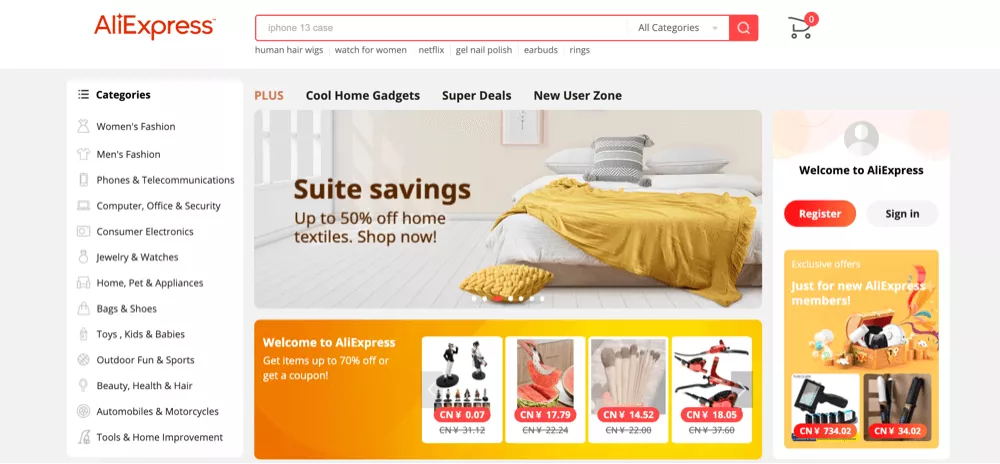
About AliExpress
AliExpress, also known as 全球速卖通, is a cross-border retail platform owned by the Alibaba Group.
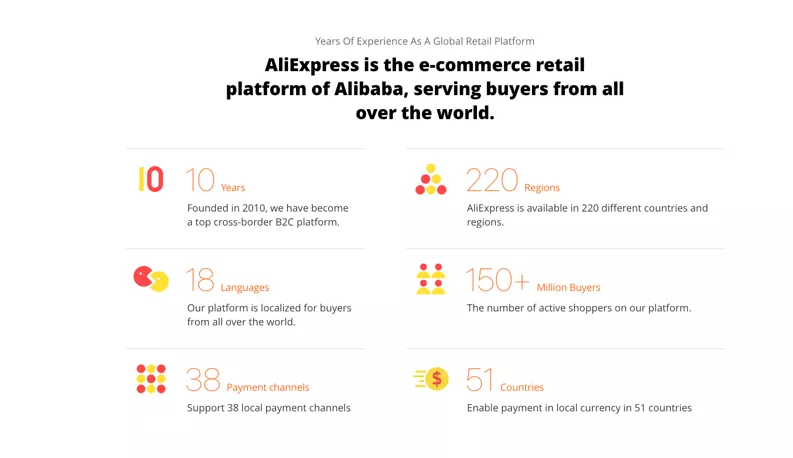
Launched in 2010 by the Alibaba Group, AliExpress facilitates small to medium size merchants and businesses in China to sell products to international online buyers worldwide. It started as a b2b (business to business) buying and selling portal and has since expanded to include b2c (business-to-consumer), c2c (consumer-to-consumer), cloud computing, and payment services. It is now available in over 220 regions and is often used based on a dropship business model.
How To Get Started On AliExpress
Sell on AliExpress
To sell on AliExpress, follow the steps below:
Step 1. First, create an AliExpress seller account here.
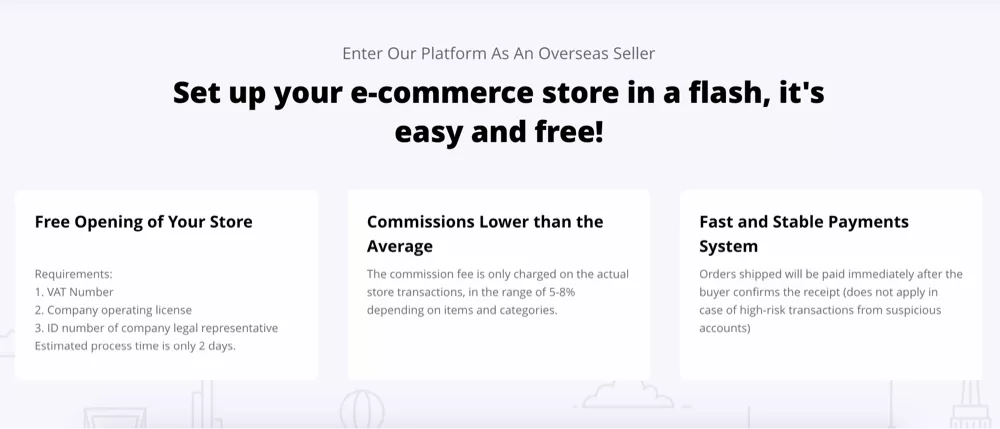
Step 2. Verify your business information by providing a business license, company legal representative ID number, etc.
Step 3. Wait for verification, which takes about 2-5 business days.
Step 4. Set up your store and list products before launching.
Cost To Sell On AliExpress
It is free of charge to open a store on AliExpress. The fee for selling on AliExpress is a low commission of 5-8%, ranging from different product categories, based on actual store transactions, which is below the market rate.
Do not have a Chinese entity, Chinese phone number or Chinese ID? We can help!
If you do not have a Chinese entity, Chinese ID, or Chinese phone number, which is essential to get started on AliExpress, 21YunBox is here to help.
We can provide the necessary supporting documents to get started on AliExpress and walk you through the process. Meanwhile, we will also bring your company, product, and service into full compliance with Chinese law.
Contact us now to learn more about our solutions for doing business in China legitimately!
RELATED COMPANIES




ARTICLES RELATED TO ALIEXPRESS
- China Implements Stricter Regulations on Internet Comment Services
- Does reCAPTCHA Work in China? Reachability, Google's Servers & PIPL
- China Cross-Border Data Transfer: What the Regulation Actually Says
- Tips for Businesses Looking to Sell Products in China: How to Start and Where to Start
- What is data privacy?
- Baidu Tieba - build brand reputation and improve search engine optimization in China!
- Why has my app been deleted from Chinese app stores, and how can I fix it?
- 15 Tips on How to Make a Website Load Faster
- Baidu vs Google
- Baidu Wangpan Guide
- How To Create A Little Red Book Brand Account And Store?
- How To Sell Products to China via WeChat?
- How to Publish My Mobile App in China: A Comprehensive Guide
- How to register a .cn domain?
- Trademark registration in China
PARENT COMPANY
Alibaba Group
OWN BY THE SAME PARENT COMPANY
CATEGORIES
eCommerceWESTERN EQUIVALENTS
- eBay
Ready to Accelerate Your Site in China Legitimately?
Join 21YunBox and the 5,000+ developers and enterprises to use modern deployment technology
Get StartedLaunch Your Site in China with Confidence
