What is Taobao and how to get started
Taobao, also known as 淘宝, is China's leading online shopping platform. It was also the eighth most-visited website globally in 2021.
What does a foreign company need to sell on Taobao in mainland China?
The gate isn’t the sign-up button — it’s a mainland identity and a Chinese business license. A purely offshore brand cannot open a mainland Taobao shop; the lawful way onto Alibaba’s marketplaces is the cross-border channel or a China entity.
Taobao is Alibaba’s mainland consumer-to-consumer marketplace. Every account runs on China’s real-name verification and settles through a verified Alipay account tied to a mainland bank, and a business storefront additionally requires market-entity registration — a Chinese business license — which the marketplace is legally obliged to verify under the PRC E-Commerce Law. An offshore-only company clears none of that directly, so the realistic compliant route is cross-border: a Tmall Global store opened on your overseas-registered entity with brand authorization, or standing up your own China entity. Either path still means handling Chinese shoppers’ personal data under PIPL. The guide below walks the original Taobao sign-up steps — read them knowing this identity-and-entity gate comes first.
This is a risk map, not legal advice — which door fits turns on your entity, your products and the data you collect. Our China team can map your route onto Alibaba’s marketplaces with you →
What a foreign company must clear to sell on Taobao
| Fact | Primary source |
|---|---|
| A Taobao business store sits behind China’s market-entity registration — a business license, not a sign-up. Under the PRC E-Commerce Law the rule “requires nearly all e-commerce operators to register as market entities,” and the marketplace itself must “verify the identity, business registration, tax registration” and “any other required permit or licenses of any on-platform operator.” That real-identity-and-license check is the platform’s own legal duty, so a company with no mainland entity has nothing to register and cannot be verified as a business seller. | Harris Sliwoski — “China’s E-Commerce Law and Its Foreign Company Impacts” (named law firm), retrieved 2026-10-07; PRC E-Commerce Law (2019), Arts. 10 & 27 |
| Tmall Global is the cross-border channel built for offshore companies — no mainland entity. It lets international brands “sell directly to Chinese consumers” “without having a physical presence in China”: a merchant can be “a registered corporate entity outside of mainland China” that holds “a retail or trading license in the country of origin” and either owns the brand or is an authorized agency, and “there is no need to open a Chinese bank account.” This is the realistic lawful route onto Alibaba’s marketplaces for a pure-foreign brand — not a mainland Taobao shop. | China Briefing (Dezan Shira & Associates) — “Selling to China Without a Physical Presence: … Tmall Global,” retrieved 2026-10-07 |
| Even selling from offshore is a regulated import channel, not a loophole. China treats “a company formed outside China that sells to consumers in China from overseas” as a cross-border e-commerce company that must “register with China customs through a company registered in China” and “report real-time transaction data of retail imports.” So the cross-border route still carries a China-side registration and data-reporting footprint, usually handled by the platform or a bonded-logistics partner — worth scoping before you commit. | Harris Sliwoski — “China’s E-Commerce Law and Its Foreign Company Impacts” (named law firm), retrieved 2026-10-07; PRC E-Commerce Law Art. 26 & the 2018 cross-border retail-import Notice |
| Whichever door you use, you handle Chinese consumers’ personal data — PIPL governs it. Order, identity and shipping data collected through the marketplace is personal information under the Personal Information Protection Law; moving it offshore is a cross-border transfer that needs a lawful mechanism (security assessment, certification or standard contract) and the individual’s “separate consent” (PIPL Arts. 38–39), and a critical-information-infrastructure operator or large-volume handler “shall store personal information collected and produced within the borders of the People’s Republic of China domestically” (PIPL Art. 40; Cybersecurity Law Art. 39). Treat data residency and cross-border transfer as a risk to confirm with counsel. | DigiChina, Stanford University — PIPL English translation, retrieved 2026-10-07; PIPL Arts. 38–40; PRC Cybersecurity Law Art. 39 |
Sources verified by the 21YunBox compliance team on 2026-10-07.
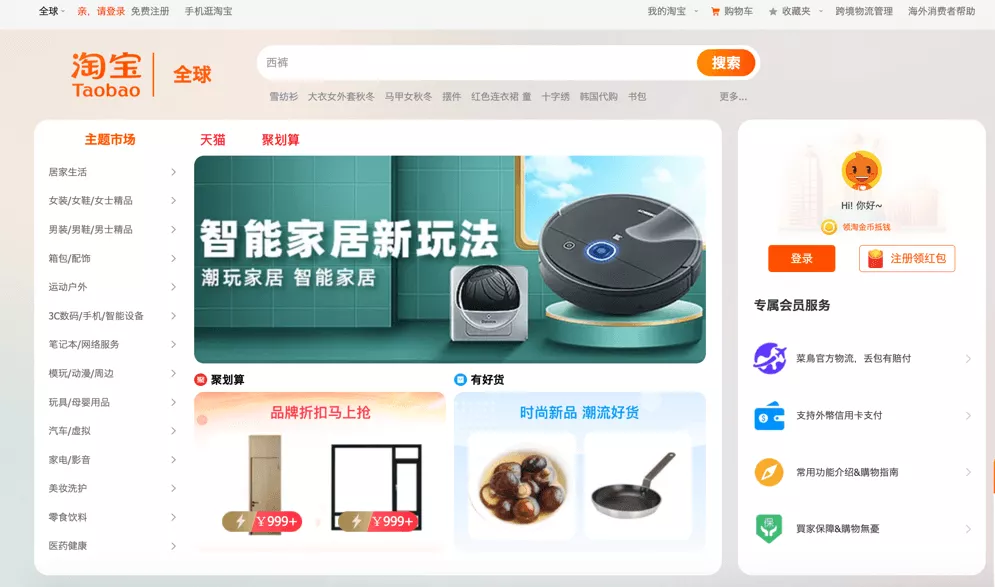
About Taobao
Taobao, also known as 淘宝, Taobao China, is China’s leading online shopping platform. It was also the eighth most-visited website globally in 2021.
Established in 2003 by Alibaba Group, Taobao China quickly became a significant contender in the Chinese consumer e-commerce market. Taobao is like eBay but with fewer auctions and more set prices. By offering free listing for sellers, instant messaging for buyers and sellers to communicate, and an escrow-based payment tool: Alipay, Taobao’s market share grew from 8% to 59% between 2003 and 2005 and then expanded to gain 80% of the Chinese online shopping market by 2010.
Now Taobao is China’s biggest consumer-to-consumer (C2C) retail platform. As of December 2021, it has 483.4 million monthly active users.
On November 11 every year also called “China’s Singles Day”, Tmall and Taobao collectively process over a trillion-dollar sales – two times the combined annual sales of CyberDay and Black Friday.
How To Get Started On Taobao
In 2021, China became the largest market for eCommerce, with a revenue of US$1,543 billion, placing it ahead of the United States. And the E-commerce value of the China market is expected to grow at a substantial CAGR of 11.6% between 2021 and 2025 to reach CNY21.4 trillion (US$3.3 trillion) in 2025. On top of that, the COVID-19 pandemic has been driving e-commerce activities in the country. These all make a solid reason to sell your products to China.
With careful planning, your business can enter China and start selling. And to reach Chinese consumers, you must have a presence on Taobao, one of the dominant Chinese online shopping platform.
However, currently only China-registered companies can register as business sellers. You cannot open a Taobao.com store with a non-Mainland China company.
If you have a Chinese entity, follow the steps below to open a Taobao store:
Step 1. Create an account with Taobao with a mobile number or an Alipay account first, then click “Open a Store for Free” on the top right corner of the Homepage.
Step 2. Choose to register as a business seller.
Step 3. Authenticate with a verified Alipay business account. If you are a legal entity, you’ll be asked to proceed with facial recognition and be required to scan your ID card.
Step 4. Provide company information (Company name, business nature, registration number, etc.)
Step 5. Proceed with facial recognition of the company’s legal representative and scan your ID card.
Cost To Use Taobao
Taobao offers free listing for sellers, so it’s free of charge to list and sell products on Taobao. However, Taobao’s escrow payment provider Alipay charges for its services on Taobao. Merchants are charged a 0.55% fee for every successful sale. The system is free to use for withdrawals under RMB 20,000 – or approximately 3,000 USD. Above this threshold, users are charged a 0.1% fee.
Do not have a Chinese entity, Chinese phone number or Chinese ID? We can help!
If you do not have a Chinese entity, Chinese ID, or Chinese phone number, which is essential to get started on Taobao, 21YunBox is here to help.
We can provide the necessary supporting documents to use Taobao and walk you through the process. Meanwhile, we will also bring your company, product, and service into full compliance with Chinese law.
Contact us now to learn more about our solutions for doing business in China legitimately!
RELATED COMPANIES












ARTICLES RELATED TO TAOBAO
- China Implements Stricter Regulations on Internet Comment Services
- Does reCAPTCHA Work in China? Reachability, Google's Servers & PIPL
- China Cross-Border Data Transfer: What the Regulation Actually Says
- Tips for Businesses Looking to Sell Products in China: How to Start and Where to Start
- What is data privacy?
- Baidu Tieba - build brand reputation and improve search engine optimization in China!
- Why has my app been deleted from Chinese app stores, and how can I fix it?
- 15 Tips on How to Make a Website Load Faster
- Baidu vs Google
- Baidu Wangpan Guide
- How To Create A Little Red Book Brand Account And Store?
- How To Sell Products to China via WeChat?
- How to Publish My Mobile App in China: A Comprehensive Guide
- How to register a .cn domain?
- Trademark registration in China
PARENT COMPANY
Alibaba Group
OWN BY THE SAME PARENT COMPANY
CATEGORIES
eCommerceWESTERN EQUIVALENTS
- Ebay
- Amazon
Ready to Accelerate Your Site in China Legitimately?
Join 21YunBox and the 5,000+ developers and enterprises to use modern deployment technology
Get StartedLaunch Your Site in China with Confidence
