Does WPML (WordPress Multilingual Plugin) Work in China? ICP, Self-Hosted Translations & Offshore Reachability
WPML is a self-hosted WordPress plugin — it stores your translations in your own WordPress database and serves them from your own host — so whether a WPML site works in mainland China is decided by where that WordPress site is hosted (ICP and data residency), not by WPML sending data offshore. Its automatic translation, updates and licensing checks reach WPML's offshore servers, a lighter reachability point. A compliance-first look at the layers.
Does WPML (WordPress Multilingual Plugin) work in China?
For a public, mainland-China audience the honest answer is "yes — but what decides it is where your WordPress site is hosted, not WPML itself." WPML is a self-hosted plugin: it keeps your translations in your own WordPress database and serves them from your own host, so the China question lands on your site's hosting and ICP, not on WPML relaying content offshore to render a page.
In WPML's own developer documentation, "WPML stores language, translation, and string data in custom database tables" on your WordPress install — a translated page is served by your host, from your database, like the rest of your site. Two doors follow for a public China site, set against WPML's own wording in the table below: your WordPress site needs an ICP filing on in-country hosting, which a plugin cannot carry; and any mainland personal data your site collects follows that host under PIPL, so an offshore host means an offshore, cross-border flow. A lighter, WPML-specific point rides along — its automatic translation (a "Private Translation Cloud"), plugin updates and site-key registration reach wpml.org offshore, so those admin-side features depend on that being reachable, though the public translated pages, served from your database, do not.
This is a risk picture to take to counsel, not a verdict — what applies turns on where you host, whether you serve the public in China, your entity, and the data your site handles. Our China team can map the WPML + WordPress path with you →
Compliance snapshot
- ✓ Keep WPML as your translation plugin — your languages, translations and language URLs don't move; WPML stores them in your own WordPress database
- ✕ WPML is a self-hosted WordPress plugin, not a host — the ICP filing attaches to where your WordPress site runs, and an offshore host has no ICP path
- ! A public translated page renders from your own database, but WPML's automatic translation, plugin updates and site-key registration reach wpml.org offshore — a lighter reachability point for those admin-side features
- ! Any mainland personal data your WordPress site collects is a PIPL / data-residency question decided by where your host sits — a hosting decision, not a WPML one
- ✓ Compliant path: ICP-filed, in-country delivery in front of your WordPress site — an overlay, not a migration
What WordPress Multilingual Plugin's own documentation says about China
| Fact | Primary source |
|---|---|
| WPML is self-hosted: it stores your translations in your own WordPress database, not on WPML's servers. In WPML's own developer documentation, "WPML stores language, translation, and string data in custom database tables" on your WordPress install. So a translated page is served by your host, from your database, exactly like the rest of your site — which is why the China question lands on where your WordPress site is hosted, not on WPML relaying content to render a page. That is the honest difference from a translation layer that renders in the visitor's browser. | WPML Documentation — WPML's Database Tables, updated 2025-08-28, retrieved 2026-10-07 |
| A public mainland-China site needs an ICP filing, and a self-hosted plugin gives it nothing to attach to. Under State Council Order No. 292 (Article 4) and MIIT Order No. 33, an ICP filing (备案) attaches to a hosting resource physically inside mainland China and to a mainland legal entity. WPML runs inside your WordPress install and adds no mainland host — so the ICP door is opened at your host, not by the plugin, and a WordPress site hosted offshore has nothing in the mainland for a filing to sit on. This is a licensing-and-location boundary, not a defect in WPML. | State Council Order No. 292 (Measures for the Administration of Internet Information Services), Article 4; MIIT Order No. 33 (ICP filing measures) |
| Because WPML keeps your data in your own database, data residency follows your WordPress host — not WPML. Any personal information your site collects from mainland visitors lives wherever your WordPress site is hosted. Host offshore and that is a cross-border transfer under PIPL (Chapter III, Articles 38–43: notice, separate consent, and one permitted transfer mechanism; Article 40 with Cybersecurity Law Article 39 (formerly Article 37) adds in-country storage for a CIIO or large-volume handler). Unlike a layer that relays each visitor request offshore to render a page, WPML itself doesn't move your visitor data — so this door is decided by your hosting choice, which is exactly where the compliant design puts an in-country, ICP-filed presence. | PIPL Chapter III, Articles 38–43 and Article 40; Cybersecurity Law Article 39 (formerly Article 37) |
| WPML's cloud translation, plugin updates and licensing checks reach WPML's offshore servers — a lighter reachability point, and only for those admin-side features. WPML's automatic translation runs on its cloud engine — it calls the recommended route "PTC – WPML's AI translation engine" (its "Private Translation Cloud") — and its setup installs an auxiliary plugin "that downloads WPML and your add-on plugins and keeps them updated" after you "Register your site key." Those calls go to wpml.org, outside the mainland. If they are slow or unreachable from inside China, automatic translation, updates and registration are affected — but the public translated pages, served from your own database, are not. This is a delivery / operations matter, separate from licensing. | WPML Documentation — AI Automatic Translation; Getting Started With WPML, retrieved 2026-10-07 |
Sources verified by the 21YunBox compliance team on 2026-10-07.
For a mainland-China audience, the first thing to settle about WPML is what it is and where your translations actually live. WPML — the WordPress Multilingual Plugin — is self-hosted: it runs inside your own WordPress install and, in its own developer documentation, “stores language, translation, and string data in custom database tables.” Your translated pages are served from your database by your host, not fetched from WPML to render. That shape matters, because it means “does WPML work in China” is not really a question about WPML — it is a question about where the WordPress site it runs on is hosted, which decides your ICP filing and where your users’ data lives, with a lighter, WPML-specific question about whether the plugin’s offshore services (automatic translation, updates and licensing) can be reached from inside the mainland.
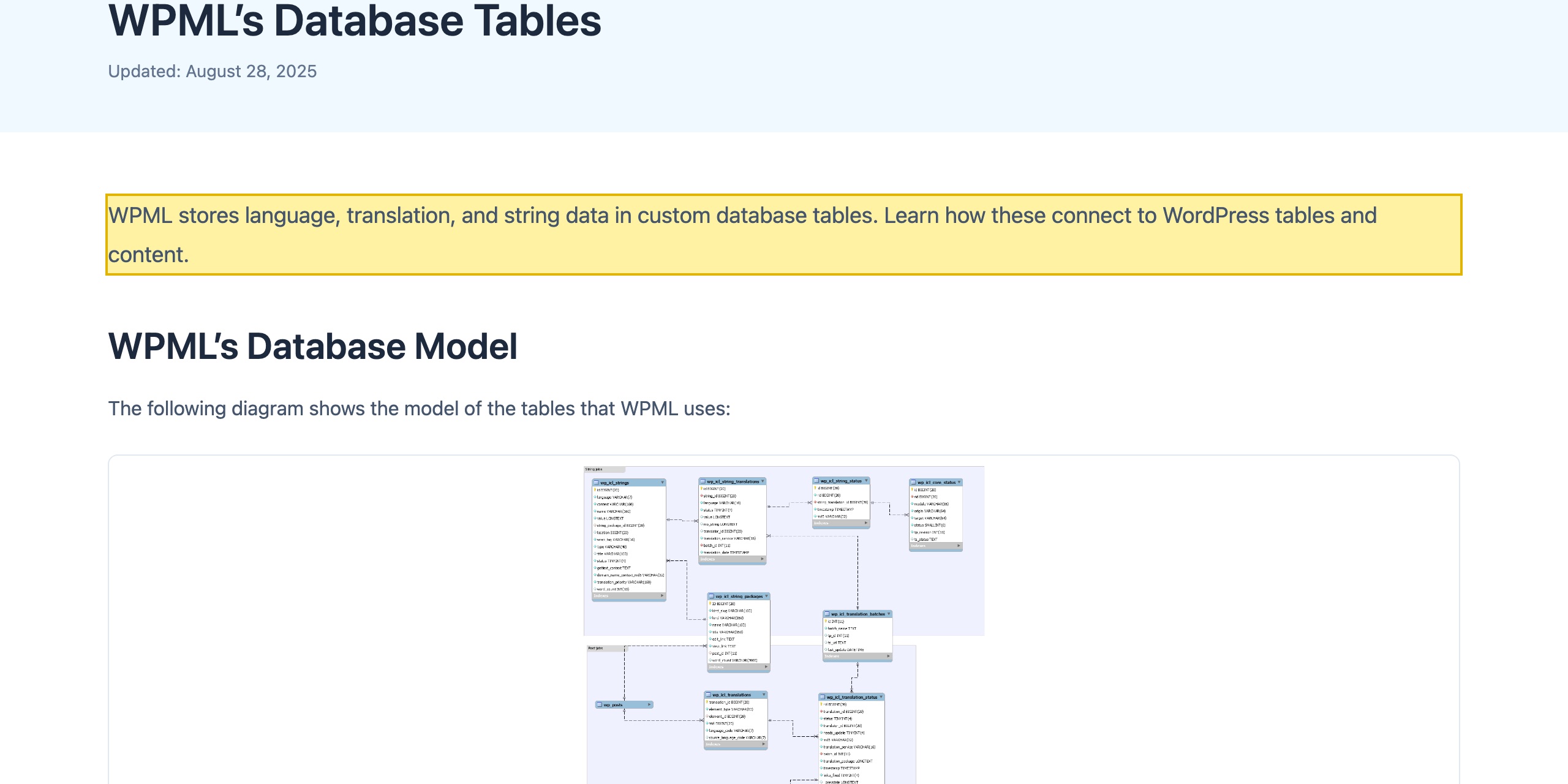
WPML in China at a glance
| What decides it | In WPML's own terms |
|---|---|
| What it is | A self-hosted WordPress plugin, not a host. It “stores language, translation, and string data in custom database tables” inside your WordPress install and serves translated pages from your own host. It translates — it does not host your site, and runs no mainland-China region. |
| Where the translations live | In your own WordPress database, on whatever host you run WordPress on. Unlike a browser-rendered translation layer, a WPML page does not call back to WPML to display — so the public pages sit wherever your site is hosted. |
| Serving the public | Your public mainland site — base pages and WPML's language URLs — needs an ICP filing tied to in-country hosting. WPML is a plugin, not a host, and offers no ICP-filing path of its own; that footing is created at your host. |
| WPML's offshore services | Automatic translation runs on WPML's cloud engine (its “Private Translation Cloud”), and setup installs an auxiliary plugin “that downloads WPML and your add-on plugins and keeps them updated” after you “Register your site key.” Those calls go to wpml.org offshore — a reachability point for those admin-side features, not for the public pages. |
| Your visitors' data | Because WPML keeps data in your own database, any mainland personal data your site collects lives wherever you host WordPress. Host offshore and that is a cross-border transfer under PIPL; host in-country and it stays on the mainland. The residency question follows your host, not WPML. |
WPML is self-hosted — so the ICP question sits at your WordPress host
WPML lives inside your WordPress install. Its own developer docs describe it storing “language, translation, and string data in custom database tables” — the translations are part of your site’s database, served by your host. That is the opposite of a layer that renders translations from someone else’s servers: nothing has to call back to WPML for a visitor to see a translated page.
The upshot is that the China licensing question doesn’t resolve inside WPML. A public-facing website delivered to mainland visitors from inside China turns on an ICP filing (ICP 备案) under State Council Order No. 292 and MIIT Order No. 33, and that filing must attach to a hosting resource physically inside the mainland, held by a mainland entity. WPML supplies neither, and a WordPress site hosted offshore has neither — so there is nothing for the filing to sit on. “We run WPML” settles your languages; it does not settle your clearance to operate in China. Switching translation modes or language-URL formats does not create the mainland hosting footing a filing needs; that footing is created at the host.
Data residency follows your host — not the plugin
Because WPML keeps your content and translations in your own WordPress database, the question of where your users’ data lives is answered by where you host WordPress, not by WPML. Serve the mainland from an offshore WordPress host and the personal information your site collects — form submissions, accounts, a visitor’s IP — sits abroad, which under China’s Personal Information Protection Law is a cross-border transfer: the handler (you, not WPML) gives notice, obtains separate consent, and clears one transfer mechanism — a CAC security assessment, the CAC standard contract, or certification. A CIIO or large-volume handler also carries an in-country storage duty (PIPL Article 40; Cybersecurity Law Article 39 (formerly Article 37)).
This is the honest difference from a translation layer that relays each visitor request offshore: WPML itself doesn’t move your visitor data across the border — your hosting choice does. Which is why the compliant answer is about where your WordPress site is served from, not about swapping out the plugin.
WPML’s offshore services are reachable-or-not — but only for the admin side
WPML does reach offshore for some things, and it is worth being precise about which. Its automatic translation runs on a cloud engine — WPML calls the recommended route “PTC – WPML’s AI translation engine,” its “Private Translation Cloud” — so the content you send for machine translation goes to WPML’s servers. Its setup installs an auxiliary plugin “that downloads WPML and your add-on plugins and keeps them updated,” and you first “Register your site key.” All of those calls go to wpml.org, outside the mainland. If that is slow or unreachable from inside China, automatic translation, plugin updates and license registration can stall.
But — and this is the point — the public translated pages are not waiting on any of it: they are served from your own database by your host. So reachability of WPML’s offshore services is an operations question for your team’s workflow, distinct from both the licensing door and the live visitor experience. If you rely on WPML’s cloud translation, the content you route through it is also worth weighing against your own data-handling policies.
This is a risk map, not a verdict: whether you need an ICP filing, in-country delivery, in-country storage, or some combination depends on where you host, what you serve, how much personal data you hold, and who your users are — all worth settling with counsel before you build.
Where 21YunBox fits — a compliant overlay, not a migration
You keep running WPML on WordPress — your languages, your translations in your own database, your language URLs and your editing workflow all stay exactly where they are. What we add is the layer a self-hosted plugin cannot create on its own: compliant, ICP-filed delivery from inside the mainland, set in front of your existing WordPress origin so your base pages and WPML’s translated URLs reach mainland readers from a licensed in-country presence — no rebuild, no second codebase, and no move off WordPress or WPML. Our China team maps your ICP, hosting, reachability and data-residency obligations against your entity and the data you handle, then stands up the in-country delivery and storage a lawful China presence needs, while WPML stays your translation plugin and WordPress stays your platform.
Related reading:
Frequently Asked Questions
Do we have to leave WPML or rebuild our site to serve mainland China?
No. The compliant pattern is an overlay, not a migration: WPML stays your translation plugin — your languages, translations and language URLs stay in your own WordPress database, and the editing workflow doesn't change — and an ICP-filed, in-country delivery layer is placed in front of your existing WordPress site for mainland visitors. There is no rebuild, no second codebase, and no move off WordPress or WPML.
WPML stores translations on our own site — so is reachability still a concern in China?
For the public pages, far less than with a layer that renders in the browser: WPML serves translated pages from your own WordPress database, so a visitor doesn't depend on WPML's servers to see them. What does reach WPML's offshore servers (wpml.org) is the admin side — automatic translation through its cloud engine, plugin updates, and site-key registration. If those are slow or blocked from inside the mainland, those features can stall even while your live pages render. The bigger question is your WordPress host itself: an offshore host is reachable but offshore, which is the licensing and data-residency issue, not a speed one.
Can 21YunBox help make our WPML / WordPress site work in mainland China?
Yes. Our China team can assess the ICP, hosting and cross-border-data exposure for your entity and your data, handle the ICP filing, and stand up compliant, ICP-filed in-country delivery in front of your WordPress site — so WPML stays your translation plugin and WordPress your platform. Get in touch to work through your specific case; treat the specifics as a risk picture to confirm with counsel.
RELATED TECHNOLOGIES






















ARTICLES RELATED TO WORDPRESS MULTILINGUAL PLUGIN
- China Implements Stricter Regulations on Internet Comment Services
- Does reCAPTCHA Work in China? Reachability, Google's Servers & PIPL
- China Cross-Border Data Transfer: What the Regulation Actually Says
- Tips for Businesses Looking to Sell Products in China: How to Start and Where to Start
- What is data privacy?
- Baidu Tieba - build brand reputation and improve search engine optimization in China!
- Why has my app been deleted from Chinese app stores, and how can I fix it?
- 15 Tips on How to Make a Website Load Faster
- Baidu vs Google
- Baidu Wangpan Guide
- How To Create A Little Red Book Brand Account And Store?
- How To Sell Products to China via WeChat?
- How to Publish My Mobile App in China: A Comprehensive Guide
- How to register a .cn domain?
- Trademark registration in China