Does Joy Rewards & Loyalty Program Work in China? Loyalty Data, PIPL & Where It's Stored
Joy (the Shopify rewards & loyalty app from Joy Loyalty) stores your shoppers' member data on Google Cloud in the United States, with no mainland-China region — so running it for Chinese customers is a cross-border transfer of personal information under PIPL, and the Shopify storefront it rides on still needs its own ICP filing. A compliance-first look at the data-residency and ICP doors.
Does Joy Rewards & Loyalty Program work in China?
Joy's rewards widget loads for Chinese shoppers, but “it works” is the wrong test. Joy is a loyalty app that collects your customers' personal data and, in its own privacy policy, stores it on Google Cloud in the United States — offshore from the mainland. Running it for Chinese shoppers is a cross-border transfer of personal information you are accountable for, and the storefront it rides on still needs its own ICP filing.
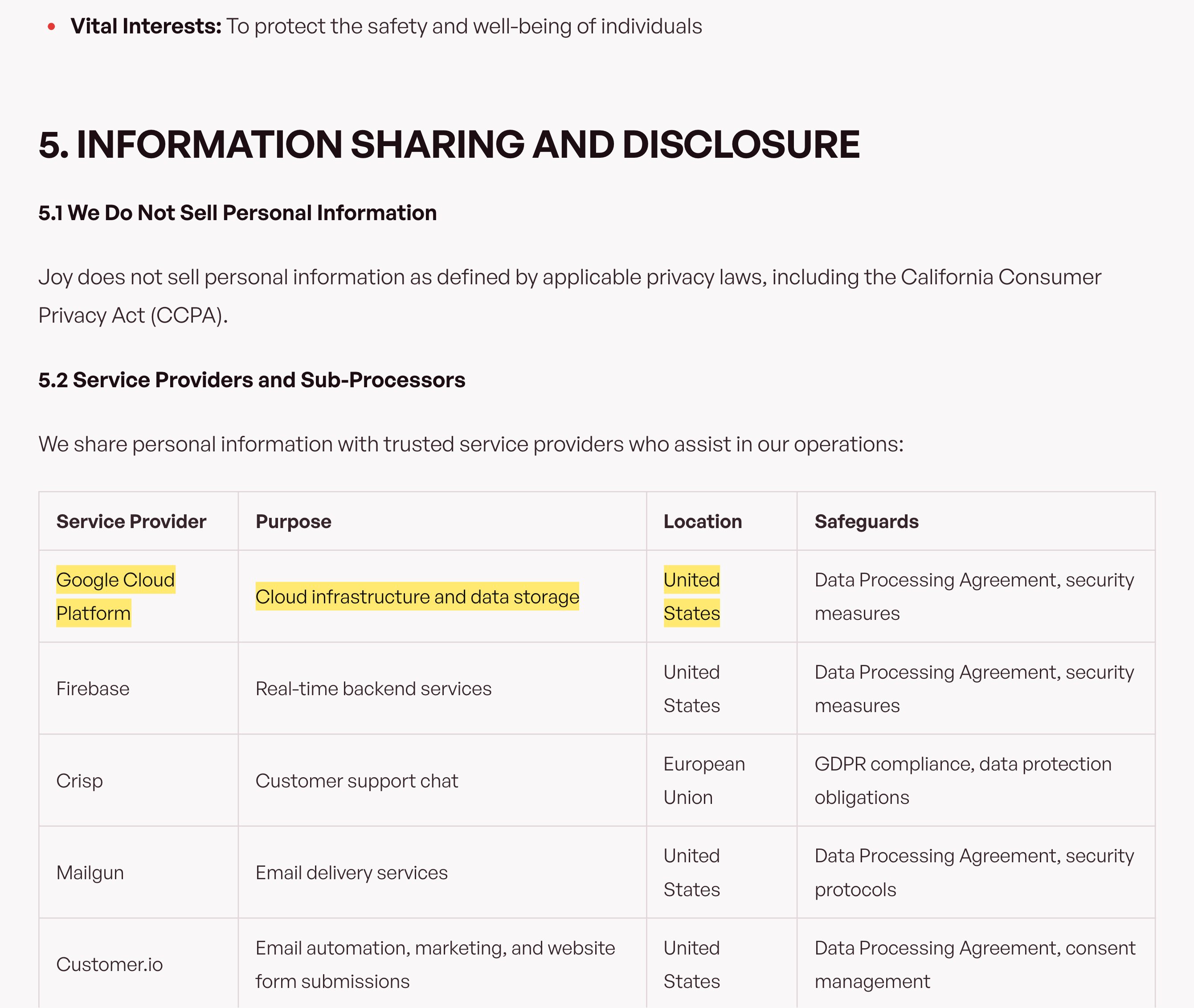
Its publisher, Joy Loyalty Pte. Ltd., lists its “Cloud infrastructure and data storage” provider as “Google Cloud Platform,” with that provider's location given as the “United States,” and states that “Personal information may be transferred to and processed in countries other than your country of residence… including the United States.” The data behind your points and tiers — “Names,” “Email addresses,” “Points balances,” “Purchase history” — is personal information, so moving it offshore is a cross-border transfer under China's Personal Information Protection Law (notice, separate consent and a transfer mechanism, Articles 38–43); for a CIIO or large-volume handler, China-collected data must stay in the mainland (PIPL Article 40; Cybersecurity Law Article 39 (formerly Article 37)). Because Joy processes this on your behalf, the handler is you — the store — not the app. And the ICP filing a public mainland site needs attaches to your Shopify storefront, which runs no mainland region, not to Joy. The table below is Joy's own wording and the rule each line triggers.
This is a risk map, not a verdict — whether you owe a cross-border mechanism, in-country storage, or both turns on what you collect, how much you hold, and who your shoppers are. Our China team can map your exposure with you →
Compliance snapshot
- ! Joy stores your members' loyalty data on Google Cloud in the US
- ! China shoppers' personal data crosses the border — PIPL, and you're the handler
- ✕ Joy runs no mainland-China region, so that data can't sit in-country
- ! A CIIO or large-volume handler owes an in-China residency duty
- ! ICP attaches to your Shopify storefront (served offshore), not to Joy
What Joy: Rewards & Loyalty Program's own documentation says about China
| Fact | Primary source |
|---|---|
| Joy stores your loyalty data on Google Cloud in the United States — not AWS, and not in mainland China. In its own privacy policy, Joy's publisher, Joy Loyalty Pte. Ltd., lists its “Cloud infrastructure and data storage” provider as “Google Cloud Platform,” with the location given as the “United States,” and describes the setup as “Secure cloud hosting with Google Cloud Platform.” No mainland-China region appears anywhere in the policy — so your Chinese shoppers' member data is held offshore by design. | Joy Loyalty (Joy Loyalty Pte. Ltd.) privacy policy (joy.so), retrieved 2026-10-07 |
| A loyalty program is built from exactly the data China's law protects. Joy states that for a merchant's customers it may process “Identity Information: Names, usernames, customer IDs,” “Contact Information: Email addresses, phone numbers, mailing addresses,” “Loyalty Program Data: Points balances, reward redemptions,” and “Transaction Data: Purchase history, order details.” Points, tiers and referrals sit on top of named, contactable individuals — personal information under PIPL, not anonymous metrics. | Joy Loyalty privacy policy (joy.so), retrieved 2026-10-07; PIPL |
| Serving Chinese shoppers moves that data across the border — and you are the handler. Joy's policy says “Personal information may be transferred to and processed in countries other than your country of residence… including the United States,” and it processes this data on the merchant's behalf. So when a mainland shopper earns points, you — the store — are the party sending their personal information offshore: a cross-border transfer PIPL governs (notice, separate consent, a transfer mechanism, Articles 38–43), with an in-China storage duty for a CIIO or large-volume handler (PIPL Article 40; Cybersecurity Law Article 39 (formerly Article 37)). | Joy Loyalty privacy policy (joy.so), retrieved 2026-10-07; PIPL Articles 38–43 & 40; Cybersecurity Law Article 39 (formerly Article 37) |
| ICP attaches to your Shopify storefront, not to the Joy app. Joy runs as an app inside a Shopify store, and Shopify runs no mainland-China region — its commerce platform is built on Google Cloud infrastructure that sits outside the mainland. A public-facing mainland site needs an ICP filing (State Council Order No. 292; MIIT Order No. 33) bound to a mainland hosting resource, so that door belongs to the storefront layer. Joy doesn't need its own ICP — treating it as if it did points the assessment at the wrong risk. | Joy app listing (apps.shopify.com/joyio) & Shopify Engineering on building with Google Cloud, retrieved 2026-10-07; State Council Order No. 292; MIIT Order No. 33 |
Sources verified by the 21YunBox compliance team on 2026-10-07.
For a mainland-China audience, the question about Joy is not whether its rewards launcher paints on your storefront — it is whether the personal data behind those points, VIP tiers and referrals is held somewhere China’s law allows. Joy answers that in its own privacy policy: the member information it keeps for each shopper lives on Google Cloud Platform in the United States, and the policy names no region inside mainland China. The widget is reachable; the exposure is that operating a loyalty program for Chinese customers carries their personal information across the border, and that the Shopify storefront Joy plugs into has its own licensing door to clear. Reachability is the easy part. Where the member data sits, and who is accountable for moving it, is the part that decides whether you may run it as-is.
Joy in China at a glance
| What decides it | In Joy's own terms |
|---|---|
| Where your data lives | Joy's privacy policy lists its “Cloud infrastructure and data storage” provider as “Google Cloud Platform,” with the location given as the “United States.” No region sits inside mainland China — and, despite a common assumption, the publisher documents Google Cloud, not AWS. |
| What it collects | Per shopper, Joy may process “Names,” “Email addresses, phone numbers,” “Points balances, reward redemptions,” and “Purchase history, order details” — personal information, not anonymous metrics. |
| Crossing the border | Joy states “Personal information may be transferred to and processed in countries other than your country of residence… including the United States.” Serving mainland shoppers moves that data offshore — a cross-border transfer PIPL governs (notice, separate consent, a transfer mechanism). |
| Who's accountable | Joy processes this data on the merchant's behalf; under PIPL the handler sending it abroad is you — the store — not the app. |
| ICP & reachability | ICP attaches to your Shopify storefront (served offshore, no mainland region), not to the Joy app; Joy isn't blocked, but it loads from offshore. Loading is the easy half — lawful handling is the half that decides it. |
Joy keeps your members’ data offshore — on Google Cloud, in the US
Joy does not store your loyalty program’s data in mainland China, and it is specific about where it does. Its privacy policy, issued by Joy Loyalty Pte. Ltd., lists its “Cloud infrastructure and data storage” provider as “Google Cloud Platform,” records that provider’s location as the “United States,” and sums up the arrangement as “Secure cloud hosting with Google Cloud Platform.” If you have seen Joy described as running on AWS, that is not what the publisher now documents — and either way, both the provider and its stated location are outside the mainland, with no China region anywhere in the policy. That geography is what turns a routine app install into a compliance question, because reaching a shopper and lawfully holding that shopper’s data are two different tests, and only the second is settled by where Joy’s servers sit.
The rewards data is personal information, so moving it is a transfer PIPL governs
A loyalty program is assembled from precisely the data China’s law protects. Joy’s own policy says that for a merchant’s customers it may process “Identity Information: Names, usernames, customer IDs,” “Contact Information: Email addresses, phone numbers, mailing addresses,” “Loyalty Program Data: Points balances, reward redemptions,” and “Transaction Data: Purchase history, order details.” Those name, contact and profile individual people — personal information under China’s Personal Information Protection Law — not anonymous telemetry. And Joy states plainly that “Personal information may be transferred to and processed in countries other than your country of residence… including the United States.”
Because that information is collected from mainland users and stored in the US, PIPL treats the flow as a cross-border transfer: the handler must give notice, obtain separate consent, and clear one transfer mechanism — a CAC security assessment, the CAC standard contract, or certification (Articles 38–43). If you are a critical information infrastructure operator or a large-volume handler, personal information collected in China must be stored in the mainland (PIPL Article 40; Cybersecurity Law Article 39 (formerly Article 37)) — a residency duty a US-hosted service has no way to meet. And since Joy processes this data on your behalf, the party accountable for the transfer is you, the store, not the app.
ICP is the storefront’s door, not Joy’s
It is just as important not to invent a door that isn’t there. Joy runs as an app inside your Shopify store, and the ICP filing a public-facing mainland site requires (State Council Order No. 292; MIIT Order No. 33) belongs to that storefront layer — not to the loyalty app bolted onto it. Shopify itself runs no mainland-China region; its commerce platform is built on Google Cloud infrastructure that sits outside the mainland, so a standard Shopify storefront is served offshore and has no in-country hosting resource to file an ICP against. That makes the storefront’s ICP and cross-border posture the real determinants of whether your China presence is compliant, with Joy riding on top of whatever you settle there. Joy does not need its own ICP, and assessing it as if it did would aim the review at the wrong layer.
Reachable, not the point — the widget loads from offshore
Joy is not blocked in China. Its on-store launcher is served from offshore infrastructure, and because it loads from outside the mainland it can be slower or less dependable for a shopper in China than an asset delivered from inside it — but a launcher that paints is still a launcher whose member data lives in another country. How quickly the points balance renders changes nothing about the compliance exposure. Loading is the delivery half of the question; lawful collection and storage of the data behind it is the half that decides whether you may use Joy as it stands.
This is a risk map, not a verdict — whether you owe a cross-border mechanism, in-country storage, an ICP filing on the storefront, or some combination depends on what you collect, how much of it you hold, and who your shoppers are, and it is worth settling with counsel before you build.
Where 21YunBox fits — a compliant overlay, not a migration
Joy stays on your Shopify store exactly as it runs today — points, VIP tiers and referrals keep working, and you move nothing off it. What we add is the piece an offshore loyalty app and an offshore storefront cannot supply between them: compliant, ICP-filed delivery from inside the mainland, set in front of your existing origin — no rebuild, no second codebase, and no move off Shopify or Joy. Our China team works through your PIPL cross-border and data-residency position for your entity, your data volumes and your shoppers, then stands up the in-country delivery and lawful data handling a compliant mainland presence calls for, while Joy and your storefront stay precisely where they already are.
Related reading:
Frequently Asked Questions
Does Joy store our loyalty data in China?
No. Joy's own privacy policy names “Google Cloud Platform” as its “Cloud infrastructure and data storage” provider, with the location given as the “United States,” and names no mainland-China region. (If you have seen Joy described as running on AWS, that is not what its publisher, Joy Loyalty Pte. Ltd., now documents.) Running the program for Chinese shoppers therefore sends their personal information offshore — a cross-border transfer under PIPL.
Does the Joy app need its own ICP filing?
No — an ICP filing attaches to the public-facing storefront, not to an app installed inside it. Joy runs on your Shopify store, and Shopify is served from offshore infrastructure with no mainland-China region, so the ICP filing a mainland site requires (State Council Order No. 292; MIIT Order No. 33) belongs to that storefront layer. On Joy itself, the live question is narrower: where your shoppers' loyalty data is collected and stored, and whether that cross-border flow is lawful.
Can 21YunBox help run Joy compliantly for our China customers?
Yes. Our China team can map your PIPL cross-border and data-residency exposure — for your entity, your data volumes and your shoppers — and stand up the ICP-filed, in-country delivery your storefront needs, while Joy and your Shopify store stay exactly where they run today. Get in touch to work through your specific case.
RELATED TECHNOLOGIES






















ARTICLES RELATED TO JOY: REWARDS & LOYALTY PROGRAM
- China Implements Stricter Regulations on Internet Comment Services
- Does reCAPTCHA Work in China? Reachability, Google's Servers & PIPL
- China Cross-Border Data Transfer: What the Regulation Actually Says
- Tips for Businesses Looking to Sell Products in China: How to Start and Where to Start
- What is data privacy?
- Baidu Tieba - build brand reputation and improve search engine optimization in China!
- Why has my app been deleted from Chinese app stores, and how can I fix it?
- 15 Tips on How to Make a Website Load Faster
- Baidu vs Google
- Baidu Wangpan Guide
- How To Create A Little Red Book Brand Account And Store?
- How To Sell Products to China via WeChat?
- How to Publish My Mobile App in China: A Comprehensive Guide
- How to register a .cn domain?
- Trademark registration in China