Does Ecwid Work in China? PIPL Cross-Border, ICP Filing & Data Residency
Ecwid (Ecwid by Lightspeed) is a hosted SaaS store you embed into any site, with no mainland-China region: your shoppers' personal data, orders and behavior sit on its offshore US cloud, so a China store is a PIPL cross-border transfer, the storefront needs an ICP filing, and China payment runs through a licensed domestic path. A compliance-first look at the residency, ICP and payment exposure.
Does Ecwid work in China?
An Ecwid store will usually load for Chinese shoppers — but that is the easy half. Ecwid (Ecwid by Lightspeed) is a hosted SaaS store with no mainland-China region, so your shoppers' personal data and orders sit on its offshore US cloud, the embedded storefront has no ICP filing of its own, and China payment needs a licensed domestic path.
Ecwid holds your customers' names, addresses, phone numbers, emails and payment identifiers, their orders and their behavior — all personal information under PIPL. Lightspeed's sub-processor list names Amazon Web Services and Google as the host, and Ecwid's privacy policy says data "may be stored on servers located in a country other than where you reside," naming the United States and Canada and no mainland region — so running a China store on it is a PIPL cross-border transfer you are responsible for, and the storefront still needs an ICP filing it can't carry as-is. The lawful lever is to keep store data in-country on a licensed in-country deployment, ICP-file and deliver the storefront in-country, and route China payment through a licensed domestic path — not to make the offshore store reachable (21YunBox is advisory on payment licensing).
This is a risk map, not a verdict — the ICP, residency and payment specifics turn on your entity, data volumes and shoppers. Our China team can map your exposure →
What Ecwid's own documentation says about China
| Fact | Primary source |
|---|---|
| Ecwid is a hosted SaaS store on an offshore cloud with no mainland-China region. Now Ecwid by Lightspeed (carried as eCom, E-Series), it is multi-tenant and cannot be self-hosted; Lightspeed's sub-processor list names Amazon Web Services and Google LLC as the "Cloud hosting provider" for the eCom lines, both headquartered in the USA, with no region inside mainland China to place a China store's data or to anchor an ICP filing. | Lightspeed — "Sub-processors" list (hosting providers for the eCom lines), retrieved 2026-10-10 |
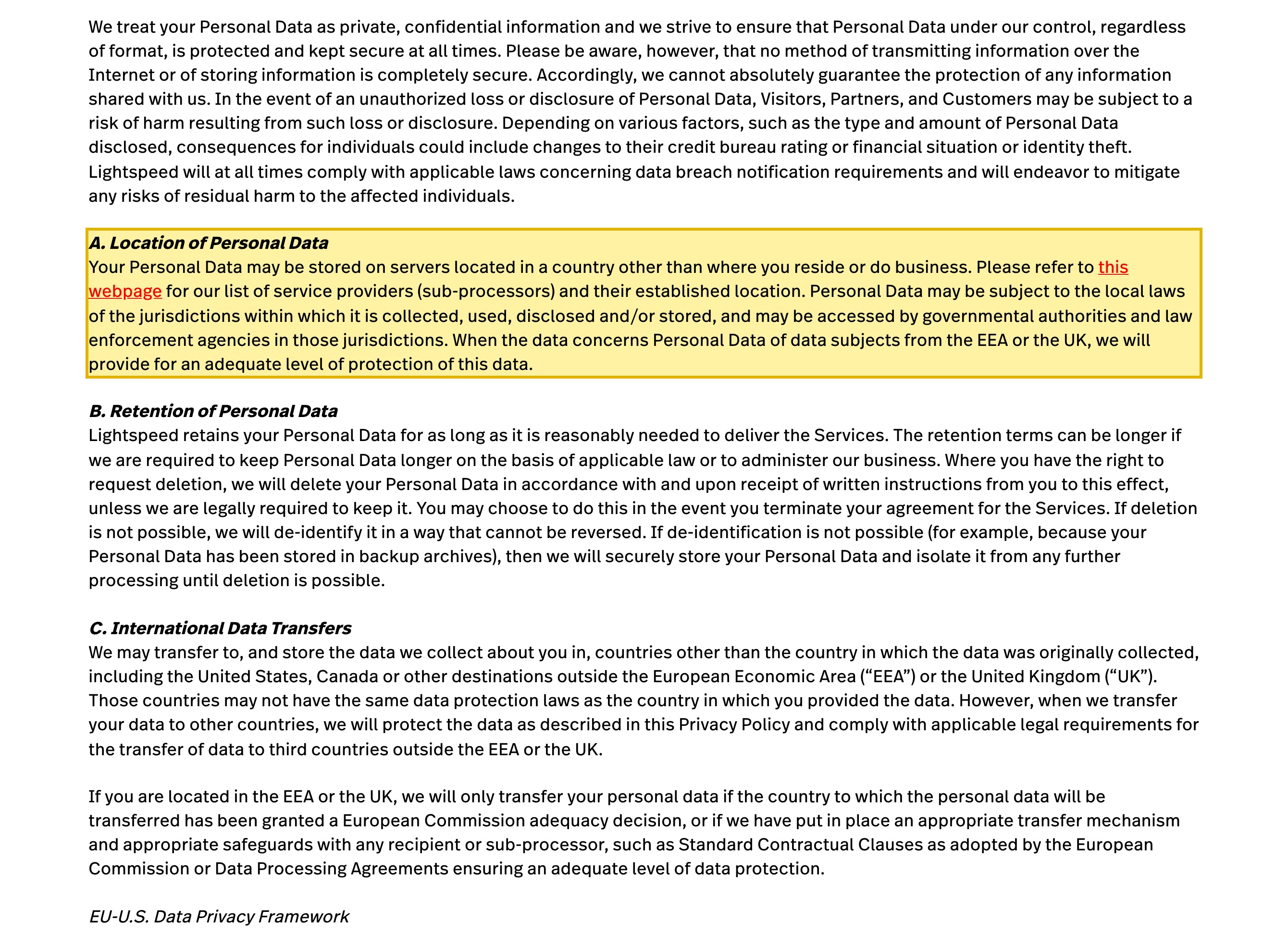
| Ecwid's own privacy policy says customer data can be stored and transferred outside your country — it names the US and Canada, not China. It states "Your Personal Data may be stored on servers located in a country other than where you reside or do business," with transfers "including the United States, Canada or other destinations outside the European Economic Area"; Ecwid, Inc. is named as certified under the EU-U.S. Data Privacy Framework. For a China store that is a cross-border transfer of personal information under PIPL. | Ecwid / Lightspeed — Privacy Policy, Effective Date July 8, 2026 (ecwid.com/privacy-policy redirects here), retrieved 2026-10-10 |
| Running a China store on Ecwid is a PIPL cross-border transfer you, the handler, must legalize. PIPL Articles 38–40 require a transfer mechanism (a CAC security assessment, the CAC standard contract, or certification) and Articles 13/23 require notice and a separate consent; a critical information infrastructure operator or high-volume handler must also store China personal information in-country under Cybersecurity Law Article 39 (formerly Article 37). | China's Personal Information Protection Law (Arts. 13, 23, 38–40) & Cybersecurity Law (Art. 39, formerly 37) — 21YunBox cross-border guide, retrieved 2026-10-10 |
| A China-facing storefront needs an ICP filing it cannot carry on a foreign SaaS domain. A public commercial site served to mainland visitors needs an ICP filing (备案) bound to a mainland hosting resource, and selling can raise the bar to a commercial ICP license; a foreign SaaS store on a foreign domain cannot be ICP-filed as-is, and embedding it into an ICP-filed page does not file the offshore commerce backend. | MIIT ICP filing requirement (State Council Order No. 292; MIIT Order No. 33) — 21YunBox ICP guide, retrieved 2026-10-10 |
Sources verified by the 21YunBox compliance team on 2026-10-10.
For a mainland-China audience, the question about Ecwid is not whether the store widget renders — it usually does — but where your shoppers’ personal data lives, whether the storefront can carry an ICP filing, and how China payment is handled. Ecwid is a hosted SaaS commerce platform, now Ecwid by Lightspeed (Lightspeed eCom, E-Series): you embed a store into a site you already run, but the catalog, customer accounts, orders and checkout all live on Lightspeed’s multi-tenant cloud. By the vendor’s own documentation that cloud runs on Amazon Web Services and Google in the United States, with no region inside mainland China. So a China-facing Ecwid store becomes a cross-border transfer of personal information under PIPL the moment a shopper checks out, the storefront has no mainland host to anchor an ICP filing, and accepting China wallets runs through licensed domestic payment. Reachability is the easy half; residency, licensing and payment are the exposure.
Ecwid in China at a glance
| What decides it | In Ecwid's own terms — and China's law |
|---|---|
| What it holds | Shopper names, shipping addresses, phone numbers, emails and payment identifiers, plus every order and the browsing/behavioral trail of a China store. All of it is personal information under PIPL, and it is generated about people in China. |
| Where it runs | A hosted, multi-tenant SaaS store on Lightspeed's cloud — Amazon Web Services and Google, by the sub-processor list's own "Cloud hosting provider" entries — with no region inside mainland China. Embedding the store into your site does not move that data in-country; running it for China shoppers is a PIPL cross-border transfer (Articles 38–40, 数据出境). |
| The ICP-filing door | A public China storefront is a public internet service that needs an ICP filing (备案), bound to a mainland hosting resource. A foreign SaaS store on a foreign domain cannot be ICP-filed as-is, and Ecwid offers no mainland-China region to file against. |
| Payment & residency | Accepting China's mobile wallets is a licensed, non-bank-payment activity a foreign platform cannot provide directly — it runs through a licensed domestic path. A critical information infrastructure operator or high-volume handler also owes in-country storage (Cybersecurity Law Article 39, formerly Article 37). |
| Reachability is not the axis | A store can load for mainland shoppers and still be non-compliant. The lawful lever is to keep customer PII and orders in-country on a licensed in-country deployment, ICP-file and deliver the storefront in-country, and route China payment through a licensed domestic path — 21YunBox is advisory on payment licensing. |
What you actually hold — customer PII, orders and behavior
An e-commerce platform holds your store’s most regulated data. On Ecwid that is every shopper’s name, shipping address, phone number and email; the payment identifiers taken at checkout; each order and its history; and the browsing and behavioral trail the store records. For a China-facing store, all of that describes people in China, and under China’s Personal Information Protection Law it is personal information you are responsible for as the handler.
Where does it live? Ecwid is a hosted, multi-tenant SaaS store — now Ecwid by Lightspeed, carried in Lightspeed’s documentation as eCom (E-Series) — and you cannot self-host it. Lightspeed’s sub-processor list names Amazon Web Services and Google as the “Cloud hosting provider” for the eCom lines, both headquartered in the United States, and Ecwid’s own privacy policy states that “Your Personal Data may be stored on servers located in a country other than where you reside or do business,” and that it may transfer and store that data in “countries other than the country in which the data was originally collected, including the United States, Canada or other destinations outside the European Economic Area.” Ecwid, Inc. is named there as certified under the EU-U.S. Data Privacy Framework. None of these documents names a mainland-China region — because there is none. Ecwid is an embeddable store: even when you drop it into a site you already run, the catalog, customer accounts, orders and checkout still execute on, and persist to, that offshore cloud. Embedding does not relocate the data.
Three doors: cross-border customer data, an ICP-filed storefront, and licensed payment
Door one — cross-border transfer of customer data (数据出境). The moment a China shopper creates an account or checks out on an Ecwid store, their personal information leaves the mainland for Ecwid’s offshore cloud. Under PIPL that is a cross-border transfer, and the handler — you, not Ecwid — must give notice, obtain a separate consent (Articles 13 and 23), and clear one transfer mechanism: a CAC security assessment, the CAC standard contract, or certification (Articles 38–40). E-commerce stores routinely cross the volume thresholds that tighten these duties.
Door two — an ICP filing for the storefront. A China-facing storefront is a public internet service, and a public commercial site served to mainland visitors needs an ICP filing (ICP 备案), tied to a hosting resource physically inside the mainland; a selling site can raise the bar to a commercial ICP license. A foreign SaaS store on a foreign domain cannot be ICP-filed as-is, and because Ecwid runs no mainland region there is nothing on it to file against. Embedding the Ecwid store into an ICP-filed page does not cure this: the commerce backend and checkout still load from an offshore service that is not itself ICP-filed.
Door three — payment, and residency. Accepting China’s dominant mobile wallets is a licensed, non-bank-payment activity that a foreign platform cannot provide directly; it must run through a licensed domestic payment path, and China’s E-Commerce Law and consumer-protection rules add platform duties on top. Separately, if you are a critical information infrastructure operator or a high-volume handler, personal information collected in China must be stored in the mainland under China’s data-localization rule — Cybersecurity Law Article 39 (formerly Article 37) (the 2025 Cybersecurity Law amendment, in force January 1, 2026, renumbered the data-localization article from 37 to 39, with the substance unchanged), set out at China’s Cybersecurity Law — a residency duty an offshore Ecwid cloud cannot meet.
Reaching the storefront isn’t the question — a compliant in-country store is
An Ecwid store is not categorically blocked, and where it loads for mainland shoppers that is a genuine convenience. But reachability is the delivery half of the question, and it leaves the legal half untouched: a store served from offshore still keeps its shoppers’ data outside the mainland, still has no ICP filing, and still cannot take China wallets on its own. On a hosted, multi-tenant SaaS with no mainland region, those gaps are structural, not a setting you can tune.
The lawful answer is to keep the regulated data and the public storefront on an in-country path — customer PII and orders held in-country on a licensed in-country deployment, the storefront ICP-filed and delivered from inside the mainland, and China payment routed through a licensed domestic path. The answer is never a tunnel that leaves the data offshore and merely makes the offshore store reachable; that moves no data in-country and files no ICP. This is a risk map, not a verdict — whether you need a commercial ICP, in-country storage, a specific transfer mechanism, or all three turns on your entity, your data volumes and who your shoppers are, so settle the specifics with counsel before you build.
The lawful path — map, localize, deliver
You keep running your store; 21YunBox adds the compliance layer a hosted SaaS with no mainland presence cannot, in front of the stack you already run — no rebuild, no migration.
- Map — inventory the customer PII, orders, behavioral data and payment flows your Ecwid store holds, where Lightspeed processes and stores them (an offshore US cloud, no mainland region), whether the storefront is ICP-filed, how China payment is handled, and the consent basis you rely on.
- Localize / govern — keep China-customer PII and orders in-country on a licensed in-country deployment; minimize and pseudonymize; obtain the Article 13/23 notice and separate consent; clear the Article 38–40 transfer mechanism for anything that must still move; and route China payment through a licensed domestic path. 21YunBox is advisory on payment licensing — it holds no China payment license.
- Deliver — the storefront carries an ICP-filing duty and needs compliant, in-country delivery (the 21YunBox Optimizer), placed in front of the stack you already run.
21YunBox is a compliant overlay and partner to the platform you chose, not a competitor to it — and 21YunBox never uses or suggests circumvention of any kind. The goal is a store that runs legally and compliantly for your users in China.
Related reading:
- Cross-border data transfers under PIPL
- China’s Cybersecurity Law
- How to get an ICP filing for China
- China’s data-export security assessment measures
Frequently Asked Questions
Is Ecwid blocked in China?
Can I keep my Ecwid customers' data inside mainland China?
Do I need an ICP filing to sell to China on Ecwid, and can I take Alipay or WeChat Pay?
RELATED TECHNOLOGIES
























ARTICLES RELATED TO ECWID
- China Implements Stricter Regulations on Internet Comment Services
- Does reCAPTCHA Work in China? Reachability, Google's Servers & PIPL
- China Cross-Border Data Transfer: What the Regulation Actually Says
- Tips for Businesses Looking to Sell Products in China: How to Start and Where to Start
- What is data privacy?
- Baidu Tieba - build brand reputation and improve search engine optimization in China!
- Why has my app been deleted from Chinese app stores, and how can I fix it?
- 15 Tips on How to Make a Website Load Faster
- Baidu vs Google
- Baidu Wangpan Guide
- How To Create A Little Red Book Brand Account And Store?
- How To Sell Products to China via WeChat?
- How to Publish My Mobile App in China: A Comprehensive Guide
- How to register a .cn domain?
- Trademark registration in China