Does Pingdom Work in China? Data Residency, ICP & Cross-Border Rules
Pingdom is cloud-only SaaS — no mainland-China region, no self-host — so the Real User Monitoring data it collects from your Chinese visitors and the alert contacts it stores land on SolarWinds' offshore cloud: a PIPL cross-border transfer of personal information. Scrubbing narrows what crosses, not whether, nor residency; a 21YunBox in-country footing is the lever.
Does Pingdom work in China?
Whether you can use Pingdom in China is first a data-residency and cross-border question, not a speed one. Pingdom is cloud-only monitoring from SolarWinds — its Real User Monitoring reads live data from your actual visitors (sessions, geographical location, platform, connection and browser performance) and its uptime checks alert the people you page. There is no mainland-China region and no self-hosted edition, so that visitor stream and those alert contacts come to rest on SolarWinds' offshore cloud.
Collected inside China and stored offshore, that is a cross-border transfer of personal information PIPL governs — notice, separate consent and one transfer mechanism, and for a CIIO or large-volume handler, in-country storage. Pingdom publishes that it does not save user IP addresses or collect identity-exposing PII; that narrows what crosses, but changes neither that the stream crosses nor where it rests.
This is a risk picture, not a verdict — your obligations turn on your data volumes and your role. Our China team can map your Pingdom exposure with you →
What Pingdom's own documentation says about China
| Fact | Primary source |
|---|---|
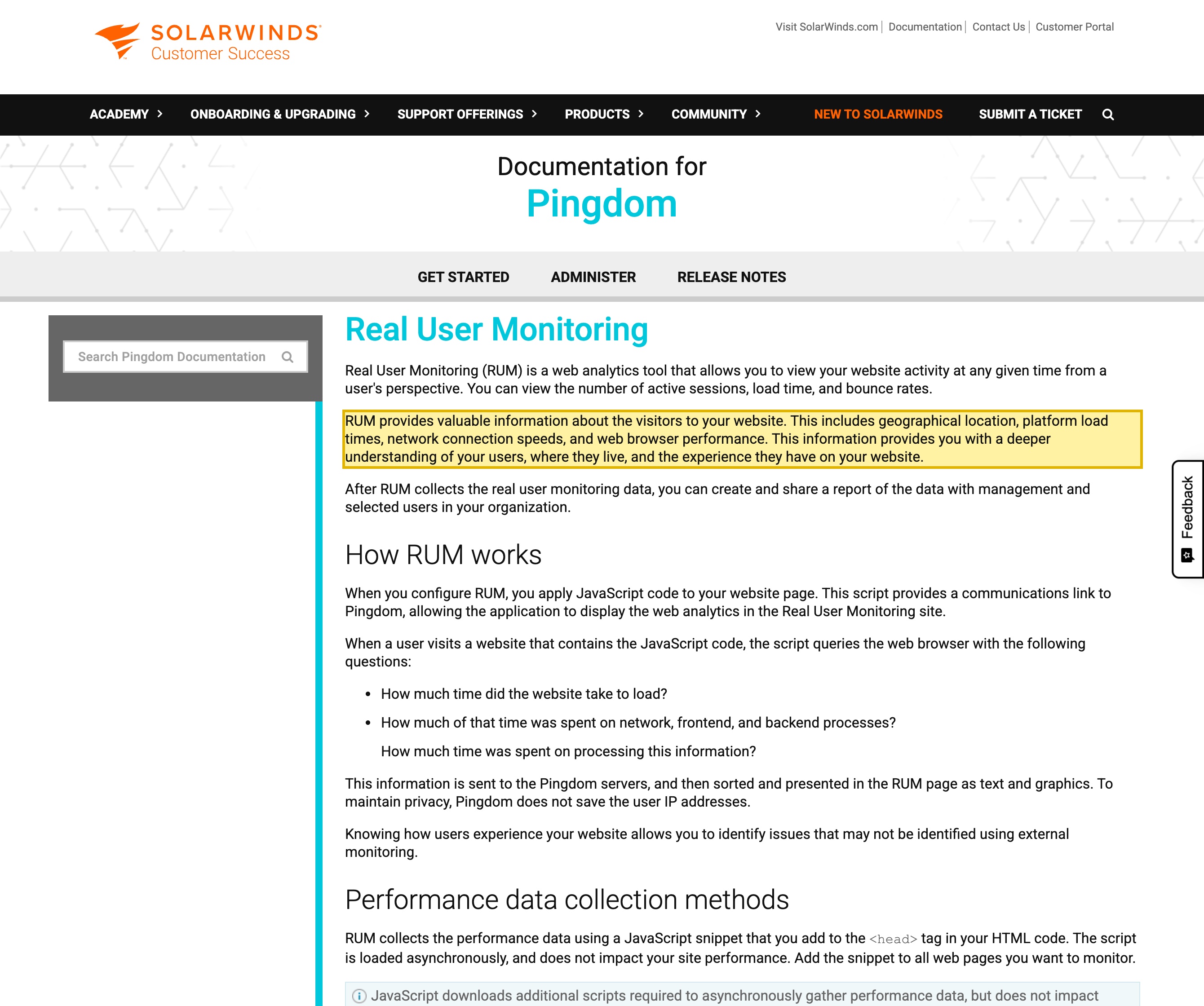
| In Pingdom's own words: Real User Monitoring is "a web analytics tool" that "provides valuable information about the visitors to your website," and the data "includes geographical location, platform load times, network connection speeds, and web browser performance." RUM writes a per-session identifier into each visitor's browser and uses the visitor's IP to derive country of origin. Pingdom adds that "To maintain privacy, Pingdom does not save the user IP addresses" and "does not collect personally identifiable information (PII)" — minimization that narrows what is kept, not whether this visitor stream is gathered in China and shipped to Pingdom's offshore cloud. | Pingdom (SolarWinds) — About Real User Monitoring, retrieved 2026-10-13 |
| Pingdom is delivered only as cloud software-as-a-service — SolarWinds hosts the console (my.solarwinds.cloud) and there is no self-hosted or on-premises Pingdom edition and no mainland-China region. (SolarWinds' separate Observability product offers a self-hosted build; Pingdom does not — the two should not be conflated.) So every record Pingdom holds for your account — the RUM visitor telemetry, the uptime results, and the responder names, emails and phone numbers your alerts notify — rests on SolarWinds' offshore infrastructure, with no in-country option to switch to. | Pingdom (SolarWinds) — product documentation (Getting Started), retrieved 2026-10-13 |
| Personal information collected from users in mainland China and sent to Pingdom's offshore cloud is a cross-border transfer under PIPL. The personal-information handler (you, Pingdom's customer — not Pingdom) must give notice, obtain separate consent for the export, and satisfy one transfer mechanism — a CAC security assessment, the CAC standard contract, or certification (PIPL Articles 38–40). | PIPL Chapter III (Cross-Border Provision of Personal Information), Articles 38–40, retrieved 2026-10-13 |
| A critical information infrastructure operator or large-volume handler must store personal information collected in China inside the mainland (PIPL Article 40; Cybersecurity Law Article 39 (formerly Article 37) — the 2025 amendment, in force January 1, 2026, renumbered the data-localization article without changing its substance). A China-facing Pingdom dashboard served from inside the mainland also needs its own ICP filing; as a cloud-only backend, Pingdom offers no mainland footing to meet either duty. | PIPL Article 40; Cybersecurity Law Article 39 (formerly Article 37, 2025 amendment in force 2026-01-01), retrieved 2026-10-13 |
Sources verified by the 21YunBox compliance team on 2026-10-13.
For teams serving mainland China, the question about Pingdom is not whether the dashboard opens, or whether its checks can reach your site from the outside — they can. The question is where the data Pingdom gathers is allowed to live. Pingdom is an uptime and Real User Monitoring service: its RUM side reads live data from your actual visitors — active sessions, geographical location, platform, connection speed and browser performance — and its uptime side probes your endpoints and pages named, contactable responders when something breaks. Run against a mainland-China audience, that real-visitor stream is collected inside China. And because Pingdom is cloud-only software-as-a-service from SolarWinds, with no mainland-China region and no self-hosted edition, the stream and the people in your alert rotation come to rest outside the country. Reaching Pingdom was never the obstacle; keeping what it collects inside the border is.
Pingdom in China at a glance
| What decides it | In Pingdom's own terms — and China's law |
|---|---|
| Where the data lives | Pingdom is cloud-only software-as-a-service from SolarWinds, with no mainland-China region and no self-hosted edition. Its RUM telemetry, uptime results and alert contacts rest on SolarWinds' offshore cloud. |
| What Pingdom collects | RUM “provides valuable information about the visitors to your website” — “geographical location, platform load times, network connection speeds, and web browser performance” — and writes a per-session identifier into each visitor's browser. The uptime side stores the responders you page. |
| Your China users' data | Gathered on mainland visitors and stored offshore, that visitor stream and those alert contacts are a cross-border transfer of personal information PIPL governs — notice, a separate consent and one transfer mechanism (Articles 38–40). |
| In-country storage | A CIIO or large-volume handler must keep personal information collected in China inside the mainland (PIPL Article 40; Cybersecurity Law Article 39 (formerly Article 37)). Pingdom names no mainland region to meet that. |
| Serving the public & reachability | A Pingdom dashboard served to mainland visitors from inside China needs its own ICP filing; as a cloud-only backend it offers no mainland footing to file against. Reachability is not the axis — where the data rests is. |
No mainland region, and no self-host, so your visitor data comes to rest offshore
Pingdom is delivered only as cloud software-as-a-service: SolarWinds hosts the console (you sign in at my.solarwinds.cloud) and there is no downloadable, self-hosted or on-premises Pingdom edition you could stand up inside China. SolarWinds’ separate Observability product does offer a self-hosted build — Pingdom does not, and the two should not be conflated. None of Pingdom’s regions is in mainland China. So the RUM snippet loaded in your mainland visitors’ browsers, the uptime checks tied to your mainland endpoints, and the responder details in your alert rotation are collected inside China and stored outside it. Because there is no in-country edition to switch to, there is no version of Pingdom that keeps this data on Chinese soil.
The data Pingdom collects is about real people
Real User Monitoring is, in Pingdom’s own words, “a web analytics tool” that “provides valuable information about the visitors to your website.” What it reads is your actual visitors’ behaviour: active sessions, bounce rates, and — in Pingdom’s phrasing — “geographical location, platform load times, network connection speeds, and web browser performance.” It writes a randomly generated session identifier into each visitor’s browser to track them across page loads, and it uses the visitor’s IP address to determine their country of origin. The uptime and alerting side is more clear-cut still: it stores the names, email addresses and phone numbers of the responders you page. Those contacts are personal information outright. Collected on mainland visitors and sent to an offshore cloud, this is what China’s Personal Information Protection Law treats as a cross-border transfer — and the duty rides on you as the handler, not on Pingdom: you owe affected users notice, a standalone consent for the transfer, and one cleared route out of the country — a CAC security assessment, the CAC standard contract, or certification (PIPL Articles 38–40).
Scrubbing narrows the exposure — it does not close the door
Pingdom publishes real data-minimization: it states that “To maintain privacy, Pingdom does not save the user IP addresses” and that it “does not collect personally identifiable information (PII) that may expose a user’s identity.” Those are worth having, and they narrow what Pingdom retains. But minimization changes what is captured, not whether the visitor stream is gathered in China and shipped to an offshore cloud — and it does nothing for residency. The session identifiers, geographic and performance readings still leave the country, and the responder contacts in your alert rotation are personal information that plainly does. If you are a critical information infrastructure operator or a large-volume handler, personal information gathered in China has to stay on mainland soil (PIPL Article 40; Cybersecurity Law Article 39 (formerly Article 37) — the 2025 amendment, in force January 1, 2026, renumbered the data-localization article without changing its substance), and with every Pingdom region offshore there is no in-country store on Pingdom alone to satisfy that duty. Separately, if you put a Pingdom dashboard in front of mainland users from inside China, that public surface needs its own ICP filing; as a cloud-only backend, Pingdom gives you no mainland hosting resource to file against.
Read this as a risk map rather than a ruling: whether you owe a transfer mechanism, in-country storage, an ICP filing, or some combination of them turns on what your telemetry actually holds, your data volumes, and who your users are — worth nailing down with counsel before you wire anything live.
Why a reachability check misses this
Point an external probe at your site and it will tell you Pingdom’s checks run and its dashboard loads from inside China. That answers the wrong question. A reachability test watches a request leave and come back; it never sees where the data Pingdom gathers comes to rest, or whether that resting place is lawful for personal information collected in China. The visitor stream and your alert contacts can flow to SolarWinds’ offshore cloud perfectly quickly and still be an unlawful cross-border transfer with no in-country storage. Speed and uptime are the delivery half; where the most-unfiltered record of your real visitors lands is the exposure — and that is the half a reachability check cannot see.
The lawful path — map, localize, deliver
You keep running Pingdom. What a cloud-only monitoring vendor with no mainland region structurally cannot give you is a lawful home inside China for the personal data its RUM and alerting gather there — and 21YunBox never uses or suggests circumvention of any kind to get around that. Instead we work three ways. We map the lawful route: your PIPL cross-border and data-residency obligations read against your entity, your data volumes, and who your users are — which China-collected telemetry must stay, and which may lawfully reach your offshore tools. We localize what cannot lawfully leave, standing up consented, in-country processing and storage for the data that has to remain on mainland soil. And we deliver the China-facing dashboard and origin through ICP-filed, in-country compliant delivery — the 21YunBox Optimizer sits in front of the stack you already run, no rebuild, no second codebase, and no move off Pingdom for the telemetry that can lawfully cross the border. The aim is plain: your monitoring runs lawfully and compliantly for your users in China.
Related reading:
- How to get an ICP filing for China
- Cross-border data transfers under PIPL
- China’s Personal Information Protection Law
- China Cybersecurity Law — data localization