Does Adobe Analytics Work in China? Regional Data Collection, Data Residency & PIPL Consent
Adobe Analytics is reachable from mainland China, and Adobe even documents a China collection option — Regional Data Collection, with a Beijing edge — so reachability is not the real China question. But that option is a gated, AppMeasurement-only performance add-on, and Adobe's own docs say data collected at an edge is forwarded to a core site for processing whose location it does not state, so a Beijing collection edge is not data residency. The decision is PIPL: visitor clickstream and IDs are personal information, tracking individuals needs consent, and processing or storing that behavioral data offshore is a cross-border transfer (数据出境), with the Cybersecurity Law's Article 39 (formerly Article 37) in-country storage duty for a critical information infrastructure operator. A compliance-first look at Adobe Analytics' China collection option, the data-residency question, and the lawful path.
Does Adobe Analytics work in China?
Yes — Adobe Analytics is reachable from mainland China, and Adobe even documents a China collection option (Regional Data Collection, with a Beijing edge) — so reachability is not the real question. What decides the China question is data residency and consent.
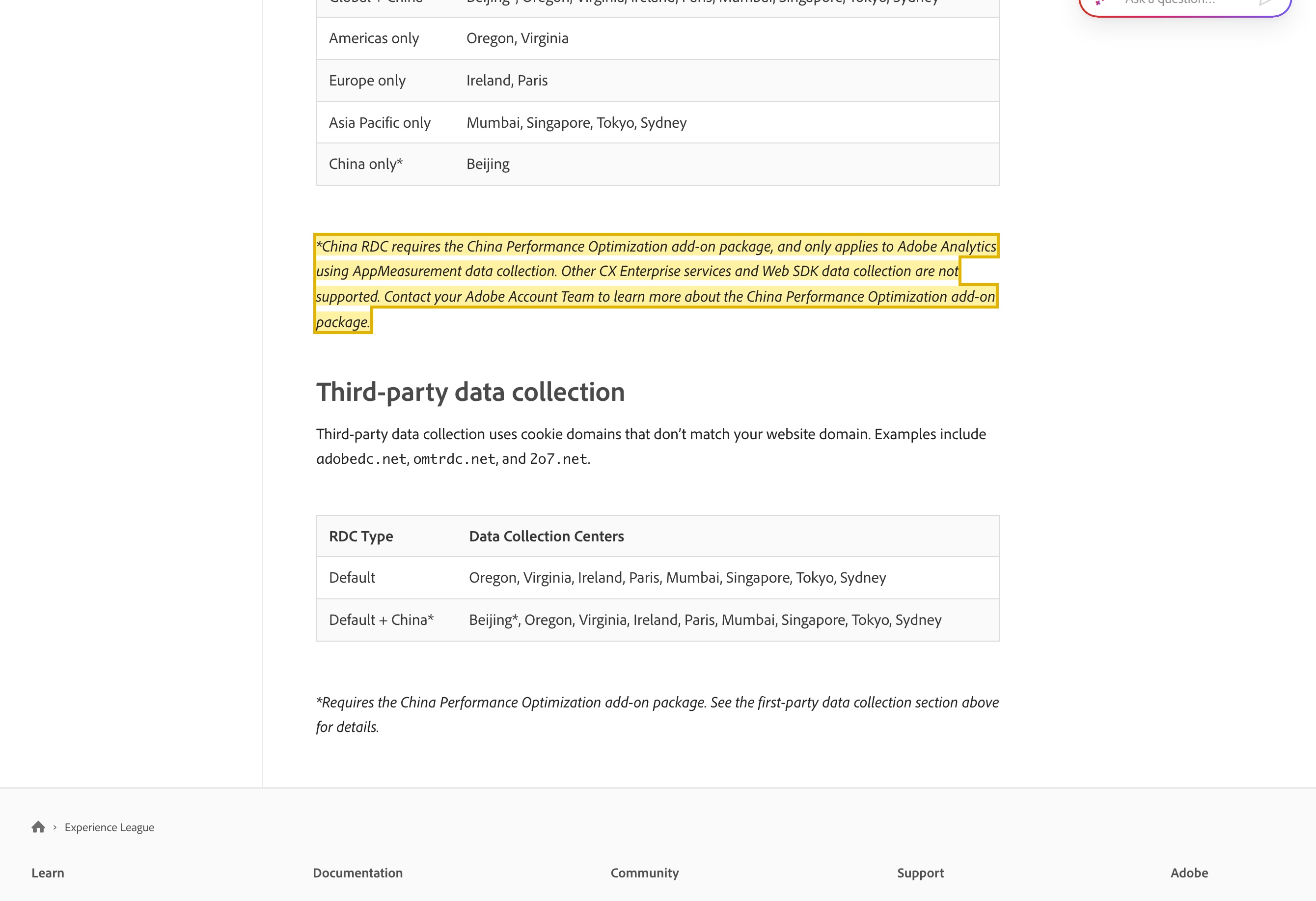
Adobe's China option is narrow and specific: its own documentation says “China RDC requires the China Performance Optimization add-on package, and only applies to Adobe Analytics using AppMeasurement data collection,” with Web SDK and other CX Enterprise services not supported, and mainland use “requires a regional use exception.” And a Beijing collection edge is not in-country storage — Adobe documents that data “is securely forwarded to a core site for processing” without stating where that core site sits. If behavioral data collected from China users is processed or stored offshore, that is a cross-border transfer under PIPL (Articles 38–40: notice, a separate consent, and a transfer mechanism), it may trigger China's data-export security assessment, and for a critical information infrastructure operator the Cybersecurity Law's Article 39 (formerly Article 37) requires in-country storage. Tracking identifiable visitors also needs a PIPL consent basis.
21YunBox maps your residency and consent exposure, localizes China-collected behavioral data onto a China-resident store (confirming any genuinely data-resident Adobe China arrangement directly with Adobe), and delivers your China-facing site or app in-country on ICP-filed infrastructure — with no rebuild, and never any form of circumvention. Treat the specifics as a risk to confirm with counsel.
What Adobe Analytics's own documentation says about China
| Fact | Primary source |
|---|---|
| Adobe's China collection option is a gated, AppMeasurement-only add-on. Adobe's Regional Data Collection documentation states: “China RDC requires the China Performance Optimization add-on package, and only applies to Adobe Analytics using AppMeasurement data collection. Other CX Enterprise services and Web SDK data collection are not supported.” | Adobe Experience League, “Regional Data Collection” (experienceleague.adobe.com), retrieved 2026-10-08 |
| Mainland-China use is a special, gated arrangement, and where data sits is set by contract. Adobe's Experience Cloud hosting-locations page states that “Use of Adobe Analytics in mainland China requires a regional use exception and the China Performance Optimization Add-on license,” and that most Adobe solutions run in cloud data centers “in various locations worldwide, with the specific location/s provisioned upon contract signing.” | Adobe, “Experience Cloud Hosting Locations” (adobe.com/trust), last updated February 26, 2026, retrieved 2026-10-08 |
| A Beijing collection edge is not in-country processing or storage. Adobe describes the mechanism as “Data collected locally at an edge site is securely forwarded to a core site for processing,” and does not state where the core site for China traffic sits; the “Global + China” routing option adds Beijing to the global centers rather than replacing them. | Adobe Experience League, “Regional Data Collection” (experienceleague.adobe.com), retrieved 2026-10-08 |
| Behavioral data sent to offshore processing is a PIPL cross-border transfer. Clickstream and visitor identifiers collected from users in mainland China are personal information; processing or storing them outside the mainland triggers PIPL Articles 38–40 — notice, a separate consent, and one transfer mechanism (a CAC security assessment, the CAC standard contract, or certification) — and tracking individuals requires a lawful consent basis. | Personal Information Protection Law of the PRC, Articles 38–40 (cac.gov.cn), retrieved 2026-10-08 |
Sources verified by the 21YunBox compliance team on 2026-10-08.
For a product with users in mainland China, the first question about Adobe Analytics is usually “will our tags even fire?” — and that is not where the China decision is settled. Adobe Analytics is reachable from the mainland, and Adobe goes a step further than many analytics vendors: it documents a China collection option, Regional Data Collection, with an edge in Beijing. So this is not a blocked-service story, and it is not a speed story either. The decision is about data residency and consent — where the behavioral data you collect from China users is processed and stored, and whether you had a lawful basis to collect it and to move it.
That matters because a collection endpoint in Beijing is not the same thing as keeping your analytics data in China. Adobe’s own documentation describes Regional Data Collection as a performance add-on that gathers first-party traffic at an in-country edge and then forwards it onward for processing — and it is deliberate about what that option does and does not cover. The behavioral record Adobe Analytics builds — clickstream, visitor identifiers, device and session data — is personal information under Chinese law, and the law that decides whether it may be collected, processed, and sent offshore is PIPL, not a latency test.
Adobe Analytics in China at a glance
| What decides it | In Adobe's own terms — and China's law |
|---|---|
| What it is | Adobe Analytics (part of Adobe Experience Cloud) collects web and app clickstream, visitor IDs, and the behavioral profile built from them. Where that data is collected, processed, and stored is set by your Adobe contract and configuration. |
| Is it reachable — and is there a China option? | Yes. Adobe Analytics is reachable from the mainland, and Adobe offers Regional Data Collection (RDC) with a Beijing edge. But China RDC is a paid add-on, AppMeasurement-only — Adobe says Web SDK and other CX Enterprise services "are not supported" — and mainland use "requires a regional use exception." Reachability is not the China question. |
| Does the Beijing edge keep data in China? | Not by itself. Adobe documents that data "collected locally at an edge site is securely forwarded to a core site for processing," and does not state where that core site sits; the "Global + China" option adds Beijing to the global centers rather than replacing them, and locations are "provisioned upon contract signing." A collection edge is not a residency guarantee. |
| Collecting China visitors' behavioral data | Clickstream and visitor IDs are personal information. Tracking identifiable individuals needs a PIPL consent basis, and processing or storing that data offshore is a cross-border transfer (数据出境) under PIPL (Articles 38–40): notice, a separate consent, and one transfer mechanism. It may trigger China's data-export security assessment, and for a critical information infrastructure operator the Cybersecurity Law's Article 39 (formerly Article 37) sets an in-country storage duty offshore processing cannot meet. |
| The lawful path | Keep the behavioral data collected from China users in-country in a China-resident analytics store, analyze only what may lawfully leave, and deliver the China-facing site or app that carries the tracking in-country on ICP-filed infrastructure. 21YunBox maps, localizes, and delivers; it never uses or suggests circumvention. |
Availability: reachable — and Adobe even documents a China collection endpoint
Adobe Analytics’ position in China is set in Adobe’s own documentation, not by a load-time check. The service is reachable from the mainland, and Adobe offers Regional Data Collection (RDC), which can gather first-party traffic at a Beijing edge. That sets Adobe apart from analytics tools with no mainland footing at all — so the honest answer is not “it doesn’t work in China.”
But Adobe is precise about how narrow that option is. Its documentation states that “China RDC requires the China Performance Optimization add-on package, and only applies to Adobe Analytics using AppMeasurement data collection,” and that “Other CX Enterprise services and Web SDK data collection are not supported.” Adobe’s Experience Cloud hosting-locations page adds that “Use of Adobe Analytics in mainland China requires a regional use exception and the China Performance Optimization Add-on license.” So the China collection endpoint is a paid, gated, AppMeasurement-only add-on — not a default, and not available to a modern Web SDK implementation. For that reason this page publishes no first-party China latency figure for Adobe Analytics: a performance add-on exists, so speed is not the axis this decision turns on. And to be unambiguous — 21YunBox neither provides nor suggests any form of circumvention; the productive question is where your China data lawfully lives.
Why a Beijing collection edge is not data residency
Here is the gate most teams miss: collecting at a Beijing edge is not the same as storing and processing in China. Adobe’s documentation describes the mechanism plainly — “Data collected locally at an edge site is securely forwarded to a core site for processing” — and does not state, there, where the core site for China traffic sits. The “Global + China” routing option, by its own description, adds Beijing to the global centers rather than replacing them. Separately, Adobe’s hosting-locations page says most Adobe solutions run in cloud providers’ data centers “in various locations worldwide, with the specific location/s provisioned upon contract signing,” and directs customers to “contact your Adobe representative for more information.”
Put together, that means the place your Adobe Analytics data is actually processed and stored is a contract-and-configuration question, not something a Beijing collection edge settles for you. If the processing or storage of behavioral data collected from China users happens offshore, you have made a cross-border transfer — and a different body of law decides whether that was lawful. Whether, and how, each duty applies to your specific configuration is a risk to confirm with counsel against what you actually collect and where it is processed.
Behavioral data is personal information: consent and cross-border
A web or app analytics record is not anonymous traffic counting. Clickstream, visitor IDs, device and session identifiers, and the behavioral profile built from them are personal information under China’s Personal Information Protection Law — and tracking identifiable individuals carries two duties at once. First, consent: PIPL requires a clear, informed basis for collecting and tracking personal information, and a separate consent where that data will be transferred outside the mainland, distinct from a user’s general agreement to use your site. Second, cross-border: if behavioral data collected in China is processed or stored offshore, that is a cross-border transfer of personal information under PIPL (Articles 38–40) — notice, a separate consent, and one transfer mechanism (a CAC security assessment, the CAC standard contract, or certification).
Above certain thresholds, or where the data is “important data,” the transfer may also require China’s data-export security assessment (数据出境安全评估) before anything leaves. And if your organization is a critical information infrastructure operator, the Cybersecurity Law’s Article 39 (formerly Article 37) requires that personal information collected and generated in China be stored in China — a duty that offshore processing of your analytics data cannot meet. None of this turns on how quickly a beacon fires; it turns on whether the behavioral data had a lawful basis to be collected and to leave.
The lawful path — map, localize, deliver
There is a lawful way to run web and app analytics for a China-facing product, and it has a shape. First, map: our China team works through what your tags actually collect from China users, where it is processed and stored under your current Adobe configuration, and where your PIPL consent and cross-border duties — and any Article 39 (formerly Article 37) residency duty — bite. The legal conclusions settle with counsel; we frame the technical picture that feeds them.
Then localize: keep the behavioral data collected from China users on a China-resident footing — a China-resident analytics or event store for what must stay in-country — and, where you want to keep Adobe in the picture, confirm directly with Adobe whether a genuinely data-resident China arrangement, not merely a Beijing collection edge, is available for your implementation. The point is that in-country residency is established on purpose, not assumed from a collection endpoint.
Then deliver: the China-facing site or app that carries your analytics is itself a public service in the mainland, so it has an ICP filing (备案) duty and needs compliant, in-country delivery. 21YunBox delivers it in-country — the 21YunBox Optimizer — in front of what you already run, with no rebuild and no re-platform. The result is China-facing analytics that run legally and compliantly for your users. What we never do, and what no one lawfully can, is route data around China’s rules or around any block: we localize what must stay in-country and deliver compliantly, and we never use or suggest circumvention of any kind.
Related reading:
- Cross-border data transfers under PIPL
- China’s data-export security assessment
- China’s Cybersecurity Law (data localization, Article 39)
- How to get an ICP filing for China
================================================================