Does Mixpanel Work in China? Data Residency, PIPL & Your Analytics Data
Mixpanel runs no data region inside mainland China — it stores analytics in the US by default, or the EU or India — so tracking your Chinese users ships their events, identifiers and IP-derived location offshore, a cross-border transfer under PIPL. A compliance-first look.
Does Mixpanel work in China?
Yes, Mixpanel loads and tracks from mainland China — but that is the easy half. Mixpanel runs no data region inside the mainland: by its own documentation it stores your analytics in the United States by default, with Europe or India as the only alternatives. So every Chinese user you track has their personal data carried offshore — a compliance question, not a speed one.
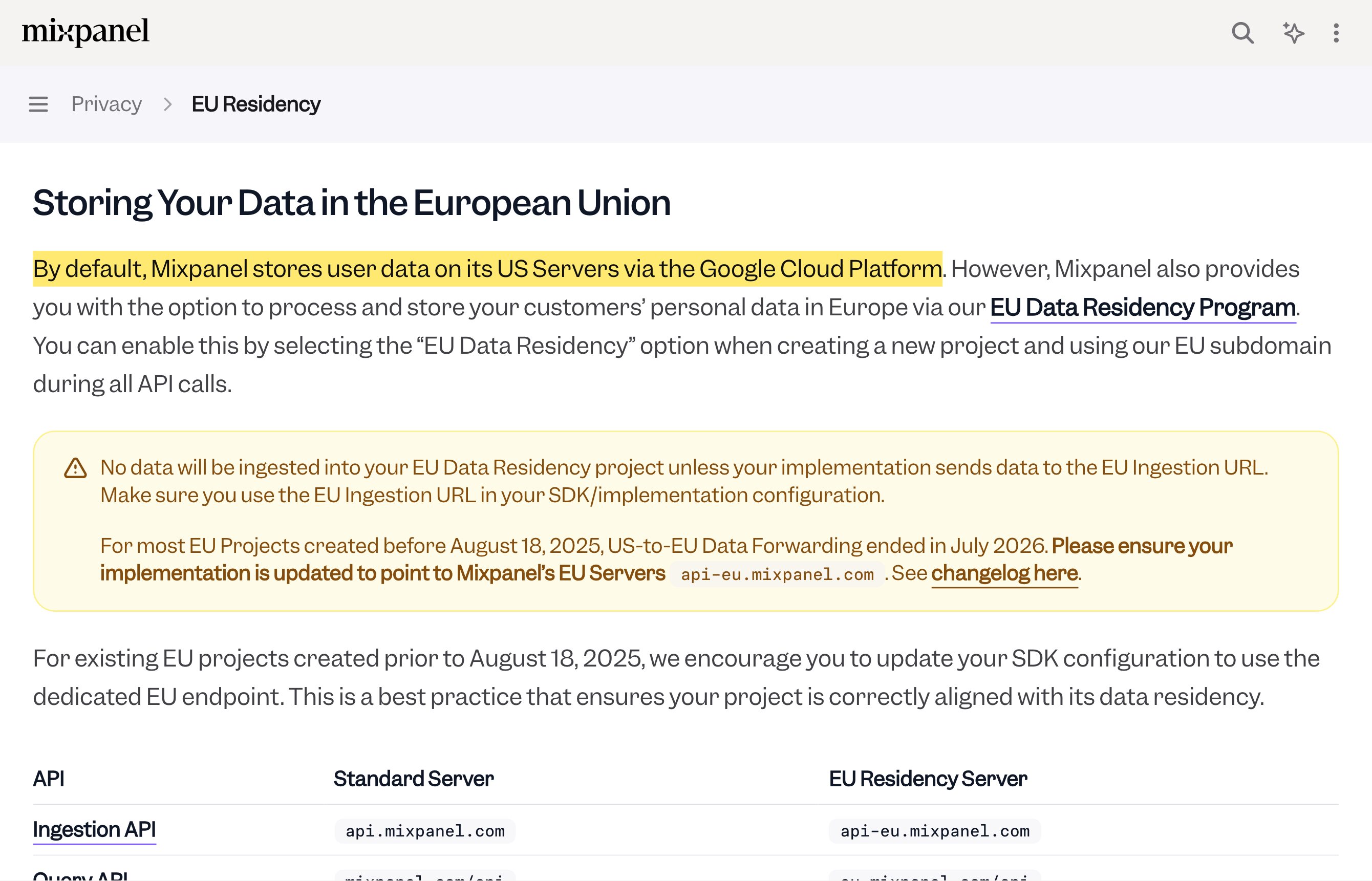
Mixpanel states it plainly: "By default, Mixpanel stores user data on its US Servers via the Google Cloud Platform," and it "also provides you with the option to process and store your customers' personal data in Europe via our EU Data Residency Program" — with India as the one other choice, and nothing inside mainland China. Each visitor's events post to api.mixpanel.com, and Mixpanel derives their location "using the IP address of the location where the request was made," storing the result alongside every user's identifiers and event history on servers outside the mainland. Under PIPL that is a cross-border transfer of personal information (notice, separate consent and a transfer mechanism), and the duty falls on the handler — you, not Mixpanel. The table below is Mixpanel's own wording and the rule each line triggers.
This is a risk map, not a verdict — what you owe turns on your data, your volumes and who your users are. Our China team can map your exposure with you →
Compliance snapshot
- ✕ No mainland-China data region — Mixpanel stores data only in the US, EU or India
- ! Tracking mainland users ships their events, identifiers and IP-derived location offshore — PIPL cross-border
- ! US servers on Google Cloud are the default unless you choose EU or India residency
- ! Residency is locked at project creation — the wrong region means a new project and a manual migration
- ! Every event posts to the offshore endpoint api.mixpanel.com — reachability is the secondary half
What Mixpanel's own documentation says about China
| Fact | Primary source |
|---|---|
| Mixpanel stores your analytics in the US by default — and offers no mainland-China region. In Mixpanel's own words, "By default, Mixpanel stores user data on its US Servers via the Google Cloud Platform," and it "also provides you with the option to process and store your customers' personal data in Europe via our EU Data Residency Program." India is the only other residency option; none of the three is inside mainland China. Analytics collected from your Chinese users is therefore stored offshore — a cross-border transfer of personal information under PIPL (Articles 38–43). | Mixpanel Docs — EU Residency (docs.mixpanel.com), retrieved 2026-10-07; PIPL Articles 38–43 |
| What leaves the country is personal data — identifiers, events and IP-derived location. Mixpanel derives each visitor's location from the request IP: its docs say geolocation properties "are set using the IP address of the location where the request was made," and that it will "take the IP address of the request and parse it through Maxmind to generate the Country, Region, and City values." It then notes, "The IP address value is discarded from the payload prior to ingestion into your project" — but the derived city, region and country, with each user's Distinct ID, device properties and full event stream, are stored on its US (or EU/India) servers. That stored profile is the personal information PIPL protects when it moves out of China. | Mixpanel Docs — Geolocation (docs.mixpanel.com), retrieved 2026-10-07; PIPL Articles 38–43 |
| You cannot move the data back in-country later — residency is fixed at project creation. Mixpanel states that "if the wrong Data Residency location was chosen before implementation, you will need to create a new project with the applicable data storage option and migrate all your existing data," and that "Mixpanel cannot assist with migrating an existing project with the wrong residency location." Because none of the three options is mainland China, there is no in-country setting to switch to — the cross-border posture is structural, not a toggle. | Mixpanel Docs — EU Residency (docs.mixpanel.com), retrieved 2026-10-07 |
| ICP attaches to your own site, not to Mixpanel — and api.mixpanel.com is one of the offshore calls it carries. The ICP filing (State Council Order No. 292; MIIT Order No. 33) is a duty of the website you operate for mainland visitors, not of an embedded analytics tool. But every tracked page view posts to Mixpanel's offshore ingestion endpoint — "api.mixpanel.com" by default — an out-of-country dependency on each mainland device, where cross-border calls are not guaranteed to be fast or consistent. Reachability is the delivery half; where your users' data is allowed to live is the half that decides whether you can use Mixpanel as-is. | Mixpanel Docs — EU Residency / ingestion endpoints (docs.mixpanel.com), retrieved 2026-10-07; State Council Order No. 292; MIIT Order No. 33 |
Sources verified by the 21YunBox compliance team on 2026-10-07.
For a mainland-China audience, the first question about Mixpanel is not whether it loads — it is where the data it collects is allowed to live. Mixpanel answers that in its own documentation: it keeps analytics in the United States by default, with Europe and India as the only alternatives, and no region inside mainland China. Point a Chinese user’s browser or app at Mixpanel and their events, identifiers and IP-derived location are gathered and carried offshore — which turns a routine analytics call into a cross-border transfer of personal information under China’s law. The tracking works; the data residency is the exposure.
Mixpanel in China at a glance
| What decides it | In Mixpanel's own terms |
|---|---|
| Where it runs | “By default, Mixpanel stores user data on its US Servers via the Google Cloud Platform.” The EU and India are the only other residency options; none sits inside mainland China. |
| What it collects | Each request carries the visitor's IP, from which Mixpanel derives city, region and country, stored with the user's Distinct ID, device properties and full event stream — personal information of your mainland users. |
| Where your China data lands | On US (or EU/India) servers, outside the mainland — a cross-border transfer of personal information PIPL governs (notice, separate consent, one transfer mechanism). |
| Keeping it in-country | Not possible on Mixpanel. Residency is fixed when the project is created, and none of the three choices is mainland China. |
| Is it reachable? | Each event posts to the offshore endpoint api.mixpanel.com. Reaching it from inside the mainland is a delivery question — secondary to where the data is allowed to sit. |
No mainland data region, so your analytics live offshore by default
Mixpanel documents its storage locations plainly. “By default, Mixpanel stores user data on its US Servers via the Google Cloud Platform,” and it “also provides you with the option to process and store your customers’ personal data in Europe via our EU Data Residency Program.” A third program keeps data in India. Those three — the United States, the EU and India — are the entire menu; there is no mainland-China region to choose. Serve and track Chinese users, and their analytics data is stored outside the mainland from the first event onward.
Under China’s Personal Information Protection Law that is a cross-border transfer, and the handler — you, not Mixpanel — must give notice, obtain separate consent, and clear one transfer mechanism: a CAC security assessment, the CAC standard contract, or certification (PIPL Articles 38–43). Where your Chinese users’ personal data is allowed to live is settled before performance ever enters the picture.
What actually crosses the border
The data Mixpanel gathers is personal information, not anonymous counts. Its own documentation describes how location is built from each visitor’s network address: geolocation properties “are set using the IP address of the location where the request was made,” and Mixpanel will “take the IP address of the request and parse it through Maxmind to generate the Country, Region, and City values.” It then states, “The IP address value is discarded from the payload prior to ingestion into your project.”
Dropping the raw IP is a real safeguard — but what remains and is stored is still personal data about your users: the derived city, region and country, each user’s Distinct ID, their device and app properties, and the full stream of events they generate. All of it lands on Mixpanel’s US, EU or India servers. For a mainland user, that is their personal information leaving China, which is exactly what PIPL’s cross-border rules govern (Articles 38–43), with a data-localization duty on top for a critical information infrastructure operator or a large-volume handler (Cybersecurity Law Article 39 (formerly Article 37); PIPL Article 40).
Residency is locked in, and ICP is a separate door
Picking the wrong place is not something you quietly fix later. Mixpanel warns that “if the wrong Data Residency location was chosen before implementation, you will need to create a new project with the applicable data storage option and migrate all your existing data,” and that “Mixpanel cannot assist with migrating an existing project with the wrong residency location.” Since mainland China is not on the menu at all, there is no in-country configuration to migrate to — the offshore posture is structural.
A separate door is the ICP filing (ICP 备案) under State Council Order No. 292 and MIIT Order No. 33: it attaches to the website you operate for mainland visitors, not to an embedded analytics tool. Mixpanel does not need its own ICP filing, but it is one of the offshore third-party calls your China-facing site carries, and it posts to the out-of-country endpoint api.mixpanel.com on every tracked view — a reachability question that rides alongside, but never replaces, the data-residency one.
This is a risk map, not a verdict: whether you owe notice and consent, a transfer mechanism, in-country storage, or all three depends on what you collect, how much of it, and who your users are — worth settling with counsel before you ship.
Where 21YunBox fits — a compliant overlay, not a migration
You keep Mixpanel exactly where it is, instrumented just as it is today. What we add is the piece an offshore analytics platform cannot provide on its own: compliant, ICP-filed delivery from inside the mainland, placed in front of your existing origin — no rebuild, no second codebase, no change to how you track your product. Our China team maps what your Mixpanel setup sends out of the country, weighs it against your PIPL cross-border and data-residency obligations for your entity and data volumes, and stands up the in-country delivery a lawful China presence needs, while helping you arrange a defensible path for the data that still has to leave.
Related reading:
Frequently Asked Questions
Does Mixpanel keep our China users' data inside mainland China?
No. Mixpanel offers three data-residency locations — the United States (the default), the EU and India — and none is inside mainland China. In its own words, "By default, Mixpanel stores user data on its US Servers via the Google Cloud Platform." Analytics collected from your mainland users is therefore stored offshore, which China's PIPL treats as a cross-border transfer of personal information. There is no Mixpanel setting that keeps that data in-country.
If Mixpanel discards the IP address, is there still a PIPL concern?
Treat it as exposure to assess with counsel, not a clean pass. Mixpanel does discard the raw IP before ingestion — but it first uses that IP to derive city, region and country, and it stores those values with each user's Distinct ID, device properties and event history on servers outside mainland China. That stored profile is still personal information belonging to your Chinese users, and moving it offshore is the cross-border transfer PIPL governs — notice, separate consent and a transfer mechanism. Dropping the raw IP narrows one field; it does not remove the transfer.
Can 21YunBox help us use Mixpanel compliantly in China?
Yes. Our China team can map your PIPL cross-border and data-residency exposure for your entity, data volumes and users, and stand up the ICP-filed, in-country delivery a compliant China presence needs — in front of the stack you already run, with Mixpanel still embedded. We don't ask you to tear out your analytics; we help you see what leaves the mainland and arrange a defensible path for it. Get in touch to work through your specific case.