Does Google Analytics Work in China? PIPL, Cross-Border Data & Residency
Google Analytics collects every visitor's identifiers, device data and approximate location and sends them to Google servers outside mainland China — a cross-border personal-data transfer under PIPL, on infrastructure with no mainland-China region and behind endpoints the Great Firewall blocks or throttles. A compliance-first look at the data-residency question.
Does Google Analytics work in China?
Not cleanly. Google Analytics will load on a China-facing site, but measuring your mainland visitors sends their identifiers, device data and approximate location to Google servers outside China — a cross-border transfer of personal information PIPL governs — and Google runs no mainland-China region to keep any of it in-country.
In Google's own words, Analytics "collects the following information through the default implementation: Number of users, Session statistics, Approximate geolocation, Browser and device information," and "stores a client ID in a first-party cookie named _ga to distinguish unique users." Its carve-out that does "not log or store individual IP addresses" is written "from EU, Switzerland, or UK users" — not China; for everyone else, measurement traffic is forwarded "to Analytics servers for processing" on Google infrastructure that has no mainland location. Sending your China users' personal information there is a cross-border transfer under PIPL (notice, separate consent and a transfer mechanism), and the same Google endpoints are blocked or throttled in the mainland — so the data is both exported and unreliably collected. The table below is Google's own wording and the rule each line triggers.
This is a risk map, not a verdict — your exposure turns on what you collect, how much, and who your users are. Our China team can map your exposure with you →
Compliance snapshot
- ! Every GA hit sends your China visitors' identifiers to Google servers offshore
- ! That export is a cross-border personal-data transfer — PIPL applies to you
- ✕ Google runs no mainland-China region or data residency for standard Analytics
- ! Google's no-IP-storage handling is carved out for the EU, UK and Switzerland — not China
- ✕ Google's analytics and tag endpoints are blocked or throttled in the mainland
What Google Analytics's own documentation says about China
| Fact | Primary source |
|---|---|
Google Analytics collects personal data from every visitor by default. In Google's own words it "collects the following information through the default implementation: Number of users, Session statistics, Approximate geolocation, Browser and device information," and "stores a client ID in a first-party cookie named _ga to distinguish unique users and their sessions on your website." Approximate location, device details and a persistent client ID are personal information — so measuring a mainland visitor means handling their personal data. | Google — [GA4] Data collection (support.google.com), retrieved 2026-10-07 |
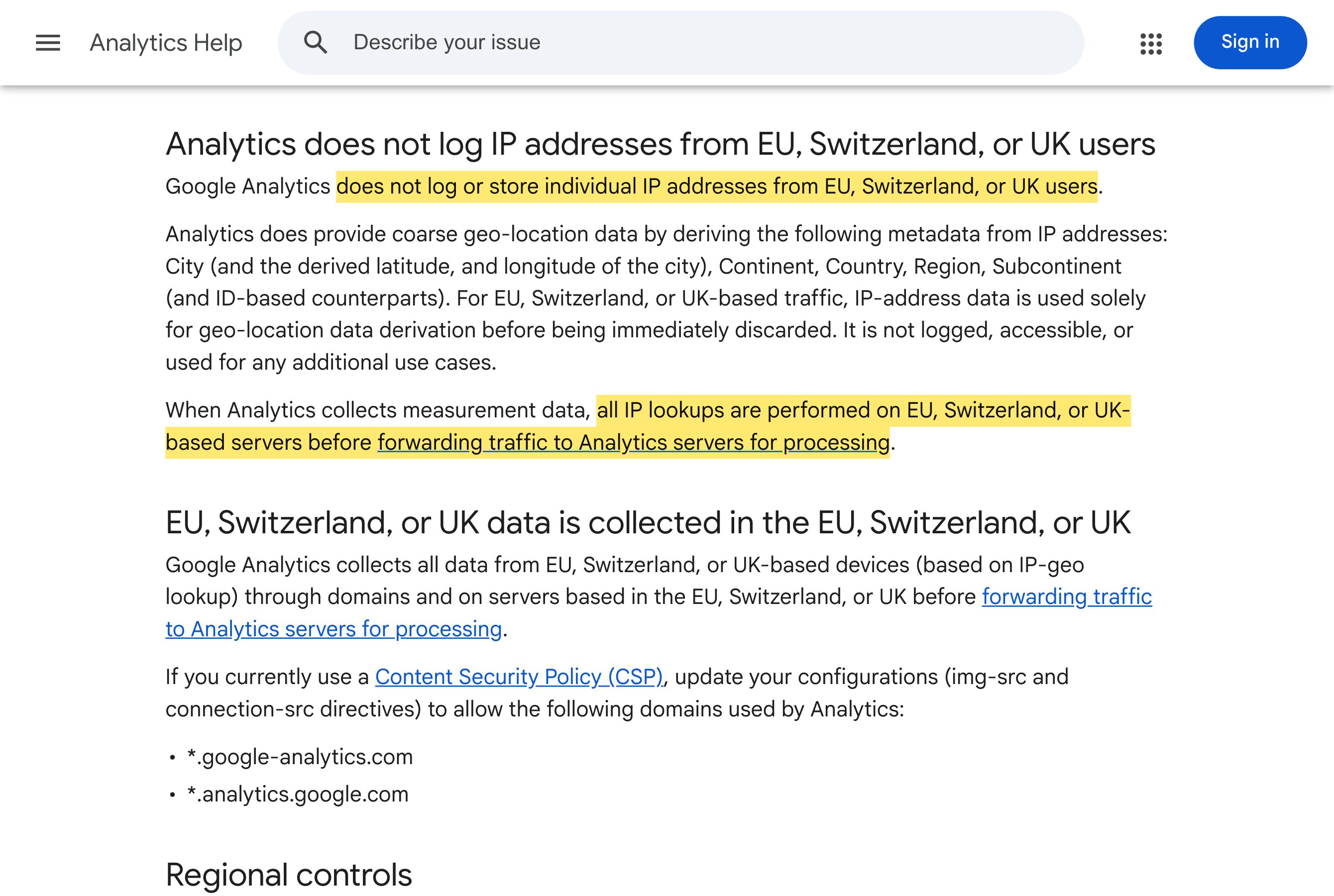
| Google's "no IP storage" protection is written for Europe, not China. Google states Analytics "does not log or store individual IP addresses from EU, Switzerland, or UK users," and that "all IP lookups are performed on EU, Switzerland, or UK-based servers." No equivalent carve-out is published for mainland China, so your Chinese visitors' traffic is handled on Google's general infrastructure like any other — not kept in-region. | Google — EU, Switzerland, or UK-focused data and privacy (support.google.com), retrieved 2026-10-07 |
| Mainland visitors' measurement traffic is forwarded to Google's Analytics servers offshore. Google: after the regional IP lookup it forwards "traffic to Analytics servers for processing." Those servers sit outside mainland China, so sending a Chinese user's personal information to them is a cross-border transfer under PIPL — the handler (you, not Google) owes notice, separate consent and one transfer mechanism: a CAC security assessment, the CAC standard contract, or certification (PIPL Articles 38–43). | Google — EU, Switzerland, or UK-focused data and privacy (support.google.com), retrieved 2026-10-07; PIPL Articles 38–43 |
| Google operates no data center in mainland China. Google's own locations run across the Americas, Europe and Asia — the nearest in Asia being "Changhua County, Taiwan," "Inzai, Japan," "Selangor, Malaysia" and "Singapore" — with none in the mainland. Standard Google Analytics therefore has no in-country region, and for a critical information infrastructure operator or a large-volume handler, personal information collected in China must be stored in the mainland (PIPL Article 40; Cybersecurity Law Article 39 (formerly Article 37)) — a residency duty offshore infrastructure cannot meet. | Google Data Centers — Locations (datacenters.google), retrieved 2026-10-07; PIPL Article 40; Cybersecurity Law Article 39 (formerly Article 37) |
Sources verified by the 21YunBox compliance team on 2026-10-07.
For a mainland-China audience, the deciding question about Google Analytics is not whether the reports fill with numbers — it is whose personal data has to leave the country for those numbers to exist. Analytics measures a visitor by sending their identifiers, device details and approximate location to Google’s own servers, and Google operates no region inside mainland China. Pointing it at your mainland visitors therefore exports their personal information across the border — something China’s privacy law governs directly — while the Google endpoints that collect it are blocked or throttled inside the country. The reporting is the easy part; the data residency is where the exposure sits.
Google Analytics in China at a glance
| What decides it | In Google's own terms |
|---|---|
| What it collects | By default Analytics collects “Number of users, Session statistics, Approximate geolocation, Browser and device information,” and stores a persistent client ID in the first-party _ga cookie — all personal information. |
| Where it's processed | Google lists no data center in mainland China; its facilities run across the Americas, Europe and Asia (Taiwan, Japan, Malaysia, Singapore, India). Mainland hits are forwarded “to Analytics servers for processing” offshore. |
| The IP carve-out | Google “does not log or store individual IP addresses from EU, Switzerland, or UK users.” No equivalent is written for China — that protection does not reach your mainland visitors. |
| The residency rule | Exporting China users' personal data is a cross-border transfer under PIPL (notice, separate consent, a transfer mechanism); CIIOs and large-volume handlers must store it in the mainland — which offshore Google infrastructure cannot do. |
| Is it reachable? | Analytics loads its tag and sends hits from Google-operated domains, which the Great Firewall blocks or throttles — so mainland collection is unreliable as well as cross-border. |
Measuring a visitor means handling their personal data
Google Analytics does not wait for you to collect anything extra — the measurement itself is the data collection. In its own documentation Google says Analytics “collects the following information through the default implementation: Number of users, Session statistics, Approximate geolocation, Browser and device information,” and that it “stores a client ID in a first-party cookie named _ga to distinguish unique users and their sessions on your website.” Approximate location, device and browser details, and a persistent per-user identifier are personal information under China’s law. So the moment Analytics runs for a mainland visitor, you are handling that visitor’s personal data — and handling it by sending it to Google.
The privacy carve-out names Europe — not China
Google has built real in-region protection, but it is explicitly regional. Analytics “does not log or store individual IP addresses from EU, Switzerland, or UK users,” and “all IP lookups are performed on EU, Switzerland, or UK-based servers before forwarding traffic to Analytics servers for processing.” There is no mainland-China version of that sentence. For a Chinese visitor, the measurement hit is forwarded to Google’s Analytics servers like any other — and those servers sit outside the mainland, because Google operates no data center inside it. Exporting your China users’ personal information to them is a cross-border transfer under PIPL: as the handler, you — not Google — must give notice, obtain separate consent, and clear one transfer mechanism (a CAC security assessment, the CAC standard contract, or certification) under Articles 38–43. If you are a critical information infrastructure operator or a large-volume handler, personal information collected in China has to be stored in the mainland (PIPL Article 40; Cybersecurity Law Article 39 (formerly Article 37)) — a residency duty an offshore analytics backend cannot satisfy, and one no configuration toggle inside Analytics changes.
Blocked at the border too — the delivery half
A second, simpler problem sits on top of the legal one: the endpoints Analytics depends on are Google-operated, and Google services are blocked or throttled in mainland China. The tag may fail to load, hits may never arrive, and the reports you lean on can quietly under-count the very market you are trying to understand. But reachability is only the delivery half of the question. Even on the days the data does get through, it got through by leaving the country — so a faster or steadier connection would not make the transfer lawful, it would only export the data more efficiently. The half that decides whether you may use Analytics for China is the legal one, not the network one.
This is a risk map, not a verdict: whether you owe separate consent, a transfer mechanism, in-country storage, or all three depends on what you collect, how much of it, and who your users are — worth settling with counsel before you rely on the numbers.
Where 21YunBox fits — a compliant overlay, not a migration
You keep running Google Analytics as you do today. What we add is the one piece Google does not: ICP-filed, in-country delivery placed in front of your existing origin inside mainland China — no rebuild, no second codebase, no migration off your current stack. Our China team maps where your visitor data travels now, weighs your PIPL cross-border and data-residency duties against your entity and your data volumes, and builds the lawful, in-mainland foundation a compliant China presence needs — while your application and your global analytics keep running exactly where they already are.
Related reading:
Frequently Asked Questions
Does using Google Analytics break PIPL in China?
Treat it as a risk to assess with counsel, not a flat yes or no. What is certain: measuring a mainland visitor sends their personal information — approximate location, device data and a persistent client ID — to Google servers outside China, and Google's no-IP-storage handling is written for EU, UK and Swiss users, not China. That export is a cross-border transfer PIPL governs, so the handler — you, not Google — owes notice, separate consent and a transfer mechanism. Whether a data-localization duty also applies depends on your role (for example, a critical information infrastructure operator) and your data volumes.
Doesn't GA4 not storing IP addresses already solve the China problem?
No. Google's statement that it "does not log or store individual IP addresses" is scoped to "EU, Switzerland, or UK users," and even where the raw IP is dropped, Analytics still collects approximate geolocation, device information and a persistent client ID and forwards them to Google's infrastructure outside the mainland. Dropping one stored field does not keep your China users' data in-country, and it does not remove the cross-border transfer that PIPL asks you to account for.
Can 21YunBox help us measure China traffic compliantly?
Yes. Our China team can map your PIPL cross-border and data-residency exposure for your entity, data volumes and users, and stand up ICP-filed, in-country delivery in front of your existing site — so a lawful, in-mainland foundation sits beside the global analytics stack you already run, with no rebuild and no second codebase. Get in touch to work through your specific setup.