Does Adobe Target Work in China? Data Residency, PIPL Cross-Border & Automated Decisioning
Adobe Target is reachable from mainland China, so reachability is not the real question: Adobe's own documentation says Target has no Edge Cluster in China and processes data at Central Clusters in Oregon, Dublin, or Singapore, all offshore. That makes the behavioral profiles its A/B testing and machine-learning personalization build on your China users a cross-border transfer under PIPL, while the automated personalization itself is automated decision-making under PIPL Article 24 — and Adobe's current Mainland China licensing terms extend their China carve-out only to a limited subset that does not include Target. A compliance-first look at the data-residency, cross-border, and automated-decisioning questions, and the lawful in-country path.
Does Adobe Target work in China?
Yes — Adobe Target is reachable from mainland China, and Adobe is candid that there is no Target node in the country, so reachability is not the real question. What decides it is data residency, consent, and a duty most experimentation tools never trigger: automated decision-making.
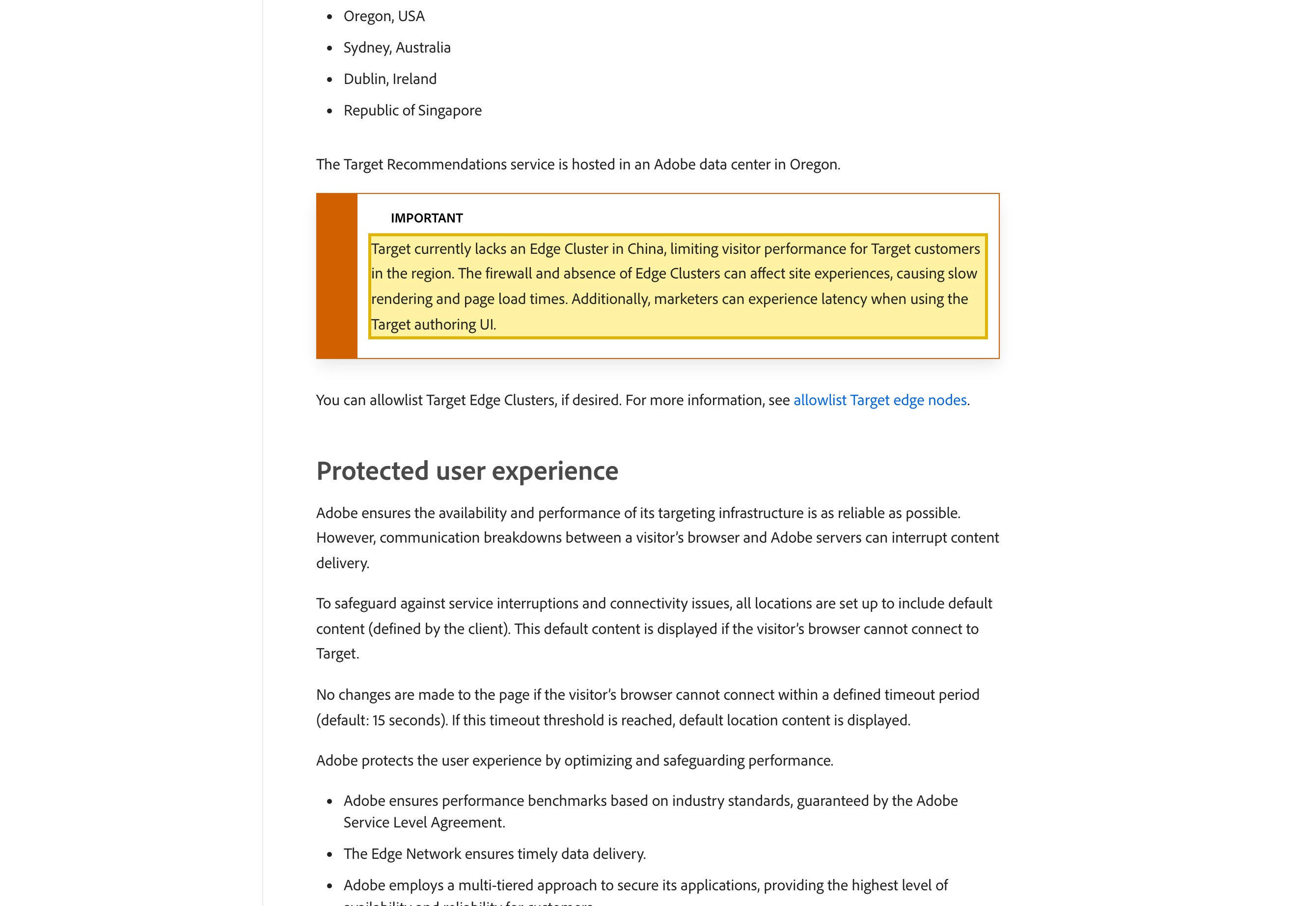
Adobe's own “How Adobe Target works” documentation says activity data is collected at the nearest of seven Edge Clusters and then processed at a Central Cluster in Oregon, Dublin, or Singapore — all offshore — and that Target “currently lacks an Edge Cluster in China.” So the behavioral profiles Target builds on your China visitors come to rest outside the mainland, which makes collecting them a cross-border transfer (数据出境) under PIPL (notice, a separate consent, and a transfer mechanism, Articles 38–40), and it may trigger China's data-export security assessment. Target's machine-learning personalization is automated decision-making under PIPL Article 24, and for a critical information infrastructure operator the Cybersecurity Law's Article 39 (formerly Article 37) adds an in-country storage duty an offshore cluster cannot meet.
21YunBox maps your cross-border, residency, consent, and automated-decisioning exposure, localizes China experimentation and personalization onto a consented, in-country setup, and delivers your China-facing app on ICP-filed infrastructure — with no rebuild, and never any form of circumvention. Treat the specifics as a risk to confirm with counsel.
What Adobe Target's own documentation says about China
| Fact | Primary source |
|---|---|
| Adobe documents no Adobe Target node in mainland China, and processes Target data offshore. Adobe's “How Adobe Target works” page states that “Customer site activity data is collected by the nearest of seven Edge Clusters” and “then directed to a pre-determined Central Cluster destination (Oregon, Dublin, or Singapore) for processing,” and notes in an Important callout that “Target currently lacks an Edge Cluster in China.” Every processing location it names is outside the mainland. | Adobe, “How Adobe Target works” (experienceleague.adobe.com; last updated September 28, 2026), retrieved 2026-10-09 |
| Every Adobe Target cluster sits offshore. Adobe lists its Target Central Clusters (processing) as Oregon, Dublin, and the Republic of Singapore, and its Target Edge Clusters (collection) as Mumbai, Tokyo, Virginia, Oregon, Sydney, Dublin, and Singapore, adding that “Visitor profile data is stored on the Edge Cluster closest to the site visitor” — which for a mainland visitor is an offshore cluster. None is in mainland China. | Adobe, “How Adobe Target works” (experienceleague.adobe.com), retrieved 2026-10-09 |
| Adobe's current Mainland China licensing terms don't extend to Adobe Target. Adobe's “Specific Licensing Terms for a Limited Subset of On-demand Services for Mainland China” (2024v1, effective May 15, 2024) define that limited subset as “Advanced Reporting and Commerce Integration Framework” — Adobe Target is not among them — and state that even those services “are global offerings, and that Customer Data and Customer Content are processed and stored outside of mainland China,” bar their use to collect or store sensitive personal data, important data (重要数据) or core data (核心数据), and may not be used by critical information infrastructure operators. | Adobe, China Licensing Terms — RSL Mainland China 2024v1 (adobe.com), retrieved 2026-10-09 |
| China-collected profiles sent offshore are a PIPL cross-border transfer, and Target's personalization is automated decision-making. Moving personal information collected from users in mainland China to Adobe Target's offshore clusters triggers PIPL Articles 38–40 (notice, a separate consent, and one transfer mechanism), while its machine-learning personalization (Auto-Target, Automated Personalization) engages PIPL Article 24 on automated decision-making: transparency and fairness, an option not based on personal characteristics for profile-driven push, and a right to refuse solely-automated decisions. | Personal Information Protection Law of the PRC, Articles 24 and 38–40 (cac.gov.cn), retrieved 2026-10-09 |
Sources verified by the 21YunBox compliance team on 2026-10-09.
For a team running Adobe Target against a mainland-China audience, the instinct is to ask whether the personalization even renders — and that is not where the China decision is made. Adobe Target is reachable from the mainland, and Adobe is candid in its own documentation that there is no Target node inside China: visitors are served from the nearest offshore edge instead. So this is neither a blocked-service story nor a speed story. What settles it is data residency, consent, and a duty most experimentation tools never raise.
That last duty is the distinctive one. Adobe Target does not just split traffic — its Auto-Target and Automated Personalization activities use machine learning to decide, per visitor, which experience to serve, based on an individual customer profile. Under Chinese law that is automated decision-making, with its own rules. Where the behavioral profile comes to rest, whether you had a lawful basis to build it, and whether the personalization itself meets those rules are the questions here — and Adobe answers the first of them in its own words.
Adobe Target in China at a glance
| What decides it | In Adobe's own terms — and China's law |
|---|---|
| What it is | Adobe Target is the A/B testing, experimentation and personalization product in Adobe Experience Cloud. Beyond simple tests, its Auto-Target and Automated Personalization activities use machine learning to choose, per visitor, which experience to serve — building and acting on an individual behavioral profile. |
| Is it reachable — is there a China node? | Reachable, but there is no in-country node. Adobe states that “Target currently lacks an Edge Cluster in China,” so mainland visitors are served from the nearest offshore cluster (such as Tokyo or Singapore). Reachability is not the China question. |
| Where does the data sit? | Offshore. Activity data is collected at the nearest of seven Edge Clusters and processed at a Central Cluster — Oregon, Dublin, or Singapore — and “Visitor profile data is stored on the Edge Cluster closest to the site visitor,” which for a mainland visitor is still an offshore cluster. No mainland-China region exists. |
| Collecting China visitors' profiles | Behavioral profiles, test assignments and personalization data are personal information. Holding them offshore is a cross-border transfer (数据出境) under PIPL (Articles 38–40): notice, a separate consent, and one transfer mechanism; it may trigger China's data-export security assessment. Deciding each visitor's experience by machine learning adds PIPL Article 24 on automated decision-making. For a critical information infrastructure operator, Cybersecurity Law Article 39 (formerly Article 37) sets an in-country storage duty an offshore cluster cannot meet. |
| Adobe's China licensing carve-out | Adobe's current Mainland China licensing terms (2024v1) extend their China-use carve-out only to a “Limited Subset of On-demand Services” defined as “Advanced Reporting and Commerce Integration Framework” — Adobe Target is not among them, and even those services' data is “processed and stored outside of mainland China.” |
| The lawful path | Run experimentation and personalization in-country on a consented, PIPL-compliant setup, send offshore only what may lawfully leave, and deliver the China-facing app that carries the tracking in-country on ICP-filed infrastructure. 21YunBox maps, localizes, and delivers; it never uses or suggests circumvention of any kind. |
Reachable — but Adobe documents no Target node in mainland China
Adobe Target’s position in China is set in Adobe’s own documentation, not by a load-time check. The service is reachable from the mainland, and Adobe describes a global serving architecture of Edge Clusters that collect activity data and Central Clusters that process it. But Adobe is unusually direct about the gap: in an Important callout on its “How Adobe Target works” page it states that “Target currently lacks an Edge Cluster in China,” and it lists every cluster it does run — Central Clusters in Oregon, Dublin, and Singapore; Edge Clusters adding Virginia, Mumbai, Sydney, and Tokyo. Not one sits inside the mainland.
That geography answers the residency question before performance ever enters it. Your China visitors’ activity is “collected by the nearest of seven Edge Clusters” and “then directed to a pre-determined Central Cluster destination (Oregon, Dublin, or Singapore) for processing,” and their profile is stored on the nearest edge — which, for a mainland user, is an offshore one. For that reason this page publishes no first-party China latency figure for Adobe Target: speed is not the axis a residency-and-consent decision turns on. One thing it is worth saying plainly: 21YunBox neither uses nor suggests any form of circumvention to force that offshore traffic through — it is both a compliance risk and beside the point. The productive question is where your China data lawfully lives.
Where the behavioral data lives: offshore processing is a cross-border transfer
Here is the gate most teams miss. A Target profile is not anonymous traffic counting — it is a continuous record of what an identifiable visitor did, the experiences they saw, and the model’s prediction of what they will respond to next. Those profiles, test assignments, and personalization events are personal information, and because Adobe processes and stores them at clusters outside the mainland, collecting them from users in China is a cross-border transfer of personal information under China’s Personal Information Protection Law. PIPL puts the duty on the handler — you, the product team, not Adobe the processor: Articles 38–40 require notice, a separate consent distinct from a user’s general agreement to use your site, and one transfer mechanism — a CAC security assessment, the CAC standard contract, or certification.
Above certain thresholds, or where the data is “important data,” that transfer may also require China’s data-export security assessment (数据出境安全评估) before anything leaves. And if your organization is a critical information infrastructure operator, the Cybersecurity Law’s Article 39 (formerly Article 37 — the data-localization provision renumbered by the 2025 Cybersecurity Law amendment that took effect on January 1, 2026, with its substance unchanged) requires that personal information generated in China be stored in China, a duty an offshore Target cluster cannot satisfy. None of this turns on how quickly an experience renders; it turns on whether the data had a lawful basis to be collected and to leave. Which of these bite your specific configuration is a risk to confirm with counsel against what you actually collect and where it is processed.
Personalization is automated decision-making — PIPL Article 24
This is the duty experimentation tools rarely surface, and it is central to Adobe Target. Adobe’s documentation describes Auto-Target as leveraging “advanced machine learning to choose from multiple high-performing, marketer-defined experiences … based on individual customer profiles,” and Automated Personalization as using “advanced machine learning to match different variations to each visitor.” That is, by definition, a decision about an individual made by automated means on the basis of their personal characteristics — the activity PIPL Article 24 governs.
Article 24 attaches specific obligations to automated decision-making: the decision-making must be transparent and its outcomes fair, with no unreasonable differential treatment; where content push or marketing is delivered to a person through automated decision-making, you must offer an option not targeted to their personal characteristics or an easy way to refuse; and an individual may ask you to explain, and may refuse a decision made solely by automated means where it significantly affects their rights. On top of that sits the baseline consent to collect and profile the user at all. Target gives marketers controls, but the Article 24 and consent duties rest with you as the handler, and how they apply to your activities — what your notice must say, what opt-out you must present — is a question to settle with counsel before you rely on the personalization in China.
Adobe’s own China terms stop short of Adobe Target
There is a further signal in Adobe’s own paperwork. For the Experience Cloud services it does let customers use in and for the mainland, Adobe maintains a dedicated set of China Licensing Terms — “Specific Licensing Terms for a Limited Subset of On-demand Services for Mainland China.” The current edition (2024v1, effective May 15, 2024) defines that “Limited Subset of On-demand Services” as, in Adobe’s words, “Advanced Reporting and Commerce Integration Framework” — and Adobe Target is not among them. Even for the services it does cover, Adobe states they “are global offerings, and that Customer Data and Customer Content are processed and stored outside of mainland China,” bars their use to “collect or store” sensitive personal data, important data (重要数据) or core data (核心数据), and says they “may not be used by” critical information infrastructure operators.
In parallel, Adobe’s Regional Data Collection documentation offers an in-country Beijing collection edge, but only for “Adobe Analytics using AppMeasurement data collection,” adding that “Other CX Enterprise services and Web SDK data collection are not supported” — the paths Adobe Target is implemented through. Read together, Adobe’s terms and its docs point the same way: there is no mainland-China home for Adobe Target’s data.
None of this is a verdict that Adobe Target is “blocked” or “illegal.” It is a risk map: which duties apply, and how, turns on your entity, the personal data your activities collect, your role under Chinese law, and who your users are — and because the personalization is automated decision-making on individual profiles held offshore, it is worth settling with counsel before your China experience depends on it.
The lawful path — map, localize, deliver
There is a lawful way to run experimentation and personalization for a China-facing product, and it has a shape. First, map: our China team works through what your Target activities actually collect from China users, how the personalization decisions are made, where the profiles are processed and stored under your current setup, and where your PIPL duties bite — cross-border transfer, the automated-decision rules of Article 24, consent and notice, and any Article 39 (formerly Article 37) residency duty. The legal conclusions settle with counsel; we build the technical picture that feeds them.
Then localize: rather than send China visitors’ profiles to an offshore Target, stand the experimentation and personalization up in-country on a consented, PIPL-compliant footing — a self-hosted or sovereign-cloud setup that keeps the China behavioral data resident in the mainland — and send offshore only what may lawfully leave, while you keep Adobe Target for the markets where it already serves you. The point is that in-country residency is established on purpose, not assumed from a collection endpoint that Adobe says does not exist for Target anyway.
Then deliver: the China-facing site or app that carries the personalization is itself a public service in the mainland, so it has an ICP filing (备案) duty and needs compliant, in-country delivery. 21YunBox delivers it in-country — the 21YunBox Optimizer — in front of what you already run, with no rebuild and no re-platform. The result is China-facing experimentation and personalization that run legally and compliantly for your users in China. What we never do, and what no one lawfully can, is route data around China’s rules or around any restriction: we localize what must stay in-country and deliver compliantly, and we never use or suggest circumvention of any kind.
Related reading:
- Cross-border data transfers under PIPL
- China’s data-export security assessment
- China’s Cybersecurity Law (data localization, Article 39)
- How to get an ICP filing for China