Does Tidio Work in China? Live Chat Data, PIPL & Reachability
Tidio is a live-chat tool built to collect your visitors' names, emails, IP addresses and chat transcripts — and its own privacy policy processes that data in the EEA and the United States, with no mainland-China region. For Chinese visitors that is a PIPL cross-border transfer, and the real-time widget still has to reach China from offshore. A compliance-first look at the data and reachability doors.
Does Tidio work in China?
Yes — the Tidio chat bubble will usually load in China, but that is the fragile half. Tidio exists to collect your visitors' personal data — names, emails, IP addresses, whole chat transcripts — and its own privacy policy stores and transfers that data offshore, never inside mainland China. For Chinese visitors that is a cross-border transfer PIPL governs, and a live chat that depends on an offshore server is the first thing to break on a bad network.
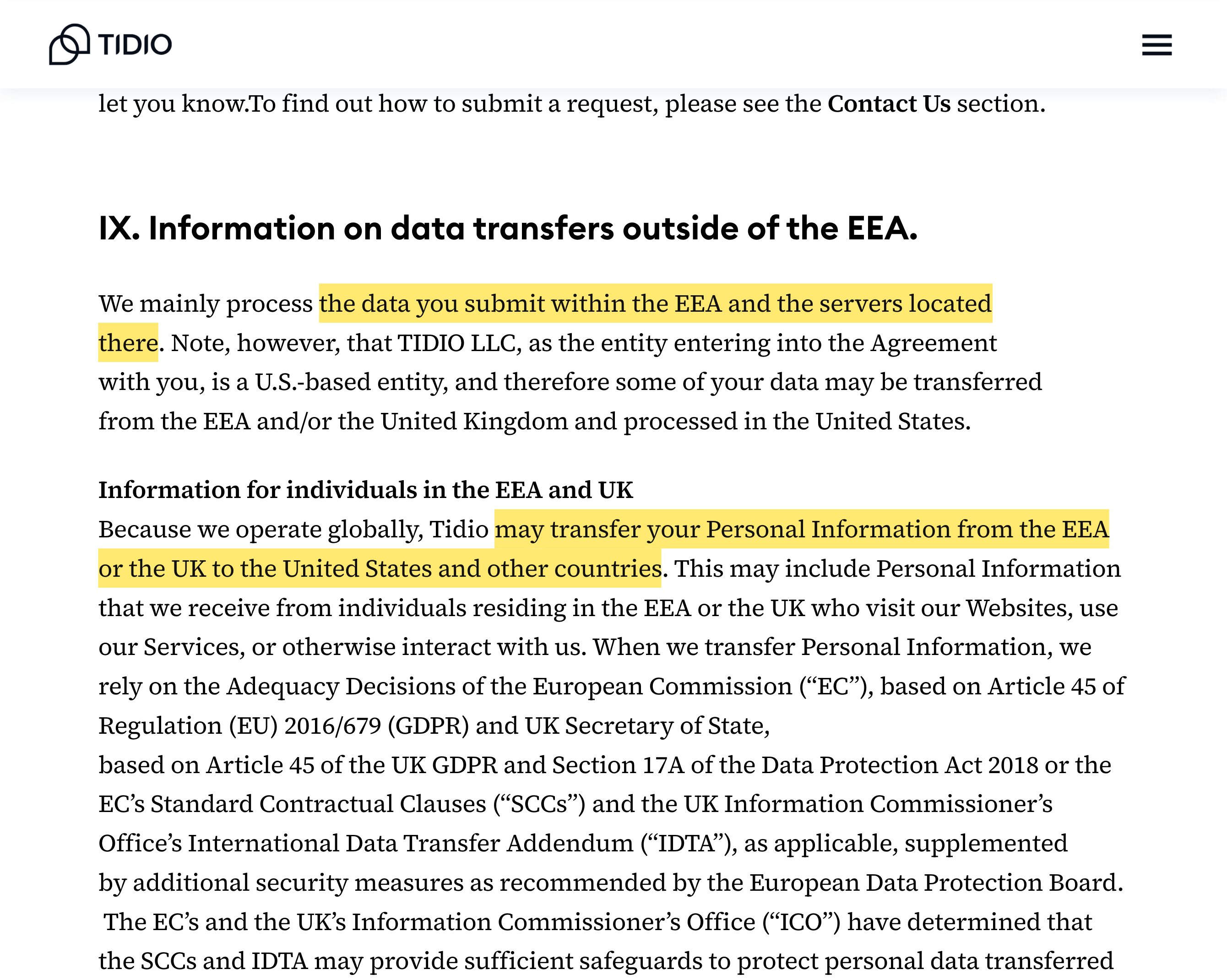
Tidio's privacy policy says, "We mainly process the data you submit within the EEA and the servers located there," and that it "may transfer your Personal Information from the EEA or the UK to the United States and other countries" — a U.S.-based entity, with no mainland-China region. The data it gathers is "your name, email address," plus "browser information, IP address, mobile network information and device identifiers" and whatever your visitors type into the chat. Collected from Chinese users and stored abroad, that is a cross-border transfer of personal information PIPL governs (notice, separate consent, a transfer mechanism), on servers that cannot be ICP-filed — while the real-time widget still has to reach China from offshore. The table below is Tidio's own wording and the rule each line triggers.
This is a risk map, not a verdict — whether you owe a transfer mechanism, in-country storage, or both turns on what you collect, how much you hold, and who your users are. Our China team can map your exposure with you →
Compliance snapshot
- ! Tidio stores your chat data on offshore servers (EEA, then the US) — no mainland region
- ! Your Chinese visitors' chat data crosses the border — PIPL governs it
- ! Names, emails, IP addresses and chat transcripts — all personal information
- ✕ A live-chat widget loaded from offshore can stall, drop, or fail to connect in China
- ! Tidio holds no ICP; that filing duty sits on your site, not the widget
What Tidio's own documentation says about China
| Fact | Primary source |
|---|---|
| Tidio stores your chat data offshore, and says so in its own policy. Tidio's privacy policy states, "We mainly process the data you submit within the EEA and the servers located there," and that "Tidio may transfer your Personal Information from the EEA or the UK to the United States and other countries." The contracting entity, Tidio LLC, "is a U.S.-based entity," and no mainland-China region appears anywhere in the policy — its security page names the platform only as "AWS Infrastructure." | Tidio Privacy Policy & Security page (tidio.com), retrieved 2026-10-07 |
| What Tidio collects is personal information, not anonymous metrics. Its privacy policy lists "identification data such as your name, email address," together with "browser information, IP address, mobile network information and device identifiers," "usage and log information" about a visitor's activity, and "any other data you may provide using our contact form (chat)." A live-chat tool's whole purpose is to capture what individual people type — names, contacts and conversations — which is personal information under China's PIPL. | Tidio Privacy Policy (tidio.com), retrieved 2026-10-07; PIPL |
| Collected from Chinese visitors and stored abroad, that data is a cross-border transfer. Because Tidio gathers your visitors' personal information in China and processes it on EEA and U.S. servers, you — the handler — are the party moving it offshore. Under China's law that is a cross-border transfer requiring notice, separate consent and one transfer mechanism (PIPL Articles 38–43), and for a critical information infrastructure operator or large-volume handler the data must be stored in the mainland (PIPL Article 40; Cybersecurity Law Article 39 (formerly Article 37)) — a duty an EEA/U.S.-only service has no way to meet. | Tidio Privacy Policy (tidio.com), retrieved 2026-10-07; PIPL Articles 38–43 & 40; Cybersecurity Law Article 39 (formerly Article 37) |
| Tidio gives you no mainland footing — so ICP sits on your site, and the live connection still crosses the border. Tidio runs as an embedded widget with no region inside mainland China, so the ICP filing a public mainland site needs (State Council Order No. 292; MIIT Order No. 33) attaches to your own site, not to the Tidio app. And because the widget and its real-time connection load from offshore servers, from inside China they can connect slowly, drop mid-conversation, or fail to open — the delivery half, where a live-chat tool is most exposed. | Tidio Security page (tidio.com) & offshore-hosting fact, retrieved 2026-10-07; State Council Order No. 292; MIIT Order No. 33 |
Sources verified by the 21YunBox compliance team on 2026-10-07.
For a mainland-China audience, the deciding question about Tidio is not whether the chat bubble paints in the corner of your site — it is where the conversations behind it are allowed to live, and whether a live connection can even hold. Tidio is a live-chat and chatbot platform whose entire job is to collect personal data: the names, email addresses, IP addresses and messages your visitors type. Its own privacy policy answers where that data goes — processed on servers in the EEA and transferred to the United States, with no region inside mainland China. The widget is reachable on a good day; the exposure is that running it for Chinese customers moves their personal information across the border into jurisdictions China’s law treats as foreign, and that a real-time chat connection to an offshore server is the first thing to fail when the network turns bad. Reachability is the fragile half. Where the data sits is the half that decides whether you may use it as-is.
Tidio in China at a glance
| What decides it | In Tidio's own terms |
|---|---|
| Where your data lives | Tidio's privacy policy says, “We mainly process the data you submit within the EEA and the servers located there,” and that it “may transfer your Personal Information from the EEA or the UK to the United States and other countries.” The host is named only as “AWS Infrastructure”; no region sits inside mainland China. |
| What it collects | Per visitor: “identification data such as your name, email address,” plus “browser information, IP address, mobile network information and device identifiers,” and “any other data you may provide using our contact form (chat)” — personal information, not anonymous metrics. |
| Crossing the border | Running live chat for mainland visitors moves that personal information offshore — a cross-border transfer PIPL governs, with notice, separate consent and a transfer mechanism (Articles 38–43). |
| Data residency | For a CIIO or large-volume handler, China-collected personal information must stay in the mainland (PIPL Article 40; Cybersecurity Law Article 39 (formerly Article 37)) — a duty an EEA/U.S.-only service cannot meet. |
| ICP & reachability | ICP attaches to your site, not to the Tidio widget; Tidio isn't blocked, but a real-time chat connection loaded from offshore can stall, drop, or fail to open. Loading is the fragile half — lawful handling is the half that decides it. |
Tidio stores your conversations offshore — and says so plainly
Tidio does not keep your chat data in mainland China, and it is candid about where it does keep it. Its privacy policy states, “We mainly process the data you submit within the EEA and the servers located there,” and that “Tidio may transfer your Personal Information from the EEA or the UK to the United States and other countries.” The entity you actually contract with, it says, “is a U.S.-based entity,” and its security page names the platform’s host only as “AWS Infrastructure.” Those are Tidio’s words, not an inference — and not one of the locations is inside the mainland.
That geography is what turns a routine chat integration into a compliance question. The handler of your Chinese visitors’ personal information is you, not Tidio; when Tidio processes that information on EEA or U.S. servers on your behalf, you are the party sending it abroad. “Our chat widget already works” does not settle it, because reaching a visitor and lawfully holding that visitor’s conversation are two different tests, and only the second is decided by where Tidio’s servers sit.
The chat data is personal information, so moving it is a transfer PIPL governs
A live-chat tool is built from exactly the data China’s law protects. Tidio’s own privacy policy lists what it gathers: “identification data such as your name, email address,” along with “browser information, IP address, mobile network information and device identifiers,” “usage and log information” about a visitor’s activity, and “any other data you may provide using our contact form (chat).” The transcripts, contact details and behavioral signals a chatbot captures are not anonymous telemetry — they name, contact and profile individual people, which is personal information under China’s Personal Information Protection Law.
Because that information is collected from mainland users and processed offshore, PIPL treats the flow as a cross-border transfer: the handler must give notice, obtain separate consent, and clear one transfer mechanism — a CAC security assessment, the CAC standard contract, or certification (Articles 38–43). And if you are a critical information infrastructure operator or a large-volume handler, personal information collected in China must be stored in the mainland (PIPL Article 40; Cybersecurity Law Article 39 (formerly Article 37)) — a residency duty a service that runs only in the EEA and the United States has no way to satisfy.
Reachability is acute for live chat — and ICP isn’t Tidio’s door
Tidio is not blocked in China, but live chat is the worst case for offshore delivery. A static widget that paints a little late is an inconvenience; a chat is a real-time, two-way connection to a server abroad, and on an unstable cross-border path it can take a long time to open, go quiet mid-conversation, or never connect at all. A support chat that cannot hold the line is worse than no chat at all — the visitor is left typing into a box that will not answer. That is the delivery half of the question, and it is unchanged by how neat the bubble looks when it does load.
It is just as important not to invent a door that isn’t there. Tidio runs as an embedded app inside your site, not as the site itself, so the ICP filing a public-facing mainland site requires (State Council Order No. 292; MIIT Order No. 33) belongs to your own domain and hosting, not to the Tidio widget. Tidio does not need its own ICP, and treating it as if it did would aim the assessment at the wrong risk. On Tidio the live questions are two and narrow: where the conversation data is collected and stored, and whether the real-time connection can reach China at all.
This is a risk map, not a verdict — whether you owe a cross-border mechanism, in-country storage, or both depends on what you collect, how much of it you hold, and who your users are, and it is worth settling with counsel before you build.
Where 21YunBox fits — a compliant overlay, not a migration
Tidio stays on your site, exactly as it runs now — the chat bubble, the bots and the shared inbox keep working, and you move nothing. What we add is the piece an offshore chat tool cannot supply for itself: compliant, ICP-filed delivery from inside the mainland, placed in front of your existing origin, with no rebuild and no second codebase to carry. Our China team works through your PIPL cross-border and data-residency position — for your entity, your data volumes and your users — then stands up the in-country delivery a lawful mainland presence calls for, so the live connection reaches China from inside China while Tidio sits precisely where it already does.
Related reading:
Frequently Asked Questions
Does the Tidio chat widget load in mainland China?
Usually it will appear — but that is the fragile part, not the safe part. The widget and its real-time connection load from Tidio's offshore servers (its security page names the host as "AWS Infrastructure," with no mainland region), so from inside China the chat can be slow to connect, drop mid-conversation, or fail to open on an unstable cross-border path. A live-chat tool that cannot hold a connection is worse than a page that merely paints slowly. And even when it connects, where the conversation data is stored is the separate question that decides whether you may use it as-is.
Is it a problem under Chinese law to run Tidio for our Chinese visitors?
Treat it as a cross-border risk to assess with counsel, not a yes/no. Tidio collects your visitors' names, emails, IP addresses and chat content and, by its own policy, processes that on EEA and U.S. servers — so you, as the handler, are moving Chinese users' personal information offshore. That is a cross-border transfer under PIPL (notice, separate consent and a transfer mechanism, Articles 38–43), and a data-localization duty may also apply if you are a critical information infrastructure operator or large-volume handler (PIPL Article 40; Cybersecurity Law Article 39 (formerly Article 37)). Tidio itself needs no ICP — that filing belongs to your own site.
Can 21YunBox help us run Tidio compliantly in China?
Yes. Our China team can map your PIPL cross-border and data-residency exposure for your entity, your data volumes and your users, and stand up the ICP-filed, in-country delivery a compliant mainland presence requires — set in front of your existing site, so Tidio keeps running exactly as it does today. Get in touch to work through your specific case.