Does Podtrac Work in China? The Measurement Prefix, Cross-Border Request Data & PIPL
Podtrac measures a podcast with a redirect prefix (dts.podtrac.com/redirect.mp3/) that routes every episode download through an offshore Podtrac server before it reaches your media host — so reachability from inside China and a cross-border flow of each listener's download request, not speed, are the real questions. Podtrac operates no mainland-China measurement endpoint, so whether that request data may lawfully leave the country is a PIPL question to confirm with counsel. A compliance-first look at the reachability, cross-border and ICP exposure — and the lawful in-country path.
Does Podtrac work in China?
Podtrac is reachable from mainland China, so the honest answer is that speed isn't where this is decided. What decides it is that Podtrac's measurement prefix routes every episode download through an offshore Podtrac server before it reaches your media host — so reachability and a cross-border flow of each listener's request are the real questions.
By Podtrac's own how-to, measurement "works by redirecting your podcast traffic through a Podtrac server which collects and analyzes information about the download request and then sends it on to where your media file is hosted"; for mp3 the wrapper is the offshore prefix https://dts.podtrac.com/redirect.mp3/. Each request reaching that endpoint carries the listener's IP and user agent, and Podtrac logs request metadata it labels "non-personal information" — but whether that is personal information is decided by PIPL's broad definition, not a US-law label. If it is, moving it offshore is a cross-border transfer (数据出境) under Articles 38–40 — notice, a separate consent, a transfer mechanism — and it may trigger China's data-export security assessment; for a critical information infrastructure operator the Cybersecurity Law's Article 39 (formerly Article 37) adds an in-country storage duty an offshore endpoint cannot meet. Podtrac's own terms put that handler duty on you, the publisher — its "Customers are the data owners/data controllers."
21YunBox maps the exposure, localizes measurement and delivery onto an in-country, ICP-filed path, and delivers the episodes in-country so a slow offshore hop isn't in the download path — with no rebuild, and never any form of circumvention. Treat the specifics as a risk to confirm with counsel.
What Podtrac's own documentation says about China
| Fact | Primary source |
|---|---|
Podtrac measures by routing every download through an offshore Podtrac server. Podtrac's own how-to page states that "Podtrac Measurement works by redirecting your podcast traffic through a Podtrac server which collects and analyzes information about the download request and then sends it on to where your media file is hosted," and that "The redirect is instantaneous and does not affect delivery of your episode file." For mp3 files the wrapper is the offshore prefix https://dts.podtrac.com/redirect.mp3/, so every download takes a cross-border hop before it reaches your media host. | Podtrac, "How to Measure your Podcast with Podtrac" (analytics.podtrac.com), retrieved 2026-10-09 |
| Podtrac logs the download request's metadata and labels it "non-personal information." Its Product Privacy Statement says the Services collect "the following non-personal information: timestamp, requested URL, referring URL, user agent, and other non-personally identifiable information as may be provided in HTTP headers." Under China's PIPL, whether a listener's request data is personal information is decided by PIPL's own definition — information relating to an identified or identifiable natural person — not by a US-law "non-PII" characterization, so the cross-border question stays live regardless of the label. | Podtrac, "Product Privacy Statement" (analytics.podtrac.com), retrieved 2026-10-09 |
| Podtrac's own terms put the handler duty on you, the publisher. Podtrac describes itself as "a service provider/data processor" and states that "Podtrac's Customers are the data owners/data controllers with respect to personal information processed through the Services." So under PIPL the cross-border obligations — notice, a separate consent, and a transfer mechanism — fall on the publisher who inserts the prefix, not on Podtrac. | Podtrac, "Product Privacy Statement" (analytics.podtrac.com), retrieved 2026-10-09 |
| Sending a China listener's request data to an offshore endpoint is a PIPL cross-border transfer. Moving personal information collected from users in mainland China to infrastructure outside the mainland triggers PIPL Articles 38–40: notice, a separate consent, and one transfer mechanism — a CAC security assessment, the CAC standard contract, or certification — and above thresholds it may require China's data-export security assessment before anything leaves. | Personal Information Protection Law of the PRC, Articles 38–40 (cac.gov.cn), retrieved 2026-10-09 |
Sources verified by the 21YunBox compliance team on 2026-10-09.
Whether Podtrac “works” in mainland China is a compliance question before it is a performance one. Podtrac measures a podcast by wrapping each episode file in a redirect prefix — https://dts.podtrac.com/redirect.mp3/… — so that every download first passes through a Podtrac server, which logs the request and then hands it on to wherever your media is actually hosted. That extra hop is the whole point of the product, and it is also where the China questions live: the prefix endpoint sits offshore, so reaching it from inside China and the cross-border flow of each listener’s download request are what decide the matter — not how fast the audio plays. Podtrac describes the mechanism in its own words.
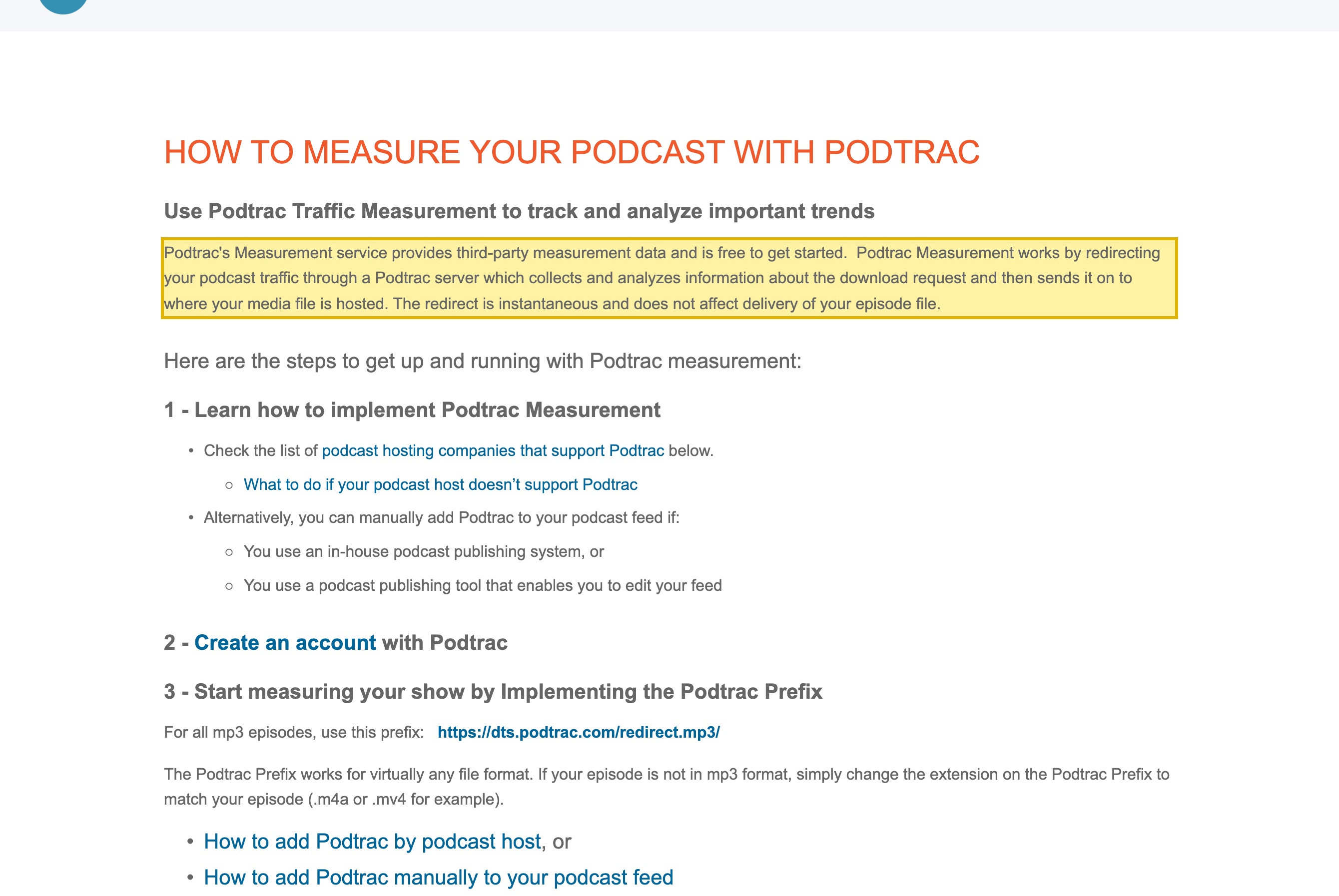
https://dts.podtrac.com/redirect.mp3/. Source: Podtrac — How to Measure your Podcast with PodtracPodtrac in China at a glance
| What decides it | In Podtrac's own terms — and China's law |
|---|---|
| What it is | A third-party podcast measurement service — “Podtrac's Measurement service provides third-party measurement data and is free to get started.” It counts and analyzes downloads by inserting a redirect prefix ahead of each episode file. |
| How it measures | By Podtrac's own how-to, measurement “works by redirecting your podcast traffic through a Podtrac server which collects and analyzes information about the download request and then sends it on to where your media file is hosted.” For mp3 the wrapper is https://dts.podtrac.com/redirect.mp3/. Every download takes that hop first. |
| Is the measurement endpoint in China? | No. The prefix host dts.podtrac.com and Podtrac's reporting sit offshore (Podtrac, Inc., United States); Podtrac names no mainland-China measurement region. If that endpoint is slow or unreachable from inside China, the redirect can delay or fail the download — the delivery half of the question. |
| What crosses the border | Each request reaching the offshore prefix carries the listener's IP (inherent in any connection) and user agent; Podtrac's Privacy Statement says the Services collect “timestamp, requested URL, referring URL, user agent, and other … information … in HTTP headers,” which it labels “non-personal information.” Whether that is personal information is decided by PIPL's definition, not a US-law label — a cross-border transfer (数据出境) question to confirm with counsel. |
| Who owes the duty, and serving the public | Podtrac calls itself “a service provider/data processor” and says “Podtrac's Customers are the data owners/data controllers.” So the PIPL handler duty — notice, separate consent, a transfer mechanism — lands on you, the publisher. The China-facing site or app that distributes the episodes is itself an Internet information service, carrying an ICP filing duty bound to a mainland resource the offshore prefix cannot provide. |
Every download takes an offshore hop first
The mechanism is not incidental to Podtrac — it is Podtrac. In its own words the service “works by redirecting your podcast traffic through a Podtrac server which collects and analyzes information about the download request and then sends it on to where your media file is hosted,” and the step “is instantaneous and does not affect delivery of your episode file.” That is true on a well-connected network. From inside mainland China it is the part to examine: before your listener’s player ever reaches your media host, it must first complete a round trip to dts.podtrac.com, an endpoint outside the mainland. If that offshore hop is slow or fails, it does not merely cost a measurement — it can delay or break the download it sits in front of.
That is a delivery concern, not the legal one, and this page publishes no first-party China latency figure for it: speed is not the axis for a decision that turns on where the request goes and whether it was allowed to go there. The productive question is not “how fast is the redirect” but “what leaves the country when it happens, and on whose compliance footing.”
The request that reaches Podtrac is a cross-border flow
Here is the gate most teams miss. The prefix endpoint is offshore, so every download request that reaches it has left mainland China — and that request is not empty. It carries the IP address inherent in any connection and the user-agent string, and Podtrac logs request metadata it describes as “non-personal information: timestamp, requested URL, referring URL, user agent, and other non-personally identifiable information as may be provided in HTTP headers.” That “non-PII” characterization is a US- and EU-framework one. China’s Personal Information Protection Law uses its own, broader definition — information relating to an identified or identifiable natural person — and a stream of per-download requests tied to a device, keyed by IP and user agent, can fall inside it. Whether it does for your show is a question for counsel, but it is answered by PIPL’s test, not by the label on the vendor’s page.
And Podtrac’s own terms settle who answers for it: Podtrac is “a service provider/data processor,” while “Podtrac’s Customers are the data owners/data controllers.” Under PIPL the duty travels with the handler — you, the publisher, not Podtrac. If the request data is personal information, moving it to an offshore endpoint is a cross-border transfer under PIPL Articles 38–40: notice, a separate consent, and one transfer mechanism — a CAC security assessment, the CAC standard contract, or certification. Above certain thresholds that transfer may also require China’s data-export security assessment (数据出境安全评估). If your organization is a critical information infrastructure operator, the Cybersecurity Law’s Article 39 (formerly Article 37 — the data-localization provision was renumbered by the 2025 amendment that took effect on January 1, 2026, with its substance unchanged) requires personal information generated in China to be stored in China, which an offshore measurement endpoint cannot satisfy. None of this is a verdict that Podtrac is “blocked” or “illegal”; it is a risk map whose lines depend on your entity, your data, and who your listeners are — worth settling with counsel before your delivery depends on it.
The lawful path — map, localize, deliver
There is a lawful way to measure and serve a podcast for a China audience, and it has a shape.
First, map: our China team works through the exposure the prefix creates — which fields in each download request leaving the mainland count as personal information under China’s definition, what notice and consent the publisher owes as the handler, whether a data-export security assessment or an Article 39 storage duty is in play, and where the ICP filing line falls for the service that distributes the episodes. The legal conclusions are settled with counsel; we build the technical picture that feeds them.
Then localize: we stand up an in-country, ICP-filed path for measuring and serving the podcast media, so the download request and the data drawn from it stay on a lawful footing inside the mainland — while you keep Podtrac for the markets where it already serves you, fed only what may lawfully leave. The measurement you depend on keeps working; the China request data stops leaving the country by default.
Then deliver: the episodes themselves reach your China listeners from inside the mainland on ICP-filed infrastructure — the 21YunBox Optimizer, set in front of the media host you already run, with no rebuild and no re-platform — so a slow or failing offshore hop is no longer in the path of the download. The result is podcast measurement and delivery that run legally and compliantly for your users in China. What we never do — and what no one lawfully can — is route listeners around any network restriction or move personal information out of China by stealth; we localize what must stay and deliver in-country.
Related reading:
- Cross-border data transfers under PIPL
- China’s data-export security assessment
- China’s Cybersecurity Law (data localization, Article 39)
- How to get an ICP filing for China