Does Segment Work in China? CDP Data, PIPL & Cross-Border Fan-Out
Segment is a customer data platform — it collects your users' identities, traits and events and routes them to hundreds of tools, storing that data in the US (Oregon) by default with no mainland-China region. Collecting a China visitor is a cross-border transfer of personal information under PIPL, amplified by every destination it fans out to. A compliance-first look at the data-residency door.
Does Segment work in China?
Yes — Segment's snippet loads and sends from mainland China, but that is exactly the exposure. Segment is a customer data platform: its whole job is to collect your users' personal data and fan it out to the rest of your stack. By default it stores and processes that data in the United States, in Oregon, with no region inside mainland China.
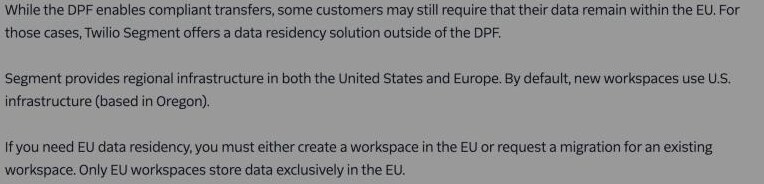
In its own documentation Segment "provides regional infrastructure in both the United States and Europe," and "by default, new workspaces use U.S. infrastructure (based in Oregon)." Regional residency is "limited to the EU" — expansion beyond it is only "under evaluation" — so there is no China option, and "once you create a workspace, you can't change its data processing region." Collecting a mainland user's identities, traits and events through Segment is therefore a cross-border transfer of personal information PIPL governs — and because a CDP exists to route that data onward, every destination it forwards to is a further transfer. The table below is Segment's own wording and the rule each flow triggers.
This is a risk map, not a verdict — how much exposure you carry turns on what you collect, where you send it, your role and data volumes, and who your users are. Our China team can map your exposure with you →
What Segment's own documentation says about China
| Fact | Primary source |
|---|---|
| By default Segment stores and processes your workspace data in the US — in Oregon. In its own documentation Segment "provides regional infrastructure in both the United States and Europe," and "by default, new workspaces use U.S. infrastructure (based in Oregon)." The region you pick "determines where Segment collects, processes, and stores the data sent to and from your workspace," and "once you create a workspace, you can't change its data processing region." For a China-facing site on the default workspace, every identity, trait and event Segment captures is stored offshore — a cross-border transfer under PIPL (notice, separate consent and a transfer mechanism, Articles 38–43). | Twilio Segment — Regional Segment guide (twilio.com/docs), retrieved 2026-10-07; PIPL Articles 38–43 |
| Segment offers only US and EU regions — there is no mainland-China option. Segment lets you "choose between US West and EU West," but states that "Regional Segment is limited to the EU," with "expansion of Regional Segment beyond the EU … under evaluation by Segment Product and R&D." Only EU workspaces "store data exclusively in the EU"; no region keeps Chinese users' data inside the mainland. For a critical information infrastructure operator or large-volume handler, personal information collected in China must be stored in the mainland (PIPL Article 40; Cybersecurity Law Article 39 (formerly Article 37)) — a residency duty neither of Segment's regions can meet. | Twilio Segment — Regional Segment guide (twilio.com/docs), retrieved 2026-10-07; PIPL Article 40; Cybersecurity Law Article 39 (formerly Article 37) |
| A CDP's whole job is to fan your data out — and each hop is its own transfer. Twilio Segment positions itself as the place to "collect, clean and activate your customer data in any tool," offering "libraries, integrations, and tools for collecting, transforming, and routing customer data" onward to your warehouse and hundreds of downstream destinations. That is the amplifier: for a mainland audience, the Segment collection point is one cross-border transfer under PIPL, and every destination it then forwards to — each with its own location and sub-processors — is a further transfer you have to account for, not just the first hop. | Twilio Segment — product overview (twilio.com/en-us/segment), retrieved 2026-10-07; PIPL Articles 38–43 |
The tracking snippet loads offshore from cdn.segment.com — the delivery half of the question. Segment's quickstart has you paste a snippet into "the <head> tag of your site" that "loads Analytics.js onto the page asynchronously" from Segment's CDN — the script at https://cdn.segment.com/analytics.js/v1/<write-key>/analytics.min.js. Served from offshore, that file can load slowly or fail from inside the mainland, and when the collection library stalls it can hold up page behavior that waits on it. But reachability is the smaller half: a snippet that loads fast still records a mainland user's data to servers outside China. | Twilio Segment — Analytics.js Quickstart (twilio.com/docs), retrieved 2026-10-07 |
Sources verified by the 21YunBox compliance team on 2026-10-07.
With Segment, the question that matters for a mainland-China audience is not whether the tracking snippet loads — it is whether you are permitted to gather, store and forward what the snippet gathers. Segment is a customer data platform, and its entire reason for being is to collect your users’ personal data — identities, traits, emails, events, whole behavioral profiles — unify it into one record, and route it onward to the rest of your stack. By default it does all of that from the United States, in Oregon, with no region anywhere inside mainland China. So the instant Segment captures a visitor in Shanghai or Shenzhen, their personal information has left the mainland and started fanning out to still more destinations — and that is a matter China’s privacy law decides well before page speed ever comes up.
Segment in China at a glance
| What decides it | In Segment's own terms |
|---|---|
| Where your data lives | By default Segment “provides regional infrastructure in both the United States and Europe,” and “new workspaces use U.S. infrastructure (based in Oregon).” It publishes no mainland-China region, so data collected for Chinese users is stored offshore. |
| What it collects | A customer data platform — Segment's job is to “collect, clean and activate your customer data in any tool”: identities, traits, events and whole behavioral profiles, not a handful of metrics. |
| The fan-out | Segment doesn't only store data; it routes it. Its “libraries, integrations, and tools for collecting, transforming, and routing customer data” send it onward to hundreds of destinations — each its own transfer. |
| The cross-border trigger | Collecting a mainland user's personal information into a US or EU workspace moves it out of China — a cross-border transfer PIPL governs, calling for notice, separate consent and a transfer mechanism. |
| Residency & who carries it | Segment's regional residency is “limited to the EU,” with no China option; you, the handler embedding the SDK — not Segment — carry the duty, and a CIIO or large-volume handler must store China data in the mainland. |
A CDP collects personal data — and the heaviest kind, at scale
Segment does not record a few page views; it builds a profile. As a customer data platform its reason for existing is to gather everything you know about a user — the identities and traits you attach to them, the emails and phone numbers, the events they fire across your site and apps — and stitch it into one unified record. Segment’s own pitch is to “collect, clean and activate your customer data in any tool.” Under China’s Personal Information Protection Law that unified record is personal information in its densest form, and some of what flows through it — contact details, precise behavior — can rise to sensitive personal information, which the law guards more tightly still. This is close to the maximal case the cross-border rules were written for.
Your China users’ data is collected and stored offshore
Where that data lands is what turns a marketing tool into a compliance exposure. Segment states plainly that it “provides regional infrastructure in both the United States and Europe,” and that “by default, new workspaces use U.S. infrastructure (based in Oregon).” The region you choose “determines where Segment collects, processes, and stores the data sent to and from your workspace,” and “once you create a workspace, you can’t change its data processing region.” There is no mainland-China region to choose — Segment’s regional residency is “limited to the EU,” and expansion beyond it is only “under evaluation.” So a user captured in the mainland is written to servers in Oregon, or at most Dublin. Under the Personal Information Protection Law that is a cross-border transfer, and the handler — you, the site embedding Segment, not Segment itself — must give notice, obtain separate consent for the transfer, and clear one transfer mechanism: a CAC security assessment, the CAC standard contract, or certification (Articles 38–43). If you are a critical information infrastructure operator or a large-volume handler, personal information collected in China must be stored in the mainland (PIPL Article 40; Cybersecurity Law Article 39 (formerly Article 37)) — a residency duty neither Oregon nor Dublin can satisfy.
The fan-out multiplies the transfer
A CDP makes this heavier than a single analytics tag, because collecting the data is only step one — the platform exists to route it. Segment describes itself as “libraries, integrations, and tools for collecting, transforming, and routing customer data,” pushing it onward to your warehouse and hundreds of downstream destinations. Every one of those destinations has its own location and its own sub-processors, so each is an onward cross-border transfer to account for — not covered by whatever you cleared for the Segment hop itself. The regional feature does not rescue this either: a workspace’s residency does not carry automatically to the tools it feeds, so the EU option that helps a GDPR story does nothing for a Chinese user’s data and nothing for the destinations downstream. One snippet, in other words, can open many doors at once — which is why a CDP sits near the top of any PIPL exposure review.
Reachable is the easy half — being allowed to collect is the hard one
Segment’s collection point is an embedded script. Its quickstart has you paste a snippet into “the <head> tag of your site” that “loads Analytics.js onto the page asynchronously” from Segment’s CDN — the file at https://cdn.segment.com/analytics.js/v1/<write-key>/analytics.min.js. Served from offshore, that script can load slowly or fail from inside the mainland, and because page logic sometimes waits on the analytics library, a stalled snippet can hold up behavior that depends on it. That is a real delivery question — but it is the smaller half. Segment is not a public website you file an ICP for yourself; it is backend data infrastructure sitting inside a site you operate, so what it adds to your China footprint is not an ICP filing but a cross-border data flow, created the instant it collects a mainland user. Reachability decides whether the data arrives; PIPL decides whether you were allowed to collect it and forward it on.
This is a risk map, not a verdict: how much exposure you carry turns on what you collect through Segment, where you route it, your role and data volumes, and who your users are — worth settling with counsel before you collect at scale.
Where 21YunBox fits — a compliant overlay, not a migration
Segment stays your customer data platform; nothing moves. What 21YunBox adds is the compliance layer the CDP itself does not provide. Our China team traces what your Segment implementation collects from mainland users — the identities, traits, events and IP-derived signals — and follows where it fans out, then weighs the PIPL cross-border and data-residency exposure that creates against your entity, your data volumes and your role. On top of that we stand up the ICP-filed, in-country delivery a lawful China presence requires, placed in front of the origin you already run — no rebuild, no second codebase, and no migration off Segment or any tool in your stack. You go on collecting; the cross-border and residency gaps become ours to map and close with you.
Related reading: