Does Marketo Work in China? Lead-Data Residency, PIPL & ICP
Marketo Engage runs in Adobe's offshore data centers — none in mainland China — so every Chinese lead you capture is stored abroad under PIPL, and the landing pages Marketo hosts for you have no ICP-filing path. A compliance-first look at the two doors.
Does Marketo work in China?
Reachable is not the question. Marketo Engage runs only in Adobe's offshore data centers — there is no mainland-China region — so every Chinese lead you capture is stored outside the mainland, and the landing pages Marketo hosts for you sit on infrastructure that can't be ICP-filed. "We run Marketo" is not the same as being compliant in China.
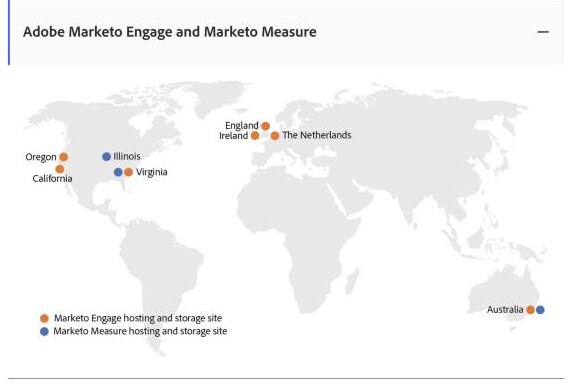
Adobe states Marketo is hosted "in the data centers of leading cloud service providers in various locations worldwide, with the specific location/s provisioned upon contract signing," and that "Even though Marketo hosts your landing pages," those pages resolve to Marketo's own domains. Store a Chinese lead's name, business email, company and Munchkin behavioral profile there and you have made a cross-border transfer of personal information PIPL governs; serve a Marketo landing page to mainland visitors and it runs on hosting that cannot be ICP-filed. The table below is Adobe's own wording and the rule each line triggers.
This is a risk map, not a verdict — what applies turns on your entity, your lead volumes and who your users are. Our China team can map your exposure with you →
Compliance snapshot
- ✕ Adobe runs no mainland-China region for Marketo Engage
- ! Every Chinese lead's data sits in Adobe data centers offshore
- ! Serving China leads to Marketo is a PIPL cross-border transfer
- ! Munchkin tracks mainland visitors' behavior to offshore servers
- ✕ Marketo-hosted landing pages can't carry an ICP filing
What Marketo's own documentation says about China
| Fact | Primary source |
|---|---|
| Marketo Engage runs in Adobe's offshore data centers — none in mainland China. Adobe's own hosting-locations page states that "Most Adobe solutions are hosted in the data centers of leading cloud service providers in various locations worldwide, with the specific location/s provisioned upon contract signing," and the Adobe Marketo Engage map it shows spans the Americas, Europe and Asia-Pacific — with no location inside mainland China. Your instance is assigned to one of those offshore data centers, never a Chinese one. | Adobe Trust Center — Experience Cloud Hosting Locations (adobe.com/trust), retrieved 2026-10-07 |
| Your Marketo lead database physically lives on Adobe's cloud sub-processors — all offshore. On Adobe's sub-processor list, Marketo Engage is named under Amazon Web Services, whose entry reads "AWS provides cloud hosting services for Adobe to host applications (including Experience Cloud, Creative Cloud and Document Cloud)," and under Snowflake, which Adobe uses "for data warehousing and database storage services." Every Chinese lead record you hold sits in that offshore infrastructure — a cross-border transfer of personal information under PIPL (notice, separate consent and a transfer mechanism, Articles 38–43). | Adobe Sub-Processors (adobe.com/privacy/sub-processors), retrieved 2026-10-07; PIPL Articles 38–43 |
Marketo tracks your mainland visitors' behavior and ties it to a named person. Adobe's developer docs describe its tracking script: "Marketo's Munchkin JavaScript tracks page visits and link clicks on Marketo landing pages and external webpages," stored via the _mkto_trk cookie and recorded as "Visit Web Page" and "Clicked Link on Web Page" activities against the lead record. For a Chinese visitor that behavioral profile is personal information collected in the mainland and stored offshore — squarely within PIPL's cross-border rules, and, for a CIIO or large-volume handler, the data-localization duty in PIPL Article 40 and Cybersecurity Law Article 39 (formerly Article 37). | Adobe Marketo Engage Developer Docs — Lead Tracking (experienceleague.adobe.com), retrieved 2026-10-07; PIPL Article 40; Cybersecurity Law Article 39 (formerly Article 37) |
The landing pages Marketo hosts for you have no ICP footing. Adobe states plainly, "Even though Marketo hosts your landing pages," the URL can be customized — but even behind your own CNAME the page still resolves to Marketo's infrastructure (the default address is a marketo.com URL; the CNAME points to [Munchkin ID].mktoweb.com). A public page served to mainland visitors needs an ICP filing bound to in-country hosting (State Council Order No. 292; MIIT Order No. 33) — and Marketo provides no mainland hosting to file against. | Adobe Marketo Engage Docs — Customize Your Landing Page URLs with a CNAME (experienceleague.adobe.com), retrieved 2026-10-07; State Council Order No. 292; MIIT Order No. 33 |
Sources verified by the 21YunBox compliance team on 2026-10-07.
For a mainland-China audience, the real question about Marketo Engage is not how quickly its forms paint — it is whether you are allowed to run your lead engine here the way you do everywhere else. Marketo answers that in its own documentation: it operates no data center in mainland China, it hosts your landing pages on its own offshore domains, and its Munchkin script records what each visitor does and files it against a person. Every one of those is a compliance fact before it is a performance one. A Chinese lead captured in Marketo is personal data stored outside the mainland; a Marketo landing page shown to mainland visitors is a public page with no ICP footing. Reaching Marketo from China is the easy part — the licensing and the data residency are the exposure.
Marketo in China at a glance
| What decides it | In Marketo's own terms |
|---|---|
| Where it runs | Adobe hosts Marketo “in the data centers of leading cloud service providers in various locations worldwide, with the specific location/s provisioned upon contract signing.” The Marketo Engage map spans the Americas, Europe and Asia-Pacific — no region sits inside mainland China. |
| Who holds the data | Marketo Engage is named on Adobe's sub-processor page under Amazon Web Services (“AWS provides cloud hosting services for Adobe…”) and Snowflake (used “for data warehousing and database storage services”) — all offshore infrastructure. |
| What it collects | Munchkin “tracks page visits and link clicks on Marketo landing pages and external webpages,” tied through the _mkto_trk cookie to each lead — behavioral personal information on your mainland visitors. |
| Serving the public | “Even though Marketo hosts your landing pages,” they resolve to Marketo's own domains (default marketo.com; CNAME to [Munchkin ID].mktoweb.com). No mainland hosting means no ICP-filing path. |
| Your leads under PIPL | A Chinese lead's name, business email, company and behavioral profile stored offshore is a cross-border transfer PIPL governs — plus a data-localization duty for CIIOs and large-volume handlers that offshore data centers cannot meet. |
No mainland region, so your lead data lives offshore
Marketo Engage runs where Adobe’s cloud providers run it. On its hosting-locations page Adobe says “Most Adobe solutions are hosted in the data centers of leading cloud service providers in various locations worldwide, with the specific location/s provisioned upon contract signing,” and the Marketo Engage map it publishes places those data centers across the Americas, Europe and Asia-Pacific. Not one is in mainland China, and the default address of a Marketo landing page — a na-sj02.marketo.com URL — points straight at a US data center.
That geography decides the data question before performance is ever in play. Every lead Marketo holds — name, business email, company, and the Munchkin behavioral history attached to the record — is personal information, and when it belongs to someone in China it is being stored outside the mainland. Under China’s Personal Information Protection Law that is a cross-border transfer, and the handler — you, not Adobe — has to give notice, obtain separate consent, and clear one transfer mechanism: a CAC security assessment, the CAC standard contract, or certification. If you are a critical information infrastructure operator or a large-volume handler, personal information collected in China must be stored in the mainland (PIPL Article 40; Cybersecurity Law Article 39 (formerly Article 37)) — a residency duty no offshore Marketo data center can satisfy.
Munchkin tracking is personal information, collected in China and stored abroad
Marketo does not only store the leads you import — it watches the ones who visit. Adobe’s developer documentation describes the tracking script in plain terms: “Marketo’s Munchkin JavaScript tracks page visits and link clicks on Marketo landing pages and external webpages,” writing a _mkto_trk cookie and logging each hit as a “Visit Web Page” or “Clicked Link on Web Page” activity tied to a person. Run that script on visitors in mainland China and you are collecting their behavioral data locally and recording it to servers abroad. That profile is personal information in PIPL’s sense, so the same cross-border obligations — and, at scale or for a CIIO, the same localization duty — attach to it as to the lead records themselves. The tracking is a feature; in China it is also exposure.
Marketo-hosted landing pages have no ICP footing
The pages and forms you build in Marketo are served by Marketo. Adobe is explicit: “Even though Marketo hosts your landing pages,” the URL can be customized — but a CNAME only changes the name on the door. The page still resolves to Marketo’s own infrastructure; the default URL is a marketo.com address and the CNAME you set points to [Munchkin ID].mktoweb.com. A public-facing page delivered to mainland visitors turns on an ICP filing (ICP 备案) under State Council Order No. 292 and MIIT Order No. 33, and that filing must attach to a hosting resource physically inside China. Marketo has none to offer, so a Marketo-hosted landing page has nothing in the mainland to file against — reaching it is not the same as being cleared to publish it there.
This is a risk map, not a verdict: whether you owe an ICP filing, in-country storage, a cross-border transfer mechanism, or all three depends on what you collect, how much personal data you hold, and who your users are — worth settling with counsel before you build.
Where 21YunBox fits — a compliant overlay, not a migration
You keep running Marketo for what it is good at — capturing leads, scoring them, nurturing and sending email. What Adobe leaves to you is the China layer: a licensed, in-country presence for the pages you publish and lawful handling of the personal data those campaigns collect. 21YunBox adds exactly that one piece — ICP-filed delivery from inside the mainland, placed in front of your existing Marketo-hosted pages and forms — with no rebuild, no second marketing platform, and no export of your instance. Our China team first maps the exposure: which lead and behavioral data crosses the border, what PIPL asks of you as the handler, and whether a residency duty reaches your volumes. Then we stand up the compliant in-country delivery and storage a lawful China presence requires, while your Marketo setup stays exactly where it already runs.
Related reading:
Frequently Asked Questions
Is it a problem that our Marketo leads are stored outside mainland China?
Treat it as a cross-border transfer to assess with counsel, not a yes/no. Marketo Engage keeps your lead database in Adobe's offshore data centers — on sub-processors such as Amazon Web Services and Snowflake — so a Chinese lead's name, business email, company and Munchkin behavioral profile leave the mainland the moment you capture them. Under PIPL that is a cross-border transfer of personal information, and as the handler you owe notice, separate consent and one transfer mechanism (a CAC security assessment, the CAC standard contract, or certification). If you are a critical information infrastructure operator or move personal information at volume, a data-localization duty can also apply (PIPL Article 40; Cybersecurity Law Article 39 (formerly Article 37)).
Do our Marketo landing pages need an ICP filing?
If you serve them to visitors inside mainland China, that is the question to settle with counsel. A public-facing website or landing page delivered to the mainland turns on an ICP filing (State Council Order No. 292; MIIT Order No. 33), and that filing has to attach to hosting physically inside China. Marketo hosts your landing pages on its own offshore infrastructure — even behind your CNAME the page resolves to a Marketo address — so there is no mainland hosting resource to file the page against.
Can 21YunBox help make our Marketo setup work in China?
Yes. Our China team can map your exposure — the PIPL cross-border and data-residency obligations around your Marketo lead data, for your entity, your data volumes and your users — and then stand up the ICP-filed, in-country delivery and storage a compliant China presence needs, in front of the Marketo stack you already run. You keep Marketo for marketing automation; we add the compliant China layer Adobe doesn't provide. Get in touch to work through your specific case.