Does ClubExpress Work in China? Member Data, PIPL & Data Residency
ClubExpress stores member data in the United States and runs on AWS — with no mainland-China region — so a China-facing club site has no ICP-filing path, and your members' profiles, dues and payment records become a cross-border transfer under PIPL. A compliance-first look at the two doors.
Does ClubExpress work in China?
Whether you can run a mainland-China club or association on ClubExpress is a data-residency question first, not a speed one. ClubExpress holds your members' profiles, dues and payment records and event registrations — and where it keeps that data is what China's law responds to.
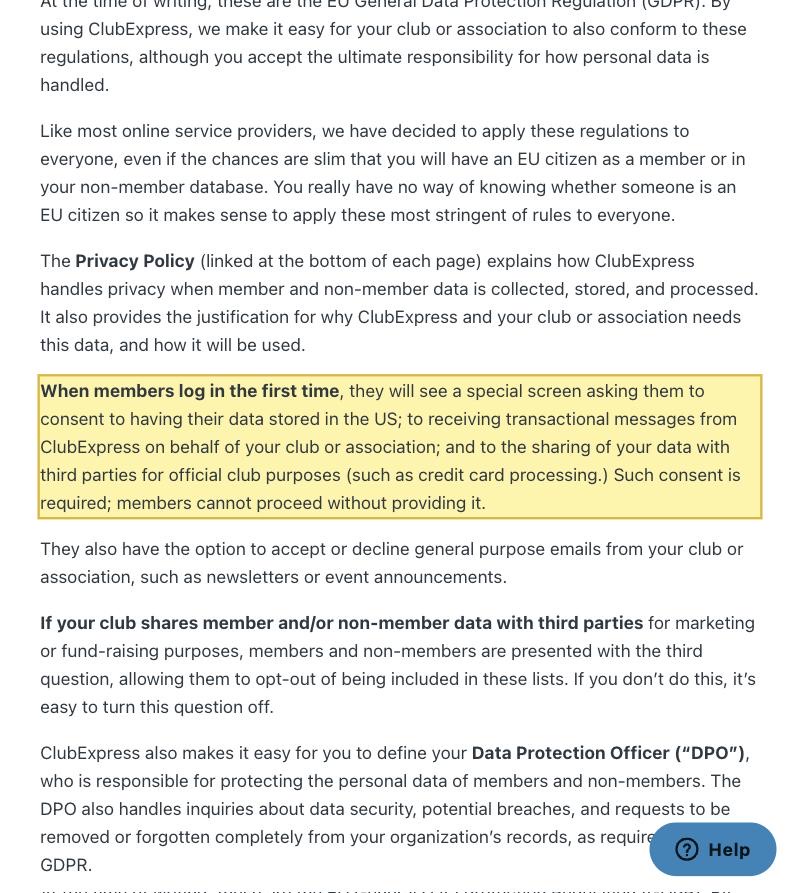
By ClubExpress's own documentation, members must “consent to having their data stored in the US” when they first log in — “Such consent is required; members cannot proceed without providing it” — and its servers are “cloud based and hosted by AWS,” with no region inside mainland China. So the records of your Chinese members are held offshore: a cross-border transfer of personal information PIPL governs — and because ClubExpress also handles dues and shares data with third parties for credit-card processing, some of it is financial data, which PIPL treats as sensitive and holds to a higher bar. Serving the public club site to mainland visitors separately raises an ICP filing question. The table below is ClubExpress's own wording and the rules it triggers.
This is a risk picture, not a verdict — your obligations turn on your membership volumes, how much payment data you hold, and your role. Our China team can map your ClubExpress exposure with you →
Compliance snapshot
- ! The public club site and join/renewal pages shown to mainland members need an ICP filing — ClubExpress offers no mainland hosting to file against
- ! Member profiles, dues and payment records are stored in the US on AWS — a cross-border transfer PIPL governs
- ! Dues and payment handling means financial data, which PIPL treats as sensitive personal information
- ✕ No mainland-China region or data-residency option on ClubExpress
- ✓ A compliant, ICP-filed in-country delivery path exists — no rebuild, no migration
What Clubexpress's own documentation says about China
| Fact | Primary source |
|---|---|
| In ClubExpress's own words: when members first log in they must “consent to having their data stored in the US,” and “Such consent is required; members cannot proceed without providing it.” ClubExpress stores member data in the United States — none of it inside mainland China — so the profiles, dues and payment records of your Chinese members are held offshore. | ClubExpress — Privacy Compliance (Help Center), retrieved 2026-10-07 |
| ClubExpress confirms its infrastructure is offshore: “ClubExpress servers are cloud based and hosted by AWS,” and it “also uses Amazon Web Services (AWS) for selected features, including the storage of documents, photos, and audio/video files.” There is no mainland-China region and no data-residency option on the platform. | ClubExpress — Platform (Help Center), retrieved 2026-10-07 |
| Because that data leaves China, PIPL puts the duty on the personal-information handler — your club or association, not ClubExpress — to give notice, obtain separate consent, and satisfy one transfer mechanism: a CAC security assessment, the CAC standard contract, or certification. ClubExpress's built-in “store my data in the US” consent is not the cross-border-specific consent PIPL requires, and it is not a transfer mechanism. | PIPL Chapter III, Articles 38–43 |
| Membership dues and payments mean financial data. Under PIPL, financial-account information is sensitive personal information (Article 28), requiring its own separate consent and a demonstrated necessity. Under the CAC's March 2024 cross-border rules, a non-CIIO transferring fewer than 100,000 individuals' non-sensitive personal information in a calendar year is exempt from the assessment, standard contract and certification — but sensitive personal information does not qualify for that exemption, and transferring the sensitive data of 10,000 individuals or more in a year triggers the CAC security assessment. | PIPL Article 28; CAC — Regulations on Promoting and Regulating Cross-border Data Flows, March 2024 |
| A public-facing club or association site delivered to mainland visitors turns on an ICP filing (State Council Order No. 292; MIIT Order No. 33), which must attach to a hosting resource inside mainland China. ClubExpress runs only offshore AWS, so there is nothing on ClubExpress to file against — and for a CIIO or large-volume handler, personal information collected in China must be stored in the mainland (CSL Article 39 (formerly Article 37); PIPL Article 40), a residency duty no offshore region can meet. | PIPL Article 40; CSL Article 39 (formerly Article 37); ClubExpress — Platform, retrieved 2026-10-07 |
Sources verified by the 21YunBox compliance team on 2026-10-07.
For a mainland-China membership, the deciding question about ClubExpress is not how quickly a member’s profile page paints — it is whether the club website you publish on it is licensed to run inside China, and where the member records it holds are allowed to live. ClubExpress answers the second half in its own documentation: member data is stored in the United States, on AWS, with no region inside mainland China. A China-facing club or association on ClubExpress is therefore served and stored entirely offshore — which leaves its public site with no footing for the ICP filing a mainland site requires, and turns every member profile, dues record and event registration into a cross-border transfer China’s law governs. The platform runs; the licensing and the data residency are the exposure.
ClubExpress in China at a glance
| What decides it | In ClubExpress's own terms |
|---|---|
| Where it stores data | “ClubExpress servers are cloud based and hosted by AWS,” and members must “consent to having their data stored in the US.” No region is inside mainland China, and the platform offers no data-residency option. |
| What it holds | Member and non-member profiles, contact details, dues and payment records, and event registrations. ClubExpress also shares data with third parties for “credit card processing,” so the platform touches financial data PIPL treats as sensitive. |
| Serving the public | The club or association website and its join and renewal pages, shown to mainland visitors, need an ICP filing tied to a mainland hosting resource. With no mainland region, ClubExpress offers no ICP-filing path of its own. |
| Your members' data | Personal data collected from Chinese members sits in the US on AWS — a cross-border transfer PIPL governs, with a stricter bar for financial data, plus a localization duty for CIIOs and large-volume handlers. |
| Reachability | The site and its data are served from offshore, US-based AWS, not a mainland region. Reachability and speed are the delivery half; they do not change the licensing or data-residency facts. |
Door one — your members’ records live in the US
ClubExpress is the system of record for your roster: profiles, contact details, dues history, renewals and event sign-ups. Where that record lives is settled in ClubExpress’s own privacy documentation — not in an infrastructure guess. New members, it says, see a screen asking them to “consent to having their data stored in the US,” and “Such consent is required; members cannot proceed without providing it.” Its servers are, in its words, “cloud based and hosted by AWS.” None of that is inside mainland China.
That one line does two things at once. It confirms the data leaves China, and it shows the gap: a “store my data in the US” click-through is a US-storage notice, not the cross-border-specific step China’s law asks for. Under the Personal Information Protection Law the duty sits with the personal-information handler — your club or association, not ClubExpress — to give notice, obtain separate consent for the transfer, and clear one transfer mechanism: a CAC security assessment, the CAC standard contract, or certification. And for a critical information infrastructure operator or a large-volume handler, personal information collected in China must be stored in the mainland (PIPL Article 40; Cybersecurity Law Article 39 (formerly Article 37)) — a residency duty an offshore US region cannot meet.
Dues and payments raise the bar — financial data is sensitive
A membership platform does not stop at names and emails. It carries dues, renewals and payment history, and ClubExpress itself notes that members consent to “the sharing of your data with third parties for official club purposes (such as credit card processing).” Under PIPL, financial-account information is sensitive personal information (Article 28), and sensitive data carries its own requirements: a separate, specific consent and a demonstrated necessity before it is processed at all. It also sits outside the lighter cross-border exemption that low-volume, non-sensitive transfers can use — under the CAC’s March 2024 cross-border rules, moving the sensitive personal information of 10,000 individuals or more in a year triggers a full CAC security assessment. The more dues and payment history your roster carries across the border, the higher the bar before any of it may lawfully leave China.
Door two — a public club site served to China needs an ICP filing
ClubExpress is not only a back-office database; it publishes your organization’s public website, its join and renewal pages, and its event listings. Shown to visitors inside mainland China, that site is exactly what China’s filing regime covers. A public-facing website delivered to mainland users from inside China turns on an ICP filing (ICP 备案) under State Council Order No. 292 and MIIT Order No. 33, and that filing must attach to a hosting resource physically in the mainland. ClubExpress runs on offshore, US-based AWS, so there is no mainland footing on ClubExpress for a filing to sit on. “We already run our club on ClubExpress” does not carry across the border: hosting a membership platform abroad is not the same as being cleared to publish its public site inside China.
Reachable or not, the residency and licensing facts don’t move
Whether a ClubExpress page paints quickly for a member in Guangzhou is a delivery question, and delivery is only half the picture. Even a page that loads instantly is still served from an offshore region and still files none of the paperwork a mainland site needs. 21YunBox has not run a first-party measurement of ClubExpress from inside China, so we publish no load figures here; what we can say from ClubExpress’s own documentation is architectural — the public site and the member records both live in the United States. That is the part no amount of network tuning changes.
This is a risk map, not a verdict: whether you need an ICP filing, in-country storage, a transfer mechanism, or all three depends on what your membership data includes, how much of it is financial, how many members you have, and who they are — worth settling with counsel before you open the doors to a China audience.
Where 21YunBox fits — a compliant overlay, not a migration
You keep running your club on ClubExpress. What we add is the one thing a US-hosted membership platform cannot: compliant, ICP-filed delivery from inside the mainland, set in front of your existing ClubExpress site — no rebuild, no second platform, and no export of your member roster to stand it up. Our China team maps your ICP and PIPL cross-border duties against your entity, your membership size and how much dues and payment history you hold, then puts the in-country delivery — and, where the law requires it, in-country storage — in place, while ClubExpress keeps doing everything else for your association.
Related reading:
Frequently Asked Questions
Does ClubExpress store Chinese members' data in China?
No. By ClubExpress's own privacy documentation, members must consent to having their data stored in the US, and its servers are cloud-based and hosted by AWS — with no region in mainland China. So the profiles, dues and payment records of your Chinese members are held offshore.
Is it against the law to run a China club or association on ClubExpress?
Not inherently. The issue is the cross-border transfer of your members' personal information — and because dues and payment handling involve financial data, PIPL treats some of it as sensitive, a higher bar. PIPL permits the transfer if you give notice, obtain separate consent and meet one of its transfer mechanisms; serving the public club site to mainland visitors also raises the ICP question. Treat it as a risk to assess with counsel, not a blanket prohibition.
Can 21YunBox help make our ClubExpress site compliant in China?
Yes. Our China team can assess your cross-border and data-residency exposure for your membership volumes, how much payment data you hold and your role, and stand up the compliant, ICP-filed in-country delivery — and, where the law requires your China members' data to stay on the mainland, in-country storage — in front of your existing ClubExpress setup. Get in touch to work through your specific case.