Does Akamai Work in China After the 2026 CDN Shutdown?
Akamai retired its own mainland-China CDN on 30 June 2026; lawful in-country delivery now runs through an ICP-filed partner. A compliance-first look at what the change means for your delivery.
Does Akamai work in China?
Whether Akamai can serve your site from inside mainland China is a licensing-and-filing question, not a speed one. Akamai's edge is fast from inside China — but on 30 June 2026 it retired its own mainland-China CDN, so lawful in-country delivery now runs through an ICP-filed partner arrangement rather than Akamai's own network.
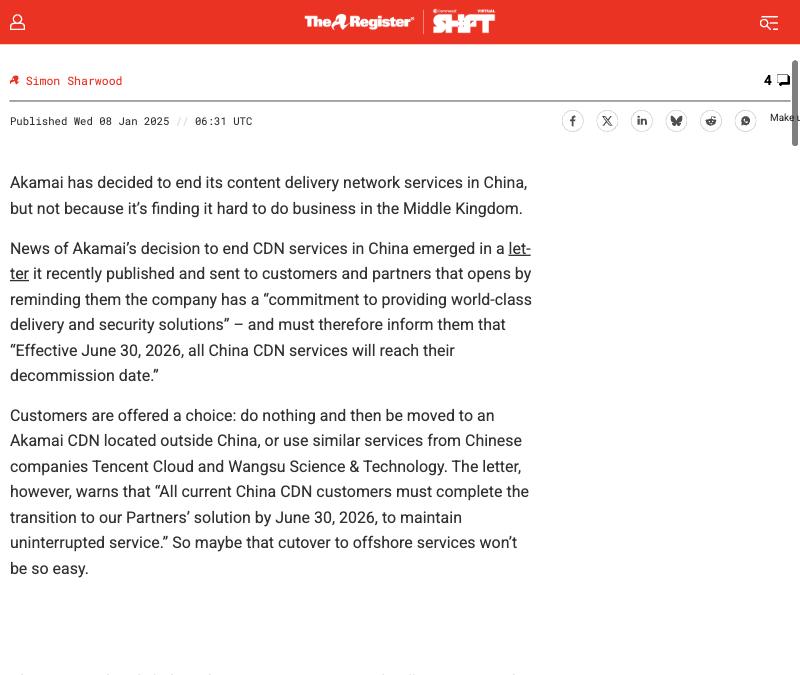
In Akamai's own customer letter, "Effective June 30, 2026, all China CDN services will reach their decommission date"; customers are told either to be moved to "an Akamai CDN located outside China" or to take "similar services from Chinese companies Tencent Cloud and Wangsu." The speed options differ, but the gate behind both is the same: delivering from inside the mainland is licensed, not just configured — it needs an ICP filing (备案) under State Council Order No. 292 and MIIT Decree No. 33, and because that filing binds to whoever provides the in-country access, moving between Akamai's partners re-opens the filing rather than just re-pointing DNS. The table below is Akamai's own wording and the rule it runs into.
This is a risk picture, not a legal verdict — your obligations turn on where you serve from and who holds the filing. Our China team can map your exposure with you →
What Akamai's documentation says, and what we measured from inside China
| Fact | Primary source |
|---|---|
| In Akamai's own customer letter: "Effective June 30, 2026, all China CDN services will reach their decommission date." Customers are offered a choice — be moved to "an Akamai CDN located outside China," or take "similar services from Chinese companies Tencent Cloud and Wangsu" — and told to "complete the transition to our Partners' solution by June 30, 2026, to maintain uninterrupted service." | Akamai customer letter, quoted by The Register (8 Jan 2025), retrieved 2026-10-07 |
| Akamai is not leaving China delivery — it is changing who runs it. Customers are being moved to Akamai's resale of Tencent Cloud and Wangsu Science & Technology for in-country delivery, and any traffic not migrated is served from points of presence in neighboring countries after the decommission date. The operator of the in-country network changes; the regulatory gate on serving from inside China does not. | South China Morning Post — Akamai to cease CDN operations in China (8 Jan 2025), retrieved 2026-10-07 |
| Whoever serves the traffic inherits the regulatory gate. By Alibaba Cloud's ICP documentation, "ICP filing applies only to servers located in the Chinese mainland," and the filing is tied to the service provider — switch provider and "you must add [the new provider] as a service provider." So moving between Akamai's China partners updates the ICP filing (备案); it is not a DNS change. Under State Council Order No. 292 and MIIT Decree No. 33, no site may be served from inside the mainland without that filing. | Alibaba Cloud — ICP filing overview, retrieved 2026-10-07; State Council Order No. 292; MIIT Decree No. 33 |
| The filing is not just paperwork a vendor hands you: an ICP filing requires mainland hosting held under a China-registered entity. Taking Akamai's partner route (Tencent Cloud or Wangsu) therefore still runs through the same entity-and-filing gate — which is why the schedule is set by the filing, not the contract, and typically runs to weeks rather than days. | Alibaba Cloud — ICP filing prerequisites, retrieved 2026-10-07; State Council Order No. 292; MIIT Decree No. 33 |
Speed is not the problem to solve here. Akamai's own site completed all 3 page loads requested from a probe inside mainland China (Alibaba Cloud cn-zhangjiakou) on 2026-08-27, with a median load of 0.4 seconds and a largest-contentful-paint of 0.5 seconds. It arrives fast — which is exactly why the real question is legal, not performance. | 21YunBox — China delivery measurement, measured from inside mainland China |
Sources verified by the 21YunBox compliance team on 2026-10-07.
Whether Akamai can serve your site from inside mainland China is a licensing-and-filing question before it is a performance one. Akamai’s edge arrives fast from inside the country — but on 30 June 2026 it retired its own mainland-China CDN, and lawful in-country delivery now runs through an ICP-filed partner arrangement rather than Akamai’s own network. The operator of the in-country network changed; the regulatory gate behind it did not. Akamai says as much in its own customer letter.
Akamai China at a glance
| What decides it | Where it stands now |
|---|---|
| The 2026 shutdown | In Akamai's own words, “Effective June 30, 2026, all China CDN services will reach their decommission date.” Its own mainland-China CDN is retired. |
| Who delivers inside China now | Akamai resells two China partners — Tencent Cloud and Wangsu. Content can still be served from inside the mainland, through a partner arrangement rather than Akamai's own points of presence. |
| Traffic you didn't migrate | Served from points of presence in neighboring countries — reachable, but from outside the mainland. |
| The gate to serve from inside the mainland | An ICP filing (备案) is mandatory. Under State Council Order No. 292 and MIIT Decree No. 33, no site may be served from inside the mainland without one. |
| Who the filing binds to | The in-country access provider. Moving between Akamai's partners re-opens the ICP filing — it is not a DNS change. |
| Speed | Akamai's edge is fast from inside China. Performance is not the deciding factor here; the gate is legal. |
What changed on 30 June 2026 — the operator, not the gate
In January 2025 Akamai notified customers it would wind down its China CDN, and on 30 June 2026 that decommission took effect. Akamai is not leaving China delivery — it is changing who runs it. Customers were offered a choice, in Akamai’s own words: be moved to “an Akamai CDN located outside China,” or take “similar services from Chinese companies Tencent Cloud and Wangsu,” and told to “complete the transition to our Partners’ solution by June 30, 2026, to maintain uninterrupted service.” Traffic that was not migrated now serves from points of presence in neighboring countries — still reachable, but from outside the mainland.
The practical takeaway: “we’re on Akamai” no longer settles the China question. The in-country network is now a partner’s, and the thing that makes in-country delivery lawful sits behind whichever partner you land on. Akamai is not unusual here: of the 19 CDNs in our China compliance census, each read against its own documentation in October 2026, 8 offer no self-serve in-country path for the core service, and seven of the 11 that do are public code libraries whose files you can simply serve yourself.
The second door — the ICP filing the vendor change doesn’t remove
Whoever serves the traffic inherits the same gate. Serving a public-facing site from inside the mainland turns on an ICP filing (备案): under State Council Order No. 292 and MIIT Decree No. 33, no site may be delivered from inside mainland China without one. By the ICP documentation Akamai’s partners file under, the filing “applies only to servers located in the Chinese mainland” and is tied to the service provider — change provider and you must add the new one to the filing.
So choosing Tencent Cloud or Wangsu for in-country delivery is not a drop-down change: it re-opens the ICP filing, and the filing itself requires mainland hosting held under a China-registered entity. That is the second door, and it is the one the vendor change leaves standing. The partner route is a real option to price — but the entity-and-filing work behind it is yours to hold, and the schedule is set by the filing, typically weeks rather than days, not by the contract.
Speed is not the thing to fix
It is worth saying plainly, because the 2026 shutdown reads like a performance story: speed is not the problem to solve here. Measured from a probe inside mainland China (Alibaba Cloud cn-zhangjiakou) on 2026-08-27, Akamai’s own site completed all three requested page loads, with a median load of 0.4 seconds and a largest-contentful-paint of 0.5 seconds. It arrives fast — which is exactly why the deciding question is legal, not technical: a site can load in half a second and still be served from infrastructure that cannot hold an ICP filing.
This is a risk picture, not a legal verdict: whether your setup needs an ICP filing, and who must hold it, turns on where you serve from and your China entity — worth confirming with counsel.
Where 21YunBox fits — a compliant overlay, not a migration
You keep Akamai for the rest of the world. We add the piece the partner change does not resolve: compliant, ICP-filed delivery from inside the mainland, placed in front of your existing origin — no rebuild, no second codebase, and no move off Akamai. Our China team maps whether the partner route or an overlay fits your case, assesses your ICP and data-residency exposure for your entity and traffic volumes, and stands up the in-country delivery and filing a compliant China presence requires.
Related reading: