Does cdnjs Work in China? Delivery, Reachability & the ICP Line
cdnjs is a free, open-source CDN for front-end libraries, served from Cloudflare's offshore global network with no mainland-China point of presence — so a page that loads its libraries at runtime can be slowed or broken there. cdnjs itself raises no ICP or PIPL duty; that falls on the site that embeds it. A delivery-first look, honestly framed.
Does cdnjs work in China?
cdnjs is not a compliance problem in its own right — it serves public open-source code, holds none of your users' data and carries no ICP — but it is an offshore dependency that can slow or break your site inside the mainland, while the ICP and PIPL duties sit squarely on the site that loads it.
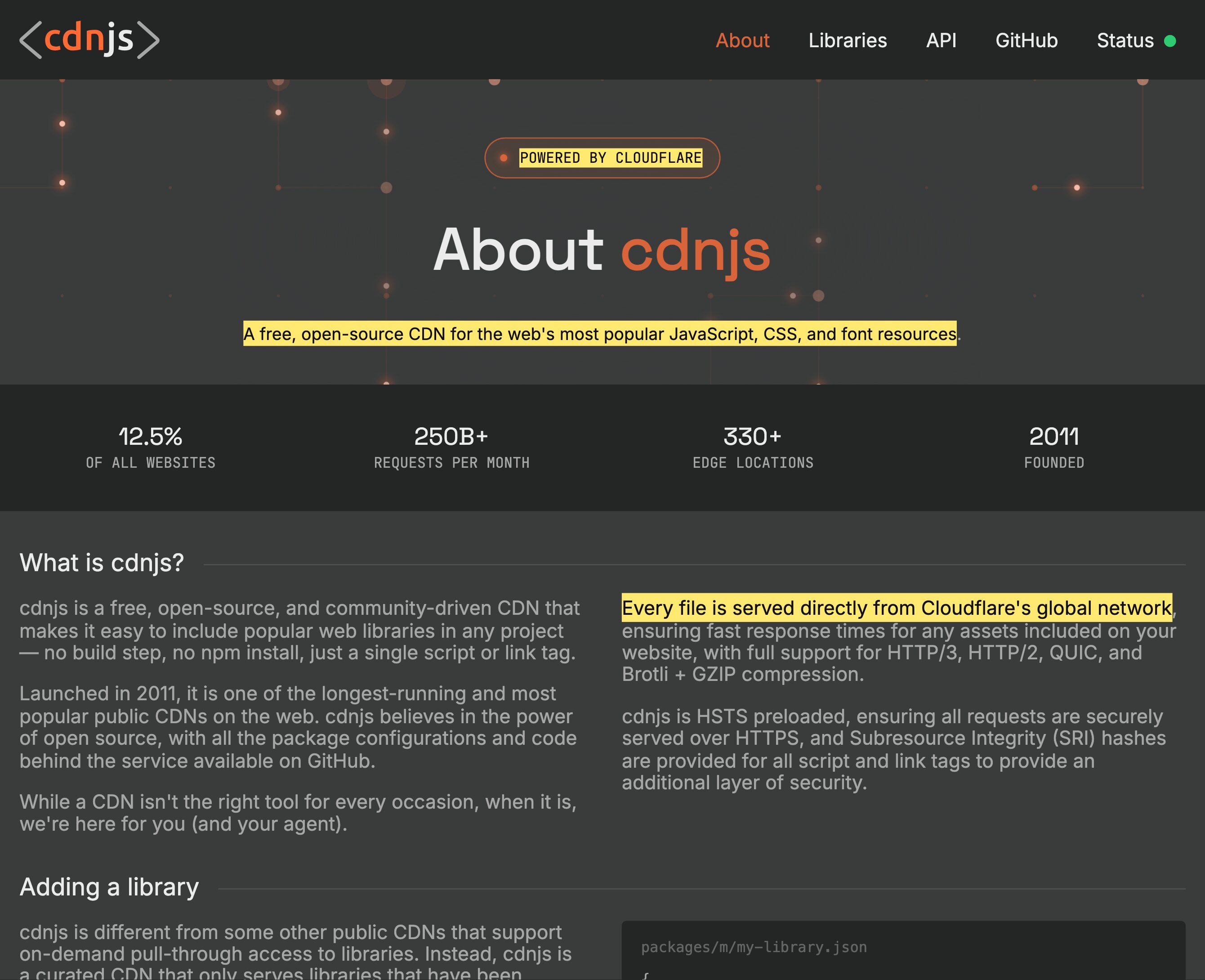
cdnjs describes itself as "a free, open-source CDN for the web's most popular JavaScript, CSS, and font resources," "Powered by Cloudflare," where "every file is served directly from Cloudflare's global network." That network has no point of presence inside mainland China (Cloudflare's in-country China Network is a separate, ICP-gated service a public cdnjs.cloudflare.com does not use — an inference from how Cloudflare provisions it), so a library pulled from cdnjs at load time is frequently slow, throttled or simply unreachable from the mainland, and the render waiting on it stalls with it. None of that is a data-residency question for cdnjs — it holds no personal information — but the public site that embeds it still needs an ICP filing on in-country hosting and still owns its own PIPL duties for the user data it collects. The table below is cdnjs's own wording and the line each fact draws.
This is a risk map, not a verdict — whether an unreliable offshore CDN merely drags your site or breaks it, and whether the site around it is filed and in-country, turns on how your front-end is built and what you collect. Our China team can map your exposure with you →
Compliance snapshot
- ! Served from Cloudflare's offshore edge — a runtime library load can slow or break in the mainland
- ✓ cdnjs serves public library code, not your users' data — no PIPL transfer runs through it
- ✓ An open-source CDN carries no ICP of its own
- ! The site that embeds cdnjs still needs an ICP filing on in-country hosting
- ! That same site owns its PIPL duties for the user data it collects
What cdnjs's own documentation says about China
| Fact | Primary source |
|---|---|
| cdnjs is a CDN for public library code, not a store of your users' data. In its own words it is "a free, open-source CDN for the web's most popular JavaScript, CSS, and font resources" — "a free, open-source, and community-driven CDN that makes it easy to include popular web libraries." It serves open-source JavaScript, CSS and fonts, so no personal information passes through cdnjs and it triggers no cross-border transfer under PIPL on its own. Forcing a data-residency story onto a public code CDN would be dishonest. | cdnjs — About (cdnjs.com/about), retrieved 2026-10-07 |
It runs on Cloudflare's offshore global network, with nothing inside the mainland. cdnjs is "Powered by Cloudflare," and "every file is served directly from Cloudflare's global network," with Cloudflare "providing the global CDN infrastructure." None of that edge sits inside mainland China — Cloudflare's in-country China Network is a separate, ICP-gated service a public cdnjs.cloudflare.com does not use (an inference from how Cloudflare provisions its China Network, not a cdnjs statement). From the mainland a library fetched from cdnjs at request time is frequently slow, throttled or unreachable, and the page waiting on it stalls too. | cdnjs — About (cdnjs.com/about), retrieved 2026-10-07 |
| The ICP filing is owed by the site that embeds cdnjs, not by cdnjs. An open-source CDN carries no ICP — but a public website shown to mainland visitors turns on an ICP filing (ICP 备案) tied to a hosting resource physically inside the mainland, under State Council Order No. 292 and MIIT Order No. 33. cdnjs sits entirely outside that regime, yet a mainland site that quietly depends on it still has to be filed and hosted in-country in its own right. | cdnjs — About (cdnjs.com/about), retrieved 2026-10-07; State Council Order No. 292; MIIT Order No. 33 |
| And the PIPL duties stay with that site, for the data it collects. Because cdnjs holds no user data, the cross-border-transfer and localization questions belong to your own site's data flows, not to the CDN: if it collects personal information from Chinese users, PIPL applies to that site (notice, separate consent and a transfer mechanism, Articles 38–43), and a CIIO or large-volume handler must store that data in the mainland (PIPL Article 40; Cybersecurity Law Article 39 (formerly Article 37)). The CDN's weakness is delivery; the compliance weight lands next door, on the site itself. | cdnjs — About (cdnjs.com/about), retrieved 2026-10-07; PIPL Articles 38–43 & 40; Cybersecurity Law Article 39 (formerly Article 37) |
Sources verified by the 21YunBox compliance team on 2026-10-07.
For a mainland-China audience, the real question about cdnjs is not whether it is permitted — it is whether it shows up. cdnjs is a free, open-source CDN for front-end libraries: it serves public code, not your users’ personal data, so in itself it triggers no cross-border-transfer or ICP duty. What it does carry is a delivery risk. cdnjs is served from Cloudflare’s offshore global network with no point of presence inside mainland China, so a page that fetches a library from it at request time depends on infrastructure that is often slow or unreachable from the mainland — and when that dependency stalls, the page stalls with it. The compliance line in this picture sits one step over, on the site that embeds cdnjs, which still has to be ICP-filed and served in-country.
cdnjs in China at a glance
| What decides it | In cdnjs's own terms |
|---|---|
| Where it runs | Files are served “directly from Cloudflare's global network” — cdnjs is “Powered by Cloudflare” — a worldwide edge with no point of presence inside mainland China. |
| What it serves | “The web's most popular JavaScript, CSS, and font resources” — public, open-source library code. Code, not user data, so no personal information passes through cdnjs. |
| Reachable from the mainland? | Answered from Cloudflare points of presence outside the country, so from inside mainland China it is frequently slow, throttled or unreachable — a delivery risk, not a clean block. |
| Data residency / PIPL | Not triggered by cdnjs itself — it stores no personal data. The cross-border-transfer question belongs to whatever your own site does with user data, elsewhere. |
| ICP filing | None on cdnjs — an open-source CDN carries no filing. The ICP duty sits on the site that embeds it, which must be filed and hosted in-country. |
Public library code, not user data — so this is a delivery question
cdnjs calls itself “a free, open-source CDN for the web’s most popular JavaScript, CSS, and font resources” — and that description is the whole of its compliance footprint. It distributes open-source library code, not the personal information your application collects, so loading a file from cdnjs is not a cross-border transfer of personal data and it carries no ICP obligation of its own. Inventing a data-residency problem for a public code CDN would be the wrong call. The exposure here is plainer and more operational: can that library actually be fetched — quickly, and on every request — from inside the mainland?
Served from Cloudflare’s offshore network, with no mainland presence
cdnjs is “Powered by Cloudflare,” and in its own words “every file is served directly from Cloudflare’s global network,” with Cloudflare “providing the global CDN infrastructure.” Not one of those edge locations is inside mainland China. Cloudflare answers mainland traffic from points of presence across the border, and its in-country China Network is a separate, ICP-gated offering that a public host like cdnjs.cloudflare.com does not ride on — that last link is an inference from how Cloudflare provisions its China Network, not something cdnjs states. The upshot is the one every offshore CDN shares: from inside the mainland cdnjs is frequently slow, throttled or flatly unreachable, and which of those you get moves with the route, the carrier and the time of day. A <script> or stylesheet that reaches out to cdnjs while the page is painting hands that uncertainty straight to your visitors — when the fetch hangs, whatever depends on it hangs too. It is a moving part you neither own nor can tune, parked on the far side of the border.
Where the ICP and PIPL line actually falls — on the embedding site
Getting the compliance door right here means naming where it actually stands. cdnjs does not need an ICP filing — the site that embeds it does. A website served to mainland visitors turns on an ICP filing (ICP 备案) under State Council Order No. 292 and MIIT Order No. 33, bound to a hosting resource physically inside the mainland; and if that same site gathers personal information from Chinese users, the cross-border transfer and localization rules of the Personal Information Protection Law govern its own data flows (PIPL Articles 38–43 and 40; Cybersecurity Law Article 39 (formerly Article 37)). cdnjs falls inside none of that — but a mainland site that leans on it inherits the CDN’s delivery weakness while still carrying every one of its own filing and data duties.
This is a risk map, not a verdict: whether an unreliable third-party CDN only drags your site or actually breaks it, and whether your own hosting and data position holds up, depends on how your front-end is assembled and what you collect — worth settling with counsel and an honest look at your real dependencies.
Where 21YunBox fits — a compliant overlay, not a migration
You keep shipping the front-end your developers already wrote. What we take off the table is the offshore dependency cdnjs introduces: the JavaScript, CSS and font assets your pages pull from it are served instead from ICP-filed delivery inside the mainland, set in front of your existing origin — no rebuild, no second codebase, and no swapping out the libraries you chose. Our China team also checks the ground cdnjs never covers: that the site loading those assets is itself ICP-filed, hosted in-country, and sound on PIPL for whatever user data it does collect. The code your browser runs is unchanged; what changes is that it now arrives from the right side of the border.
Related reading:
Frequently Asked Questions
Does cdnjs need an ICP filing or raise a PIPL cross-border issue?
Not cdnjs itself. It serves public, open-source library code rather than your users' personal data, so no cross-border transfer of personal information runs through it and it carries no ICP of its own. Both duties land one step away, on the public site that embeds cdnjs: that site needs an ICP filing on in-country hosting, and it owns its own PIPL obligations for whatever personal data it collects from Chinese users. Treat the CDN as a delivery dependency and your own site as the place the compliance questions actually live.
Why does a page that loads cdnjs slow down or fail in mainland China?
Because cdnjs is served from Cloudflare's offshore global network, which has no point of presence inside the mainland, mainland traffic is answered from across the border. From inside China that makes a cdnjs request frequently slow, throttled or unreachable, and it shifts with the network, the route and the hour. When a script or stylesheet pulled from cdnjs at load time stalls, the part of your page waiting on it stalls with it — a delivery risk you do not control, not a clean, predictable block.
Can 21YunBox help serve cdnjs libraries reliably in China?
Yes. Our China team can serve the same JavaScript, CSS and font assets your pages pull from cdnjs from ICP-filed delivery inside the mainland, set in front of your existing origin — no rebuild and no change to the libraries your developers chose — and check the part cdnjs never touches: that the site embedding them is itself ICP-filed, hosted in-country and clean on PIPL for the user data it handles. Get in touch to work through your specific setup.