What does it actually take to make a website work in China?
Two conditions have to hold, and most launch plans only budget for one. The first is permission: State Council Decree No. 292 puts internet information services under a filing or licensing regime, and the filing is issued to a mainland legal entity and binds to the hosting arrangement — so it has a lead time that a launch date does not automatically accommodate. The second is arrival, and it is the one that surprises people. Measured fact: across 280 enterprise sites requested three times each from a probe inside mainland China on 2026-08-28~29, 58% finished every attempt and 34% finished none — and roughly two thirds of the sites that finished none had already returned a first byte and painted content before stalling. That means the usual failure is not a site that is blocked; it is a site that answers, starts rendering, and never completes. A launch checklist that ends at «is it reachable» will pass on a site that no visitor can use. The ordering that works is entity, then filing, then placement, then the per-resource work — and only the last of those is engineering.What we measured, and what the rules require
| Fact | Primary source |
|---|---|
Across 280 enterprise sites requested three times each from a probe inside mainland China (Alibaba Cloud cn-zhangjiakou) on 2026-08-28~29, 58% finished every attempt and 34% finished none. Of those that finished none, roughly two thirds had returned a first byte and most had painted content before stalling. | 21YunBox — 280-site China delivery census, measured from inside mainland China |
| Measured across 88 real page loads from a Beijing China Mobile residential broadband line on 2026-08-30, 102 hosts never returned a response and 101 of them were third parties the pages pulled in — while every one of the 57 sites that failed to finish loading did return a first byte. What breaks a launch is usually not the site. | 21YunBox — paired measurement from a Beijing residential broadband line |
| State Council Decree No. 292 places internet information services under a filing or licensing regime. The filing is issued to a mainland legal entity and attaches to the arrangement under which the site is served, so the entity question sits upstream of the hosting decision rather than beside it. | State Council Decree No. 292, Article 4 — Administrative Measures on Internet Information Services |
Sources verified by the 21YunBox China engineering team on 2026-08-30.
Getting your websites to work in China can be tricky. You probably know Google, Facebook, Uber, and many other big tech companies had tried coming to China but failed. There are many reasons for the failures but the things I’m about to tell you will save you time and money to prevent mistakes.
Github and AWS don’t work in China
Any successful web apps can’t live without version control and hosting platforms. Github and AWS, the two most popular services in the world don’t work in China. What do I mean by “don’t work in China?”. More specially, say you want to clone a project to a server in China, what you normally do is:
```bash git clone repo_name.git ```
but you can only get up to 10kb/s speed to download your code in China, and in fact, you get this regularly:
```bash "fatal: unable to access '
So this means you will have a hard time cloning your project to a server in China and the overall developers’ experience in China would be terrible.
**What's more?**
AWS (Amazon Web Service), GCP (Google Cloud Platform), and the cloud platforms you love don’t work in China. If you have been using AWS, you know you can switch regions and spin up servers in minutes. When you come to China, whatever you do on AWS, you need to replicate it on AWS China again and then apply for the ICP License.
Wait for a second, isn’t AWS China just another region of the AWS system? Sorry to tell you it’s not, it’s on its own system in China, and the only two regions (Beijing and Ningxia) are not operated by AWS directly, in fact, it is operated by another two different companies in China.
**What's ICP License?**
ICP (Internet Content Provider) License is a permit to have your websites go live in China. I know you are probably curious what happens if I don’t have an ICP License and try to push a website up online, you will see this on your browser while visiting your domain:
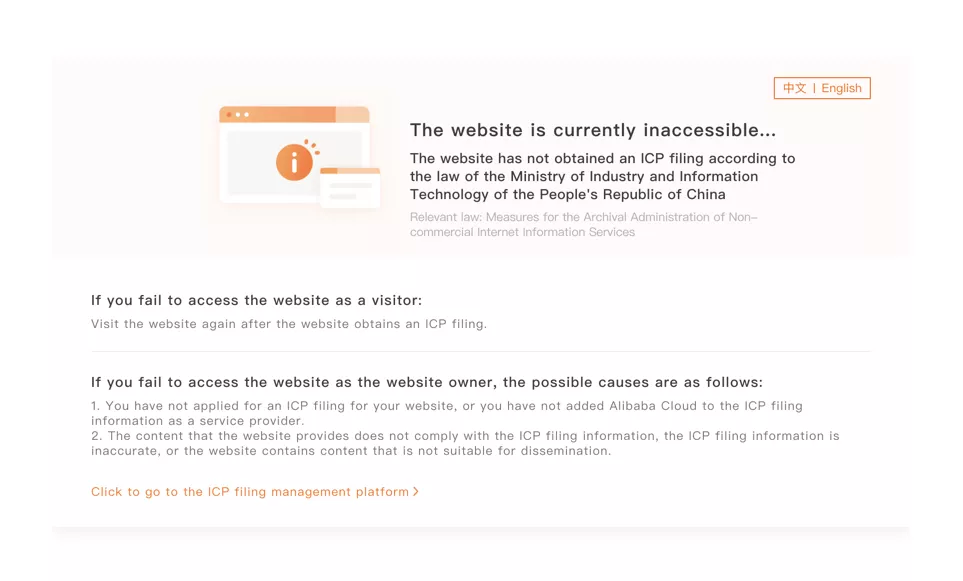
What it means is that no one can see your website. What happens behind the scene is that the default 80 and 443 ports are blocked for all servers in China before your ICP filing is completed.
**Anything else?**
I hated you tell you there are more, here are some of them that I think you don’t want to miss:
- Payment Processing Services: Stripe, Paypal, and Square;
- Social Network: TikTok, Facebook, Instagram, and Snapchat;
- Video sharing platforms: Youtube and Vimeo
You read it right, TikTok is on the list.
Isn’t TikTok a Chinese-owned company? Right, but the one Chinese users use is called Douyin, and TikTok is for users outside of China. These two apps share a similar user interface and are owned by the same company.
If I’m going to list every service that doesn’t work in China, I’m probably running out of space here, but I guess you probably get what I mean already. The point I’m going to make is that the technology you familiar with doesn’t work in China.
The good news
Like I promised in the beginning, I will walk you through the steps to make your website live in China with the tool you are familiar with. Here are the steps and actions:
**1. Sign up on 21YunBox**
Click here to get an account.
What is 21YunBox? If you have used services like Netlify, Vercel, or Heroku, you probably like the way they make deployment easy. 21YunBox does the same and is optimized to give the best performance in China that you can’t get anywhere. Simply put, it is a hosting platform that enables you to use the tech you familiar with inside China.
If this doesn’t make sense to you, let’s look at it this way, instead of you hosting a website with a Ubuntu server on AWS (meaning you install docker, Nginx, system libraries, and many other things to get a website up live), these platform pre-install everything you need to run web apps and databases, you just need to write the code and commit changes, within minutes, you will see your website live.
**2. Connect your Code**
Connect your Github repository on 21YunBox Console.
Wait for a second, didn’t I say Github doesn’t work in China above? Yes, it doesn’t work in China. But we make Github work by utilizing dedicated networks between China and other countries internally. So you can use Github normally inside China, this means you have a fast git clone and fast speed on pulling libraries. Like I promised to you can use the technology you are familiar with inside China on 21YunBox.
**3. Build the sites you want, with the tools you love**
Pick the stack you are using and deploy it on 21YunBox in minutes:
Static Site Generator + Headless CMS + Hosting Solution:
- Deploy Gatsby + Sanity + 21YunBox
- Deploy NextJs + Strapi + 21YunBox
- Deploy NuxtJs + Contentful + 21YunBox
- Deploy React + Airtable + 21YunBox
Backend Framework + Database:
- Deploy ExpressJS + MongoDB
- Deploy Ruby on Rails + PostgreSQL
- Deploy Django + PostgreSQL
- Deploy Laravel + MySQL
Don’t see your stack? You can check out our docs to learn more or submit a feature request.
Hopefully, by now, you are clear on what to do to get your website live in China. The following two steps will make sure you have everything covered to host your site on a root domain legally, let’s move on.
**4. Test Your Site Live**
If you have just spend few minutes completing the steps from above, you probably see your website live in China already (on a 21YunBox sub-domain). With the site present in China, you can pass it to the content team in China to perform user acceptance tests, and have some early users open it to see the speed boost in China.
The next thing would be to configure your DNS (Domain Name Server) to send traffic to the new site in China. If you still remember what I told you earlier: your site will be inaccessible if you don’t have an ICP. We also have this covered for you, read the next step.
**5. Get Your ICP License**
If you have a company entity registered in China, all you need is just follow our guide and put together the required docs and send it to us. It normally takes 10-20 business days for us and the MIIT (Ministry of Industry and Information Technology of the People’s Republic of China) to process.
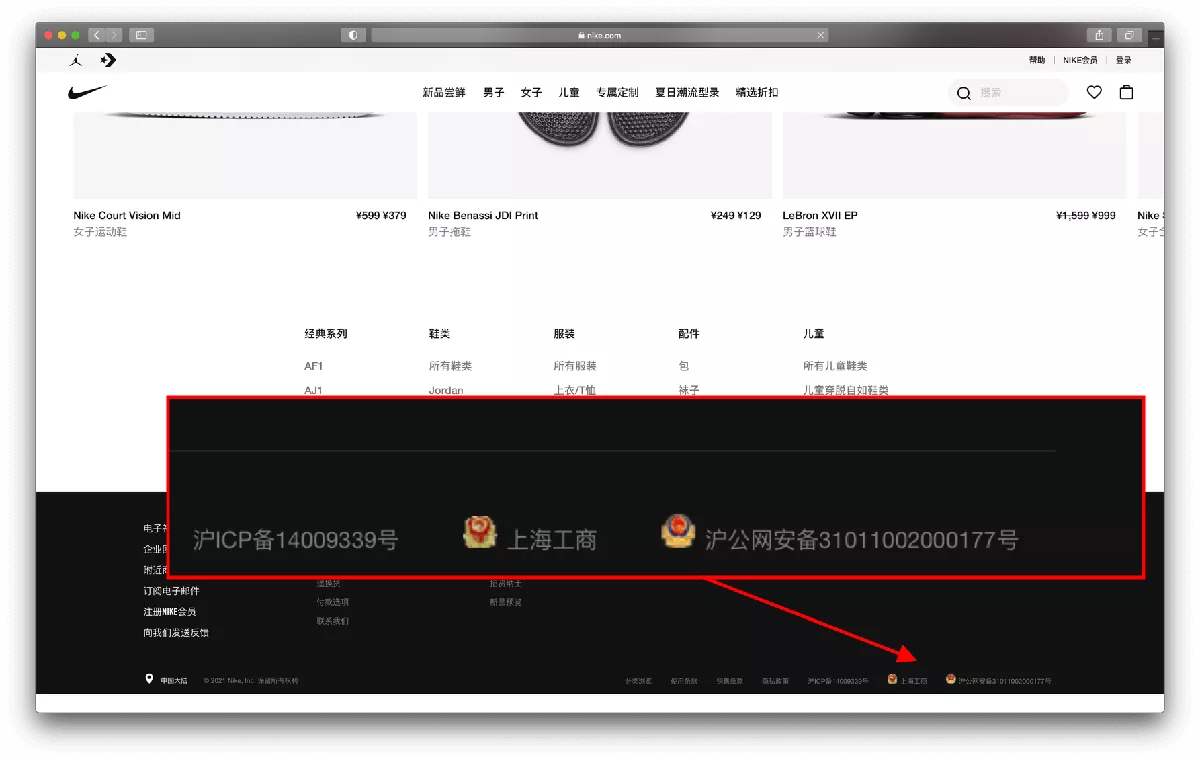
During the process, you would expect to get 2 phone calls to verify you are operating this website legally from MIIT, after that you will have an ICP number and you need to put it on the footer of your website. For example, here is Nike’s website and its ICP no.
What happens if I don’t have a company entity in China? Then there are many possible solutions for you, click here to schedule a call with us, so we can answer your questions on the phone.