Does Cloudinary Work in China? CDN Reachability, ICP & Where Your Media Lives
Cloudinary's own CDN, in its words, excludes mainland China — so from inside the country your images and video are served from offshore edges, slower and sometimes unreachable. Its in-country fix is Enterprise-only and tied to an ICP license. A delivery-first look, plus a note on the user-uploaded media you store offshore.
Does Cloudinary work in China?
Partly — and for a media platform the catch is delivery, not paperwork. Cloudinary's global CDN “excludes China” in its own words, so from inside the mainland your images and video are hauled in from offshore edges — slower, sometimes barely reachable. Its own in-country fix is Enterprise-only and runs through Akamai, which needs an ICP license, or ChinaCache.
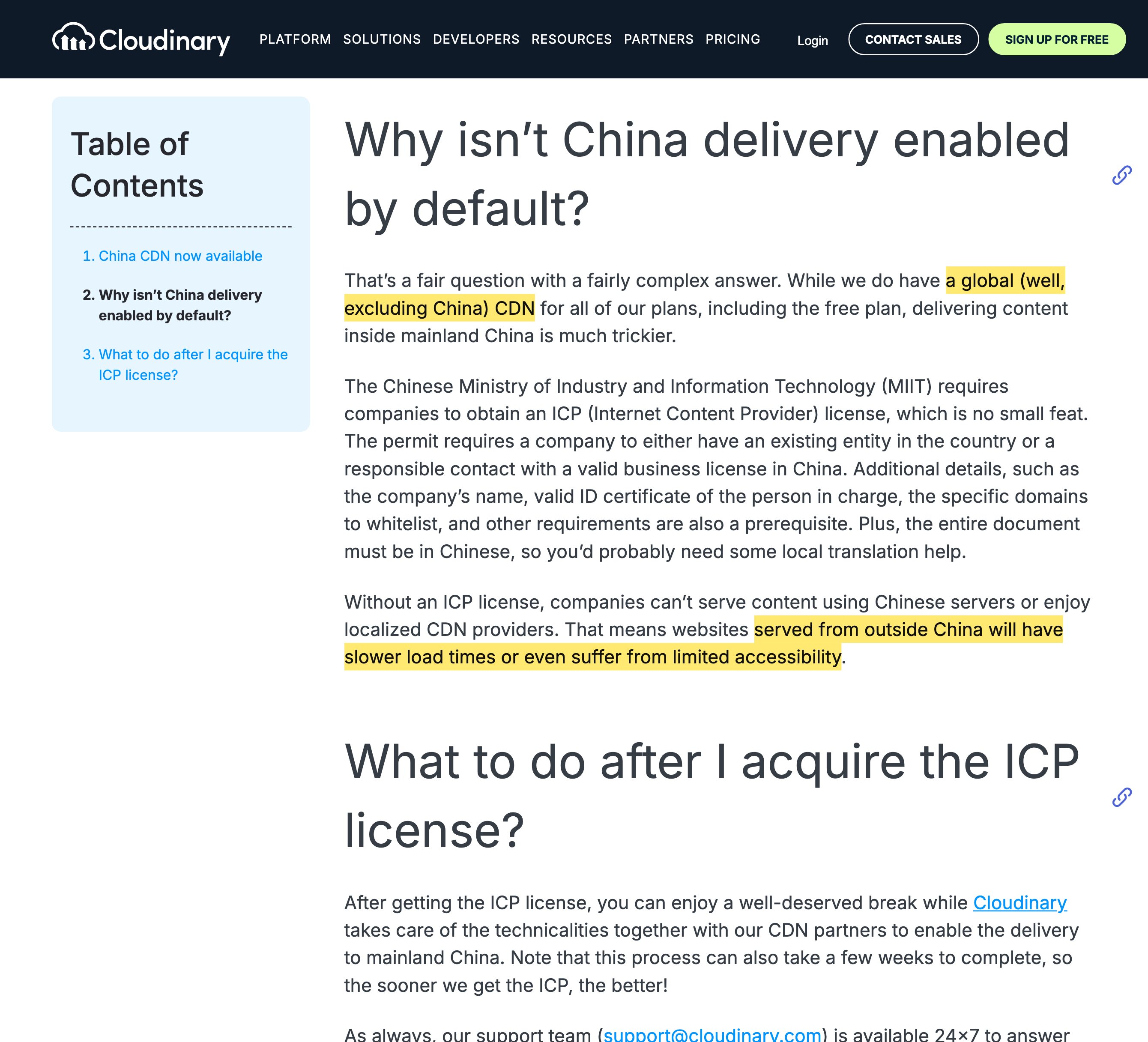
Cloudinary is candid about it: it runs “a global (well, excluding China) CDN,” and warns that content “served from outside China will have slower load times or even suffer from limited accessibility,” with requests hauling “all the way to neighboring countries, such as Singapore or Malaysia.” That delivery gap is the main event. The lighter, separate question is storage — a brand's own marketing assets raise nothing, but if the media you upload holds users' personal data, keeping it offshore is a cross-border transfer PIPL governs. The table below is Cloudinary's own wording and what each line triggers.
This is a risk map, not a verdict — what applies turns on how your media reaches users and whether any of it is personal data. Our China team can map your exposure with you →
Compliance snapshot
- ! Cloudinary's global CDN “excludes China” — its own words; media is served offshore
- ! From the mainland that means slower loads or “limited accessibility”
- ! Its in-country China CDN is Enterprise-only, via Akamai (needs ICP) or ChinaCache
- ✓ Your brand's own marketing images and video raise no personal-data issue
- ! User-uploaded media (photos, IDs) stored offshore is a PIPL cross-border question
What Cloudinary's own documentation says about China
| Fact | Primary source |
|---|---|
| Cloudinary is a media CDN and digital-asset platform whose global delivery network explicitly leaves out mainland China. It delivers through a “globally distributed architecture, powered by leading CDN partners, including Akamai, Fastly, and Cloudflare,” and tells customers in its own words that this is “a global (well, excluding China) CDN.” None of those partner edges sit inside the mainland, so by default every image and video request leaves the country to be served. | Cloudinary — Multi-CDN solution page and “Cloudinary Now Supports Content Delivery in China” blog, retrieved 2026-10-07 |
| From inside the mainland, that offshore network is slow or intermittent — again in Cloudinary's own words. Without local servers, Cloudinary says, “requests from mainland China need to haul all the way to neighboring countries, such as Singapore or Malaysia, adding unnecessary and frustrating latency,” and content “served from outside China will have slower load times or even suffer from limited accessibility.” Media-heavy pages — hero video, image galleries, user-photo feeds — are where visitors feel it first. | Cloudinary — “Cloudinary Now Supports Content Delivery in China” blog, retrieved 2026-10-07 |
| Cloudinary's own in-country fix is Enterprise-only and leans on an ICP filing. Its “China CDN is an advanced solution and available for our Enterprise customers only,” offered because “Cloudinary has partnered with China CDNs Akamai and ChinaCache” — and “Akamai requires a valid ICP license.” Cloudinary tells customers plainly that whether an ICP requirement “pertains to you is a legal question so consult with your legal team.” That ICP filing, under State Council Order No. 292 and MIIT Order No. 33, attaches to the site operator — not to Cloudinary. | Cloudinary — “A Primer: Content Delivery Through a China CDN” blog, retrieved 2026-10-07; State Council Order No. 292; MIIT Order No. 33 |
| The lighter question is what the media you upload contains. Cloudinary stores your original and derived assets in its cloud, which — like its CDN — sits outside the mainland (inference from Cloudinary's stated “excluding China” architecture). A brand's own marketing images and video raise no personal-information issue. But where the media is users' personal data — profile photos, user-generated uploads, identity or document images — storing and serving it offshore is a cross-border transfer under PIPL (notice, separate consent and a transfer mechanism, Articles 38–43), with an in-China storage duty for a CIIO or large-volume handler (PIPL Article 40; Cybersecurity Law Article 39 (formerly Article 37)). | Cloudinary architecture (globally distributed CDN, “excluding China”), retrieved 2026-10-07; PIPL Articles 38–43 and 40; Cybersecurity Law Article 39 (formerly Article 37) |
Sources verified by the 21YunBox compliance team on 2026-10-07.
For a mainland-China audience, the real question about Cloudinary is not how clever its transformations are — it is whether the images and video ever arrive. Cloudinary answers that in its own documentation: it runs “a global (well, excluding China) CDN.” A China-facing site therefore keeps working, but its media is pulled in from offshore edge servers, and Cloudinary’s own warning is that content “served from outside China will have slower load times or even suffer from limited accessibility.” Reachability is the first exposure. The second, lighter one is what those assets contain: a brand’s marketing images raise nothing, but user-uploaded media that holds personal data sits offshore too — and that is a question China’s privacy law asks.
Cloudinary in China at a glance
| What decides it | In Cloudinary's own terms |
|---|---|
| What it is | A media CDN and digital-asset platform that delivers through a “globally distributed architecture, powered by leading CDN partners, including Akamai, Fastly, and Cloudflare.” |
| Where it delivers | Those partner edges span the world but, in Cloudinary's words, it is “a global (well, excluding China) CDN” — none of them sit inside mainland China. |
| What mainland users feel | Requests “haul all the way to neighboring countries, such as Singapore or Malaysia,” so content “served from outside China will have slower load times or even suffer from limited accessibility.” |
| The in-country fix | “China CDN is an advanced solution and available for our Enterprise customers only,” via Akamai — which “requires a valid ICP license” — or ChinaCache. |
| Your stored media | Uploaded originals and derivatives live in Cloudinary's cloud, outside the mainland. Marketing assets raise nothing; user media containing personal data is a PIPL cross-border question. |
A global CDN that, in Cloudinary’s words, “excludes China”
Cloudinary’s job is to store your images and video and deliver optimized versions from edge servers close to each user. It does that through “a globally distributed architecture, powered by leading CDN partners, including Akamai, Fastly, and Cloudflare,” with dynamic multi-CDN routing on Enterprise accounts. That network is genuinely global, with one stated exception — Cloudinary itself calls it “a global (well, excluding China) CDN.” For a mainland audience the parenthesis is the whole story: the default delivery path has no point of presence inside China, so every image and video request leaves the country to be answered.
What that feels like from inside the mainland
Cloudinary is unusually candid about the consequence. Without local servers, it writes, “requests from mainland China need to haul all the way to neighboring countries, such as Singapore or Malaysia, adding unnecessary and frustrating latency,” and a site “served from outside China will have slower load times or even suffer from limited accessibility.” On a text-light page that is an annoyance; on the media-heavy pages Cloudinary exists to power — a full-bleed hero video, a product gallery, a feed of user photos — it is the difference between a page that feels instant and one that paints in piece by piece, or stalls. No figures belong here: reachability from inside China swings with network conditions, so the honest statement is Cloudinary’s own qualitative one, not a number.
Cloudinary’s own China fix is Enterprise-only — and leans on ICP
Cloudinary does offer a way in, and the shape of it is telling. “China CDN is an advanced solution and available for our Enterprise customers only,” delivered through two partners it has lined up: “Cloudinary has partnered with China CDNs Akamai and ChinaCache to help our customers with content delivery in China.” The difference between them is licensing — “Akamai requires a valid ICP license,” while ChinaCache is the route for customers without one. Cloudinary does not pretend to resolve that for you; it tells customers that whether an ICP requirement “pertains to you is a legal question so consult with your legal team.” The ICP filing (ICP 备案) under State Council Order No. 292 and MIIT Order No. 33 attaches to whoever operates the site, not to Cloudinary — so “we use Cloudinary” does not carry an in-country delivery license along with it.
The lighter question: where your uploaded media lives
Delivery is the headline; storage is the quieter second door. Cloudinary keeps your uploaded originals and their derived versions in its own cloud, which — like its CDN — sits outside mainland China. For a brand’s own marketing photography and video that is nothing to worry about: there is no personal information in a product shot. It changes only when the media itself is personal data — profile pictures, user-generated uploads, identity or document images. Holding and serving those from offshore is, under China’s Personal Information Protection Law, a cross-border transfer: notice, separate consent, and one transfer mechanism (Articles 38–43), plus an in-China storage duty for a critical information infrastructure operator or a large-volume handler (PIPL Article 40; Cybersecurity Law Article 39 (formerly Article 37)). So weigh this against what you actually upload, not against Cloudinary in the abstract.
This is a risk map, not a verdict: whether your exposure is mainly slow delivery, a data-residency question, or both turns on how much of your traffic is media, where your users sit, and whether any of that media is personal data — worth settling with counsel before you build.
Where 21YunBox fits — a compliant overlay, not a migration
Your media stays on Cloudinary. What we add is the one thing a “global (well, excluding China) CDN” cannot give you on its own: reliable, ICP-filed delivery from inside the mainland, set in front of your existing Cloudinary setup so images and video resolve from in-country — no rebuild, no second codebase, and no move off the platform your team already uses. Where the assets you store carry users’ personal data, our China team maps the PIPL cross-border and residency questions for your entity and your volumes, then arranges compliant in-country storage. You keep Cloudinary’s transformations and workflow; you gain the in-country footing it was never built to provide.
Related reading:
Frequently Asked Questions
Will our Cloudinary images and videos load for users in mainland China?
They will resolve, but from offshore. Cloudinary says its global CDN “excludes China,” so requests “haul all the way to neighboring countries, such as Singapore or Malaysia,” and content “served from outside China will have slower load times or even suffer from limited accessibility.” Media-heavy pages feel it first — a hero video that stalls, a gallery that paints in slowly. Reliable in-country delivery means caching the media inside the mainland, which Cloudinary itself offers only as an Enterprise China CDN tied to an ICP filing.
Do we need an ICP license to use Cloudinary in China?
To run your Cloudinary account, no. But to deliver media from inside the mainland you do: Cloudinary's China CDN runs through Akamai, which “requires a valid ICP license,” or through ChinaCache, and Cloudinary tells customers that whether ICP applies “is a legal question so consult with your legal team.” The filing attaches to the website operator, not to Cloudinary, so treat it as a risk to confirm with counsel rather than a box Cloudinary ticks for you.
Can 21YunBox help make Cloudinary work in China?
Yes. Our China team can stand up reliable, ICP-filed media delivery from inside the mainland in front of your existing Cloudinary setup — so your images and video resolve locally without re-platforming — and, where the media you store includes users' personal data, map the PIPL cross-border and residency questions and arrange compliant in-country storage. Get in touch to work through your specific case.