Does Microsoft Ajax CDN Work in China? Retirement, ICP & Offshore Scripts
Microsoft is retiring the Ajax CDN (ajax.aspnetcdn.com), so any site still referencing it must migrate regardless of China. And because it ships JavaScript libraries, not user data, the CDN raises no PIPL data-residency problem — the ICP filing sits on your website, and the only China question left is whether offshore scripts load. A compliance-first look.
Does Microsoft Ajax CDN work in China?
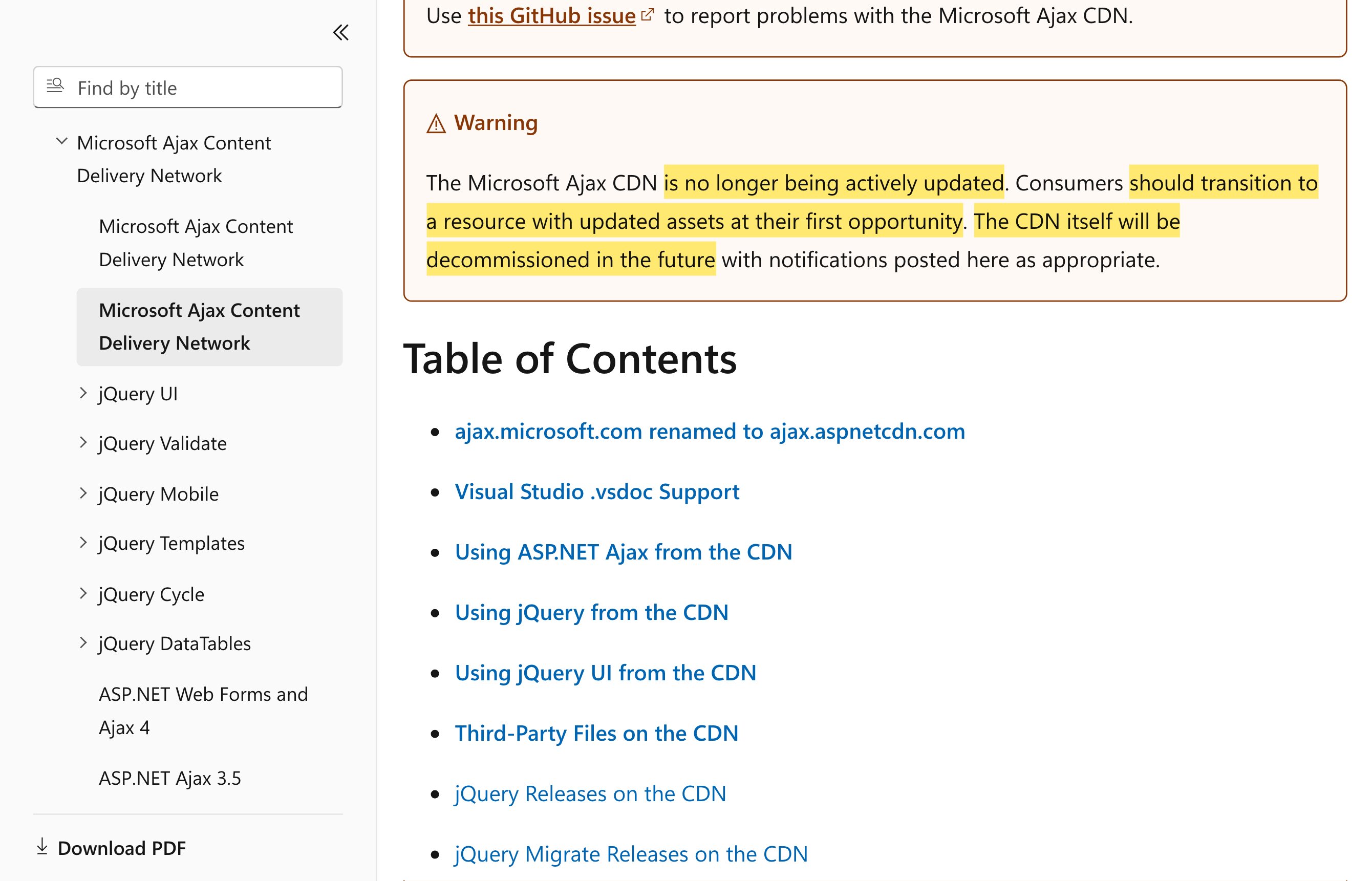
Not the way you'd hope — and for two separate reasons. First, Microsoft is retiring the Ajax CDN: its own docs say it "is no longer being actively updated" and "will be decommissioned in the future," so any site still loading jQuery or other libraries from ajax.aspnetcdn.com has to move them off, China or not. Second, because this is a pure script host that ships code rather than your users' data, the CDN is not where your China compliance risk lives.
Microsoft's documentation tells consumers to "transition to a resource with updated assets at their first opportunity," and warns that "production applications should not take a hard dependency on CDN assets." For a mainland-China audience that leaves two real issues, neither of them about the CDN storing data: the ICP filing a public mainland site needs attaches to your website and its in-country host, not to an offshore script endpoint, and because this CDN carries code rather than personal information it is not itself a cross-border transfer under PIPL — the residency question lives in your own backend. What is left is reachability: the libraries it serves are render-blocking, so an offshore, unmaintained host that loads slowly or not at all from inside the mainland can stall your pages. The table below is Microsoft's own wording and what each line means for a China-facing site.
This is a risk map, not a verdict — what you actually need turns on where your site is hosted, what data it collects, and who your users are. Our China team can map your real exposure with you →
Compliance snapshot
- ✕ Microsoft is decommissioning the Ajax CDN — migrate off it, China or not
- ✓ It ships libraries, not user data — no PIPL residency problem from the CDN itself
- ! The ICP filing attaches to your website, not to this offshore script host
- ! Served offshore — reachability of render-blocking scripts is the live risk
- ! Microsoft's own guidance: don't take a hard dependency; keep a fallback
What Microsoft Ajax CDN's own documentation says about China
| Fact | Primary source |
|---|---|
| Microsoft is retiring the Ajax CDN. Its own documentation now carries the notice: "The Microsoft Ajax CDN is no longer being actively updated. Consumers should transition to a resource with updated assets at their first opportunity. The CDN itself will be decommissioned in the future with notifications posted here as appropriate." The endpoint still resolves today, but it is end-of-life — so any site, China-facing or not, that still pulls jQuery or other libraries from ajax.aspnetcdn.com is building on infrastructure Microsoft has slated to shut down. | Microsoft Learn — Microsoft Ajax Content Delivery Network Assets (learn.microsoft.com), retrieved 2026-10-07 |
| It ships libraries, not your users' data. Microsoft describes the service as a network that "hosts popular third party JavaScript libraries such as jQuery and enables you to easily add them to your Web applications," loaded "simply by adding a <script> tag to your page that points to ajax.aspnetcdn.com." A script host sends code to the browser; it does not collect or store the personal information of your visitors. So, unlike a cloud region or a database, this CDN is not itself a cross-border transfer of personal information under PIPL (Articles 38–43) — that data-residency question lives in your own backend, not in this endpoint. | Microsoft Learn — Microsoft Ajax Content Delivery Network Assets (learn.microsoft.com), retrieved 2026-10-07; PIPL Articles 38–43 |
| The ICP filing sits on your website, not on this CDN. A public-facing site shown to mainland visitors needs an ICP filing (ICP 备案) under State Council Order No. 292 and MIIT Order No. 33, and that filing attaches to the in-country host actually serving your site — not to an offshore script endpoint like ajax.aspnetcdn.com, which Microsoft recommends over the older ajax.microsoft.com address. Embedding a foreign CDN neither grants nor satisfies that filing; it only adds an offshore dependency to a page whose own hosting is what must be filed. | Microsoft Learn — Microsoft Ajax Content Delivery Network Assets (learn.microsoft.com), retrieved 2026-10-07; ICP regime — State Council Order No. 292; MIIT Order No. 33 |
| Microsoft says not to depend on it — which is the whole China reachability question. Its documentation warns: "Production applications should not take a hard dependency on CDN assets. Applications should test for the CDN asset referenced, and use a fallback asset when the CDN is not available." The libraries this CDN serves are render-blocking, so when an offshore, no-longer-maintained host loads slowly or intermittently from inside the mainland, pages that wait on those scripts can stall or break. That reachability exposure is the delivery half of the question — separate from the legal half above. | Microsoft Learn — Microsoft Ajax Content Delivery Network Assets (learn.microsoft.com), retrieved 2026-10-07 |
Sources verified by the 21YunBox compliance team on 2026-10-07.
For a mainland-China audience, the first thing to settle about the Microsoft Ajax CDN is not how quickly it serves jQuery — it is that Microsoft is winding the service down. Its own documentation now carries a retirement notice, and that alone means any site still pulling libraries from ajax.aspnetcdn.com has to move them, China or not. The China angle is narrower than it first looks: this is a pure script host, so it ships code to the browser rather than storing your users’ data — which keeps it clear of the data-residency problem a cloud region or database would raise, and puts the ICP obligation on your own website instead. What is left is a reachability question: whether an offshore, no-longer-maintained endpoint loads reliably from inside the mainland for the render-blocking libraries it carries.
Microsoft Ajax CDN in China at a glance
| What decides it | In Microsoft's own terms |
|---|---|
| Is it still supported? | No. Microsoft's docs state the CDN “is no longer being actively updated” and “will be decommissioned in the future,” and tell consumers to “transition to a resource with updated assets at their first opportunity.” This is end-of-life, independent of China. |
| What it serves | JavaScript libraries, not user data — it “hosts popular third party JavaScript libraries such as jQuery,” loaded by “adding a <script> tag to your page that points to ajax.aspnetcdn.com.” A script host sends code to the browser; it stores none of your visitors' personal information. |
| Data residency / PIPL | No cross-border transfer of personal data arises from the CDN itself, because it carries code rather than user data. Your PIPL and data-localization duties sit in your own backend, not in this endpoint. |
| ICP filing | Attaches to your website and its in-country host — not to an offshore script CDN. Embedding ajax.aspnetcdn.com neither grants nor satisfies an ICP filing. |
| Is it reachable? | Served from offshore. The libraries it ships are render-blocking, so an unmaintained foreign endpoint that loads slowly or intermittently from inside the mainland can stall your pages — which is why Microsoft itself says not to take “a hard dependency” on it. |
Microsoft is retiring the Ajax CDN — so this decision is largely made
Before China enters the picture at all, the service’s own status narrows your options. In a warning at the top of its documentation, Microsoft states that “the Microsoft Ajax CDN is no longer being actively updated,” that “consumers should transition to a resource with updated assets at their first opportunity,” and that “the CDN itself will be decommissioned in the future with notifications posted here as appropriate.” The ajax.aspnetcdn.com endpoint still resolves today, but it is on a published path to shutdown. A site that loads jQuery or other libraries from it therefore has migration ahead of it no matter where its audience sits — and standing up a China-facing site on an endpoint its own maker is retiring would be building on sand.
A script CDN is not where your China data risk lives
This is the part worth getting right, because it is easy to over-state. The Microsoft Ajax CDN is a pure asset host: in Microsoft’s words it “hosts popular third party JavaScript libraries such as jQuery and enables you to easily add them to your Web applications,” which you use “simply by adding a <script> tag to your page that points to ajax.aspnetcdn.com.” It sends code — library files — down to the browser. It does not collect, process, or store the personal information of the people visiting your site.
That distinction decides the compliance question. Because the CDN carries code rather than user data, embedding it does not by itself create a cross-border transfer of personal information under PIPL, and it triggers no data-localization duty — those obligations live where your site actually gathers and keeps user data, in your own backend. Nor does a script endpoint carry an ICP filing: a public-facing site served to mainland visitors needs an ICP filing (ICP 备案) under State Council Order No. 292 and MIIT Order No. 33, and that filing attaches to the in-country host serving the site — not to a foreign CDN you reference from a <script> tag. Pulling libraries from ajax.aspnetcdn.com neither grants nor satisfies that filing; it simply adds an offshore dependency to a page whose own hosting is what must be filed.
What’s actually left is reachability — and it’s fragile
Strip away the data-residency and ICP points that do not apply to a script host, and one real China exposure remains: whether the libraries load. Microsoft’s own guidance is blunt about the general risk — “production applications should not take a hard dependency on CDN assets,” and applications “should test for the CDN asset referenced, and use a fallback asset when the CDN is not available.” The libraries this CDN serves are typically render-blocking, so a page that waits on jQuery from an offshore, no-longer-maintained endpoint inherits that endpoint’s reliability. When such a host loads slowly or intermittently from inside the mainland, the page can stall or break — a delivery problem, separate from the legal questions, but a real one for a China-facing site.
This is a risk map, not a verdict: whether a stalled script, a missing ICP filing on your own site, or a PIPL duty in your backend is what matters for you depends on how your site is hosted, what data it collects, and who your users are — worth settling with counsel before you build.
Where 21YunBox fits — a compliant overlay, not a migration
You do not need the Microsoft Ajax CDN to keep its libraries, and you should not try to revive a service its own maker is retiring. The durable move is to serve your site’s own assets — the JavaScript libraries included — from ICP-filed delivery inside the mainland, set in front of the origin you already run, with no rebuild, no second codebase, and no dependence on a foreign script host that is on its way out. Our China team maps where your real obligations sit — the ICP filing on your website, and any PIPL duties in the data your backend collects — then stands up the compliant, in-country delivery that an offshore CDN, retired or not, was never going to provide.
Related reading:
Frequently Asked Questions
Is the Microsoft Ajax CDN being shut down?
Yes. Microsoft's own documentation states the CDN "is no longer being actively updated" and "will be decommissioned in the future," and tells consumers to "transition to a resource with updated assets at their first opportunity." The ajax.aspnetcdn.com endpoint still resolves today, but it is end-of-life — so any site referencing it should plan to move its libraries off, a decision that stands independently of China.
Does using the Microsoft Ajax CDN create a China data-residency problem?
Not on its own. The CDN ships JavaScript libraries such as jQuery to the browser; it does not collect or store your visitors' personal information, so embedding it is not itself a cross-border transfer of personal data under PIPL, and it carries no data-localization duty. Your PIPL and ICP obligations live where your site is actually hosted and where it collects user data — not in a third-party script endpoint. Treat the specifics as risk to confirm with counsel for your own setup.
Can 21YunBox help serve these libraries reliably in China?
Yes. Rather than lean on an offshore, soon-to-be-retired script host, our China team can deliver your site's own assets — including the JavaScript libraries it needs — from ICP-filed, in-country delivery placed in front of your existing origin, with no rebuild and no second codebase. We can also map your real ICP and PIPL exposure, which sits on your website and backend rather than on the CDN. Get in touch to work through your case.