Does jsDelivr Work in China? Reachability, Reliability & the ICP-Gated CDN
jsDelivr is a free public CDN for open-source files — reachable from mainland China, but its own network page describes a "Near China" network, not points of presence inside the mainland. So your assets load across the border, and reliable in-country delivery is gated by China's ICP licensing. A compliance-first look at reachability, reliability and the fix.
Does jsDelivr work in China?
Whether jsDelivr works in China is a reachability-and-reliability question — and the part that makes in-country delivery reliable runs into China's licensing regime, not a speed setting. jsDelivr serves public, open-source files, so this is a delivery question, not a personal-data one: PIPL's cross-border rules are not the axis here.
In jsDelivr's own words it is "A free CDN for open source projects," "Optimized for JS and ESM delivery from npm and GitHub," over a "Multi-CDN Global Network." For China, though, its network page describes not points of presence inside the mainland but a "Near China" network — "multiple locations close [to] Chinese urban centers." Close to the mainland is still outside it: a mainland browser fetches your jsDelivr-hosted assets across the border and rides whatever the cross-border network is doing that minute, so a render-blocking <script> can stall or fail in the tail even when jsDelivr is healthy. Serving those same files from inside the mainland — the one place that removes the border — takes an ICP-filed in-country path that a public, offshore-adjacent CDN does not give you. The facts below set out what's verified and what to confirm with jsDelivr.
This is a delivery-and-licensing risk picture, not a verdict on jsDelivr. Our China team can map an in-country asset-delivery path with you →
What jsDelivr's own documentation says about China
| Fact | Primary source |
|---|---|
| In jsDelivr's own words: jsDelivr is "A free CDN for open source projects," "Optimized for JS and ESM delivery from npm and GitHub," delivered over a "Multi-CDN Global Network." It serves public, open-source files — not your users' personal data — so the China question here is about delivery and reliability, not PIPL or data residency. That is the honest axis for a public asset CDN. | jsDelivr — official site (homepage), retrieved 2026-10-07 |
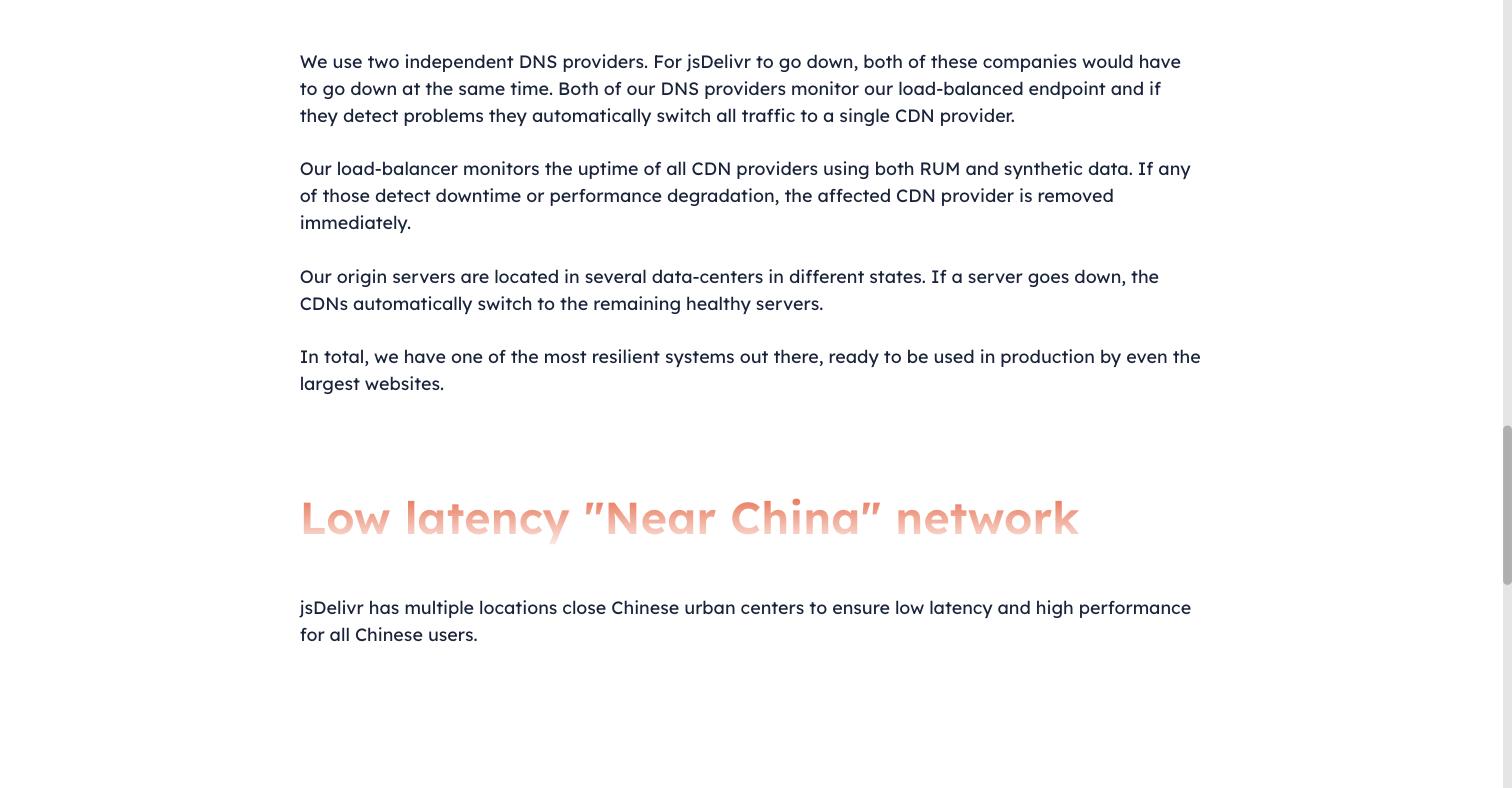
| jsDelivr's own network page does not describe points of presence inside mainland China. It describes a "Low latency 'Near China' network" with "multiple locations close [to] Chinese urban centers to ensure low latency and high performance for all Chinese users." Close to the mainland is still outside it: a "near China" network serves mainland browsers across the border, not from in-country, ICP-filed infrastructure you control. | jsDelivr — Our Network, retrieved 2026-10-07 |
| Serving a site or service to mainland visitors from infrastructure physically inside the mainland is gated by China's licensing regime: it needs an ICP filing (ICP 备案) under the State Council's Order No. 292 and MIIT's Order No. 33, attached to a mainland hosting resource. That licensing dependency — not raw speed — is why running in-country points of presence means holding a license, and why a public CDN's in-mainland availability can be granted, changed or withdrawn over time. Confirm jsDelivr's current China delivery status with jsDelivr. Separately, your own public-facing domain needs its own ICP filing, whichever CDN serves its assets. | PRC Regulations on Telecommunications (State Council Order No. 292); Administrative Measures for the Filing of Non-operational Internet Information Services (MIIT Order No. 33) |
| The gap is licensing, not engineering. jsDelivr publishes a large, resilient network — in its own terms "Four CDN & three DNS providers" and "More than 540 points of presence" — yet for China its own page stops at a "Near China" network rather than in-mainland POPs. Even a four-CDN, multi-hundred-PoP system describes China as near because serving from inside is a licensing question a public CDN cannot clear on your behalf. | jsDelivr — Our Network / homepage network stats, retrieved 2026-10-07 |
Sources verified by the 21YunBox compliance team on 2026-10-07.
For a mainland-China audience, the useful question about jsDelivr is not how fast a public CDN can be — it is whether the open-source files your pages depend on will load reliably, every time, for users inside the mainland. jsDelivr answers part of that in its own words: it is a free public CDN for open-source npm and GitHub files, and for China its network page publishes not points of presence inside the mainland but a “Near China” network. A public asset CDN carries none of your users’ personal data, so this is not a data-residency question — it is a reachability-and-reliability one. And the piece that makes in-country delivery reliable is gated by China’s licensing regime, not by a speed dial.
jsDelivr in China at a glance
| What decides it | In jsDelivr's own terms |
|---|---|
| What it is | A free public CDN for open-source files — “A free CDN for open source projects,” “Optimized for JS and ESM delivery from npm and GitHub,” over a “Multi-CDN Global Network.” It carries no personal data of your users, so the China question is delivery, not PIPL. |
| Where it serves China from | Its network page describes a “Low latency ‘Near China’ network” — “multiple locations close [to] Chinese urban centers” — not points of presence inside the mainland. Close to China is still across the border. |
| What that means for reliability | Mainland browsers fetch your assets across the border, subject to cross-border network conditions. A render-blocking script can stall or fail in the tail even when jsDelivr itself is healthy. |
| In-country delivery | Serving these files from inside the mainland needs an ICP filing tied to a mainland hosting resource. A public, offshore-adjacent CDN gives you no in-country, ICP-filed path you control. |
| Your own site | Separate from jsDelivr: a public-facing site you run for mainland visitors from in-country infrastructure needs its own ICP filing — whichever CDN serves its assets. |
Reachable, yes — reliable in the tail is the real question
jsDelivr is not blocked in mainland China. A public CDN for open-source libraries, it generally resolves and serves. But “it loads” and “it loads every time, fast enough, for every user” are different promises, and for a script host the gap between them is exactly where pages break. jsDelivr’s own description of its China setup is a “Near China” network — locations close to Chinese urban centers, not inside the mainland. So every request from a mainland browser for one of your jsDelivr-hosted files crosses the border and rides whatever the cross-border network is doing at that moment.
When the file jsDelivr serves is a render-blocking <script> or stylesheet in your page’s critical path, an intermittent cross-border stall does not merely slow one asset — it can hold up rendering or fail the load outright, even while jsDelivr’s own network is perfectly healthy. That tail — the occasional slow or failed fetch, not the median case — is the exposure a public, offshore-adjacent CDN leaves on a China-facing page. We describe this qualitatively on purpose: we publish China performance numbers only with the method, sample and date behind them, and we hold no first-party jsDelivr measurement to stand one on here.
Why it’s a “Near China” network, not an in-China one — ICP licensing
The reason a large, well-engineered multi-CDN still describes its China presence as near rather than inside is not engineering — jsDelivr publishes a four-CDN network with hundreds of points of presence. It is licensing. Delivering a site or service to mainland visitors from infrastructure physically located in the mainland turns on an ICP filing (ICP 备案) under the State Council’s Order No. 292 and MIIT’s Order No. 33, tied to a mainland hosting resource. Running points of presence inside China means holding that license — so a public CDN’s in-mainland availability depends on licensing that can be granted, changed, or withdrawn over time, independent of how fast the network is. That is why the honest status of any public CDN’s China delivery is “confirm the current state with the vendor,” and why jsDelivr’s own page today points to a “Near China” network rather than in-mainland points of presence.
One more licensing point, separate from jsDelivr’s: your own public-facing site needs its own ICP filing to be served to mainland visitors from in-country infrastructure — whichever CDN delivers its assets. Choosing a reliable asset-delivery path does not remove that obligation on your domain.
This is a delivery-and-licensing risk map, not a legal verdict: whether and how it applies to you turns on what you serve, from where, and to whom — worth settling with counsel before you build.
Where 21YunBox fits — a compliant overlay, not a migration
You keep pulling the same open-source libraries you already use. We add the one piece a public, offshore-adjacent CDN cannot: compliant, ICP-filed delivery of those assets from inside the mainland, set in front of your existing origin — no rebuild, no second codebase, and no change to how your pages reference their files. Instead of mainland users fetching your render-blocking scripts across the border from a “near China” network, they load them from in-country, ICP-filed infrastructure that takes the border out of the critical path. Our China team maps which of your jsDelivr-served assets actually matter for mainland users, stands up the in-country delivery path, and checks whether your own domain needs its own ICP filing — so the reliability and the licensing are handled together.
Related reading: