Does Azure AI Speech Work in China? The 21Vianet Sovereign-Cloud Path, Voice-Data Residency & Cross-Border
Azure AI Speech is available in mainland China — but through the separate, network-isolated sovereign cloud, Microsoft Azure operated by 21Vianet (世纪互联), in the China East 2, China North 2, and China North 3 regions, not the global service. The real decision for a China-facing voice feature isn't how fast a transcript returns — it's voice-data residency: Azure Speech processes speech data in the region where the resource lives, so a global region puts recordings and transcripts offshore, a PIPL cross-border transfer, while the data-resident lawful path is the 21Vianet cloud (with a documented feature gap to confirm). A compliance-first look at the two Azures, where voice data is processed, CSL Article 39 (formerly Article 37) residency, and the lawful in-country path.
Does Azure AI Speech work in China?
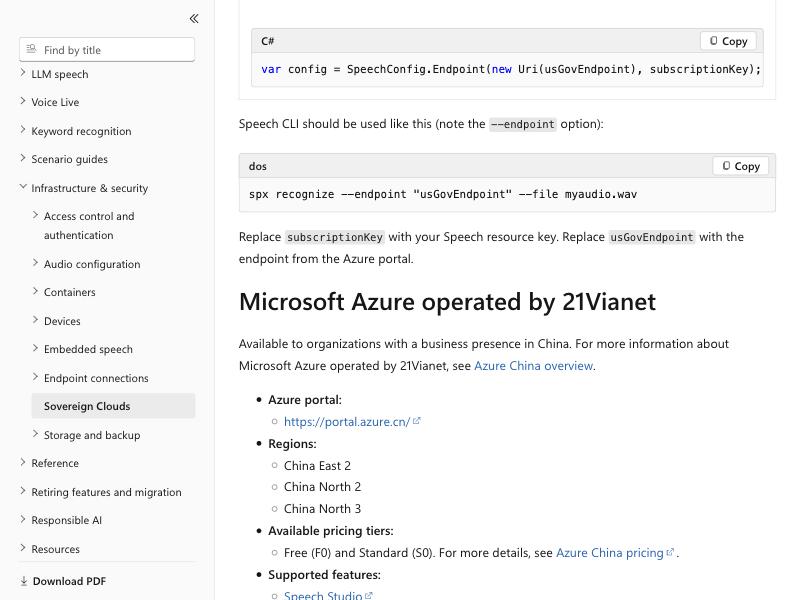
Yes — Azure AI Speech is available in mainland China, but through a separate, network-isolated sovereign cloud: Microsoft Azure operated by 21Vianet (世纪互联), in the China East 2, China North 2, and China North 3 regions, not the global service. Microsoft documents the Speech service as "available to organizations with a business presence in China," with data kept in-country on that footing.
Because a lawful in-country option exists, the real decision is voice-data residency, not speed. Microsoft states Azure Speech "stores and processes speech data in the region where you create your resource," so a global region puts recordings and transcripts outside the mainland — a PIPL cross-border transfer of personal information (and, for a CII operator, a residency problem under Cybersecurity Law Article 39 (formerly Article 37)), with a higher bar where voice is used to identify a person. The data-resident path is the 21Vianet cloud — but feature parity is not one-to-one, so confirm the specific capability you need with Microsoft and 21Vianet.
21YunBox maps the lawful voice path, localizes your feature onto the data-resident China option — the 21Vianet-operated Speech service where available, or a domestic speech service — and delivers the China-facing app that captures the audio in-country on ICP-filed infrastructure, so it runs legally in the mainland. We never use or suggest any form of circumvention. Treat the specifics as a risk to confirm with counsel.
What Azure AI Speech's own documentation says about China
| Fact | Primary source |
|---|---|
| Azure AI Speech runs in China through the 21Vianet sovereign cloud. Microsoft's Speech "sovereign clouds" page lists the service under “Microsoft Azure operated by 21Vianet,” “Available to organizations with a business presence in China,” in the China East 2, China North 2, and China North 3 regions — a separate cloud from the global service, with its own portal.azure.cn and .azure.cn endpoints. | Microsoft Learn — Sovereign Clouds, Speech service (learn.microsoft.com), retrieved 2026-10-08 |
| Feature availability in the China cloud is not complete. On the same Microsoft page, the China (21Vianet) cloud supports core speech to text, text to speech, translation, pronunciation assessment, and keyword recognition, but lists custom voice, personal voice, text-to-speech avatar, Voice Live, live interpreter, video translation, and LLM speech as unsupported. Confirm the capability you need before you build. | Microsoft Learn — Sovereign Clouds, Speech service (learn.microsoft.com), retrieved 2026-10-08 |
| Speech data lives where the resource lives. Microsoft's Speech regions documentation states: “Azure Speech stores and processes speech data in the region where you create your resource.” A resource created in a global (non-China) region therefore processes a China user's voice data outside the mainland. | Microsoft Learn — Supported regions for Azure Speech (learn.microsoft.com), retrieved 2026-10-08 |
| Sending voice data to an offshore region is a PIPL cross-border transfer. Routing a Chinese user's recordings, transcripts, or attached records to a Speech resource outside the mainland triggers PIPL Articles 38–40: notice, a separate consent, and one transfer mechanism — a CAC security assessment, the CAC standard contract, or certification — with in-country storage for CII operators under Article 40 and Cybersecurity Law Article 39 (formerly Article 37). | Personal Information Protection Law of the PRC, Articles 38–40 (cac.gov.cn), retrieved 2026-10-08 |
Sources verified by the 21YunBox compliance team on 2026-10-08.
For a mainland-China audience, the question to settle about Azure AI Speech — the speech-to-text, text-to-speech, and translation service in Azure AI services, formerly Cognitive Services Speech — is not how quickly a transcript comes back. It is which Azure you are calling. Azure global, operated by Microsoft, is one cloud. Microsoft Azure operated by 21Vianet (世纪互联) is a separate, network-isolated cloud that runs inside the mainland under a licensed local operator, with its own portal at portal.azure.cn and its own .azure.cn endpoints. Azure AI Speech exists in both — but they are not the same service, and they do not sit in the same country.
That matters because Speech is, by design, a service that handles voice. A request carries whatever a person said and, depending on how you use it, a recording that can identify them. Where that audio is processed is therefore the decision — not the frame rate of the playback. And here the honest answer has a hopeful shape most foreign voice services can’t offer: a data-resident, in-country footing already exists. Microsoft’s own documentation lists Azure AI Speech among the services available in the 21Vianet-operated China cloud, in the China East 2, China North 2, and China North 3 regions, “available to organizations with a business presence in China.” The lawful way to put Azure AI Speech in front of Chinese users runs through that footing — never around a block, and never through any form of circumvention.
It is a path to confirm, not a guarantee. The 21Vianet cloud does not carry every Speech capability the global service does: Microsoft’s own sovereign-cloud page marks several features — custom voice, personal voice, the text-to-speech avatar, Voice Live, live interpreter, video translation, and LLM speech — as unsupported there. So whether the specific capability your product depends on is available in the China cloud is something you verify directly with Microsoft and 21Vianet before you build.
Azure AI Speech in China at a glance
| What decides it | In Microsoft's own terms — and China's law |
|---|---|
| What it is | Azure AI Speech — speech to text, text to speech, and speech translation (the Speech service in Azure AI services, formerly Cognitive Services Speech). Two clouds matter for China: the global Azure service, and a separate cloud, Microsoft Azure operated by 21Vianet (世纪互联), run inside the mainland. |
| Is there a lawful in-China option? | Yes — through the 21Vianet cloud. Microsoft documents Azure AI Speech as available in Microsoft Azure operated by 21Vianet, in the China East 2, China North 2, and China North 3 regions, "available to organizations with a business presence in China." Data is kept in-country on that footing. |
| Feature parity is not one-to-one | Core speech to text, text to speech, translation, pronunciation assessment, and keyword recognition are supported in the China cloud, but Microsoft's own sovereign-cloud page lists custom voice, personal voice, the text-to-speech avatar, Voice Live, live interpreter, video translation, and LLM speech as unsupported there. Confirm the capability you need with Microsoft and 21Vianet before you design around it. |
| Where the voice data is processed | Microsoft states Azure Speech "stores and processes speech data in the region where you create your resource." A global (non-China) region therefore puts recordings and transcripts outside the mainland — a cross-border transfer of personal information under PIPL (Articles 38–40); where voice is used to identify a person (voiceprint), it can be sensitive personal information. The 21Vianet regions keep that data in-country. |
| The app that captures the audio | The China-facing app, IVR, or call feature that records users and sends the audio is itself a public mainland service, so it carries an ICP filing (备案) duty and needs compliant, in-country delivery like any other China-facing property. |
Two Azures: Speech in the sovereign cloud operated by 21Vianet
Azure AI Speech’s presence in the mainland is set by Microsoft’s documentation, not by a load-time test — and the documentation is specific about which Azure carries it. The global “supported regions” list for Speech names datacenters across the US, Europe, and the wider Asia-Pacific, but no mainland-China region. The China footing lives on a different page: Microsoft’s Speech “sovereign clouds” documentation, which describes these clouds as “isolated in-country/region platforms with independent authentication, storage, and compliance requirements,” and lists Azure AI Speech under “Microsoft Azure operated by 21Vianet,” available in the China East 2, China North 2, and China North 3 regions, through portal.azure.cn and .azure.cn endpoints, to organizations with a business presence in China.
Two consequences follow. First, the China cloud is a separate account on a separate cloud — a resource you stand up at portal.azure.cn, not a region toggle on a global Azure subscription. Second, availability is at the feature level, and it is not complete: Microsoft’s own list names custom voice, personal voice, the text-to-speech avatar, Voice Live, live interpreter, video translation, and LLM speech as unsupported in the China cloud today, and such lists change over time. Treat the capability you depend on as a question to settle with Microsoft and 21Vianet, not an assumption carried over from the global service. For that reason this page publishes no first-party China latency figure for Speech: a lawful in-country cloud already exists, so speed is not the axis the decision turns on.
The data axis: voice is personal information, and where it is processed decides residency
The gate that actually decides a China voice deployment is the audio itself. Microsoft states plainly that Azure Speech “stores and processes speech data in the region where you create your resource” — so the choice of region is the choice of where your users’ voice data goes. Create the resource in a global (non-China) region and serve a user in China from it, and every recording, transcript, and any attached record leaves the country: a cross-border transfer of personal information under China’s Personal Information Protection Law. The duty sits on the handler — you, not the cloud vendor. PIPL Articles 38–40 require notice, a separate consent distinct from the user’s agreement to use the feature, and one transfer mechanism — a CAC security assessment, the CAC standard contract, or certification.
Voice also raises the sensitivity bar. A recording is personal information in every case, and where you use voice to identify a specific individual — voiceprint or speaker recognition — it can be sensitive personal information (biometric characteristics) under PIPL, which carries a higher consent-and-necessity standard. How far that reaches depends on what your feature actually does with the audio, which is why it belongs with counsel rather than a default assumption.
Underneath that sits residency. A critical information infrastructure operator or a large-volume handler must store personal information collected in China inside the mainland — PIPL Article 40, together with the Cybersecurity Law (Article 39 in the revision in force since January 1, 2026; formerly Article 37) — a duty an offshore region structurally cannot meet, and where volumes or sensitivity cross the thresholds the export itself needs a CAC data-export security assessment before it may proceed. Deploy instead into the 21Vianet regions, and the residency question changes shape: the voice data stays within China by design, on the licensed local operator’s datacenters, and the cross-border problem narrows to whatever you deliberately route out.
The app that captures the voice still needs filing
Choosing a data-resident region settles where the audio is processed; it does not, on its own, make the product that collects it a lawful China service. The microphone-enabled app, the IVR or call-center flow, the voice assistant or dictation feature that records a user in China and ships the audio to Speech is itself a public-facing property in the mainland. That carries an ICP filing (备案) duty and needs compliant in-country delivery like any other China-facing site or app — a transcription that returns the instant someone stops speaking, off an unfiled, offshore front end, has solved only half the problem.
The lawful path — map, localize, deliver
There is a lawful way to run Azure AI Speech for Chinese users, and it has a clear shape: the voice data is handled from inside China on a footing that keeps it resident, and the China-facing app that captures the audio is itself filed and delivered in-country. The part 21YunBox owns is that footing, and it is more than advice. Our China team does three things on it. We map the lawful voice path — your PIPL and data-residency exposure, whether the specific Speech capability you need is available in the 21Vianet cloud, and where the sensitive-information bar may apply — so you know what each option obliges before you commit. We localize your feature onto a compliant China-legal option: standing up Azure AI Speech in Microsoft Azure operated by 21Vianet where the capability you need is available, or integrating a domestic speech service where it is not, so the audio stays in-country in place of a call that would otherwise run offshore. And we deliver the China-facing app that captures and surfaces the voice in-country on ICP-filed infrastructure — the 21YunBox Optimizer — in front of what you already run, with no rebuild and no re-platform.
The result is a speech feature that runs legally and compliantly for your users in China. What we never do, and what no one lawfully should, is route anyone around a block through any other form of circumvention: this is a lawful, data-resident in-country deployment, built on the China cloud Microsoft and 21Vianet already provide. Where the service you want isn’t offered there, we localize onto a licensed domestic equivalent rather than reach offshore.
Related reading:
- Cross-border data transfers under PIPL
- China’s Cybersecurity Law — Article 39 (formerly Article 37) and data localization
- China’s data-export security assessment measures
- How to get an ICP filing for China