Does Agora Work in China? Reachability, the App's Telecom & Content Licensing, and Call Data
Agora (声网) is unusual among foreign developer services: it runs its real-time network inside mainland China — Agora's own docs list 'Mainland China' as an SD-RTN media zone the SDK connects to — so on the network side the answer is largely yes. The real decision for a China-facing real-time audio/video or live app is a compliance one at the app level: an ICP filing, usually a commercial ICP or value-added telecom license, content and real-name duties for interactive and live features, and call media that is personal information under PIPL. A compliance-first look at reachability, the licensing gate, the content rules, the call-data question, and the lawful path.
Does Agora work in China?
Agora (声网) works in mainland China — it operates its real-time network inside the country, so the first answer on reachability is largely yes. Agora's own developer docs list "CHINA: Mainland China" as an SD-RTN media zone its SDK connects to, which makes Agora unusual among foreign developer services: it is not the thing standing between your app and your users in China.
Because reachability is settled, the real decision for a China-facing product is a compliance one, and it sits at the app level, not Agora's network. A real-time audio/video or live-streaming app is an online information and value-added telecom service: it needs an ICP filing (usually a commercial ICP license), can require a value-added telecom business license, and — for interactive or live content — real-name registration, content moderation, and audio-visual/live-streaming permits. The call media and the user identifiers behind it are personal information under PIPL, so routing or storing them offshore raises a cross-border question.
21YunBox maps the lawful path, localizes your app onto a compliant in-country footing — with Agora's China-capable network as the enabler — and delivers it on ICP-filed infrastructure, so your real-time feature runs legally in China. Agora already works there, so this is never about circumvention — we never use or suggest it. Treat the specific licensing questions as risks to confirm with counsel.
What Agora's own documentation says about China
| Fact | Primary source |
|---|---|
| Agora operates inside mainland China. Agora's developer docs ("Restrict media zones") state the SDK "automatically connects them to the Agora SDRTN(R) media zone that is geographically closest to the user," and list "CHINA: Mainland China" among the selectable media zones — so Agora's real-time network reaches the mainland, and reachability is not the blocker. | Agora Docs, "Restrict media zones" (docs.agora.io), retrieved 2026-10-08 |
| A China-facing app needs an ICP footing — and often a license. Any site or app offered to the public in the mainland needs an ICP filing (备案) under the Measures for the Administration of Internet Information Services; a commercial app generally needs a commercial ICP license, and operating real-time interactive audio/video for profit can require a value-added telecom business license (增值电信业务经营许可证). | China Telecommunications Business Licensing Measures / Measures for the Administration of Internet Information Services — 21YunBox compliance reference, retrieved 2026-10-08 |
| Interactive and live content carries its own permits. A China-facing service that transmits audio-visual programs or hosts live streams falls under the Provisions on the Administration of Network Audio-Video Information Services and related live-streaming rules — real-name registration, real-time content moderation, and, depending on the content, specific permits. Which apply turns on what users actually do. | China Provisions on the Administration of Network Audio-Video Information Services — 21YunBox compliance reference, retrieved 2026-10-08 |
| Call media sent offshore is a PIPL cross-border transfer. Audio, video, user identifiers, and recordings collected from a mainland user are personal information; routing or storing them outside the mainland triggers PIPL Articles 38–40 — notice, a separate consent, and one transfer mechanism (a CAC security assessment, the CAC standard contract, or certification). | Personal Information Protection Law of the PRC, Articles 38–40 (cac.gov.cn), retrieved 2026-10-08 |
Sources verified by the 21YunBox compliance team on 2026-10-08.
For a mainland-China audience, the usual “+China” question — will it even connect? — is the wrong starting point for Agora. Unlike most foreign developer services, Agora (声网) runs real-time media inside the mainland: its Software-Defined Real-Time Network (SD-RTN) includes a Mainland China media zone, and Agora’s own documentation lists “CHINA: Mainland China” among the zones an app’s SDK connects to. So on the network side the honest answer is largely yes — Agora is not the thing standing between your app and your users in China.
Because reachability is settled, the real decision moves to a different axis — a compliance one — and it sits at the level of your app, not Agora’s network. A China-facing app that carries real-time voice, video, or interactive live streaming is an online information service and, for commercial operation, a value-added telecom service: it turns on an ICP filing, licensing duties, and — for interactive and live content — real-name registration, content moderation, and content or live-streaming permits. The audio and video themselves, and the user identifiers behind them, are personal information under PIPL. None of that is about milliseconds, and none of it is cleared by Agora’s network reaching the mainland. To be plain up front: nothing here involves getting around a block — Agora already works in China — and 21YunBox never uses or suggests circumvention of any kind.
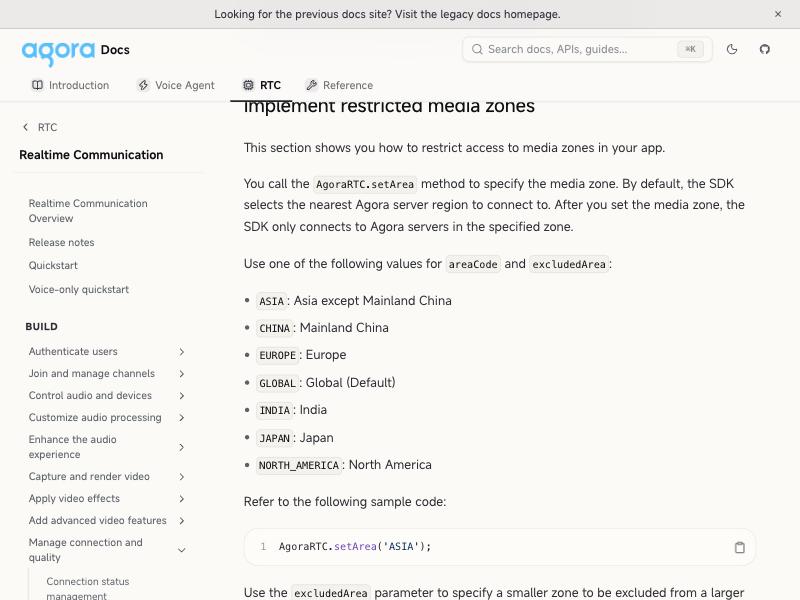
AgoraRTC.setArea. Under “Use one of the following values for areaCode and excludedArea,” Agora lists “CHINA: Mainland China” as a media zone — alongside Asia, Europe, India, Japan, North America, and Global — so Agora runs real-time media inside the mainland. Source: docs.agora.io — Restrict media zonesAgora in China at a glance
| What decides it | In Agora's own terms — and China's law |
|---|---|
| What it is | Agora (声网) — a real-time engagement platform: voice, video, interactive live streaming, and signaling, delivered through its Software-Defined Real-Time Network (SD-RTN). It operates globally and, unlike most foreign developer services, inside mainland China. |
| Is it reachable in the mainland? | Largely yes. Agora's SD-RTN includes a Mainland China media zone, and its own docs list “CHINA: Mainland China” as a zone the SDK connects to. Agora is not the blocker here, so reachability is not the deciding question. |
| The real gate: app-level licensing | A China-facing app offering real-time audio/video or live streaming is an online information and value-added telecom service. It needs an ICP filing (备案), usually a commercial ICP license, and — for commercial operation — can require a value-added telecom business license (增值电信业务经营许可证). The category depends on the service and is subject to telecom foreign-investment rules. |
| Interactive & live content | Interactive and live audio/video carry content duties: real-name registration, real-time moderation, and — depending on the content — permits under the Provisions on the Administration of Network Audio-Video Information Services and the related live-streaming rules. Which permits apply turns on what users actually do. |
| Call media & user data | Audio/video streams, user identifiers, and recordings are personal information under PIPL; voice and face data can be sensitive personal information. Routing or storing it outside the mainland is a cross-border transfer (Articles 38–40); data-localization bites for a CII or large-volume handler (Cybersecurity Law Article 39 (formerly Article 37)). |
| The lawful path | Run the China-facing app on an ICP-filed, in-country footing with the required telecom and content compliance, using Agora's China-capable network as the enabler. 21YunBox maps that path, localizes the app onto a compliant footing, and delivers it in-country — never through circumvention of any kind. |
Reachability: Agora’s network reaches the mainland — that part is largely settled
Agora’s position is in its own developer docs, not a load-time guess. The SDK connects a user to “the Agora SDRTN(R) media zone that is geographically closest to the user,” and the selectable media zones include “CHINA: Mainland China” alongside Asia, Europe, North America, Japan, and India. Agora even frames the choice of zone as a way to “meet the laws and regulations of the user’s country” — its own acknowledgment that where real-time media is carried is itself a regulatory question. For a China-facing real-time feature, then, the question is not whether Agora can reach the mainland; it is whether the app that uses it is licensed and delivered on a compliant footing.
For that reason this page publishes no first-party China latency figure for Agora: speed is not the axis for a service that already operates in-country — licensing and data are. And to be unambiguous, since Agora is reachable there is nothing here to work around: 21YunBox neither provides nor suggests circumvention of any kind. The productive question is how to run a real-time China-facing app lawfully.
The real gate: your app is a value-added telecom and content service
Suppose you ship a China-facing app with real-time calling, a video room, or a live-streaming feature. The first gate is not the SDK — it is what that app is, in Chinese regulatory terms. Any site or app made available to the public in the mainland needs an ICP filing (备案) as a baseline, under the Measures for the Administration of Internet Information Services. If the app is commercial — most are — it generally needs a commercial ICP license (经营性 ICP, the B25) rather than a simple filing. And because real-time interactive audio/video behaves like a telecommunications service, operating it for profit can require a value-added telecom business license (增值电信业务经营许可证); the exact sub-category depends on what your feature does, and telecom is subject to China’s foreign-investment limits — a point to settle with counsel before you build.
The through-line is that these filings and licenses attach to your app and your operating entity, not to Agora. Agora’s network reaching the mainland is the enabler; it does not carry, or satisfy, your ICP or telecom obligations. Whether and which of them apply to your specific service is a risk to confirm with qualified counsel against what you actually ship.
Interactive and live content carries its own compliance
Real-time audio/video that is interactive or broadcast adds a content layer on top of the telecom layer. Under the Provisions on the Administration of Network Audio-Video Information Services and the related live-streaming and online-performance rules, a China-facing service that transmits audio-visual programs or hosts live streams can need its own permits, must verify users by real identity, and must moderate content in real time. Which permits apply depends on exactly what your users do on the feature — one-to-one calling, group rooms, and public live broadcast are treated differently — so the precise obligations are a risk to confirm with counsel against your real use case.
The point for Agora specifically: its network can carry the stream in the mainland, but the permits, the real-name checks, and the moderation attach to your app, not to the SDK underneath it. A compliant real-time feature is one where those duties are met by the operator who offers it to the public.
Call media and user data are personal information
The last gate is the data. A real-time session is never just a connection — it carries voices, faces, screen shares, chat, and the identifiers tied to real people, plus any recordings you keep. Under China’s Personal Information Protection Law, all of that is personal information, and voice and facial data can be sensitive personal information with a higher bar. If your app routes or stores that media or those user records outside the mainland — a non-China media zone, an offshore recording store, an overseas analytics pipeline — that is a cross-border transfer under PIPL (Articles 38–40): notice, a separate consent distinct from agreeing to use the feature, and one transfer mechanism — a CAC security assessment, the CAC standard contract, or certification.
Data-residency can bite harder still. For an operator whose systems are designated critical information infrastructure, or that handles personal information above the state-set threshold, the personal information collected in the mainland must be handled within the mainland — the data-localization duty in the Cybersecurity Law Article 39 (formerly Article 37, renumbered by the 2025 amendment in force January 1, 2026). Agora’s Mainland China media zone can keep the real-time media path in-country; whether your whole data flow does — recordings, logs, analytics, user records — is a question about your architecture, not about Agora.
The lawful path — map, localize, deliver
There is a clean way to run a real-time China-facing feature, and it does not involve working around anything. It has a shape: the app is filed and licensed for what it actually does, the content and real-name duties are met, the media and user data stay on a compliant footing, and the whole thing is delivered in-country. Our China team works on that footing and does three things. We map the lawful path — the ICP filing or commercial ICP license, the telecom and content-permit questions, and your PIPL and data-residency exposure — so you know exactly what counsel and the regulators need to see. We localize your app onto that footing — standing up the filings, real-name and moderation, and a China-resident data and media path (using Agora’s Mainland China media zone as the enabler, or a domestic real-time provider where that fits your case better) in place of any flow that cannot run compliantly. And we deliver the China-facing app in-country on ICP-filed infrastructure — the 21YunBox Optimizer — in front of the app you already run, with no rebuild and no re-platform. The result is a real-time feature that runs legally and compliantly for your users in China. What we do not do — because Agora already operates in the mainland and no one lawfully needs it — is route traffic around any block: we never use or suggest circumvention of any kind.
Related reading:
- China Telecommunications Business Licensing Measures
- China’s Provisions on the Administration of Network Audio-Video Information Services
- China Commercial ICP License (B25): who needs one
- Cross-border data transfers under PIPL
- China’s Cybersecurity Law — data localization (Article 39, formerly Article 37)
- How to get an ICP filing for China
================= BLOCK 2: ENHANCEMENT-JSON (merge into src/data/page-enhancements.json) ================= Add this one top-level key (key = permalink without leading slash). Validated as parseable JSON.
{