Does 8x8 Work in China? PIPL Cross-Border, Telecom Licensing & Data Residency
8x8 bundles cloud phone, video, and team messaging with a cloud contact center, carrying your China users' calls, recordings, transcripts, and call-detail records to offshore regions — a PIPL cross-border transfer of voiceprint-grade sensitive data — while providing voice and contact-center service in China is a value-added telecom business a foreign platform cannot license directly. A compliance-first look at the licensing door and the residency exposure.
Does 8x8 work in China?
Providing voice and contact-center service in China needs a value-added telecom license a foreign platform can't hold on its own, and the calls and recordings 8x8 carries are sensitive personal data sitting offshore.
8x8 is an integrated cloud phone, video, and contact-center platform that stores calls, recordings (a voiceprint is sensitive PI), transcripts, and call-detail records in offshore regions — so carrying your China users' interactions to it is a PIPL cross-border transfer of sensitive personal information (Articles 28 and 29, with separate consent for the voiceprint), on top of the value-added telecom-licensing door. Tellingly, 8x8's own 2021 China offering reached local numbers through a licensed in-country carrier and a Shanghai facility, not a China telecom license of its own. The lawful lever is to route the China voice and contact-center leg through a licensed in-country operator and keep recordings and interaction data in-country — not to make the offshore platform reachable. 21YunBox is advisory on telecom licensing and holds no China telecom license.
This is a risk map, not a verdict — settle the specifics with counsel. Our China team can map your exposure →
What 8x8's own documentation says about China
| Fact | Primary source |
|---|---|
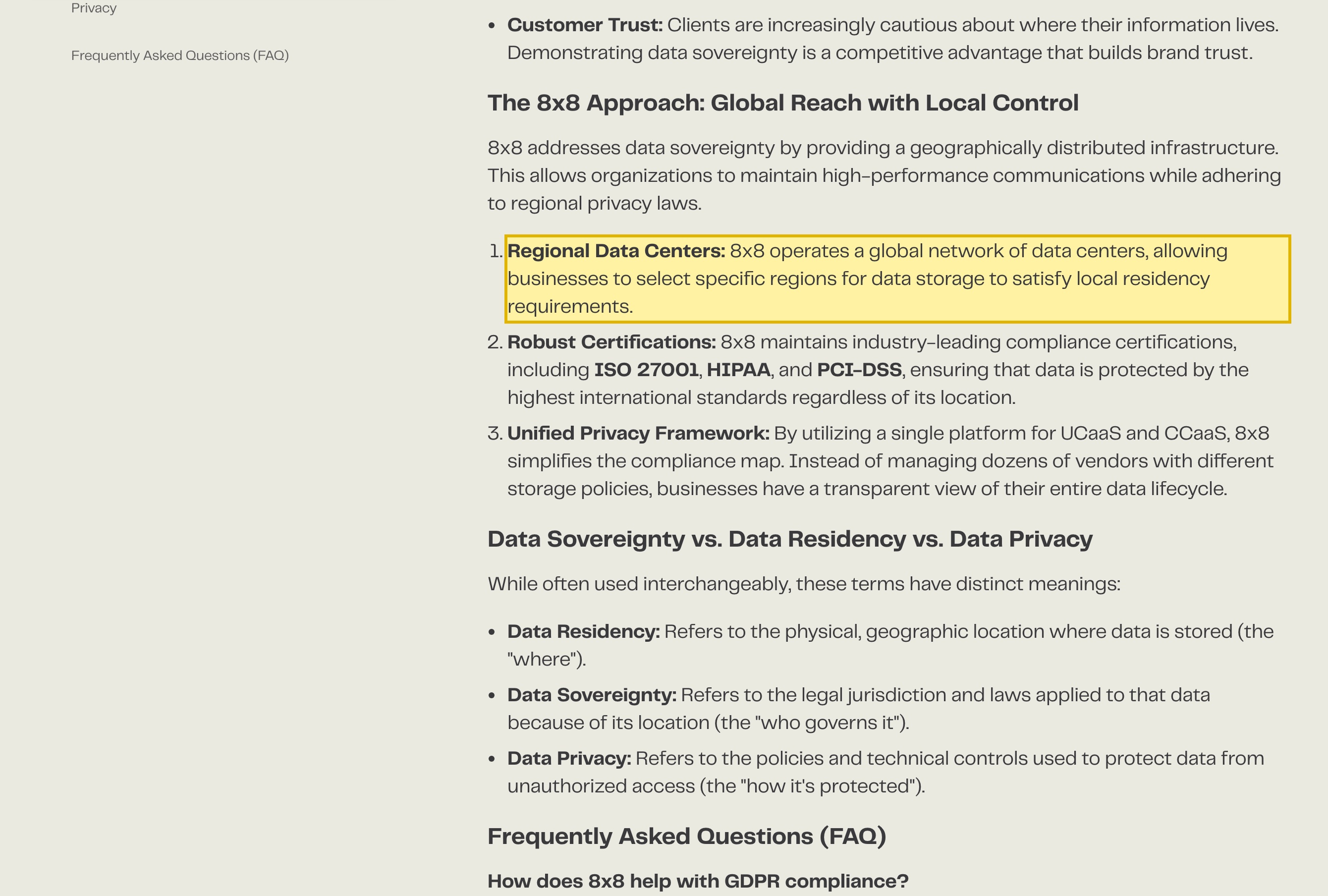
| 8x8 stores data in offshore regions a customer selects, with no mainland-China region named for data storage. 8x8's data-sovereignty page states it "operates a global network of data centers, allowing businesses to select specific regions for data storage to satisfy local residency requirements," and that through the admin console "organizations can often specify storage preferences for sensitive assets like call recordings and meeting logs" — the documented platform regions are offshore (Asia-Pacific, Europe, North America), so calls, recordings and transcripts tied to China users come to rest outside the mainland. | 8x8, "What is Data Sovereignty? Importance & Compliance" (8x8.com), retrieved 2026-10-10 |
| 8x8 records calls and meetings, transcribes and analyzes them with AI, and processes personal data across borders. 8x8's Global Privacy Notice holds "communications metadata, call-records data, messages, voicemails, meetings and transcripts," says it "records certain video conferences by default," uses AI "to enable transcriptions, summaries or analytics," and states personal information "may be transferred to and processed in countries other than the one in which you reside" — while asserting it "does not engage in automated decision-making that produces legal or similarly significant effects for individuals," so any PIPL Article 24 exposure turns on how you configure routing and scoring. | 8x8 Global Privacy Notice (8x8.com), retrieved 2026-10-10 |
| A call recording is a voiceprint — sensitive personal information under PIPL that requires separate consent. PIPL Article 28 defines biometric information (including a voiceprint) as sensitive personal information, and Article 29 requires a specific purpose, strict necessity, and a separate consent to handle it; carrying it offshore adds the cross-border duties of Articles 38-40 (notice, a separate transfer consent, and a transfer mechanism). | Personal Information Protection Law of the PRC, Articles 28-29 and 38-40 (cac.gov.cn), retrieved 2026-10-10 |
| Running voice or a contact center for mainland users is a licensed value-added telecom activity. China's Measures for the Administration of Telecommunications Business Licensing (MIIT Order No. 42, in force September 1, 2017) require a Telecommunications Business Operating License and confine operation to the stated service type and area (Articles 4 and 16); value-added telecom needs the Value-Added Telecommunications Business License (增值电信业务经营许可证), which a foreign operator cannot hold directly — so in-country voice runs through a licensed local operator. | Measures for the Administration of Telecommunications Business Licensing, MIIT Order No. 42, Arts. 4 and 16 (gov.cn), promulgated 2017-07-03, in force 2017-09-01 |
Sources verified by the 21YunBox compliance team on 2026-10-10.
For a mainland-China audience, the question about 8x8 is not whether a call connects — it is whether you may lawfully carry it, and where its record rests. 8x8 is an integrated cloud communications platform: business phone, video, and team messaging (8x8 Work) alongside a cloud contact center, run as a multi-tenant cloud with no mainland deployment. Two gates decide it. Providing voice and contact-center service to mainland users is a licensed value-added telecom business a foreign platform cannot hold on its own — 8x8’s own China numbers ran through a licensed in-country carrier, not an 8x8 license. The calls, recordings, transcripts, and call-detail records it captures rest on offshore regions: a cross-border transfer in which a recording is a voiceprint — sensitive under PIPL Article 28, needing separate consent (Article 29) — with a residency duty for larger handlers and an Article 24 angle where AI routes or scores.
8x8 in China at a glance
| What decides it | In 8x8's own terms — and China's law |
|---|---|
| What it is, and what it carries | 8x8 — an integrated cloud phone, video, and team-messaging platform (8x8 Work) with a cloud contact center. It carries and stores voice calls, call and screen recordings, voicemails, transcripts, call-detail records, and contact data. Its own privacy notice lists "communications metadata, call-records data, messages, voicemails, meetings and transcripts." A call recording is the caller's voice — a voiceprint — and so is sensitive personal information, not ordinary PII. |
| Where it is processed and stored | 8x8 runs a global network of data centers and lets customers select a region; the regions it documents for the platform are offshore (Asia-Pacific, Europe, North America), and its data-sovereignty page names no mainland-China region for data storage. Personal information collected from your China users therefore comes to rest offshore — a cross-border transfer under PIPL (Articles 38–40, 数据出境): notice, a separate consent, and one transfer mechanism. 8x8's notice states data "may be transferred to and processed in countries other than the one in which you reside." |
| The telecom-business-licensing door | Providing voice and contact-center service to mainland users is a value-added telecom business. It needs a Value-Added Telecommunications Business License (增值电信业务经营许可证) under the Measures for the Administration of Telecommunications Business Licensing (MIIT Order No. 42) — one a foreign platform cannot hold directly. 8x8's own route to the mainland proves the shape: its 2021 China offering reached local numbers through a licensed in-country carrier and a Shanghai facility, not an 8x8 telecom license. Lawful in-country voice runs through a licensed local operator. |
| Voiceprint, consent, and residency | A recording and its transcript are the speaker's voice and words: a voiceprint is sensitive personal information under PIPL Article 28, raising the bar to a specific purpose, strict necessity, and a separate consent (Article 29). For a critical-information-infrastructure operator or high-volume handler, that data must also stay in-country under Cybersecurity Law Article 39 (formerly Article 37) — the 2025 Cybersecurity Law amendment, in force January 1, 2026, renumbered the data-localization article from 37 to 39, substance unchanged. AI transcription, routing, and sentiment scoring add a PIPL Article 24 automated-decision angle. |
| The lawful path | Reachability was never the axis. Route the China voice and contact-center leg through a licensed in-country operator, keep recordings, transcripts, and call-detail records in-country with the Article 29 consent, minimize and pseudonymize, and deliver any China-facing surface over ICP-filed, in-country infrastructure (the 21YunBox Optimizer) in front of the 8x8 stack you already run. On telecom 21YunBox is advisory — it holds no China telecom license. |
What you actually carry and store — calls, recordings and interaction data
An 8x8 deployment is dense with personal information, and some of it is the most sensitive kind there is. Across 8x8 Work and the contact center it carries and stores voice calls, call recordings, screen recordings, voicemails, meeting recordings, transcripts, call-detail records, and the contact and account data attached to each interaction. 8x8’s own privacy notice names the set plainly — “communications metadata, call-records data, messages, voicemails, meetings and transcripts” — and says it “records certain video conferences by default to improve collaboration, service quality and provide training.” Transcription is a first-class feature: 8x8 states it “uses AI responsibly to enhance its services. For example, to enable transcriptions, summaries or analytics,” and its contact-center AI produces live transcripts, call summaries, and sentiment analysis. A recorded call is the caller’s voice — a biometric — alongside their name, number, account references, and whatever they say: an address, a complaint, a card number read aloud to settle a bill. The transcript, the summary, and the sentiment score all inherit that content.
None of this rests in the mainland by default. 8x8 is a multi-tenant cloud: a customer selects a storage region from 8x8’s global network, and the regions documented for the platform are offshore, with no mainland-China region named on its data-sovereignty page for data storage. There is no customer-run, on-premises 8x8 deployment to point at mainland soil, so the residency lever here is region choice plus a licensed in-country path — not self-hosting. 8x8’s notice is candid that personal information “may be transferred to and processed in countries other than the one in which you reside,” and retention is real: it describes audio and video retention of up to three months for recorded meetings, with transcripts following the recording’s own retention, and separate hot- and cold-storage windows for contact-center recordings. So the recordings and transcripts of your China callers are not momentary — they are written, kept, and processed on infrastructure outside the mainland.
Two doors: a telecom license you can’t hold, and a cross-border transfer of sensitive voice data
The first door is licensing. Providing voice, telephony, or contact-center service to users in the mainland is a value-added telecom business, and under the Measures for the Administration of Telecommunications Business Licensing (MIIT Order No. 42) it requires a Value-Added Telecommunications Business License (增值电信业务经营许可证) that, under China’s foreign-investment rules, a foreign operator cannot hold directly. This is not a speed setting; it is a structural limit. 8x8’s own history makes the point better than any argument: in 2021 it announced an industry-first cloud phone and contact center for multinationals in mainland China, and it reached local numbers in cities such as Shanghai, Beijing, Guangzhou, and Shenzhen through an interconnection with a licensed in-country carrier and a Shanghai facility — not through a telecom license 8x8 holds itself. (Its dedicated China pages now redirect, so confirm the current arrangement with 8x8.) Reaching mainland users lawfully means routing through a licensed in-country operator; that is exactly what 8x8 did, and it is the pattern that holds.
The second door is the data. A call recording, a transcript, a voicemail, and a call-detail record generated from or about a person in the mainland are personal information; carried to an offshore 8x8 region, they are a cross-border transfer (数据出境) under China’s Personal Information Protection Law. PIPL puts the duty on the handler — the business operating the phone system or contact center, not only 8x8 as the vendor: Articles 38–40 require notice, a separate consent distinct from the agreement to use the service, and one transfer mechanism (a CAC security assessment, the standard contract, or certification). A voiceprint is sensitive personal information under Article 28, which raises the bar to a specific purpose, strict necessity, and its own separate consent (Article 29). Where the operator is a critical-information-infrastructure operator or a high-volume handler, the data must also be stored in the mainland under Cybersecurity Law Article 39 (formerly Article 37). And because 8x8’s AI transcribes, summarizes, routes, and scores interactions, PIPL Article 24 can bear on any automated decision that affects a caller — note that 8x8’s privacy notice states it “does not engage in automated decision-making that produces legal or similarly significant effects for individuals,” so how Article 24 applies turns on how you configure routing and scoring, a fact only your team holds.
Reaching the platform isn’t the question — a licensed in-country path is
Because a foreign platform cannot hold the value-added telecom license and 8x8’s own mainland numbers run through a licensed local carrier, the productive question is not how to make 8x8 respond from Shanghai — it is how to run voice and a contact center for Chinese users lawfully. That has a shape. Route the China voice and contact-center leg through a licensed in-country operator that holds the telecom license; keep the recordings, transcripts, voicemails, and call-detail records of your China interactions in-country, with the Article 29 separate consent for the voiceprint data and data minimization throughout; and keep a lawful cross-border basis for anything that still leaves. This is the opposite of a tunnel that ships the data offshore anyway — localizing means the records come to rest on mainland soil and the voice runs on a licensed domestic path. On the license and carriage itself, 21YunBox is advisory: it does not hold a China telecom license and is not a carrier, so that license and the carrier relationship sit with a licensed local operator and your counsel. Which obligations bite — whether you are a CII operator, which volume thresholds you cross, which transfer mechanism fits, and how ICP filing and the renumbered Cybersecurity Law Article 39 (formerly Article 37) apply — turns on facts only you and your counsel hold. Treat this page as a map of the exposure, not a ruling, and settle the specifics with counsel.
The lawful path — map, localize, deliver
Reaching Chinese users with phone and contact center the lawful way has a shape, and it keeps 8x8 where it already runs. 21YunBox is a compliant overlay, not a migration, and for a platform like 8x8 we are a partner to it, not a competitor.
Map. We inventory what you carry and store — calls, recordings, screen recordings, voicemails, transcripts, call-detail records, and contact data — what personal and sensitive (voiceprint) information each holds, which offshore region 8x8 processes and retains it in, how your mainland numbers and calls are originated and terminated today, where AI transcribes, routes, or scores, and the consent basis for the sensitive data — so you know exactly what counsel and a licensed in-country operator need to confirm.
Localize / govern. We help you route the China voice and contact-center leg through a licensed in-country telecom/contact-center operator, keep recordings, transcripts, and call-detail records in-country, obtain the Article 29 separate consent for the voiceprint data, minimize and pseudonymize, and honor any Article 24 option. On the telecom-licensing leg our role is advisory: 21YunBox holds no China telecom license. Localizing means keeping the telephony and the records on a lawful, in-country, licensed path — never a tunnel that ships the data offshore anyway.
Deliver. The app, site, agent console, and customer portal around the contact center carry an ICP filing duty and need compliant, in-country delivery — the 21YunBox Optimizer — in front of the stack you already run, with no rebuild. The result is a communications stack that runs legally and compliantly for your users in China. 21YunBox never uses or suggests circumvention of any kind.
Related reading:
- Cross-border data transfers under PIPL
- China’s Measures for the Administration of Telecommunications Business Licensing (MIIT Order No. 42)
- China’s Cybersecurity Law — data localization (Article 39, formerly Article 37)
- China’s Data Export Security Assessment Measures
- How to get an ICP filing for China