Does SendGrid Work in China? Data Residency, Deliverability & Cross-Border Email
SendGrid's API and SMTP are callable from mainland China, so reachability is not the real question. The decision is data residency: SendGrid (Twilio SendGrid) runs no mainland-China sending region — its only regional data-residency option is the EU — so the recipient addresses, message content, and event data your China-facing email collects are stored and processed offshore, making every send a cross-border transfer (数据出境) under PIPL, and for a critical information infrastructure operator the Cybersecurity Law's in-country storage duty under Article 39 (formerly Article 37) is one an offshore region cannot meet. A compliance-first look at SendGrid's region availability, the data-residency and deliverability questions, and the lawful path.
Does SendGrid work in China?
Yes — SendGrid's API and SMTP are callable from mainland China, so the honest answer is that reachability is not the problem. What decides the China question is data residency.
SendGrid (Twilio SendGrid) runs no mainland-China sending region; its only regional data-residency option is the EU, and by default email runs through the global endpoint (api.sendgrid.com), which stores data outside the EU. SendGrid itself treats recipient email addresses, message content, and event data as personal information — so sending email collected from users in mainland China through an offshore SendGrid is a cross-border transfer (数据出境) under PIPL, requiring notice, a separate consent, and a transfer mechanism, and it may trigger China's data-export security assessment. For a critical information infrastructure operator, the Cybersecurity Law's Article 39 (formerly Article 37) requires such data to be stored in China, which an offshore SendGrid cannot satisfy. Getting email into mainland mailboxes from offshore IPs is a separate operational hurdle.
21YunBox maps your cross-border and residency exposure, localizes the China leg onto a China-resident email or notification service (keeping SendGrid for your other markets), and delivers your China-facing app in-country on ICP-filed infrastructure — with no rebuild, and never any form of circumvention. Treat the specifics as a risk to confirm with counsel.
What SendGrid's own documentation says about China
| Fact | Primary source |
|---|---|
| SendGrid's only regional data-residency option is the EU — there is no mainland-China region. Twilio SendGrid's Data Residency FAQ asks “Is Data Residency planned for regions outside the EU?” and answers: “Only the EU can use Data Residency. Twilio is evaluating expanding to other regions based on demand and feasibility.” | Twilio SendGrid Docs, “FAQ on Data Residency for EU” (twilio.com), retrieved 2026-10-08 |
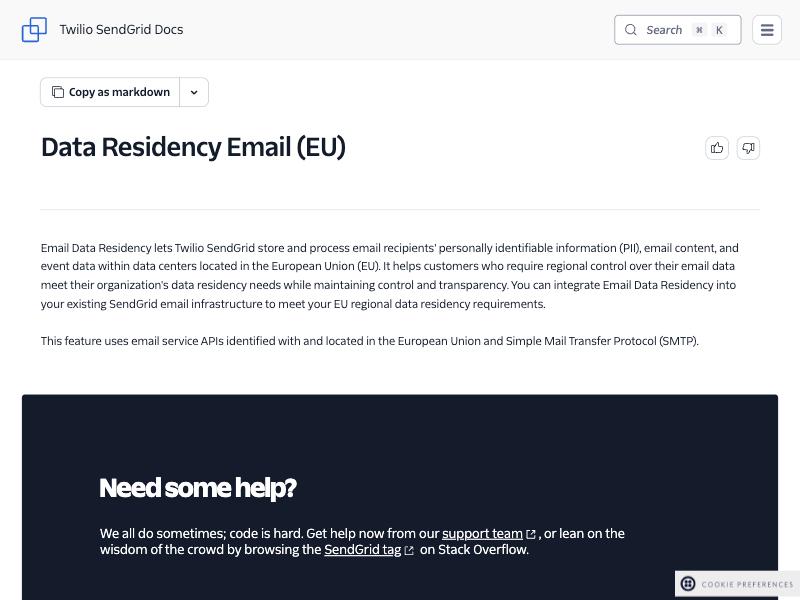
| SendGrid stores recipients' PII, message content, and event data — the payload at stake. Twilio SendGrid's Data Residency documentation states the feature lets it “store and process email recipients' personally identifiable information (PII), email content, and event data within data centers located in the European Union (EU).” | Twilio SendGrid Docs, “Data Residency Email (EU)” (twilio.com), retrieved 2026-10-08 |
| By default, email runs through the global endpoint and leaves the EU. SendGrid's FAQ states that sending through a parent or global subuser “defaults to the global endpoint (api.sendgrid.com),” which “routes data outside the EU”; the EU-resident path requires the separate endpoint https://api.eu.sendgrid.com/. | Twilio SendGrid Docs, “FAQ on Data Residency for EU” (twilio.com), retrieved 2026-10-08 |
| SendGrid itself classifies recipient addresses and event data as personal data. Its FAQ states that under the GDPR “the EU considers email event data such as opens, clicks, unsubscribes, and recipient email addresses as personal data” — the same records are personal information under China's PIPL when collected from users in the mainland. | Twilio SendGrid Docs, “FAQ on Data Residency for EU” (twilio.com), retrieved 2026-10-08 |
Sources verified by the 21YunBox compliance team on 2026-10-08.
For a product emailing users in mainland China, the first question about SendGrid is usually “can we even send to China?” — and on the wire, the answer is yes: SendGrid’s API and SMTP are callable from the mainland, and it is not a service China blocks outright. So reachability is not where the China decision is won or lost. The decision is about data residency: where the recipient addresses, message content, and engagement events your email program collects are stored, and whether that data was allowed to be there.
That is because SendGrid (Twilio SendGrid) does not run a sending region inside China. Its only regional data-residency option is the European Union, and by default email runs through SendGrid’s global endpoint, which stores data outside the EU. The moment the personal information in your China-facing email — recipient addresses, message bodies, open-and-click events — lives in an offshore SendGrid, you have made a cross-border transfer (数据出境), and a different body of law decides whether that was lawful.
SendGrid in China at a glance
| What decides it | In SendGrid's own terms — and China's law |
|---|---|
| What it is | SendGrid (Twilio SendGrid) is a transactional and marketing email service — an API and SMTP relay that stores recipient addresses, message content, and engagement events (opens, clicks, unsubscribes) and sends from its own infrastructure. |
| Is it reachable from the mainland? | Yes. SendGrid's API and SMTP are callable from China — it is not a service China blocks outright. Reachability is not the China question. (Getting mail delivered into mainland mailboxes from offshore IPs is a separate operational matter, below.) |
| Where does the email data sit? | Offshore. SendGrid's only regional data-residency option is the EU (documented data centers in Frankfurt, Dublin, and Amsterdam). By default, email runs through the global endpoint, api.sendgrid.com, which SendGrid says “routes data outside the EU.” There is no mainland-China region. |
| Sending China-collected email through it | SendGrid itself treats recipient email addresses, message content, and event data as personal information. Sending it from an offshore SendGrid is a cross-border transfer (数据出境) under PIPL (Articles 38–40): notice, a separate consent, and one transfer mechanism. For a critical information infrastructure operator, the Cybersecurity Law's Article 39 (formerly Article 37) adds an in-country storage duty an offshore region cannot meet. |
| The lawful path | Route the China leg through a China-resident email or notification service, keep SendGrid for your other markets, and deliver the China-facing app that triggers the emails in-country on ICP-filed infrastructure. 21YunBox maps, localizes, and delivers; it never uses or suggests circumvention. |
Availability: reachable — but where does the email data live?
SendGrid’s position is set in its own documentation, not by a load-time test. SendGrid describes Email Data Residency as a feature that stores and processes “email recipients’ personally identifiable information (PII), email content, and event data” in EU data centers — and, asked whether residency is planned beyond the EU, it answers plainly that “Only the EU can use Data Residency,” with other regions merely under evaluation. Its documented residency footprint is a set of EU data centers (identified in SendGrid’s own locations table as EU-West-1, EU-Central-1, DUB1, and AMS1 — Frankfurt, Dublin, and Amsterdam). None of them is in China. And by default, email that is not pinned to the EU runs through the global endpoint, api.sendgrid.com, which SendGrid says “routes data outside the EU.”
So “does it reach China?” is the wrong test. It reaches. The real question is where your China-collected email data sits, and whether it was allowed to leave the country at all. For that reason this page publishes no first-party China latency figure for SendGrid: speed is not the axis for a decision that turns on data residency. And to be unambiguous — 21YunBox neither provides nor suggests any form of circumvention; the productive question is how to keep your China email data on a lawful footing.
The data-residency question: offshore email is a cross-border transfer
Here is the gate most teams miss. A SendGrid account that sends from any offshore region — the global endpoint or the EU — is, by definition, outside the mainland. The recipient addresses, message content, and engagement events it holds for your users in China are personal information; SendGrid itself classifies “email event data such as opens, clicks, unsubscribes, and recipient email addresses as personal data.” Storing and processing that data offshore is a cross-border transfer of personal information under China’s Personal Information Protection Law. PIPL puts the duty on the handler — you, not the email vendor: Articles 38–40 require notice, a separate consent distinct from the user’s agreement to receive your email, and one transfer mechanism — a CAC security assessment, the CAC standard contract, or certification.
Above certain thresholds, or where the data is “important data,” that transfer may also require China’s data-export security assessment (数据出境安全评估) before anything leaves. And if your organization is a critical information infrastructure operator, the Cybersecurity Law’s Article 39 (formerly Article 37 — the data-localization duty was renumbered by the 2025 amendment in force since January 1, 2026, with its substance unchanged) requires that personal information collected and generated in China be stored in China — an in-country storage duty that a SendGrid account hosted in an offshore region simply cannot satisfy. None of this turns on how fast an API call returns; it turns on whether the data had a lawful basis to be there. Whether, and which of these, apply to your specific program is a risk to confirm with counsel against what you actually send and store.
Deliverability into mainland mailboxes is a separate hurdle
Even setting the compliance gate aside, there is an operational reality worth naming: email sent from offshore IP ranges to mainland mailbox providers faces filtering and deliverability friction that senders outside China rarely encounter. This page puts no number on it — a deliverability rate is only meaningful with a stated method, sample, and date — but it is a common reason teams end up wanting a China-resident sending path regardless of the legal analysis. It is, however, a delivery problem, not the decision. The decision is still the data-residency question above: even email that lands perfectly can be unlawful if the personal information behind it had no basis to leave the country.
The lawful path — map, localize, deliver
There is a lawful way to run email for a China-facing product, and it has a shape. First, map: our China team works through your PIPL cross-border exposure and your data-residency duties — identifying which recipient data and message content collected in China must stay in the country, what may lawfully leave, and where a data-export security assessment or an Article 39 storage duty bites. Settle the legal conclusions with counsel; we frame the technical picture that feeds them.
Then localize: route the China leg — the transactional and notification email you send to users in the mainland — through a China-resident email or notification service that keeps those recipient addresses and message bodies in-country, while you keep SendGrid for the markets where it already serves you. 21YunBox stands up and integrates that China-resident path in place of the offshore send, so your China email stops being the thing that quietly carries personal information out of the country.
Then deliver: the China-facing app or site that triggers and renders those emails — the sign-up, the receipt, the password reset — is itself a public service in the mainland, so it carries an ICP filing (备案) duty and needs compliant, in-country delivery. 21YunBox delivers it in-country — the 21YunBox Optimizer — in front of what you already run, with no rebuild and no re-platform. The result is a China-facing email program that runs legally and compliantly for your users in China. What we do not do, and what no one lawfully can, is hand you a way around China’s data-export rules or around any block: we localize the China leg onto a lawful, in-country service and deliver in-country, and we never route personal information out of China by stealth.
Related reading:
- Cross-border data transfers under PIPL
- China’s data-export security assessment
- China’s Cybersecurity Law (data localization, Article 39)
- How to get an ICP filing for China