Does Amazon Connect Work in China? PIPL Cross-Border, Telecom Licensing & Data Residency
Amazon Connect is AWS's cloud contact center, and it has no mainland-China region — so your China callers' call recordings, transcripts, and contact records rest offshore as a PIPL cross-border transfer of sensitive voiceprint data, while carrying mainland voice is a licensed value-added telecom activity a foreign platform cannot hold directly. A compliance-first look at the telecom-licensing door and the data-residency exposure.
Does Amazon Connect work in China?
Providing voice and contact-center service in China needs a value-added telecom license a foreign platform can't hold, and the calls and recordings Amazon Connect carries are sensitive personal data sitting offshore.
Amazon Connect is AWS's cloud contact center with no mainland-China region, so the call recordings (a speaker's voiceprint), screen recordings, transcripts, contact trace records, and contact data it stores come to rest in an offshore AWS Region — a PIPL cross-border transfer of sensitive personal information (Article 28, with a separate Article 29 consent), on top of the value-added telecom-licensing door a foreign platform cannot satisfy directly. The lawful lever is to route China-facing voice and contact-center through a licensed in-country operator and keep recordings and interaction data in-country — not to make the offshore platform reachable. 21YunBox is advisory on the telecom-licensing leg.
This is a risk map, not a verdict — settle the specifics with counsel. Our China team can map your exposure →
What Amazon Connect's own documentation says about China
| Fact | Primary source |
|---|---|
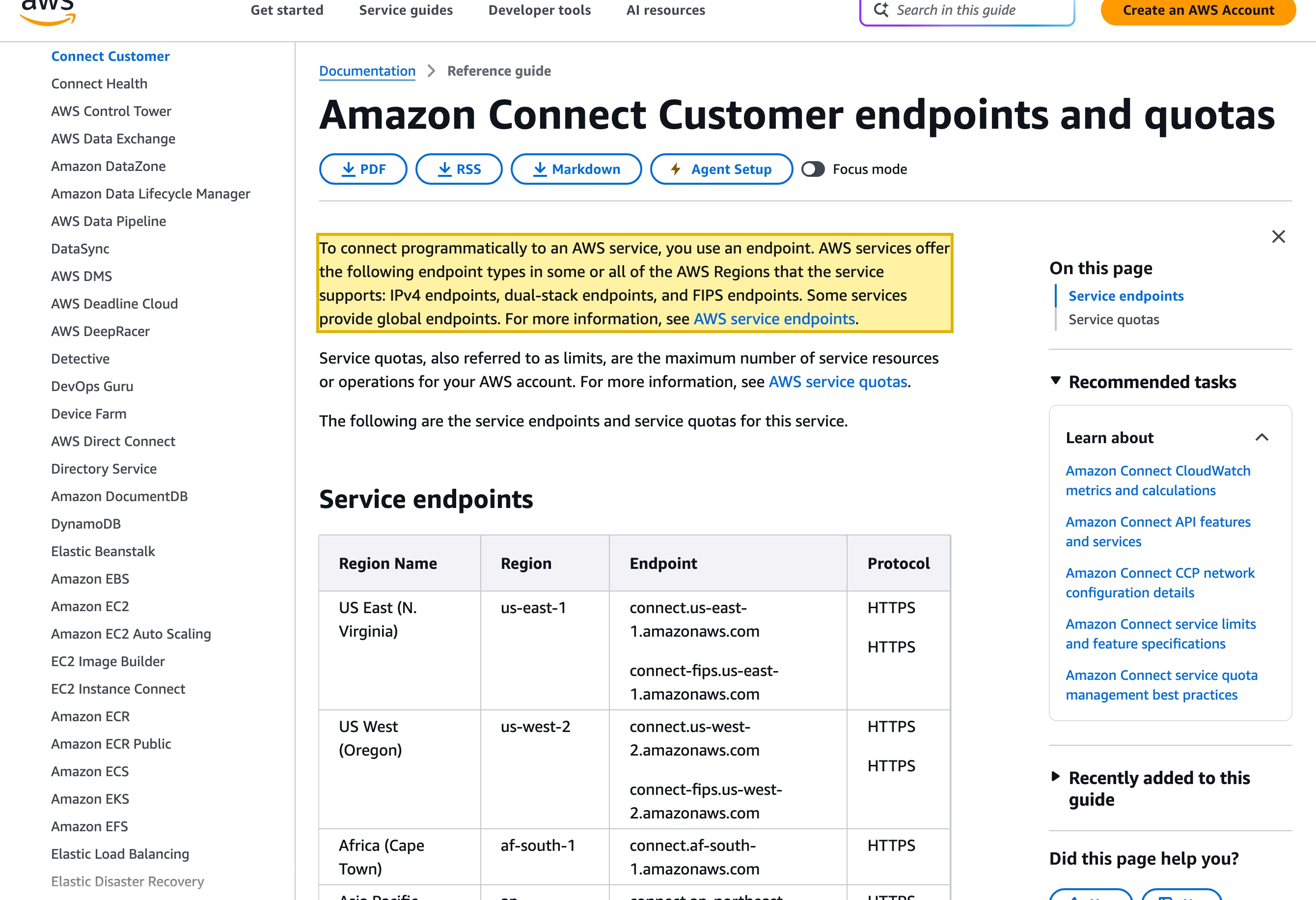
| Amazon Connect has no mainland-China region. AWS's service-endpoint list runs Amazon Connect in Regions across the Americas, Europe, Asia Pacific, and Africa — US East (N. Virginia), US West (Oregon), Canada (Central), Europe (Frankfurt) and (London), Asia Pacific (Tokyo), (Seoul), (Singapore) and (Sydney), Africa (Cape Town), and AWS GovCloud (US-West) — with none in mainland China; it is not offered in the AWS China (Beijing or Ningxia) partition, so recordings, transcripts, and contact trace records rest in the offshore Region where the instance is created. | AWS, “Amazon Connect endpoints and quotas” (docs.aws.amazon.com), retrieved 2026-10-10 |
| Call recordings and transcripts are stored in an Amazon S3 bucket in your AWS account, in the instance's Region. AWS states that “Recordings are stored in the Amazon S3 bucket that are created for your instance,” with S3 server-side encryption and KMS on by default; because there is no mainland-China Region to create the instance in, that bucket — and the voiceprints, transcripts, and contact records it holds — sits offshore. | AWS, “When, what, and where for contact recordings in Amazon Connect” (docs.aws.amazon.com), retrieved 2026-10-10 |
| Carrying your China users' recordings and contact data offshore is a PIPL cross-border transfer of sensitive personal information. A call recording is a speaker's voiceprint — biometric sensitive personal information under PIPL Article 28, requiring a separate consent under Article 29 — and exporting it engages PIPL Articles 38–40: notice, that separate consent, and a transfer mechanism (a CAC security assessment, standard contractual clauses, or certification). | Personal Information Protection Law of the PRC, Articles 28, 29, 38–40, retrieved 2026-10-10 |
| Providing voice and contact-center service in China is a licensed value-added telecom business a foreign platform cannot hold directly. It needs a Value-Added Telecommunications Business License (增值电信业务经营许可证) under the Telecommunications Business Licensing Measures (MIIT Order No. 42), so mainland voice must run through a licensed in-country operator; for a CIIO or high-volume handler, Cybersecurity Law Article 39 (formerly Article 37) can require mainland-collected data to stay in-country. | MIIT Telecommunications Business Licensing Measures (Order No. 42); Cybersecurity Law Article 39 (formerly 37), retrieved 2026-10-10 |
Sources verified by the 21YunBox compliance team on 2026-10-10.
For a contact center serving mainland China, the question to settle about Amazon Connect is not whether an agent can open the desktop or whether a call connects — it is whether the voice may lawfully be carried, and where the record of every interaction comes to rest. Amazon Connect is AWS’s fully cloud contact center: inbound and outbound voice, chat, IVR, call and screen recording, and real-time and post-call transcription, sentiment, and analytics through Contact Lens, with generative agent assistance through Amazon Q in Connect. There is no on-premises edition, and it runs in AWS Regions across the Americas, Europe, Asia Pacific, and Africa — none in mainland China. So two doors open at once: providing voice and contact-center service in China is a licensed value-added telecom business a foreign platform cannot hold directly, and the recordings (a voiceprint is Article 28 sensitive personal information, needing a separate Article 29 consent), transcripts, contact trace records, and contact data you carry come to rest offshore — a cross-border transfer under PIPL Articles 38–40, with a residency duty for a CIIO or high-volume handler and an Article 24 question wherever the AI features score or route.
Amazon Connect in China at a glance
| What decides it | In Amazon Connect's own terms — and China's law |
|---|---|
| What it carries and stores | Amazon Connect holds the most revealing data a company keeps about its customers: call recordings, screen recordings, voice and chat transcripts, contact trace records (CTRs — the per-contact detail records), IVR inputs, and contact and case data, each tied to a named caller and agent. AWS's guidance is plain: recordings "are stored in the Amazon S3 bucket that are created for your instance," in your AWS account and the instance's Region. A recording is a speaker's voiceprint — sensitive personal information under PIPL. |
| Where it is processed and stored | Amazon Connect runs in AWS Regions across the Americas, Europe, Asia Pacific, and Africa; its published service-endpoint list has no mainland-China region, and it is not offered in the AWS China (Beijing or Ningxia) partition. For a mainland audience the interaction data is generated in China but comes to rest offshore — a cross-border transfer of personal information (数据出境) under PIPL Articles 38–40: notice, a separate consent, and one transfer mechanism. |
| The telecom-business-licensing door | Providing inbound/outbound voice and a contact center to users in China is a value-added telecom service. Operating one for mainland users needs a Value-Added Telecommunications Business License (增值电信业务经营许可证) under the Telecommunications Business Licensing Measures (MIIT Order No. 42) that a foreign provider cannot hold directly. Amazon Connect offers no mainland-China (+86) numbers and gates China-bound outbound calling behind eligibility conditions; reaching Chinese numbers lawfully runs through a licensed in-country operator. |
| Voiceprint, sensitive PI, and residency | Voiceprints in recordings — with card, health, or financial details and identity-verification answers read aloud — are sensitive personal information under PIPL Article 28, and collecting or transferring them needs a separate consent under Article 29. A data-localization duty can require mainland-collected data to stay in-country for a critical-information-infrastructure or high-volume handler: Cybersecurity Law Article 39 (formerly Article 37) — the 2025 Cybersecurity Law amendment, in force January 1, 2026, renumbered the data-localization article from 37 to 39, substance unchanged. Contact Lens and Amazon Q in Connect add a PIPL Article 24 automated-decision question wherever AI scores or routes. |
| Reachability is not the axis | Whether an agent can open the desktop or a call connects is not the question; whether the voice may lawfully be carried, and where the recordings and contact records come to rest, is. The lawful lever is to route China-facing voice and contact-center through a licensed in-country operator, keep recordings, transcripts, and contact records in-country on a consented footing, and serve any China-facing surface — agent desktop, self-service portal, callback or intake form — from ICP-filed in-country infrastructure. On the telecom leg 21YunBox is advisory: it does not hold a China telecom license. |
What you actually carry and store — calls, recordings, and interaction data
A contact-center platform is a concentrated store of personal information, and Amazon Connect is no exception. Every voice call can be recorded; agent and customer audio are stored on separate stereo channels, and AWS’s own guidance is explicit about where they land: recordings “are stored in the Amazon S3 bucket that are created for your instance,” encrypted by default with S3 server-side encryption and KMS. Alongside the recordings sit screen recordings, real-time and post-call transcripts from Contact Lens, contact trace records (the per-contact detail records that log numbers, timestamps, queue and agent, and disposition), IVR inputs, and the contact and case data in the agent workspace — each tied to a named caller and a named agent. A recording is a speaker’s voiceprint; transcripts and screen recordings capture names, account numbers, and whatever a customer reads aloud — card numbers, health complaints, identity-verification answers. Under PIPL, biometric characteristics such as voiceprints, along with financial accounts and medical information, are sensitive personal information (Article 28). Amazon Connect is a fully cloud service — there is no on-premises or self-hosted edition to keep this data on mainland soil by default — and the S3 bucket sits in the AWS Region where you created the instance, which, with no mainland-China region available, is offshore.
Two doors: a telecom license you can’t hold, and a cross-border transfer of sensitive voice data
For Amazon Connect the residency question is not the only one. Carrying interactive voice to and from mainland China — originating and terminating calls, running a contact center for mainland users — is itself a value-added telecom service, and operating one is a licensed activity under China’s Measures for the Administration of Telecommunications Business Licensing (电信业务经营许可管理办法, MIIT Order No. 42). It requires a Value-Added Telecommunications Business License (增值电信业务经营许可证) that a foreign provider cannot hold directly. Amazon Connect’s own posture reflects this: it offers no mainland-China (+86) phone numbers and gates China-bound outbound calling behind eligibility conditions introduced in October 2023. Amazon Connect is not a China-licensed, in-country voice carrier that you operate as; reaching mainland numbers lawfully means routing through a licensed local operator.
The second door is data. Collected in the mainland and stored in an offshore AWS Region, the recordings, transcripts, contact trace records, and contact data are a cross-border transfer of personal information (数据出境) under PIPL Articles 38–40: notice, a separate consent, and one transfer mechanism — a CAC security assessment, the CAC standard contract, or certification. Because a recording is a voiceprint — sensitive personal information under Article 28 — the consent must be separate and the necessity strict (Article 29). Where volumes are high or the handler operates critical information infrastructure, a data-localization duty can require mainland-collected data to stay in-country: Cybersecurity Law Article 39 (formerly Article 37), renumbered from 37 to 39 by the 2025 amendment that took effect January 1, 2026, with the localization substance unchanged. And because Contact Lens and Amazon Q in Connect analyze, score, and can drive routing and agent guidance from the live conversation, PIPL Article 24’s rules on automated decision-making come into view wherever those features decide something about a person.
Reaching the platform isn’t the question — a licensed in-country path is
There are real levers to reduce what leaves the country, and they are worth using — you can disable or redact recording for sensitive queues, keep transcripts out of certain flows, choose the AWS Region nearest your users, and tighten retention so less data persists. Each shrinks the volume and sensitivity of what ends up offshore. None of them puts a mainland-China region under Amazon Connect, because there isn’t one to choose, and none makes a foreign platform a China-licensed voice carrier. The lawful shape is different: route the China-facing voice and contact-center leg through a licensed in-country operator, keep the recordings, transcripts, and contact records that must remain on mainland soil in-country on a consented footing — with the separate Article 29 consent for the voiceprint data — and serve any China-facing surface from ICP-filed in-country infrastructure. That is localization in the lawful sense: keeping the telephony and the data on an in-country, licensed path, never a tunnel that ships the recordings offshore anyway. On the telecom leg 21YunBox’s role is advisory and lighter — it does not hold a China telecom license, and the license and carrier relationship sit with a licensed local provider and your counsel. This page maps exposure; it does not issue a verdict. Which obligations apply to your entity, your interaction volumes, and your callers and agents is a determination to settle with qualified counsel against what you actually run.
The lawful path — map, localize, deliver
There is a lawful way to run a China-facing contact center, and it does not involve operating Amazon Connect as if a mainland Region existed. 21YunBox is a compliant overlay, not a migration — and for an AWS-native platform like Amazon Connect, a partner alongside the stack you already run, not a competitor. We do three things.
Map. We inventory the calls, recordings, transcripts, contact trace records, IVR inputs, and contact data Amazon Connect carries and stores, which of it is personal and which is sensitive (the voiceprints and anything read aloud), where it is processed and stored (an offshore AWS Region, with no mainland-China option), how your mainland telephony is originated and terminated today, where Contact Lens and Amazon Q in Connect make automated decisions, and the consent basis — read against PIPL cross-border, sensitive-PI, data-residency, and ICP duties and the value-added telecom gate, so you know exactly what counsel and a licensed local carrier need to confirm.
Localize. We help you keep the recordings, transcripts, and contact records that must stay on mainland soil in-country on a consented, lawful footing, obtain the Article 29 separate consent for the voiceprint data, and route the mainland voice leg onto a China-licensed operator — while you keep Amazon Connect for the markets it already serves. On the telecom leg our role is advisory: 21YunBox does not hold a China telecom license, and the license and carrier relationship sit with a licensed local provider and your counsel.
Deliver. We serve any China-facing surface — the agent desktop, a self-service portal, an intake or callback form — over ICP-filed, in-country infrastructure (the 21YunBox Optimizer), in front of the stack you already run, with no rebuild and no second codebase.
The result is a contact center that runs legally and compliantly for your users in China. 21YunBox never uses or suggests circumvention of any kind.
Related reading:
- Cross-border data transfers under PIPL
- China’s Cybersecurity Law — data localization (Article 39, formerly Article 37)
- China’s Data Export Security Assessment Measures
- How to get an ICP filing for China
- China’s Telecommunications Business Licensing Measures (MIIT Order No. 42)