Does RingCentral Work in China? PIPL Cross-Border, Telecom Licensing & Data Residency
RingCentral runs no mainland-China data center — RingEX phone and RingCX contact center store calls, recordings, transcripts, and CDRs offshore, so carrying your China users' voice there is a PIPL cross-border transfer of sensitive voiceprint data, and providing in-country voice needs a value-added telecom license a foreign platform cannot hold. A compliance-first look at the licensing door and the residency exposure.
Does RingCentral work in China?
Providing voice and contact-center service in China needs a value-added telecom license a foreign platform like RingCentral cannot hold, and the calls and recordings it carries are sensitive personal data sitting offshore.
RingEX (business phone, video, messaging) and RingCX (contact center) capture calls, voicemail, recordings (a voiceprint), transcripts, and CDRs, and RingCentral's own datasheet stores them in the US, UK, Germany, and Canada — no mainland-China region — so carrying your China users' voice there is a PIPL cross-border transfer of Article 28/29 sensitive personal information, on top of the value-added telecom-licensing door. The lawful lever is to route China voice and contact center through a licensed in-country operator and keep recordings and interaction data in-country — not to make the offshore platform reachable (21YunBox is advisory on telecom licensing).
A risk map, not a verdict — settle the specifics with counsel. Our China team can map your exposure →
What RingCentral's own documentation says about China
| Fact | Primary source |
|---|---|
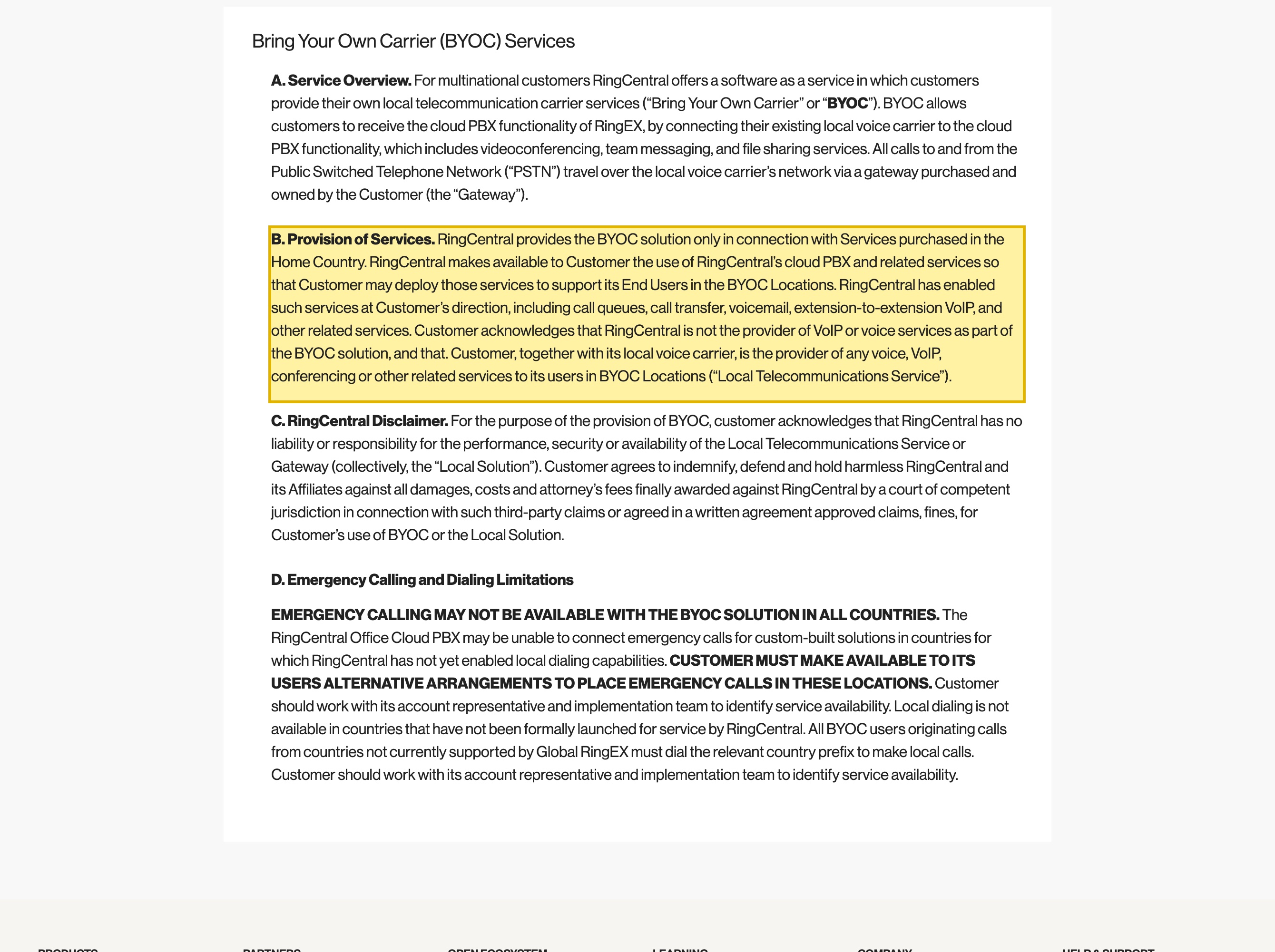
| RingCentral is not the China voice provider — a local licensed carrier is. Its Bring Your Own Carrier terms state that "customers provide their own local telecommunication carrier services" and list China Mobile among certified carrier partners. Providing in-country voice is a value-added telecom business a foreign platform cannot hold directly; see the telecom business licensing measures. | RingCentral BYOC Service Description (retrieved 2026-10-10) |
| No mainland-China region — recordings and transcripts rest offshore. RingCentral's RingCX privacy datasheet says it stores personal data in the United States, United Kingdom, Germany, and Canada, and that RingCX collects "interaction recordings, interaction metadata, call summaries and transcripts" — so carrying your China users' voice there is a PIPL cross-border transfer. | RingCentral RingCX Privacy Datasheet (retrieved 2026-10-10) |
| A call recording is a voiceprint = PIPL Article 28 sensitive personal information. It needs a separate, heightened consent (Article 29) and a prior impact assessment, and cannot be anonymized away; cross-border carriage is governed by PIPL Articles 38–40. | Personal Information Protection Law of the PRC, Articles 24/28/29/38–40 |
| CIIO and high-volume handlers must store the data in-country. Cybersecurity Law Article 39 (formerly Article 37) requires in-country storage — the 2025 amendment, in force January 1, 2026, renumbered the article from 37 to 39, substance unchanged — on top of the value-added telecom license a foreign voice platform cannot hold. | PRC Cybersecurity Law Article 39 (formerly Article 37) |
Sources verified by the 21YunBox compliance team on 2026-10-10.
For a mainland-China operation, the question about RingCentral is not whether the app opens or whether a call connects — it is whether your organization may lawfully carry that voice, and where the record of every conversation comes to rest. RingCentral is a cloud communications platform: RingEX delivers business phone, video, and team messaging, and RingCX adds a cloud contact center with recording, transcription, and AI agent assist. It is cloud-only — there is no on-premises edition to keep the data in your own racks. Two gates decide the China question. First, providing voice and contact-center service to users in China is a licensed value-added telecom business a foreign platform cannot hold. Second, the calls, recordings (a voiceprint is Article 28 sensitive personal information), transcripts, and CDRs you carry sit on RingCentral’s offshore cloud — a PIPL cross-border transfer needing separate, heightened consent, and raising an Article 24 question wherever AI routes or scores a call.
RingCentral in China at a glance
| What decides it | In RingCentral's own terms — and China's law |
|---|---|
| What RingCentral carries and stores | RingEX runs business phone, video, and team messaging; RingCX adds an inbound/outbound contact center. Between them they capture calls, voicemail, call recordings, transcripts, call detail records (CDRs), SMS, and contact data — all personal information, and a recording is the speaker's voiceprint. |
| Where that data comes to rest | RingCentral's own RingCX privacy datasheet lists its data-storage countries as the United States, United Kingdom, Germany, and Canada. There is no mainland-China region to select, so the records rest offshore — carrying them there is a PIPL cross-border transfer (数据出境, Articles 38–40) made by you, the handler. |
| The telecom-business-licensing door | Providing voice and contact-center service to users in China is a value-added telecom business that needs the 增值电信业务经营许可证, which a foreign operator cannot hold directly. RingCentral's BYOC terms say the customer and its local carrier provide the voice — so lawful reach runs through a licensed in-country operator. |
| Sensitive personal data and residency | A call recording is a voiceprint — PIPL Article 28 sensitive personal information, which needs a separate, heightened consent (Article 29) and cannot be anonymized away. For a CIIO or high-volume handler, in-country storage is also required under Cybersecurity Law Article 39 (formerly Article 37). |
| Why reachability is not the axis | Whether the dashboard loads is not the question. The lever is to route China voice and contact center through a licensed in-country operator, keep recordings, transcripts, and CDRs in-country, obtain Article 29 consent, and deliver the surrounding surfaces on ICP-filed infrastructure. 21YunBox is advisory on the telecom-licensing leg. |
What you actually carry and store — calls, recordings, and interaction data
Treat RingCentral as a pipe and a vault for conversations, not a web app. On the RingEX side it carries business voice calls, voicemail, video meetings, team messages, and SMS, and it holds the directory of users and contacts that makes those features work. On the RingCX side the contact center records inbound and outbound calls, captures IVR and keypad entries, logs agent activity and case histories, and — as RingCentral’s own RingCX privacy datasheet puts it — collects “interaction recordings, interaction metadata, call summaries and transcripts.” Each of those is personal information, and a recording or voicemail is a biometric identifier: the speaker’s voiceprint.
All of it comes to rest on RingCentral’s offshore infrastructure. The RingCX privacy datasheet states plainly that “RingCentral data centers where we store personal data as part of the Service are located in the following countries,” and lists the United States, United Kingdom, Germany, and Canada — there is no mainland-China region. RingCentral is cloud-only; unlike a legacy on-premises PBX, there is no self-hosted edition that would let you keep those recordings inside your own mainland racks, so residency has to be solved by a lawful in-country deployment rather than by self-hosting. RingCX’s AI features add one more hop: the datasheet says its transcription features “turn speech into text transcripts, which is then submitted to a third-party AI service provider,” so the content can move again, to a further subprocessor, before it is ever summarized or scored.
Two doors: a telecom license you can’t hold, and a cross-border transfer of sensitive voice data
The first door is licensing. Originating or terminating domestic Chinese telephony, carrying calls on China’s networks, and operating a contact center are value-added telecom activities governed by China’s telecom rules; the operator needs a 增值电信业务经营许可证 (value-added telecom business operating license), which under China’s foreign-investment regime a foreign platform cannot hold directly, and only through a tightly limited joint venture. RingCentral does not pretend otherwise. Its Bring Your Own Carrier terms say “customers provide their own local telecommunication carrier services” and that “RingCentral is not the provider of VoIP or voice services as part of the BYOC solution” — the customer and its local carrier are. RingCentral even lists China Mobile among its certified carrier partners. In other words, lawful voice in China runs through a licensed in-country operator; a foreign UCaaS/CCaaS platform cannot be that operator on its own. (See our note on the value-added telecom business licensing measures.)
The second door is data. Carrying your China users’ calls, recordings, transcripts, and CDRs to RingCentral’s offshore cloud is a cross-border transfer of personal information (数据出境) that you, as the handler, must justify under China’s Personal Information Protection Law, Articles 38–40: a transparent notice, a lawful transfer mechanism (a security assessment, certification, or standard contract), and — because a voiceprint is Article 28 sensitive personal information — a separate, heightened consent under Article 29, supported by a prior impact assessment. A voiceprint cannot be anonymized away. If your China operation is a critical information infrastructure operator or a high-volume handler, the recordings and interaction data must also be stored in-country under Cybersecurity Law Article 39 (formerly Article 37) — the 2025 Cybersecurity Law amendment, in force January 1, 2026, renumbered the data-localization article from 37 to 39, with the substance unchanged. And RingCX’s agentic AI, agent assist, and sentiment features raise a PIPL Article 24 automated-decision question wherever they route, prioritize, or score an interaction.
Reaching the platform isn’t the question — a licensed in-country path is
Making the RingCentral dashboard open from the mainland would not resolve a single one of these obligations; it would simply move more sensitive voice data offshore, faster. The compliant posture is the opposite of a tunnel. Route your China-facing voice and contact center through a licensed in-country telecom/contact-center operator; keep the recordings, voicemail, transcripts, and CDRs in-country; minimize and pseudonymize what you retain; obtain the Article 29 separate consent for the voiceprint data; and honor any Article 24 opt-out where AI decides routing or scoring. 21YunBox is advisory on the telecom-licensing leg — it holds no China telecom license, so the carriage sits with a licensed in-country operator and your counsel, while 21YunBox maps the exposure and stands up the lawful in-country data and delivery path around the RingCentral stack you already run. This page is a risk map, not a verdict: settle the specifics with qualified Chinese counsel before you rely on any one arrangement.
The lawful path — map, localize, deliver
- Map — inventory the calls, voicemail, recordings, transcripts, CDRs, SMS, contact data, and interaction logs RingEX and RingCX carry and store; mark which hold personal and sensitive (voiceprint, biometric) information; record where they are processed and stored (offshore — the United States, United Kingdom, Germany, and Canada, with no mainland-China region), how Chinese telephony is originated and terminated today, where AI makes automated decisions, and the consent basis (heightened for sensitive PI).
- Localize / govern — route China-facing voice and contact center through a licensed in-country telecom/contact-center operator; keep recordings, transcripts, and CDRs in-country under a lawful domestic deployment; minimize and pseudonymize; obtain the Article 29 separate consent for the voiceprint data; and honor any Article 24 option. Localize means keeping the telephony and the data on a lawful, in-country, licensed path — never a tunnel that ships the data offshore anyway.
- Deliver — the site, app, and agent portal around the contact center carry an ICP filing duty and need compliant, in-country delivery through the 21YunBox Optimizer, in front of the stack you already run — no rebuild, no migration.
21YunBox never uses or suggests circumvention of any kind. The goal is simple: RingCentral running legally and compliantly for your users in China — a compliant overlay and partner, advisory on telecom licensing, not a competitor to the vendor.
Related reading
- Cross-border data transfers under PIPL
- China’s Cybersecurity Law
- China data export security assessment measures
- How to get an ICP license for your website