Does Twilio Work in China? SMS/Voice Delivery, the Telecom License & Recipient-Data Rules
Twilio can deliver SMS into mainland China, but only on a best-effort basis — its own China SMS Guidelines say Twilio uses 'commercially reasonable efforts' and does not guarantee delivery, with two-way SMS, MMS, and number portability unavailable. Reachability was never the real question, though. Operating a messaging or voice service for mainland users is a licensed value-added telecom activity (增值电信业务许可证, the commercial ICP license), the China-facing app needs its own ICP filing, and a recipient's phone number and the message content are personal information under PIPL. A compliance-first look at the best-effort delivery picture, the telecom-licensing gate, the recipient-data duties, and the lawful China path.
Does Twilio work in China?
Twilio can deliver SMS to mainland China, but only on a best-effort basis — and reachability was never the real question. Twilio's own China SMS Guidelines say it uses “commercially reasonable efforts” to deliver SMS to China and does not guarantee delivery; two-way SMS, MMS, and number portability are listed as unavailable, sender IDs are overwritten, and content rules are strict. Twilio is not blocked, but it is also not a China-licensed, in-country carrier you can operate as.
Because delivery is partial and best-effort, the decision for a China-facing product is a licensing-and-data one, not a speed one. Operating a messaging or voice service for mainland users is a licensed value-added telecom activity — under the Measures for the Administration of Telecommunications Business Licensing (MIIT Order No. 42) it needs a Value-Added Telecommunications Business License (增值电信业务许可证, the commercial ICP license) — and the China-facing app needs its own ICP filing. A recipient's phone number and the message content are personal information, so handling them offshore is a PIPL cross-border transfer. The lawful route runs through a China-licensed provider — never around a restriction.
On telecom our role is lighter and advisory: 21YunBox does not hold a China telecom license and is not a messaging carrier. We map the China-licensed path and your PIPL and ICP exposure, help you localize just the China leg onto a compliant provider (keeping Twilio for other markets), and deliver the China-facing app in-country on ICP-filed infrastructure. We never use or suggest circumvention. Treat the specifics as a risk to confirm with counsel.
What Twilio's own documentation says about China
| Fact | Primary source |
|---|---|
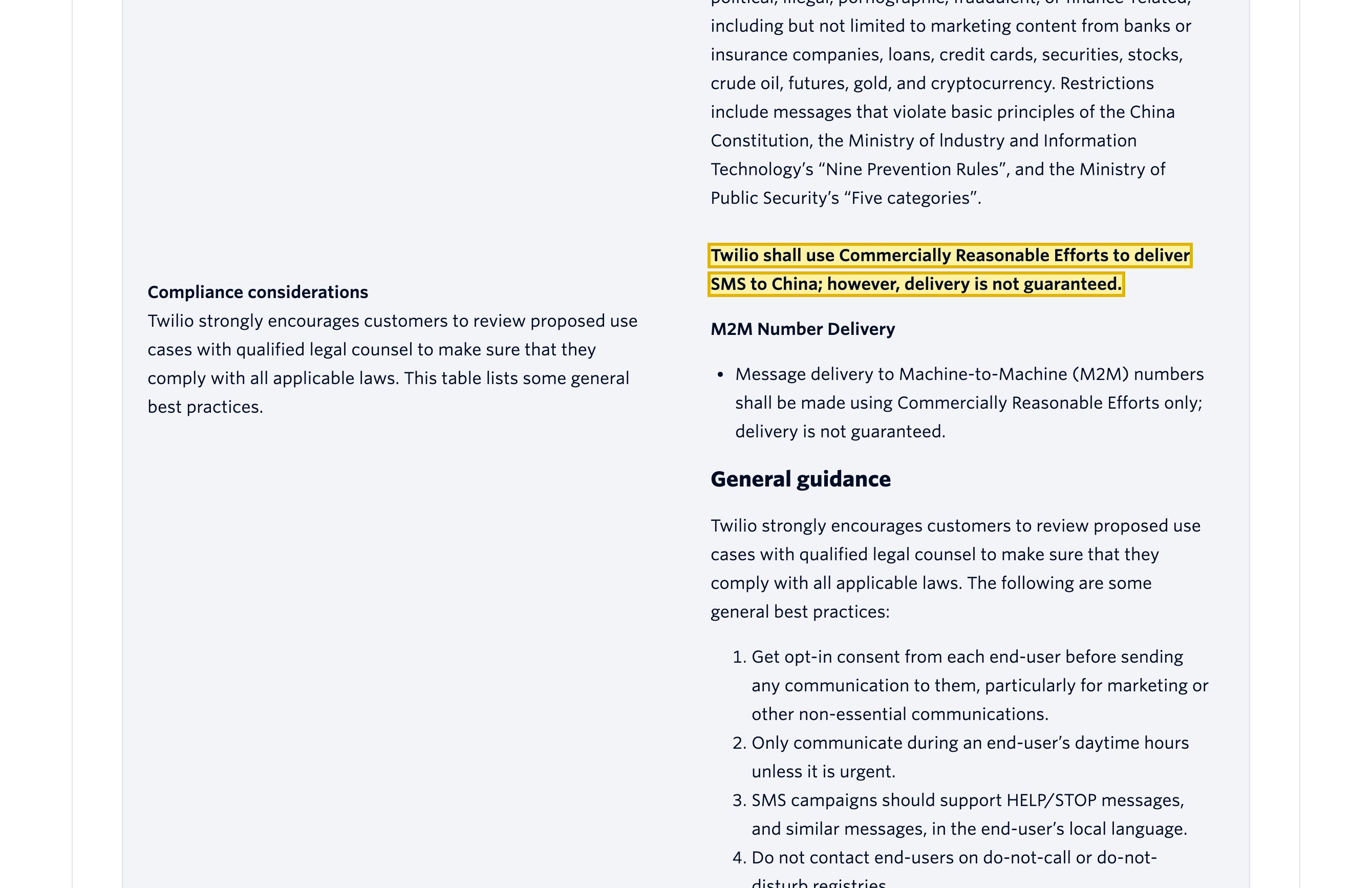
| Twilio does not guarantee SMS delivery to China and treats it as a restricted destination. Twilio's China SMS Guidelines state: “Twilio shall use Commercially Reasonable Efforts to deliver SMS to China; however, delivery is not guaranteed.” The same page lists two-way SMS, MMS, and number portability as unavailable, marks long codes and alphanumeric sender IDs as not supported by Twilio for China, and notes a domestically pre-registered sender ID is “Overwritten.” | Twilio, “China: SMS Guidelines” (twilio.com), retrieved 2026-10-08 |
| Chinese networks impose strict content rules on SMS, with heavy penalties. Twilio's China SMS Guidelines state: “Chinese networks have very strict regulations about the type of SMS content which can be sent to subscribers on their network. The networks impose heavy fines and cut off connections if these rules are breached.” The restrictions bar URLs in the body and finance-related marketing, and cite the Ministry of Industry and Information Technology's and the Ministry of Public Security's own rule-sets. | Twilio, “China: SMS Guidelines” (twilio.com), retrieved 2026-10-08 |
| Operating a messaging/voice service for China users is a licensed value-added telecom activity. China's Measures for the Administration of Telecommunications Business Licensing (电信业务经营许可管理办法, MIIT Order No. 42, in force September 1, 2017) require a business to obtain a Telecommunications Business Operating License and to operate only within the service type and coverage area it states (Articles 4 and 16); a value-added telecom operator must hold the Value-Added Telecommunications Business License (增值电信业务许可证), commonly the commercial ICP license. | Measures for the Administration of Telecommunications Business Licensing, MIIT Order No. 42, Arts. 4 and 16 (gov.cn), promulgated 2017-07-03, in force 2017-09-01 |
| A recipient's phone number and message content are personal information sent across the border. A phone number — and the names, codes, and records a message often carries — is personal information; sent from or about a mainland user to a platform operated offshore, it triggers PIPL Articles 38–40: notice, a separate consent distinct from the agreement to use the service, and one transfer mechanism — a CAC security assessment, the CAC standard contract, or certification. | Personal Information Protection Law of the PRC, Articles 38–40 (cac.gov.cn), retrieved 2026-10-08 |
Sources verified by the 21YunBox compliance team on 2026-10-08.
For a mainland-China audience, the first thing to settle about Twilio is not how fast a text arrives — it is that reachability is only partial, and that it was never the real question. Twilio can deliver SMS into China, but on its own terms it does so on a best-effort basis: its China SMS Guidelines say Twilio uses “commercially reasonable efforts” and does not guarantee delivery, two-way SMS and MMS are listed as not available, and even a domestically pre-registered sender ID is overwritten before it reaches the handset. So Twilio is not blocked the way some foreign services are — but it is also not a China-licensed, in-country messaging carrier that you can operate and send as.
Because delivery is partial and best-effort, the decision for a China-facing product moves to a different axis — a regulatory one, and specifically a licensing-and-data one. Three gates decide whether and how you may message or call users in the mainland, and none is about milliseconds: whether operating a messaging or voice service for mainland users is a licensed telecom activity you are cleared for; whether a recipient’s phone number and the content you send are handled lawfully as personal information under PIPL; and, underneath both, whether the China-facing app that triggers those messages is itself licensed (ICP-filed) and delivered in-country. The lawful way to reach Chinese users runs through those gates — never around a block, and never through circumvention of any kind.
Twilio in China at a glance
| What decides it | In Twilio's own terms — and China's law |
|---|---|
| What it is | Twilio — cloud communications APIs for Programmable Messaging (SMS), Voice, WhatsApp, and Verify (OTP). It is operated by Twilio from outside the mainland; there is no Twilio China telecom entity or China messaging license that you send or call as from inside the country. |
| Can it reach mainland China? | Partly, and best-effort. Twilio's China SMS Guidelines say it uses "commercially reasonable efforts" to deliver SMS to China and does not guarantee delivery; two-way SMS, MMS, and number portability are listed as not available, and even a domestically pre-registered sender ID is "Overwritten." Content rules are strict. So whether a message happens to arrive is not the deciding question. |
| The licensing gate | Operating a messaging or voice service for mainland users is a licensed value-added telecom activity. Under China's Measures for the Administration of Telecommunications Business Licensing (电信业务经营许可管理办法, MIIT Order No. 42, in force September 1, 2017), running a value-added telecom business requires a Value-Added Telecommunications Business License (增值电信业务许可证, the commercial ICP license); the China-facing app also needs its ICP filing (备案). A foreign provider that holds neither cannot operate the service in the mainland directly. |
| Recipient number & message content | A recipient's phone number and the message or call content are personal information. Collected from or about a mainland user and handled by a service operated offshore, that is a cross-border transfer under PIPL (Articles 38–40): notice, a separate consent, and one transfer mechanism. Data-localization bites for a CII or large-volume handler (Cybersecurity Law Article 39 (formerly Article 37)). |
| The lawful path | Run the China leg through a China-licensed SMS/voice provider and keep Twilio for the markets where it is licensed to operate, with the China-facing app ICP-filed and delivered in-country. 21YunBox maps that path, localizes the China leg onto a compliant provider, and delivers the app — on telecom its role is advisory, not a license: we do not hold a China telecom license. |
Delivery to China is best-effort — and that is not the deciding question
Twilio’s position on China is set on its own China SMS Guidelines page, not by a load-time test. Twilio does attempt delivery into the mainland, but on terms it states plainly: it “shall use Commercially Reasonable Efforts to deliver SMS to China; however, delivery is not guaranteed.” The same page lists two-way SMS as not supported, MMS as not available, number portability as unavailable, and marks long codes and alphanumeric sender IDs as not supported by Twilio for China — where a domestically pre-registered sender ID is used at all, it is overwritten before the subscriber sees it. On top of that sit strict content rules: Chinese networks “have very strict regulations about the type of SMS content which can be sent,” they “impose heavy fines and cut off connections if these rules are breached,” and the restrictions bar URLs in the body and finance-related marketing and cite the Ministry of Industry and Information Technology’s and the Ministry of Public Security’s own rule-sets.
That makes the usual “does the OTP arrive in Shanghai?” framing beside the point. Whether a given text lands on a given day is not the question — Twilio itself declines to guarantee it, and treats China as a heavily restricted, best-effort destination rather than a market it is licensed to operate in. For that reason this page publishes no first-party China delivery-rate or latency figure for Twilio: a best-effort number measured on one day would say nothing about whether the service is lawful to run. And to be unambiguous — there is no lawful shortcut around the restrictions, and 21YunBox neither provides nor suggests circumvention of any kind. The productive question is a different one: how to message and call Chinese users lawfully.
The licensing gate: messaging and voice for China users is a licensed telecom activity
Suppose you do want to send OTPs, notifications, or marketing texts — or place calls — to users in mainland China as part of a product. The first gate is not which API you wire in; it is whether you may operate that messaging or voice service in China at all. Providing paid or commercial communications services over the networks is a licensed telecommunications activity, governed by China’s Measures for the Administration of Telecommunications Business Licensing (电信业务经营许可管理办法, Ministry of Industry and Information Technology Order No. 42, in force since September 1, 2017). Those Measures define the Value-Added Telecommunications Business License — commonly the commercial ICP license — that a value-added telecom operator must hold, and they require that a business “obtain, in accordance with law, an Operating License issued by a telecommunications administration authority” and operate only within the service type and coverage area that license states (Articles 4 and 16). Messaging (短信) and voice services sit inside this value-added regime, and the three mainland carriers that actually carry the traffic hold the basic-telecom licenses underneath it.
So a flow that reaches into China from offshore does not clear this gate by itself: the entity operating the China-facing messaging or voice service needs the telecom license, and the China-facing app that triggers the messages needs its own ICP filing. The common lawful pattern is not to hold the license yourself but to run the China leg through a China-licensed provider that already holds it — while you complete the sender-signature and template registration (签名/模板报备) that the Chinese carriers require, and keep Twilio for the other markets it is licensed to serve. Whether and how Order No. 42 applies to your specific use case — and which arrangement fits your entity — is a risk to confirm with qualified counsel against what you actually ship.
Recipient numbers and message content are personal information
The second gate is the data. A message is never just a payload: it carries the recipient’s phone number, and often a name, an order reference, a verification code tied to a real account, or call-detail records. A phone number is personal information, and the content frequently is too. Collected from or about a user in the mainland and sent to or handled by a platform operated outside China, that is a cross-border transfer of personal information under China’s Personal Information Protection Law. PIPL puts the duty on the handler — you, the operator of the app, not only the API vendor: Articles 38–40 require notice, a separate consent distinct from the user’s agreement to use the service, and one transfer mechanism — a CAC security assessment, the CAC standard contract, or certification.
Residency can bite on top of consent. Where the operator is a critical information infrastructure operator or processes personal information above the state-set threshold, the personal information collected and generated in the mainland must be stored in the mainland — the data-localization duty the Cybersecurity Law sets in its Article 39 (formerly Article 37, renumbered by the 2025 amendment in force January 1, 2026). None of this turns on how quickly a text is delivered; it turns on whether a recipient’s number and the message content had a lawful basis to leave the country, and whether they had to stay in the first place.
The lawful path — map, localize, deliver (keep Twilio where it is licensed to run)
There is a lawful way to reach Chinese users with SMS, voice, and OTPs, and it has a shape: the China leg runs on a China-licensed provider that holds the telecom license, the recipient data stays on a compliant footing, and the China-facing app that triggers the messages is licensed and served in-country. The usual pattern is to route only the mainland leg to a licensed domestic SMS/voice and notification service — for example, a licensed China provider such as Alibaba Cloud Short Message Service (阿里云短信) — while Twilio continues to serve every market where it is licensed to operate. Which arrangement fits depends on your entity, your volumes, and your data — settle it with counsel and a licensed local provider before you build.
Underneath that choice sits the part 21YunBox owns — and here it is worth being honest about how much of it is ours. On the telecom leg specifically, our role is advisory and lighter than it is for delivery: 21YunBox does not hold a China telecom license and is not a messaging carrier; the license and the carrier relationship sit with a licensed China provider and your counsel, not with us. What we do on that footing is three things. We map the lawful path — a China-licensed SMS/voice provider and the signature and template registrations it entails — together with your PIPL, data-residency, and ICP exposure, so you know exactly what counsel and a local provider need to confirm. We help you localize the China leg onto it — adopting and integrating that compliant, China-legal provider in place of the Twilio call for mainland recipients, while the rest of your Twilio usage stays untouched. And we deliver the China-facing app in-country on ICP-filed infrastructure — the 21YunBox Optimizer — in front of the product you already run, with no rebuild and no re-platform. The result is a communications flow that runs legally and compliantly for your users in China. What we do not do, and what no one lawfully can, is hand you a way to operate an unlicensed messaging service into the mainland or route traffic around any restriction: we localize the China leg onto a licensed provider and deliver the app, and we never use or suggest circumvention.
Related reading:
- China’s Measures for the Administration of Telecommunications Business Licensing (MIIT Order No. 42)
- Cross-border data transfers under PIPL
- China’s Cybersecurity Law — data localization (Article 39, formerly Article 37)
- How to get an ICP filing for China