Does YouTube Work in China? Blocked Embeds, ICP & the Compliant Fix
YouTube is blocked by the Great Firewall in mainland China, so an embedded YouTube player loads from blocked Google hosts and fails — breaking your China-facing page. There is no compliant way to unblock it; the fix is to remove the blocked embed, host your video on a China-reachable platform, and deliver your own site from an ICP-filed in-country path. A compliance-first look.
Does YouTube work in China?
Whether YouTube works in China is a reachability question with a blunt answer: it is blocked by the Great Firewall, and there is no compliant way to make it load inside the mainland. 21YunBox does not route around that block, and would not — the honest fix is to stop depending on a blocked host, not to tunnel to it.
The damage most teams actually see is not youtube.com itself but the YouTube player they embedded. YouTube's own instructions tell you to "copy the HTML code" and "paste the code into your website HTML" — an <iframe> whose src is https://www.youtube.com/embed/… (or youtube-nocookie.com in privacy-enhanced mode), both Google-operated hosts. Inside the mainland those hosts don't answer, so the player never initializes: the video is a blank rectangle and the surrounding page can stall while it waits. The compliant path is to remove or gracefully degrade that blocked dependency, host the video on a platform reachable inside China, and serve your own site from an ICP-filed, in-country path. The table below separates what's blocked from what you can actually fix.
This is a delivery-and-licensing picture, not a verdict — what applies depends on whether your site is public-facing in the mainland and how your video is embedded. Our China team can map an in-country path with you →
What YouTube's documentation says, and what we measured from inside China
| Fact | Primary source |
|---|---|
A YouTube embed is an <iframe> that loads from Google's own hosts. On YouTube's embed-code page the instruction is to "copy the HTML code" and "paste the code into your website HTML," and the code it hands you is an <iframe> whose src is https://www.youtube.com/embed/… — or https://www.youtube-nocookie.com/embed/… in privacy-enhanced mode. Both are Google-operated domains, so any page that embeds YouTube depends on reaching Google to render the player. | YouTube Help — Embed videos & playlists, retrieved 2026-10-07 |
The player code loads from www.youtube.com too, so a blocked host means an empty frame. In Google's IFrame Player API reference the embed is an <iframe> with src on www.youtube.com/embed/…, and the API "will replace the specified element with the <iframe> element containing the player." When that Google host can't be reached from inside the mainland, the iframe has nothing to load — the viewer sees blank space where the video should be, and scripts waiting on it can stall the rest of the page. | Google for Developers — YouTube IFrame Player API reference, retrieved 2026-10-07 |
From inside the mainland, YouTube returned nothing. Requested directly from a probe inside mainland China (Alibaba Cloud cn-zhangjiakou) on 2026-08-28, www.youtube.com produced no first byte in any of three attempts, each abandoned at a 60-second ceiling — a block on the destination, not a slow load. So neither the page nor an embedded player it hosts can be reached the way an ordinary CDN tweak assumes. | 21YunBox — China delivery census, measured from inside mainland China |
| Your own public site still needs an ICP filing — that part doesn't go away with the video. A website served to mainland visitors from inside China turns on an ICP filing (ICP 备案) under State Council Order No. 292 and MIIT's filing measures, tied to a hosting resource physically located in the mainland. Removing a broken YouTube embed fixes the video; it does not, by itself, give a China-facing site the in-country, ICP-filed footing it needs to operate lawfully. | State Council Order No. 292, Article 4 (Measures for the Administration of Internet Information Services) |
Sources verified by the 21YunBox compliance team on 2026-10-07.
For a mainland-China audience, the question about YouTube has a blunt answer before performance ever comes up: YouTube is blocked by the Great Firewall, and there is no compliant way to make it load inside the mainland. What actually trips up most businesses is more specific — the YouTube player they embedded. An embed is an iframe served from Google’s own hosts, and when those hosts can’t be reached, the video is a blank rectangle and the page around it can hang. The fix is not to tunnel to a blocked platform; it is to stop depending on it, and to put your own site on compliant, in-country footing.
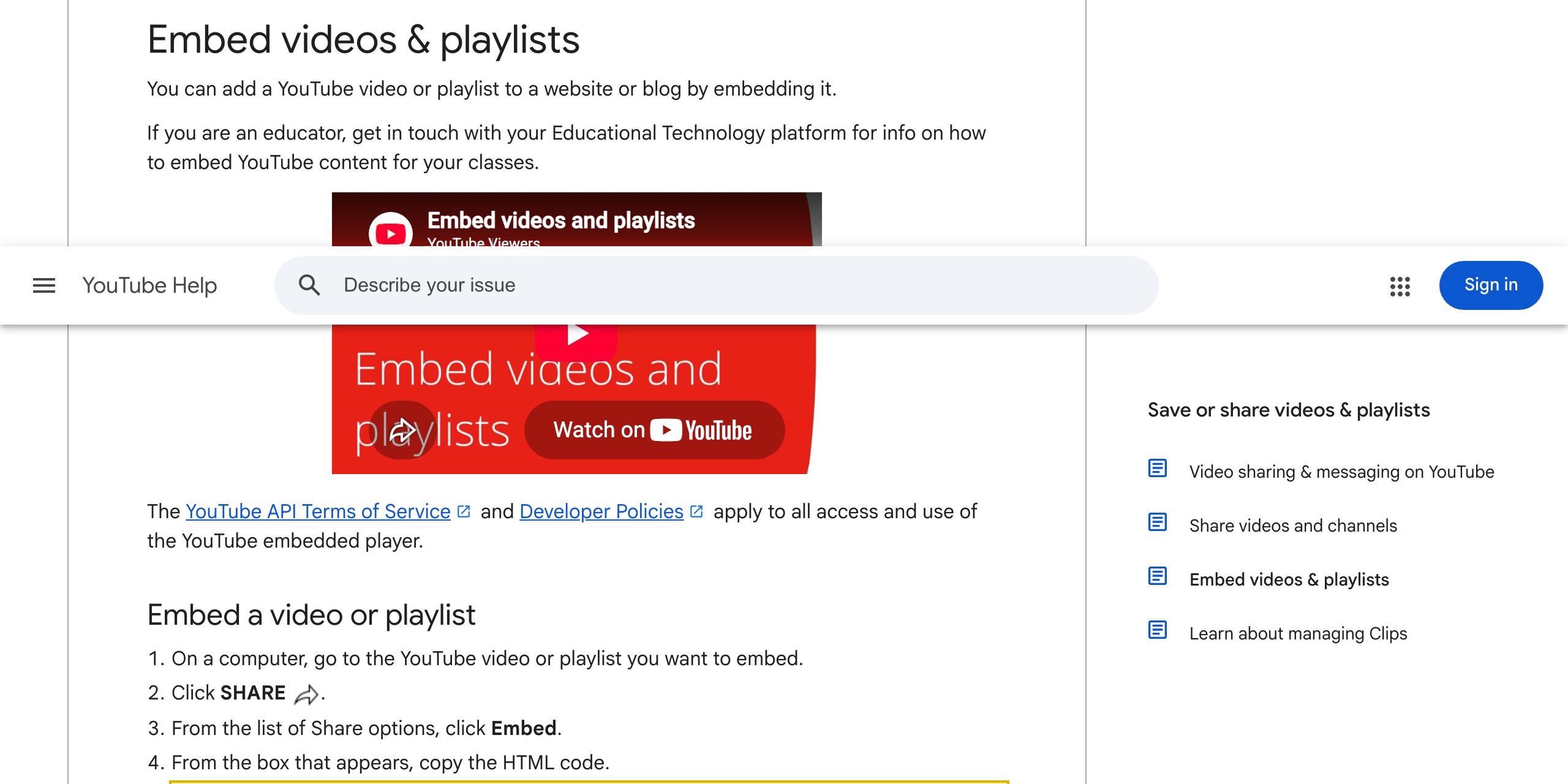
<iframe> whose src is https://www.youtube.com/embed/… (or https://www.youtube-nocookie.com/embed/… in privacy-enhanced mode), both Google-operated hosts the mainland blocks. Source: support.google.com/youtube/answer/171780YouTube in China at a glance
| What decides it | What it means for a China-facing page |
|---|---|
| Is it reachable? | No. YouTube is blocked by the Great Firewall; youtube.com and the hosts its player uses do not load from inside the mainland. This is a block on the destination, not a slow route. |
| Your embedded player | A YouTube embed is an <iframe> loaded from www.youtube.com or youtube-nocookie.com. Those Google hosts are blocked, so the player can't initialize — a blank frame, and scripts waiting on it can stall the page. |
| Can it be unblocked? | Not compliantly. There is no lawful way to route mainland visitors around the Firewall to a blocked platform, and 21YunBox does not do it. The fix is to remove the dependency, not tunnel to it. |
| Your own site's license | A public site served to mainland visitors needs an ICP filing tied to in-country hosting — independent of where the video lives. |
| The compliant fix | Remove or gracefully degrade the blocked embed, host the clip on a China-reachable video platform, and deliver your own site from an ICP-filed, in-country path — as an overlay on your current stack. |
Blocked at the destination, not slowed on the route
YouTube’s problem in China is not latency; it is reachability. The Great Firewall blocks the service, so from inside the mainland youtube.com and the Google hosts its player relies on simply do not answer — not slowly, but at all. In 21YunBox’s own testing from inside China, requests to YouTube returned no response rather than a delayed one. No amount of routing or caching on your side changes that, because the block sits on the destination, not on the path your page takes to reach it. That is the honest starting point, and it rules out the whole category of “just make it faster” answers.
Why the embed breaks your China-facing page
The damage most teams actually see is on their own pages. A YouTube video is usually added as an embed — an iframe whose source is a Google host — and YouTube’s instructions are to paste that code straight into your site. When a mainland visitor opens the page, the browser tries to load the player from that blocked host, finds nothing, and leaves a blank rectangle where the video was. Worse, player scripts that wait on the embed can delay or distort the rest of the layout, so a single dead video can make an otherwise working page look broken. Because the page renders normally everywhere outside China, this rarely gets filed as a bug — it just quietly costs you the mainland visitor.
Your own site still needs an ICP filing
Removing a broken embed fixes the video, but it does not settle the separate question of whether your site is cleared to operate in the mainland at all. A public-facing website served to mainland visitors from inside China turns on an ICP filing (ICP 备案) under State Council Order No. 292 and MIIT’s filing measures, and that filing has to attach to a hosting resource physically located in the mainland. That obligation is about your site, not about YouTube — it stands whether your video ends up on a Chinese platform, your own player, or nowhere at all. Reaching China and being licensed to operate there are two different things. Whether it applies to you is a risk question worth settling with counsel, based on what you serve and who your users are.
The compliant fix — remove the blocked dependency, not tunnel to it
The durable fix follows from the diagnosis, and it is not to tunnel to YouTube. 21YunBox does not route visitors around the Great Firewall to a blocked platform, and a public China-facing site should not depend on that working. Instead: remove or gracefully degrade the blocked embed so the page renders cleanly without it; host the video itself on a platform that is actually reachable inside the mainland; and deliver your own site from a compliant, in-country path. Each step replaces a dependency on a blocked host with one that works lawfully inside China — the opposite of trying to sneak the blocked one through.
Where 21YunBox fits — a compliant overlay, not a migration
You keep building on the stack you already have. We add the parts a blocked platform can’t give you: we help you replace or degrade the dead YouTube embed, move the clip to a China-reachable video host, and set up compliant, ICP-filed delivery of your own site from inside the mainland — in front of your existing origin, with no rebuild, no second codebase, and no attempt to route around the Firewall. Our China team maps your ICP obligations against your entity and what you serve, then stands up the in-country delivery a lawful China presence needs, while your application stays exactly where it runs today.
Related reading: