Does Webex Work in China? Telecom Licensing, Data Residency & the Two Doors
Cisco states it cannot sell paid Webex Meetings or Webex App subscriptions in mainland China, and runs no mainland data center — so real-time meetings touch two doors: value-added telecom licensing, which foreign providers can't hold directly, and the cross-border transfer of meeting content under PIPL. A compliance-first look.
Does Webex work in China?
Whether your organization can rely on Webex inside mainland China is first a telecom-licensing and data-routing question, not a speed one. Webex is a real-time, interactive meeting service — so both who may operate such a service in China and where each meeting's audio, video and recordings are allowed to travel are what China's law responds to.
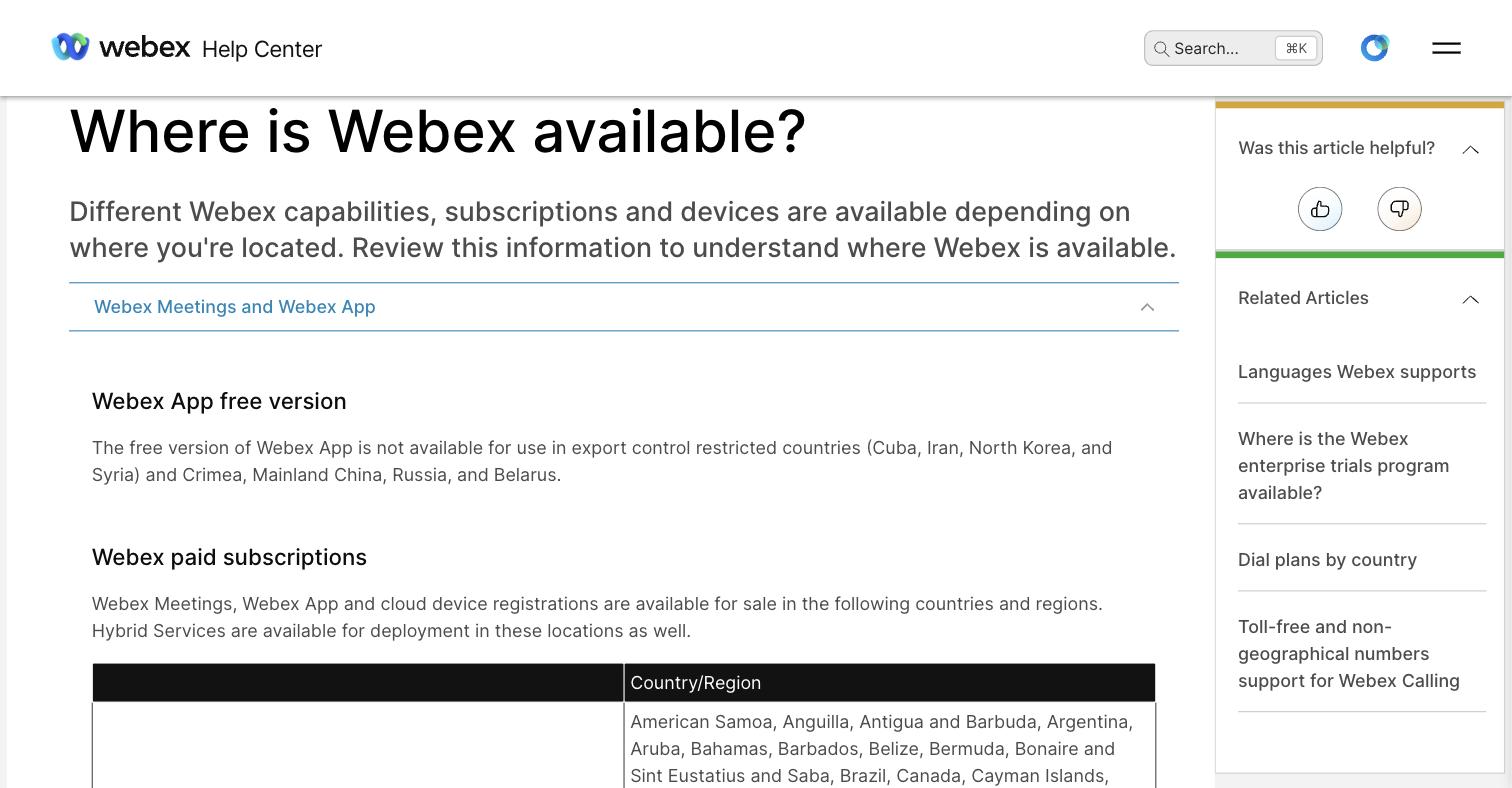
Cisco says it in its own words: the free Webex App is "not available for use in … Mainland China," and paid Webex is "available for sale" only in a published list of countries and regions that does not include the mainland. Operating a commercial, interactive communications service to the public in China is a value-added telecom business, and foreign providers cannot hold that license directly — that is the first door. The second is data: Webex lists no mainland-China data center, so your meetings' media and participant data are carried to and stored in an offshore cluster, a cross-border transfer PIPL governs. The table below is Cisco's own record and the rules it triggers.
This is a risk picture, not a verdict — what applies turns on your entity, your users and the data your meetings carry. Our China team can map your Webex exposure with you →
Compliance snapshot
- ✕ Cisco's availability page excludes mainland China — the free Webex App explicitly, and paid Webex by omission from its for-sale list
- ✕ Running a real-time comms service to the public in China is a licensed value-added telecom activity — not open to foreign providers directly
- ! No mainland-China data center — meeting audio, video, chat and recordings are carried and stored offshore
- ! Meeting content and participant data leaving China is a cross-border transfer PIPL governs
- ✓ A compliant, ICP-filed in-country delivery path exists — no rebuild, no migration
What Webex's own documentation says about China
| Fact | Primary source |
|---|---|
| In Cisco's own words: the free Webex App "is not available for use in export control restricted countries (Cuba, Iran, North Korea, and Syria) and Crimea, Mainland China, Russia, and Belarus," and paid Webex — "Webex Meetings, Webex App and cloud device registrations" — is "available for sale in the following countries and regions," a published list that does not include mainland China. Paid Webex is not offered for the mainland-China market the way it is elsewhere. | Cisco Webex — "Where is Webex available?", retrieved 2026-10-07 |
| Cisco lists its Webex Meetings clusters and data centers in Dallas–Fort Worth, New York and Ashburn (USA), London (UK), Toronto (Canada), Frankfurt (Germany), Sydney and Melbourne (Australia), Tokyo (Japan), Jeddah (Saudi Arabia), Bombay (India) and Singapore — none in mainland China. So the audio, video, chat and recordings of a meeting joined from China are carried to, and stored in, an offshore cluster — the nearest being Tokyo, Singapore or Bombay. | Cisco Webex — "Cisco Webex Meetings Clusters and Data Center Locations", retrieved 2026-10-07 |
| Operating or selling a commercial, interactive communications service to the public in China is a value-added telecom service (VATS), gated by a value-added telecom business license — not a simple website filing. Foreign participation runs through a dedicated regime, the Regulations on the Administration of Foreign-Invested Telecommunications Enterprises (State Council Order No. 333), so a foreign provider cannot simply sell the service directly — the licensing reality behind Cisco's statement above. | China — Regulations on the Administration of Foreign-Invested Telecommunications Enterprises (State Council Order No. 333), via gov.cn |
| Because the meeting runs through an offshore cluster, the personal data in it — participants' identities, plus the audio, video, chat and recordings gathered from people in China — leaves the country. PIPL governs that cross-border transfer: the personal-information handler (you, Cisco's customer — not Cisco) must give notice, obtain separate consent, and satisfy one transfer mechanism — a CAC security assessment, the CAC standard contract, or certification. For a CIIO or large-volume handler, personal information collected in China must be stored in the mainland (PIPL Article 40; CSL Article 39 (formerly Article 37)). | PIPL Chapter III, Articles 38–43; Article 40; CSL Article 39 (formerly Article 37) |
| Webex is not provisioned as a mainland-market product end to end: Cisco notes that Android users in mainland China cannot install the Webex Meetings app from Google Play or the Amazon Appstore, since those stores are unavailable there, and directs them to download from the Webex website instead. It is a distribution gap, not the compliance question — but it shows the service is built for the markets Cisco sells to, which do not include the mainland. | Cisco Webex — "Unable to Find Google Play Store to Install the Webex Meetings App for Android in Mainland China", retrieved 2026-10-07 |
Sources verified by the 21YunBox compliance team on 2026-10-07.
For a mainland-China audience, the deciding question about Webex is not how crisp the video is — it is whether a foreign provider may operate a real-time interactive meeting service inside China at all, and where each meeting’s audio, video and recordings are allowed to travel. Cisco answers the first part itself: it does not sell paid Webex to the mainland market. That single fact opens onto two compliance doors — one about the right to operate the service (telecom licensing), one about the data your meetings carry (residency and cross-border transfer) — and Webex’s own documentation describes both.
Webex in China at a glance
| What decides it | What the record shows |
|---|---|
| Does Cisco sell it there? | No. Cisco's availability page states the free Webex App “is not available for use in … Mainland China,” and lists the countries and regions where paid Webex is “available for sale” — a list that does not include mainland China. Paid Webex is not offered for the mainland market. |
| Right to operate | A commercial, interactive communications service to the public in China is a value-added telecom service, gated by a value-added telecom business license — a regime not open to foreign providers directly. |
| Where it runs | Webex clusters sit in the USA (Dallas–Fort Worth, New York, Ashburn), UK, Canada, Germany, Australia, Japan, Saudi Arabia, India and Singapore. No data center is in mainland China; the nearest are Tokyo, Singapore and Bombay. |
| Your meeting data | Audio, video, chat, recordings and participant personal data are carried to and stored in an offshore cluster — a cross-border transfer of personal information PIPL governs. |
| App distribution | In the mainland the Webex Meetings app is not available through Google Play or the Amazon Appstore; Cisco directs Android users to download from the Webex website instead. |
Door one — a meeting service to the public is a licensed telecom business
On its own availability page Cisco states that the free Webex App “is not available for use in export control restricted countries (Cuba, Iran, North Korea, and Syria) and Crimea, Mainland China, Russia, and Belarus,” and that paid Webex — “Webex Meetings, Webex App and cloud device registrations” — is “available for sale in the following countries and regions,” a published list that does not include mainland China. That is not a performance note; it is the shape of China’s telecom regime showing through. Running or selling a commercial, interactive communications service to the public in mainland China is a value-added telecom service, and the right to provide it turns on a value-added telecom business license rather than a simple website filing.
Foreign providers cannot hold that license directly. Foreign participation in Chinese telecom runs through a dedicated regime — the Regulations on the Administration of Foreign-Invested Telecommunications Enterprises (State Council Order No. 333) — which routes it through a qualifying foreign-invested telecom enterprise rather than a straight sale from abroad. So “our team already runs on Webex” describes your offices elsewhere; it does not describe a service Cisco offers for sale inside the mainland. Where real-time communications must reach the public in China, the lawful route runs through licensed in-country arrangements — a telecom-licensing question before it is ever a networking one.
Door two — your meetings’ data leaves China
Even where meetings connect for users travelling or federated in, Webex lists no data center inside mainland China. Its published clusters sit in the United States (Dallas–Fort Worth, New York, Ashburn), the United Kingdom, Canada, Germany, Australia, Japan, Saudi Arabia, India and Singapore — so the audio, video, chat and recordings of a meeting joined from China are carried to, and stored in, an offshore cluster.
Under China’s Personal Information Protection Law that is a cross-border transfer of personal information: the handler — you, Cisco’s customer, not Cisco — must give notice, obtain separate consent, and clear one transfer mechanism (a CAC security assessment, the CAC standard contract, or certification). For a critical information infrastructure operator or a large-volume handler, personal information collected in China must be stored in the mainland (PIPL Article 40; Cybersecurity Law Article 39 (formerly Article 37)) — a residency duty no offshore Webex cluster can meet.
This is a risk map, not a verdict: whether you face a licensing obligation, a data-residency duty, or both depends on your entity, who your users are, and the personal data your meetings carry — worth settling with counsel before you commit.
Where 21YunBox fits — a compliant overlay, not a migration
You keep the collaboration tools your teams rely on. What we add is the piece an offshore meeting service cannot: a compliant, ICP-filed in-country delivery path for your China-facing web presence and the content that surrounds your meetings — registration pages, recordings you host yourself, help content and events — set up without a rebuild or a second codebase. Our China team maps both doors for your situation: the telecom-licensing exposure your real-time communications create, and the PIPL cross-border and data-residency obligations for your entity and data volumes, then stands up the lawful in-country delivery and storage an offshore model leaves you to arrange. We do not resell Webex or work around Cisco’s availability — we build the compliant China delivery path it does not provide.
Related reading:
Frequently Asked Questions
Can I buy Webex for use in mainland China?
Not from Cisco directly. Cisco's own availability page lists the countries and regions where paid Webex is "available for sale," and mainland China is not among them — and it states the free Webex App "is not available for use in ... Mainland China." Operating a commercial, real-time communications service to the public in China is a licensed value-added telecom activity that foreign providers cannot hold directly, so the service is not offered for the mainland market the way it is elsewhere.
Where does Webex store my meeting data?
In one of its offshore clusters. Cisco lists Webex data centers in the US, UK, Canada, Germany, Australia, Japan, Saudi Arabia, India and Singapore — none in mainland China — so a meeting joined from China has its audio, video, chat and recordings carried to and stored in an offshore cluster. For personal data gathered from people in China, that is a cross-border transfer under PIPL, which calls for notice, separate consent and a transfer mechanism; a CIIO or large-volume handler may also face an in-country storage duty. Treat it as a risk to assess with counsel, not a blanket prohibition.
Can 21YunBox help make our China setup compliant around Webex?
Yes. Our China team can assess both doors for your situation — the telecom-licensing exposure your real-time communications create, and the PIPL cross-border and data-residency obligations for your entity and data volumes — and stand up the compliant, ICP-filed in-country delivery for your China-facing web presence and the content around your meetings, without a rebuild. Get in touch to work through your specific case.