Does Microsoft Teams Work in China? Data Residency & 21Vianet
Microsoft runs Teams as two separate clouds: a worldwide tenant that stores data offshore and a China-only instance operated by 21Vianet. A compliance-first look at the PIPL and data-residency questions.
Does Microsoft Teams work in China?
Whether you can run Microsoft Teams for China-based staff is first a data-residency and cross-border question, not a speed one. What decides it is where Teams keeps your chats, meetings and files — and under whose law.
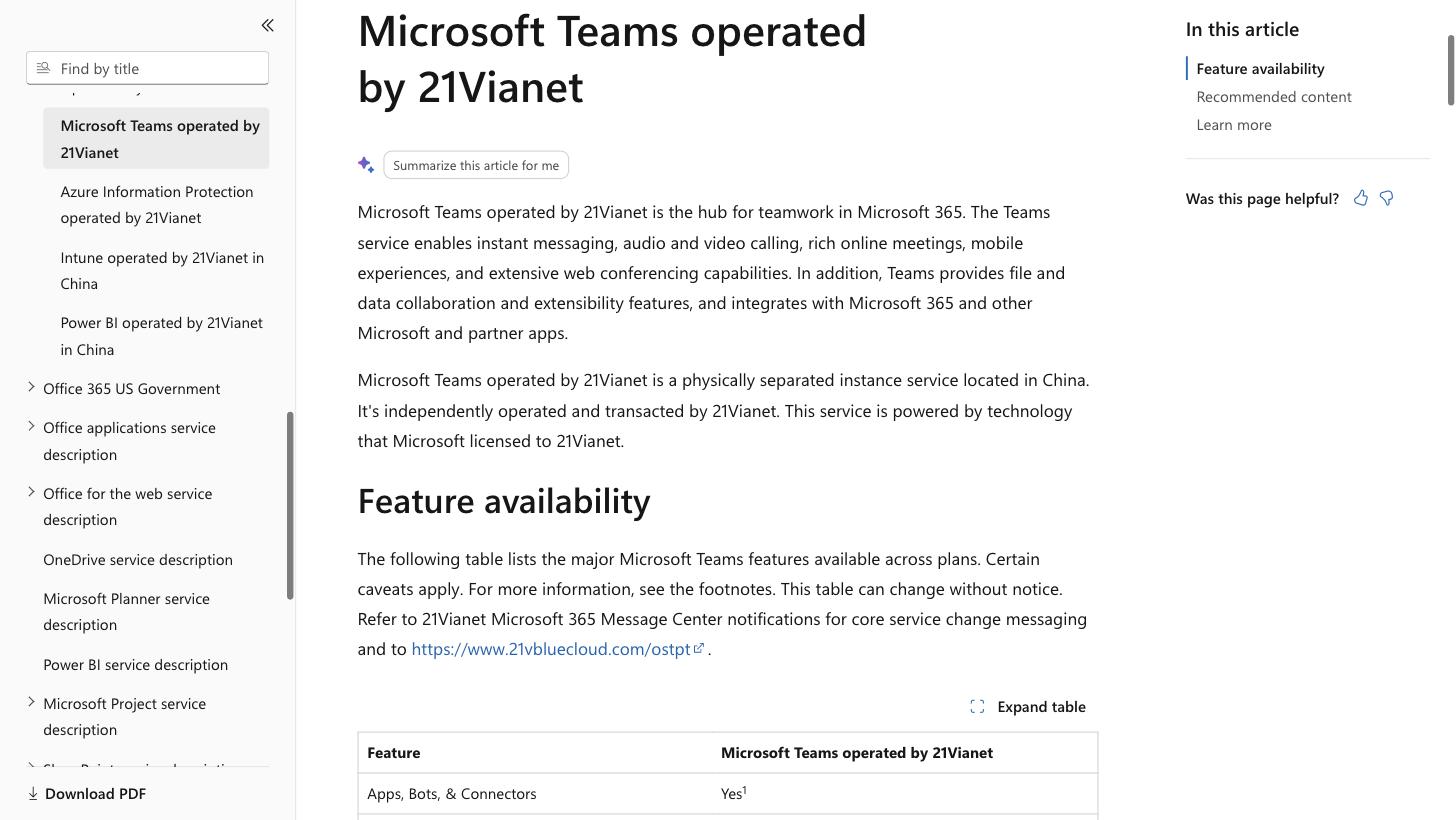
Microsoft runs Teams as two separate clouds. Its own service description calls Microsoft Teams operated by 21Vianet "a physically separated instance service located in China," run by 21Vianet to keep "data within China" and "subject to Chinese laws." The worldwide tenant most multinationals use has no mainland-China data-residency geography, so the personal information your China users generate in Teams is held offshore — a cross-border transfer of personal information that PIPL governs, needing separate consent, a transfer mechanism, and for a CIIO or large-volume handler, in-country storage. The table below is Microsoft's own wording and the rules it triggers.
This is a risk read, not a legal verdict — what you owe turns on which tenant you run, your data volumes and your role. Our China team can map your Teams exposure with you →
Compliance snapshot
- ! Worldwide tenant stores Teams chats, meetings & files outside mainland China
- ! Using it for China staff is a cross-border PI transfer — PIPL applies
- ✕ No mainland-China data residency on the worldwide tenant
- ✓ A compliant in-country path exists: Teams operated by 21Vianet
- ! That path is a separate China tenant, and public web still needs an ICP filing
What Microsoft Teams's documentation says, and what we measured from inside China
| Fact | Primary source |
|---|---|
| In Microsoft's own words: it runs Teams as two separate clouds. Microsoft Teams operated by 21Vianet is "a physically separated instance service located in China" that is "independently operated and transacted by 21Vianet" and "powered by technology that Microsoft licensed to 21Vianet." Microsoft states it "does not operate the service itself," that 21Vianet "operates local Microsoft 365 data centers … while keeping data within China," and that "these services are subject to Chinese laws." | Microsoft Learn — Teams operated by 21Vianet (2026-06-19) and Microsoft 365 operated by 21Vianet (2025-06-24), retrieved 2026-10-07 |
| Microsoft's worldwide Microsoft 365 cloud publishes its data-residency geographies, and mainland China is not one of them — the list runs from Australia through the United Kingdom, and China is served only by the separate 21Vianet cloud. 21YunBox inference: an organization on the global/worldwide tenant therefore has its Teams chats, meetings and files stored in a Microsoft datacenter geography outside mainland China, which is what makes using it for China staff a cross-border transfer. | Microsoft Learn — Microsoft 365 data locations (updated 2026-09-03), retrieved 2026-10-07; 21YunBox inference from the published geography list |
| Because that data leaves China, PIPL Chapter III puts the duty on the personal-information handler — Microsoft's customer, not Microsoft — to obtain separate consent for the overseas transfer and satisfy one mechanism: a CAC security assessment, the CAC standard contract, or certification. How heavy that is scales with volume: under the CAC's March 2024 cross-border rules, a non-CIIO moving fewer than 100,000 individuals' non-sensitive personal information in a calendar year is exempt from all three. | PIPL Chapter III, Articles 38–40; CAC — Provisions on Promoting and Regulating Cross-border Data Flows (March 2024) |
| For a CIIO or large-volume handler, personal information collected in China must be stored in mainland China (CSL Article 39 (formerly Article 37); PIPL Article 40). Microsoft's own in-country answer is the separate 21Vianet instance — and even there its service description notes "China Internet compliance policy requires that you get an Internet Content Provider (ICP) number for a public website," the same ICP filing any in-country delivery carries. | PIPL Article 40; CSL Article 39 (formerly Article 37); Microsoft Learn — Microsoft 365 operated by 21Vianet (footnote 11), retrieved 2026-10-07 |
The question here is legal, not whether a page loads: requested from a probe inside mainland China (Alibaba Cloud cn-zhangjiakou) on 2026-08-28, the Microsoft Teams marketing page completed all 3 of 3 attempts, first byte in a median 1,093ms and largest-contentful-paint at 6,672ms. Reachability of the live service (calls, meeting media) is a separate delivery matter — but it is delivery, not the compliance question that decides whether you may use it. | 21YunBox — China delivery measurement, measured from inside mainland China |
Sources verified by the 21YunBox compliance team on 2026-10-07.
Whether Microsoft Teams “works” for a China-based team is a data-residency question before it is a performance one. Microsoft runs Teams as two separate clouds: the worldwide tenant most multinationals already sign in to, which keeps data in Microsoft datacenter geographies outside mainland China, and Microsoft Teams operated by 21Vianet, which Microsoft’s own service description calls “a physically separated instance service located in China.” That split is Microsoft’s architecture, not ours — and it is the clearest statement there is of the two doors a China audience forces open: where your users’ chats, meetings and files are stored, and under whose law. Microsoft documents both in its own words.
Microsoft Teams in China at a glance
| What decides it | In Microsoft's own terms |
|---|---|
| Two clouds, not one | Microsoft runs Teams as two separate clouds. Its in-country product, Microsoft Teams operated by 21Vianet, is “a physically separated instance service located in China.” |
| Who runs the China instance | It is “independently operated and transacted by 21Vianet” and “powered by technology that Microsoft licensed to 21Vianet.” |
| Where China data lives | The Microsoft 365 operated by 21Vianet service description says 21Vianet “operates local Microsoft 365 data centers … while keeping data within China,” and that “these services are subject to Chinese laws.” |
| The worldwide tenant | Microsoft's worldwide Microsoft 365 publishes its data-residency geographies, and mainland China is not one of them (21YunBox inference) — so a global-tenant organization's Teams chats, meetings and files are held offshore. |
| Serving the public web | “China Internet compliance policy requires that you get an Internet Content Provider (ICP) number for a public website” (Microsoft 365 operated by 21Vianet service description). |
Door one — the worldwide tenant keeps your China data offshore
The tenant your organization most likely already runs is the global one, and it has no mainland-China home. Microsoft’s worldwide Microsoft 365 publishes the data-residency geographies it offers — and mainland China is not on that list; China is served only by the separate 21Vianet cloud (21YunBox inference from Microsoft’s published geographies). So the personal information your China-based staff generate inside Teams — messages, meeting records, shared files — is stored in a datacenter outside the mainland.
Under China’s Personal Information Protection Law that is a cross-border transfer of personal information, and the duty sits with the personal-information handler — Microsoft’s customer, which is you, not Microsoft. You must give notice, obtain separate consent for the overseas transfer, and satisfy one transfer mechanism: a CAC security assessment, the CAC standard contract, or certification (PIPL Articles 38–40). “We already use Teams” therefore does not answer the China question — it quietly picks the offshore door.
Door two — Microsoft Teams operated by 21Vianet, a China-only instance
Microsoft’s own in-country answer is a different product, not a setting on the one you have. Its service description calls Microsoft Teams operated by 21Vianet “a physically separated instance service located in China,” “independently operated and transacted by 21Vianet” and “powered by technology that Microsoft licensed to 21Vianet.” The companion Microsoft 365 operated by 21Vianet service description adds that 21Vianet “operates local Microsoft 365 data centers … while keeping data within China,” and that “these services are subject to Chinese laws.”
That keeps data in the mainland — the one thing the worldwide tenant cannot do. But it is a separate tenant, with its own sign-in and its own feature set, that you adopt rather than toggle on; and a public-facing website served from inside China still turns on an ICP filing, as Microsoft’s own service description acknowledges: “China Internet compliance policy requires that you get an Internet Content Provider (ICP) number for a public website.” For a CIIO or large-volume handler, personal information collected in China must be stored in the mainland (Cybersecurity Law Article 39 (formerly Article 37); PIPL Article 40) — a bar the offshore worldwide tenant cannot clear. Few vendors offer even that much: in our 763-service China compliance census, read against each vendor’s own documentation in October 2026, only 62 ran a genuine mainland region or sovereign partition — and that route still leaves the filing, the mainland entity and MLPS with the customer.
Whether the live service is reachable minute to minute — call setup, meeting media — is a separate delivery question worth planning for. It is not, however, the question that decides whether you are allowed to run Teams for a China audience.
This is a risk read, not a verdict: which cloud fits — and what consent, contracts or in-country storage you owe — turns on which tenant you run, how much personal information you move, and your role under PIPL. It is worth settling with counsel before you commit.
Where 21YunBox fits — a compliant overlay, not a migration
You keep running Microsoft 365 and Teams. We add the piece the worldwide tenant can’t give a China audience: our China team maps which cloud fits your case, assesses your PIPL cross-border and data-residency exposure for your tenants, data volumes and role, and stands up the ICP-filed, in-country delivery and storage a compliant China presence requires — in front of the web properties that have to reach mainland users, with no tenant migration and no moving your people off the stack they already use.
Related reading:
Frequently Asked Questions
Where does Microsoft Teams store our data if our staff are in China?
On the global/worldwide tenant, in a Microsoft datacenter geography outside mainland China — Microsoft's worldwide cloud offers no mainland-China data-residency region, so chats, meetings and files are held offshore. Microsoft's in-country product, Teams operated by 21Vianet, is a separate instance that it says keeps data within China and is subject to Chinese law.
Should we switch to Microsoft 365 operated by 21Vianet, the China version?
It is Microsoft's own in-country answer and it keeps data in China — but it is a separate tenant operated by 21Vianet, with feature gaps and its own identity, and public-facing web still needs an ICP filing. Whether to run it, keep the worldwide tenant, or bridge the two is a compliance and architecture decision, not a speed one; weigh it against your data volumes and your role under PIPL.
Can 21YunBox help make our Teams and Microsoft 365 setup compliant in China?
Yes. Our China team can assess your cross-border and data-residency exposure for your tenants, data volumes and role, and provide the ICP-filed, in-country delivery and storage the worldwide tenant can't. Get in touch to work through your specific setup.


