Does GoTo Webinar Work in China? Reachability, PIPL & Data Residency
GoTo Webinar runs its webinars and virtual events from offshore infrastructure — it operates 'on a global basis' and processes personal data in other countries, with no mainland-China region — so a live China event leans on real-time media crossing the border, your attendees' data sits offshore under PIPL, and a public interactive service raises telecom-licensing questions. A compliance-first look.
Does GoTo Webinar work in China?
Whether you can run GoTo Webinar for a mainland-China audience is first a reachability-and-data question, not a speed one. GoTo Webinar is a webinar and virtual-event platform — a live session is continuous real-time audio and video, and it gathers your attendees’ registration and engagement data — so where the stream originates and where that data is processed are what China’s law responds to.
GoTo runs as a global service with no mainland-China region. Its own privacy policy states that GoTo “operates on a global basis” and “may transfer your personal data to, or store or otherwise process it in, other countries or regions.” So two things decide it before performance does: a live webinar depends on heavy real-time media crossing the border from offshore, the least reliable thing to deliver into China; and your China attendees’ registration and engagement data is processed outside the mainland — a cross-border transfer PIPL governs. Running a public, interactive real-time service in China also meets value-added telecom licensing. The facts below are GoTo’s own words and the rules they trigger.
This is a risk picture, not a verdict — your obligations turn on your data volumes, your role, and whether your events are public. Our China team can map your GoTo Webinar exposure with you →
What Go To Webinar's own documentation says about China
| Fact | Primary source |
|---|---|
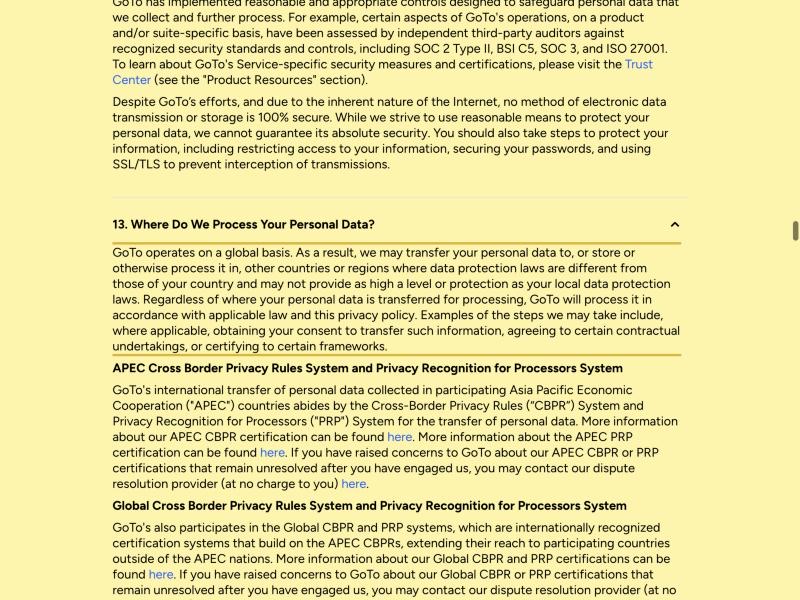
| In GoTo’s own words: under the heading “Where Do We Process Your Personal Data?” GoTo states that it “operates on a global basis” and “may transfer your personal data to, or store or otherwise process it in, other countries or regions where data protection laws are different from those of your country.” GoTo Webinar is served from this global infrastructure with no mainland-China region named, so registration and engagement data gathered from attendees in China is processed offshore — a cross-border matter, not a speed one. | GoTo — Privacy Policy, §13 “Where Do We Process Your Personal Data?” (effective March 9, 2026), retrieved 2026-10-08 |
| A webinar platform is also a data platform: registration collects personal information — names, work emails, companies and job titles, plus any custom fields — and the event produces engagement data such as poll answers, chat, Q&A and attendance records. Collected from people in China and processed on GoTo’s offshore infrastructure, that data leaves the mainland. PIPL governs that cross-border transfer: the personal-information handler — you, GoTo’s customer, not GoTo — must give notice, obtain separate consent, and satisfy one transfer mechanism (a CAC security assessment, the CAC standard contract, or certification). | PIPL, Chapter III (Articles 38–43) |
| Offering a commercial, real-time interactive audio/video communications service to the public in mainland China is a value-added telecommunications service (VATS), gated by a value-added telecom business license rather than a simple site filing — and foreign-invested participation is tightly restricted. A foreign provider cannot simply sell or operate the service directly; the more a China-facing event programme resembles a standing public service, the more this applies (MIIT Order No. 42). | China — Telecommunications Business Licensing Measures (MIIT Order No. 42), promulgated July 3, 2017, via gov.cn gazette |
| The exposure scales with volume and role, not merely with using the tool. Under the CAC’s March 2024 cross-border rules, a non-CIIO transferring fewer than 100,000 individuals’ non-sensitive personal information in a calendar year is exempt from the security assessment, standard contract and certification — while a CIIO or large-volume handler faces data-localization duties (CSL Article 39 (formerly Article 37); PIPL Article 40) that offshore event infrastructure cannot meet. | CAC — Provisions on Promoting and Regulating Cross-border Data Flows, March 2024 |
Sources verified by the 21YunBox compliance team on 2026-10-08.
For a mainland-China audience, the deciding questions about GoTo Webinar are not how polished the webinar console is — they are whether a live session’s audio and video can be carried reliably across the border, and where your attendees’ data is allowed to be processed. GoTo answers the second in its own privacy policy: it operates globally and processes personal data in other countries. A China-facing GoTo Webinar is therefore reachable as a global service but served entirely from offshore — which leaves a live stream leaning on real-time media crossing the border, turns your attendees’ registration and engagement data into a cross-border transfer China’s law governs, and, for a public interactive programme, raises a telecom-licensing question before performance ever enters it.
GoTo Webinar in China at a glance
| What decides it | In GoTo's own terms |
|---|---|
| Where it runs | Global infrastructure, no mainland-China region. GoTo “operates on a global basis” and processes personal data in other countries; a live session's audio and video are carried from outside the mainland. |
| The live stream | A webinar is sustained, real-time audio and video. Served from offshore, every minute of it crosses the border as it happens — the least forgiving kind of delivery into China, and a property of where the service runs, not a tuning setting. |
| Serving the public | Offering a commercial, interactive real-time communications service to the public in China is a licensed value-added telecom activity — not something a foreign provider can sell or operate directly. |
| Your attendees' data | Registration details and engagement data — polls, chat, Q&A, attendance — collected from people in China are processed outside the mainland: a cross-border transfer PIPL governs. |
| Data residency | GoTo operates globally and names no mainland-China region or in-country-storage option, so there is nothing to select for in-country residency. |
Served from offshore, so a live stream leans on the border
GoTo runs as a global SaaS, and its own privacy policy describes a company that “operates on a global basis” and may “transfer your personal data to, or store or otherwise process it in, other countries or regions” — with no mainland-China region named. A recorded replay can be cached close to viewers; a live webinar cannot. The session is continuous, interactive, real-time audio and video, and when it originates offshore every minute of it has to traverse the border as it happens — the single most fragile thing to carry into China, where cross-border throughput is variable and long-lived media connections are the first to degrade. That is a fact about where the service runs, not a setting to tune, and it holds before you even reach the question of whether you are cleared to run the event at all.
Your attendees’ data is processed offshore — and PIPL follows it
A webinar platform is also a data platform. Registration gathers personal information — names, work emails, companies, job titles, and whatever custom fields you add — and the event itself produces engagement data: poll answers, chat, Q&A, and attendance records. Processed on GoTo’s global infrastructure, all of it leaves the mainland. Under China’s Personal Information Protection Law that is a cross-border transfer, and the handler — you, GoTo’s customer, not GoTo — has to give notice, obtain separate consent, and clear one transfer mechanism: a CAC security assessment, the CAC standard contract, or certification. GoTo’s policy frames its international transfers around APEC and global cross-border privacy mechanisms and names no mainland-China region, so there is no in-country-residency option to select. If you are a critical information infrastructure operator or a large-volume handler, personal information collected in China must be stored in the mainland (PIPL Article 40; Cybersecurity Law Article 39 (formerly Article 37)) — a residency duty an offshore webinar platform cannot meet.
A public, interactive service also meets telecom licensing
There is a third door that applies precisely because GoTo Webinar is real-time and interactive. Running a commercial, interactive audio/video communications service to the public in mainland China is a value-added telecommunications service, gated by a value-added telecom business license rather than a simple site filing, and foreign-invested participation is tightly restricted. A single internal all-hands is a different matter from a standing programme of public, open-registration webinars — but the more your China-facing events look like a service offered to the public, the more this licensing question applies on top of the delivery and data ones.
None of this is a verdict — it is a risk map. Whether you face a cross-border-transfer mechanism, an in-country-storage duty, a licensing question, or all three turns on what your events collect, how much personal data you hold, who your attendees are, and whether the programme is public. It is worth settling with counsel before you build.
Where 21YunBox fits — a compliant overlay, not a migration
You keep running your events on GoTo Webinar. We add the piece an offshore webinar platform cannot: compliant, ICP-filed delivery from inside the mainland for your own China-facing properties around the event — the registration and landing pages, the attendee portal, and the embedded players — placed in front of your existing origin, with no rebuild, no second codebase, and no move off GoTo. Our China team maps your PIPL cross-border and data-residency obligations against your entity and data volumes, flags where a public interactive programme raises telecom-licensing questions, and stands up the in-country delivery and storage a lawful China presence needs — while your events keep running where they already run.
Related reading:
- How to get an ICP filing for China
- Cross-border data transfers under PIPL
- China’s value-added telecom business licensing