Does THEOplayer Work in China? Offshore Video, Viewer Data & PIPL
THEOplayer (now Dolby OptiView Player) is a client-side video player you install and host yourself — it carries no mainland-China delivery, so the video and player assets reach Chinese viewers from offshore, and the viewer data its analytics and ads collect is a PIPL cross-border question for whoever operates the app. A compliance-first look at the doors.
Does THEOplayer work in China?
THEOplayer plays in mainland China — it is a client-side player — but "we use THEOplayer" settles almost nothing about compliance: it carries no mainland delivery of its own, and the real questions sit on the site that embeds it, the video it streams across the border, and the viewer data it collects.
THEOplayer — now the Dolby OptiView Player after Dolby's 2024 acquisition — is "the universal video player solution," a JavaScript library you install "through npm" and which needs "a web server and domain name to host your code." It is not a China delivery network: the player assets and the heavy video both stream from your offshore origin, crossing the border on every mainland play. Its insights, analytics and ads modules collect viewer data — "device-related data (such as the IP address…)" and "usage statistics" — which Dolby's own policy says it "may transfer… to the United States." For a Chinese viewer that is a cross-border transfer of personal information under PIPL (Articles 38–43), on a stack with no mainland footing to carry the embedding site's ICP filing. The table below is THEOplayer's and Dolby's own wording and the rule each one triggers.
This is a risk map, not a verdict — which duties apply turns on what you stream, how much viewer data you keep and who is watching. Our China team can map your exposure with you →
Compliance snapshot
- ! THEOplayer is a client-side player SDK — no mainland-China delivery of its own
- ! Video and player assets served offshore cross the border on every mainland play
- ! Its insights, analytics and ads modules collect viewer data — PIPL applies
- ✕ An offshore-served embed gives the site no mainland footing to ICP-file
- ! Streaming programming to a China audience may engage SARFT/MIIT content rules
What THEOplayer's own documentation says about China
| Fact | Primary source |
|---|---|
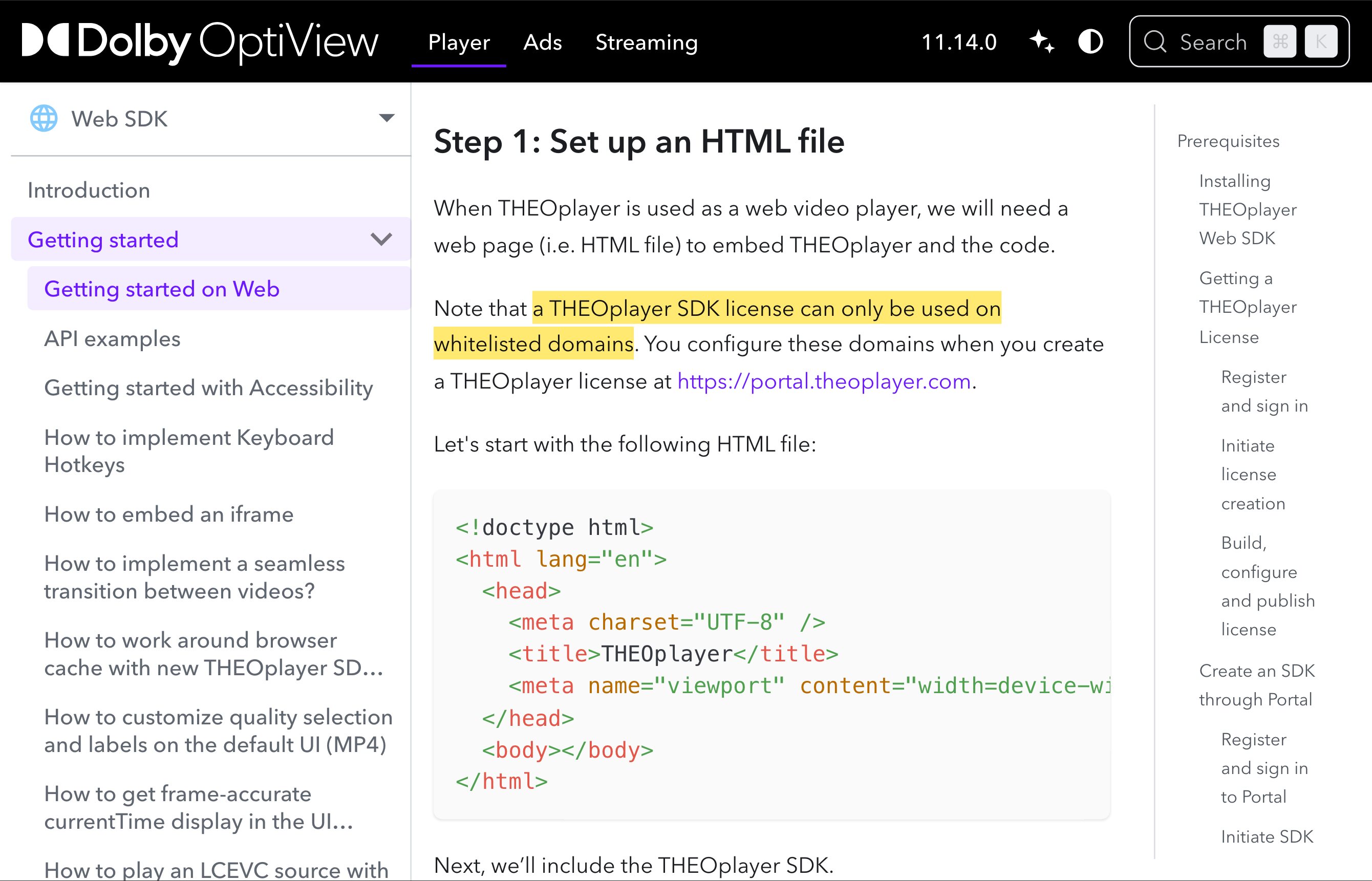
| THEOplayer is a client-side player you host yourself — not a mainland-China delivery network. THEO's Web SDK guide tells you to install the player "through npm," states you need "a web server and domain name to host your code," and notes that "a THEOplayer SDK license can only be used on whitelisted domains." Now the Dolby OptiView Player (Dolby acquired THEO in 2024), it is a JavaScript library that rides on your own origin — it gives you no mainland point of presence, so the video and player assets reach a Chinese viewer from wherever you host them, offshore by default, outside any ICP-filed in-country delivery. | THEOplayer (Dolby OptiView) — Web SDK getting-started & npm package, retrieved 2026-10-07 |
| The player's insights, analytics and ads modules are built on viewer data. Dolby's Global Privacy Policy says it collects "device-related data (such as the IP address of your computer and/or Internet service provider)," together with "your interactions with and preferences on our Services, usage statistics, and other analytics and technical information," gathered through "browser cookies, web beacons, device identifiers, server logs." For a mainland-China viewer every one of those is personal information, so wiring in the player's viewer insights, an analytics connector or its ads module puts a China-facing deployment under the Personal Information Protection Law (Articles 38–43). | Dolby Global Privacy Policy, retrieved 2026-10-07; PIPL Articles 38–43 |
| The personal data heads offshore — a cross-border transfer under PIPL. Dolby's own policy states it "may transfer the personal information we obtain about you to the United States," and that for visitors located abroad "this information will be transferred to Dolby in the U.S." Served to Chinese viewers from offshore, those viewer records leave the mainland: a cross-border transfer of personal information that needs notice, separate consent and a transfer mechanism — and, for a critical information infrastructure operator or large-volume handler, in-country storage the offshore stack cannot provide (PIPL Article 40; Cybersecurity Law Article 39 (formerly Article 37)). | Dolby Global Privacy Policy, retrieved 2026-10-07; PIPL Article 40; Cybersecurity Law Article 39 (formerly Article 37) |
| The ICP line falls on the site that embeds the player, and an offshore embed gives it no footing. A public site served to mainland visitors needs an ICP filing tied to a mainland hosting resource (State Council Order No. 292; MIIT Order No. 33). THEOplayer is client-side — you install it "through npm" and need "a web server and domain name to host your code" — so it adds no mainland footing to file against; the player rides on top of whatever delivery the operator already runs, rather than supplying the in-country presence a filing attaches to. | THEOplayer Web SDK getting-started (optiview.dolby.com), retrieved 2026-10-07; State Council Order No. 292; MIIT Order No. 33 |
Sources verified by the 21YunBox compliance team on 2026-10-07.
For a mainland-China audience, the real question about THEOplayer is not whether the video plays — it is whether you are cleared to deliver it there and allowed to collect what the player records while it does. THEOplayer (now the Dolby OptiView Player) is a client-side SDK you embed and host yourself; it gives you no presence inside mainland China, so the video and the player assets reach Chinese viewers from offshore, and the viewing data its analytics and ads modules gather is personal information the moment the viewer is in China. Playback is the easy half. The licensing of your site, the border your viewers’ data crosses, and the content rules a streaming service can trip are the exposure.
THEOplayer in China at a glance
| What decides it | In THEOplayer's own terms |
|---|---|
| What it is | A client-side player SDK for Web/HTML5, Android, iOS, Roku, React Native, Flutter and smart TVs — “the universal video player solution,” installed “through npm” and hosted on your own server. No mainland-China region or point of presence of its own. |
| Serving the public | A public site served to mainland visitors needs an ICP filing on a mainland hosting resource (State Council Order No. 292; MIIT Order No. 33). The player is self-hosted and client-side, so it adds no mainland footing — the ICP duty sits on the embedding site. |
| What it records per viewer | Its insights, analytics and ads modules gather “device-related data (such as the IP address of your computer…),” plus “usage statistics, and other analytics and technical information,” via “browser cookies, web beacons, device identifiers.” Personal data for a Chinese viewer. |
| Crossing the border | Dolby's Global Privacy Policy says it “may transfer the personal information we obtain about you to the United States” — a cross-border transfer PIPL governs (notice, separate consent, a transfer mechanism; Articles 38–43), with in-country storage for a CIIO or large-volume handler (Article 40; Cybersecurity Law Article 39 (formerly Article 37)). |
| Audio-visual content | Streaming audio-visual programming to a mainland audience can engage China's online audio-visual program rules (SARFT/MIIT Order No. 56) — a fact-specific risk to settle with counsel, not a settled yes or no. |
A client-side player, not a China delivery network
THEOplayer — “the universal video player solution created by THEO Technologies,” now the Dolby OptiView Player after Dolby’s 2024 acquisition — is a library you embed, not a network you route through. THEO’s own Web SDK guide has you install it “through npm,” and need “a web server and domain name to host your code”; “a THEOplayer SDK license can only be used on whitelisted domains.” Nothing in that setup puts a byte inside mainland China. The player and the video it plays reach a Chinese viewer from your own origin — offshore for a global stack — and because video is the heaviest thing on the page, every play drags that media across the border. That is the delivery half of the question: real, but not the half that decides whether you may run it. We are deliberately not attaching a number here — there is no clean first-party measurement for this page, and the point holds without one. Reachable is not the same as cleared to operate.
The viewer data it collects is personal — and it heads offshore
A modern player is also an instrument. Wire in THEOplayer’s viewer insights, an analytics connector or its ads module and you begin recording who watched, from where, on what. Dolby’s Global Privacy Policy describes the shape of that collection across its services: “device-related data (such as the IP address of your computer and/or Internet service provider),” together with “your interactions with and preferences on our Services, usage statistics, and other analytics and technical information,” gathered through “browser cookies, web beacons, device identifiers, server logs.” For a viewer in mainland China every one of those is personal information, and Dolby’s policy is explicit about where the data it handles goes: it “may transfer the personal information we obtain about you to the United States.” Under the Personal Information Protection Law that is a cross-border transfer — notice, separate consent and one transfer mechanism (a CAC security assessment, the CAC standard contract, or certification; Articles 38–43) — and for a critical information infrastructure operator or a large-volume handler, personal information collected in China must be stored in the mainland (PIPL Article 40; Cybersecurity Law Article 39 (formerly Article 37)), which an offshore stack cannot do. Be clear about scope, though: the player is a client-side component, so the heavier PIPL and ICP duties fall on whoever operates the site and on where the video and viewer records actually live — the player rides on top of that, it does not absolve it.
Streaming programming to China can trigger audio-visual rules too
There is a third door most player comparisons never mention. Distributing streaming audio-visual programming to a mainland audience can engage China’s online audio-visual program rules — the SARFT/MIIT Administrative Provisions on Internet Audio-Visual Program Services (Order No. 56) — which govern who may provide such a service and under what licensing. Whether they reach your deployment is fact-specific: it turns on what you stream, to whom, and in what capacity, and it is a question for counsel, not a settled yes or no. We flag it because a player that “just plays video” can quietly place you inside a licensing regime that has nothing to do with speed.
This is a risk map, not a verdict: whether ICP filing, PIPL notice and separate consent, in-country storage, audio-visual licensing, or several at once apply to you depends on what you stream, how much viewer data you keep and who is watching — worth settling with counsel before you ship to a mainland audience.
Where 21YunBox fits — a compliant overlay, not a migration
Your player stays exactly as it is. THEOplayer keeps running on your own origin, with the insights and ads you already rely on untouched. What we add is the piece a client-side player structurally cannot carry: compliant, ICP-filed delivery from inside the mainland, placed in front of the origin you already run — no rebuild, no second codebase, and no move off THEOplayer or Dolby. Our China team maps your PIPL cross-border, data-residency and audio-visual exposure against your entity, your data volumes and your audience, then stands up the in-country, filed delivery and storage a lawful China presence is built on — while the video and the viewer analytics you depend on keep working as they do today.
Related reading:
Frequently Asked Questions
Does "we already use THEOplayer" make our video compliant in China?
No — it settles almost nothing. THEOplayer is a client-side player you install "through npm" and host on your own server; it gives you no mainland-China point of presence, so the video and player assets reach Chinese viewers from offshore, and the viewer data its analytics and ads collect is personal information under PIPL the moment the viewer is in China. Compliance turns on the site that embeds the player — its ICP filing, where your video and viewer records are stored, and whether any audio-visual rules apply — not on the player component itself.
Do China's streaming / audio-visual rules apply to our video?
Treat it as a fact-specific risk to confirm with counsel, not a blanket yes or no. Distributing streaming audio-visual programming to a mainland audience can engage China's online audio-visual program rules (the SARFT/MIIT Administrative Provisions on Internet Audio-Visual Program Services, Order No. 56), which govern who may provide such a service and under what licensing. Whether they reach you depends on what you stream, to whom and in what capacity — alongside the separate PIPL cross-border and ICP questions a China-facing deployment raises.
Can 21YunBox help make our THEOplayer setup work in China?
Yes. Our China team can map which duties apply — assessing your PIPL cross-border, data-residency and audio-visual exposure for your entity, data volumes and audience — and stand up the ICP-filed, in-country delivery and storage a compliant China presence needs, in front of the THEOplayer origin you already run. Your player and the viewer analytics you rely on keep working untouched. Get in touch to work through your specific case.