Does Cvent Work in China? ICP, Attendee Data & Data Residency
Cvent stores event and attendee data on AWS regions in the US and EU — none inside mainland China — so a China-facing registration site is served offshore with no ICP-filing path, and attendee data (some of it sensitive) becomes a cross-border transfer under PIPL. A compliance-first look at the two doors.
Does Cvent work in China?
Whether you can use Cvent for a mainland-China event is a compliance question first — about where attendee data lives and whether the registration site is licensed to run inside China — not a speed one. Cvent runs your event registration, and the personal data those forms collect is what China's law responds to.
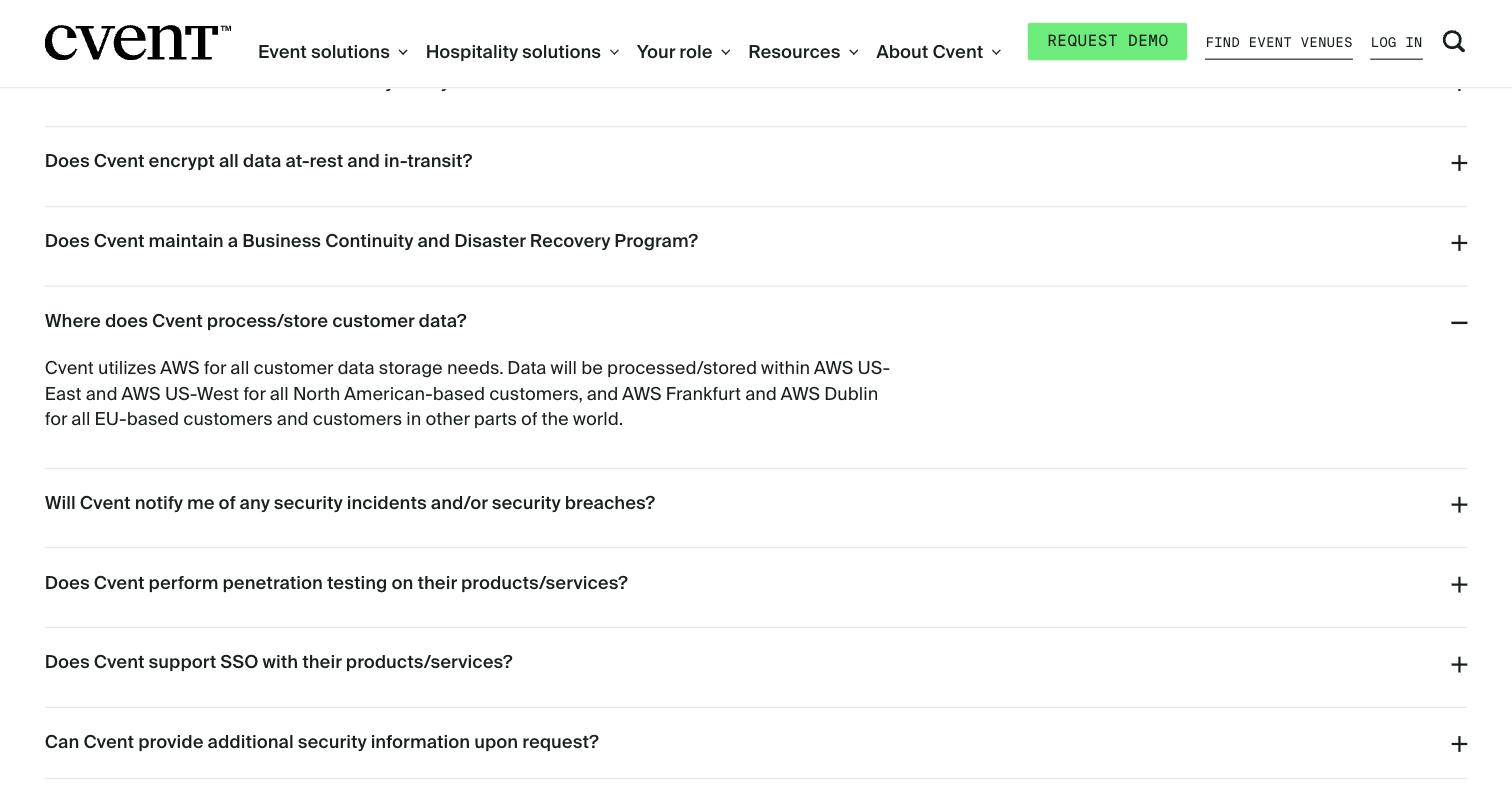
By Cvent's own security documentation, it "utilizes AWS for all customer data storage needs," processing and storing data in AWS US-East and US-West for North America and AWS Frankfurt and Dublin for the EU and "customers in other parts of the world" — no region inside mainland China. So the names, contact details and travel information your Chinese attendees enter are held offshore: a cross-border transfer of personal information PIPL governs — and because registration forms can capture passport IDs and dates of birth, some of it is sensitive personal information, which PIPL treats more strictly. Serving the public registration microsite to mainland visitors separately raises an ICP filing question. The table below is Cvent's own wording and the rules it triggers.
This is a risk picture, not a verdict — your obligations turn on your attendee volumes, how sensitive the fields are, and your role. Our China team can map your Cvent exposure with you →
Compliance snapshot
- ! A public registration site shown to mainland visitors needs an ICP filing — Cvent offers no mainland hosting to file against
- ! Event and attendee data is stored on offshore AWS regions (US and EU) — a cross-border transfer PIPL governs
- ! Registration forms can hold sensitive PI — passport IDs, dates of birth — which PIPL treats more strictly
- ✕ No mainland-China region or data-residency option on Cvent
- ✓ A compliant, ICP-filed in-country delivery path exists — no rebuild, no migration
What Cvent's own documentation says about China
| Fact | Primary source |
|---|---|
| In Cvent's own words: Cvent "utilizes AWS for all customer data storage needs," and "data will be processed/stored within AWS US-East and AWS US-West for all North American-based customers, and AWS Frankfurt and AWS Dublin for all EU-based customers and customers in other parts of the world." None of those regions is in mainland China — the registration data of your Chinese attendees is held offshore. | Cvent — Security ("Where does Cvent process/store customer data?"), retrieved 2026-10-07 |
| Event registration forms routinely capture identity details. Cvent confirms it "offers field-level encryption for any field designed to contain potentially sensitive information, such as Date of Birth, Social Security Number, Passport ID, and more." Under PIPL those categories are sensitive personal information, which requires its own separate consent and a demonstrated necessity — a higher bar than ordinary attendee contact data. | Cvent — Security ("Does Cvent encrypt all data at-rest and in-transit?"); PIPL Articles 28–29, retrieved 2026-10-07 |
| Because that data leaves China, PIPL puts the duty on the personal-information handler — you, the event organizer, not Cvent — to give notice, obtain separate consent, and satisfy one transfer mechanism: a CAC security assessment, the CAC standard contract, or certification. | PIPL Chapter III, Articles 38–43 |
| The exposure scales with volume and sensitivity, not merely with using the tool. Under the CAC's March 2024 cross-border rules, a non-CIIO transferring fewer than 100,000 individuals' non-sensitive personal information in a calendar year is exempt from the assessment, standard contract and certification — but sensitive personal information does not qualify for that exemption, and transferring the sensitive data of 10,000 individuals or more in a year triggers the CAC security assessment. | CAC — Regulations on Promoting and Regulating Cross-border Data Flows, March 2024 |
| A public-facing registration site delivered to mainland visitors turns on an ICP filing (State Council Order No. 292; MIIT Order No. 33), which must attach to a hosting resource inside mainland China. Cvent runs only offshore AWS regions, so there is nothing on Cvent to file against — and for a CIIO or large-volume handler, personal information collected in China must be stored in the mainland (CSL Article 39 (formerly Article 37); PIPL Article 40), a residency duty no offshore region can meet. | PIPL Article 40; CSL Article 39 (formerly Article 37); Cvent — Security, retrieved 2026-10-07 |
Sources verified by the 21YunBox compliance team on 2026-10-07.
For a mainland-China event, the deciding question about Cvent is not how fast its registration pages paint — it is whether that public registration site is licensed to run inside China, and where the personal data your attendees hand over is allowed to live. Cvent answers the second half in its own security documentation: it stores customer data on AWS regions in the United States and the EU, with none inside mainland China. A China-facing event on Cvent is therefore served and stored entirely offshore — which leaves its public registration site with no footing for the ICP filing a mainland site requires, and turns every attendee record into a cross-border transfer China’s law governs. The event runs; the licensing and the data residency are the exposure.
Cvent in China at a glance
| What decides it | In Cvent's own terms |
|---|---|
| Where it stores data | Cvent “utilizes AWS for all customer data storage needs” — US-East and US-West for North America, Frankfurt and Dublin for the EU and “customers in other parts of the world.” No region is inside mainland China. |
| What the forms collect | Registration and survey forms capture attendee personal data; Cvent offers field-level encryption for fields such as “Date of Birth, Social Security Number, Passport ID, and more” — categories PIPL treats as sensitive personal information. |
| Serving the public | A registration microsite shown to mainland visitors needs an ICP filing tied to a mainland hosting resource. With no mainland region, Cvent offers no ICP-filing path of its own. |
| Your attendees' data | Personal data collected from Chinese attendees sits on offshore AWS regions — a cross-border transfer PIPL governs, with a stricter bar where the data is sensitive, plus a localization duty for CIIOs and large-volume handlers. |
| Reachability | Registration pages are served from those offshore AWS regions, not a mainland one. Reachability and speed are the delivery half; they do not change the licensing or data-residency facts. |
Door one — a public registration site served to China needs an ICP filing
Cvent’s strength is the public-facing piece: the branded registration site, the agenda, the surveys. Shown to visitors inside mainland China, that site is exactly what China’s filing regime covers. A public-facing website delivered to mainland users from inside China turns on an ICP filing (ICP 备案) under State Council Order No. 292 and MIIT Order No. 33, and that filing has to attach to a hosting resource physically in the mainland. By its own security documentation Cvent stores and serves from AWS regions in the United States and the EU — none in mainland China — so there is no mainland footing on Cvent for a filing to sit on. “We already run our events on Cvent” does not carry across the border: hosting an event platform abroad is not the same as being cleared to publish its registration site inside China.
Door two — your attendees’ data stays offshore
Run a China event on Cvent and the data your attendees enter — names, contact details, job titles, travel and accommodation choices — lands in AWS US-East, US-West, Frankfurt or Dublin. In Cvent’s own words it “utilizes AWS for all customer data storage needs,” processing and storing in those regions for North American, EU and other customers alike. Under China’s Personal Information Protection Law that is a cross-border transfer, and the duty sits with the handler — you, the event organizer, not Cvent — to give notice, obtain separate consent, and clear one transfer mechanism: a CAC security assessment, the CAC standard contract, or certification. For a critical information infrastructure operator or a large-volume handler, personal information collected in China must be stored in the mainland (PIPL Article 40; Cybersecurity Law Article 39 (formerly Article 37)) — a residency duty an offshore AWS region cannot satisfy.
Registration forms hold sensitive data — a higher bar
Events ask for more than an email address. Badge pickup, visa letters, international travel and dietary or health needs mean a registration form can hold passport numbers, dates of birth and health details. Cvent acknowledges as much: it “offers field-level encryption for any field designed to contain potentially sensitive information, such as Date of Birth, Social Security Number, Passport ID, and more.” Under PIPL those are sensitive personal information, carrying their own requirements — a separate, specific consent and a demonstrated necessity — and they do not qualify for the lighter cross-border exemption that ordinary, low-volume transfers can use. The more of this your event collects, the higher the bar before the data may lawfully leave China.
Reachable or not, the licensing and residency facts don’t move
Whether a Cvent registration page paints quickly for an attendee in Shanghai is a delivery question, and delivery is only half the picture. Even a page that loads instantly is still served from an offshore region and still files none of the paperwork a mainland registration site needs. 21YunBox has not run a first-party measurement of Cvent from inside China, so we publish no load figures here; what we can say from Cvent’s own documentation is architectural — the registration site and its data live offshore. That is the part no amount of network tuning changes.
This is a risk map, not a verdict: whether you need an ICP filing, in-country storage, a transfer mechanism, or all three depends on what your event collects, how sensitive it is, how many attendees you have, and who they are — worth settling with counsel before you open registration.
Where 21YunBox fits — a compliant overlay, not a migration
Keep running your events on Cvent. We add the piece an offshore event platform cannot: compliant, ICP-filed delivery from inside the mainland, placed in front of your existing Cvent registration site — no rebuild, no second event platform, and no export of your attendee lists to set it up. Our China team maps your ICP and PIPL cross-border obligations against your entity, your attendee volumes and how sensitive your forms are, then stands up the in-country delivery and, where the law requires it, in-country storage — while Cvent keeps doing what it already does for the rest of your events.
Related reading:
Frequently Asked Questions
Does Cvent store Chinese attendees' data in China?
No. By Cvent's own security documentation, it uses AWS for all customer data storage, processing and storing data in AWS US-East and US-West for North America and AWS Frankfurt and Dublin for the EU and customers in other parts of the world — none in mainland China. So the registration records of your Chinese attendees are held offshore.
Is it illegal to run a China event on Cvent?
Not inherently. The issue is the cross-border transfer of attendee personal information — and registration forms can hold sensitive data such as passport IDs and dates of birth, which PIPL treats more strictly. PIPL permits the transfer if you give notice, obtain separate consent and meet a transfer mechanism; serving the public registration site to mainland visitors also raises the ICP question. Treat it as a risk to assess with counsel, not a blanket prohibition.
Can 21YunBox help make our Cvent event compliant in China?
Yes. Our China team can assess your cross-border and data-residency exposure for your attendee volumes, the sensitivity of your forms and your role, and stand up the compliant, ICP-filed in-country delivery — and, where the law requires your China attendees' data to stay on the mainland, in-country storage — in front of your existing Cvent setup. Get in touch to work through your specific case.