Does Kaltura Work in China? Offshore Video, Viewer Analytics & PIPL
Kaltura isn't blocked in China — it's offshore. Its player and video stream from Kaltura's own hosts and third-party CDNs, and by its own privacy policy the Kaltura Platform hosts and processes the information it collects in the US and other countries. A compliance-first look at the delivery and PIPL exposure.
Does Kaltura work in China?
Whether you can use Kaltura for a mainland-China audience is first a delivery-and-data-residency question, not a speed one. Kaltura is an enterprise video platform — it hosts, streams and measures your video — and both where it streams from and where the data it gathers ends up are what China's law responds to.
Kaltura is not blocked by the Great Firewall; it is business video that loads in China. But its player and video stream from offshore hosts and "third party content delivery networks," so every play crosses the border, and by Kaltura's own privacy policy "The Kaltura Platform hosts and processes information in the United States (US) and in other countries around the world" — collecting viewer data such as IP addresses and viewing activity along the way. That makes the data gathered from your China audience a cross-border transfer PIPL governs, and Kaltura names the Account Owner — you — as the data controller who carries it. The table below is Kaltura's own wording and the rules it triggers.
This is a risk picture, not a verdict — your obligations turn on what you capture, your volumes and your role. Our China team can map your Kaltura exposure with you →
Compliance snapshot
- ! Reachable, not blocked — but player and video stream from offshore hosts and CDNs, so every play crosses the border
- ! Collects viewer personal data — IP addresses, device identifiers and viewing activity
- ! Hosts and processes that data in the US and other countries — a cross-border transfer PIPL governs
- ✕ No mainland-China hosting region or data-residency option
- ✓ A compliant, ICP-filed in-country delivery path exists — no re-upload, no migration
What Kaltura's own documentation says about China
| Fact | Primary source |
|---|---|
| In Kaltura's own words, "The Kaltura Platform is a set of online hosted software (“SaaS”) tools for hosting, managing and distributing video content over the Internet," and to deliver it Kaltura states that "we transmit video content via third party content delivery networks (CDNs)." Those hosts and CDNs sit offshore — none inside mainland China — so the player and every video segment are fetched across the border. | Kaltura — Privacy Policy (Kaltura Platform; sharing with Partners), retrieved 2026-10-08 |
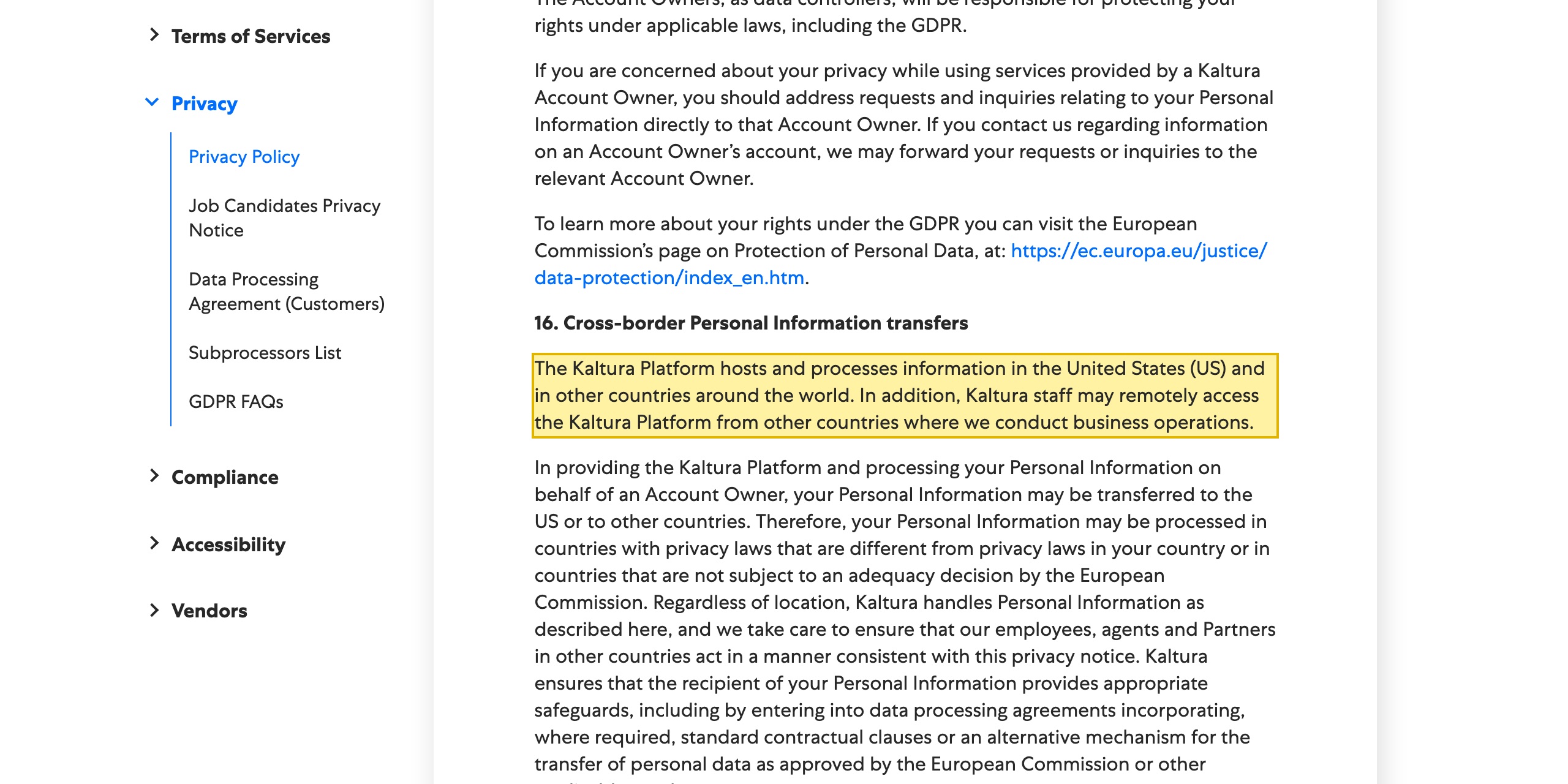
| By its own privacy policy, "The Kaltura Platform hosts and processes information in the United States (US) and in other countries around the world," and "your Personal Information may be transferred to the US or to other countries." So the viewer data gathered from your China audience is processed offshore — a cross-border transfer PIPL governs. There is no mainland-China hosting region. | Kaltura — Privacy Policy (hosting; Cross-border Personal Information transfers), retrieved 2026-10-08 |
| Kaltura's analytics run on viewer-level personal data, not anonymous counts. In its own words, "Personal Information about you may include IP addresses, and URLs used to deliver content to you, and the Kaltura Platform may collect other system information such as MAC addresses," and "The activity on the Kaltura Platform production servers is logged within the system for the purpose of providing Kaltura Account Owners and Partners with statistical analysis of use." That is personal information about a person in China. | Kaltura — Privacy Policy (information collected on the Kaltura Platform), retrieved 2026-10-08 |
| The duty is yours, not Kaltura's. Kaltura states "the Account Owner is the Data Controller of the Personal Information of its Users … Kaltura is the Data Processor." Under PIPL the personal-information handler — you, the Account Owner embedding Kaltura — must give notice, obtain separate consent, and clear one transfer mechanism: a CAC security assessment, the CAC standard contract, or certification. Under the CAC's March 2024 cross-border rules, a non-CIIO moving fewer than 100,000 individuals' non-sensitive personal information in a calendar year is exempt from all three. | Kaltura — Privacy Policy; CAC — Regulations on Promoting and Regulating Cross-border Data Flows, March 2024 |
| For a CIIO or large-volume handler, personal information collected in China must be stored inside mainland China (PIPL Article 40; Cybersecurity Law Article 39 (formerly Article 37)). Because Kaltura hosts and processes in the US and other countries with no mainland region, keeping your China viewers' data on Chinese soil means running the delivery and storage on infrastructure inside the mainland — which is what brings an ICP filing for the public page it sits on into the picture. | PIPL Article 40; Cybersecurity Law Article 39 (formerly Article 37) |
Sources verified by the 21YunBox compliance team on 2026-10-08.
For a mainland-China audience, the deciding question about Kaltura is not how quickly a clip starts — it is where that clip streams from and where the data Kaltura gathers about the people watching it comes to rest. Kaltura is not blocked by the Great Firewall; it is an enterprise video platform that loads in China. But its player and video files are delivered from Kaltura’s own offshore hosts and the third-party CDNs it names, so every play is reached across a long cross-border path, and by its own privacy policy the Kaltura Platform hosts and processes the information it collects in the United States and other countries — never inside the mainland. The reachability is real; the offshore delivery and the offshore viewer data are the exposure.
Kaltura in China at a glance
| What decides it | In Kaltura's own terms |
|---|---|
| Where it's served from | Kaltura is “a set of online hosted software (“SaaS”) tools for hosting, managing and distributing video content over the Internet,” and it delivers that video via “third party content delivery networks (CDNs).” None of those hosts or CDNs sits inside mainland China. |
| What it records | “Personal Information about you may include IP addresses, and URLs used to deliver content to you,” plus “other system information such as MAC addresses.” Activity on its production servers is logged for “statistical analysis of use.” |
| Who carries the duty | “The Account Owner is the Data Controller of the Personal Information of its Users … Kaltura is the Data Processor.” So the compliance obligation falls on you, the site embedding Kaltura — not on Kaltura. |
| Where the data lives | “The Kaltura Platform hosts and processes information in the United States (US) and in other countries around the world.” There is no mainland-China hosting region. |
| Is it reachable? | Yes — Kaltura is enterprise video, not a blocked consumer platform. The offshore distance shows up as slower, patchier playback and players that can stall a page, not as a block. |
Reachable, not blocked — but the player streams from offshore
Begin with what Kaltura is not: it is not blocked in China. It carries enterprise, education and media video rather than consumer entertainment, so it is rarely caught by network blocks and it loads from inside the mainland. What it cannot rewrite is distance. Kaltura describes its product as “a set of online hosted software (“SaaS”) tools for hosting, managing and distributing video content over the Internet,” and it is explicit about how the bytes travel: “we transmit video content via third party content delivery networks (CDNs).” Those hosts and CDN edges live outside mainland China, so a viewer’s browser reaches out across the border and back for the player script and for each video segment — and if one of those offshore dependencies hangs, an embedded player can sit spinning while the rest of the page waits on it.
That is a delivery problem, and it shapes the viewing experience. But it is a separate question from whether you are permitted to put Kaltura in front of Chinese viewers — and no amount of network tuning touches the second half. A clip that plays is not the same as viewer data that is cleared to leave the country.
What Kaltura records about every viewer
Kaltura’s worth to a business is its measurement, and that measurement is built on viewer-level data, not anonymous tallies. In Kaltura’s own description, “Personal Information about you may include IP addresses, and URLs used to deliver content to you, and the Kaltura Platform may collect other system information such as MAC addresses to allow the system to recognize your devices.” On top of that, “the activity on the Kaltura Platform production servers is logged within the system for the purpose of providing Kaltura Account Owners and Partners with statistical analysis of use,” and signing a viewer in means Kaltura collects “the user IDs and passwords used in order to access the Kaltura Platform.”
All of that is personal information about a person located in China. And Kaltura is clear about who answers for it: “the Account Owner is the Data Controller of the Personal Information of its Users … Kaltura is the Data Processor.” In China’s terms, that places the handler’s duty on you — the organization embedding Kaltura — not on the platform.
Where that data lives — offshore, under PIPL
Here is the line that settles the compliance question before performance is even in the room. Kaltura’s privacy policy states plainly: “The Kaltura Platform hosts and processes information in the United States (US) and in other countries around the world,” and, in its cross-border section, that “your Personal Information may be transferred to the US or to other countries.” So the viewing records, IP data and credentials gathered from your China audience do not remain in China — they are processed offshore.
Under China’s Personal Information Protection Law that is a cross-border transfer, and because Kaltura names the Account Owner as the data controller, the obligation sits with you, not with Kaltura. You must give notice, obtain separate consent, and clear one transfer mechanism: a CAC security assessment, the CAC standard contract, or certification. How heavy that burden is scales with volume — under the CAC’s March 2024 cross-border rules, a non-CIIO moving fewer than 100,000 individuals’ non-sensitive personal information in a calendar year is exempt from all three. A critical information infrastructure operator or a large-volume handler, by contrast, must keep personal information collected in China inside the mainland (PIPL Article 40; Cybersecurity Law Article 39 (formerly Article 37)) — a residency duty an offshore-only platform cannot meet. And because the page your video is embedded in is itself public-facing, serving it to mainland visitors from inside China draws in its own ICP filing — a separate door, but part of the same “cleared to operate” question.
This is a risk map, not a verdict: whether you face only a consent-and-mechanism step or a full data-localization duty turns on what you capture, how much, and who you are — worth settling with counsel before you build.
Where 21YunBox fits — a compliant overlay, not a migration
Your Kaltura embeds stay exactly where they are. We add the piece an offshore video platform cannot: compliant, ICP-filed delivery from inside the mainland, placed in front of your existing embeds — no re-uploading your library, no second player to maintain, and no move off Kaltura. Our China team maps your PIPL cross-border and data-residency obligations against your entity and your viewer volumes, then stands up the in-country delivery and, where the law requires it, the in-country storage a lawful China presence needs — while your Kaltura account keeps running where it already does.
Related reading:
Frequently Asked Questions
Is Kaltura blocked in China?
No. Kaltura is an enterprise video platform, not a blocked consumer service, so it generally loads from inside the mainland. What it cannot change is geography: its player and video stream from offshore hosts and third-party CDNs, so every play crosses the border and can start slowly, buffer, or stall a page while the rest waits. Reachability is the delivery half; where the viewer data lives is the compliance half.
Is it against the law to use Kaltura in China?
Not inherently. The issue is the cross-border transfer of personal information: Kaltura collects viewer data — IP addresses, viewing activity and more — and, by its own policy, hosts and processes it in the US and other countries. PIPL permits that transfer if you give notice, obtain separate consent and meet one transfer mechanism; whether you also face a data-localization duty depends on your role and your volumes. Treat it as a risk to settle with counsel, not a blanket ban.
Can 21YunBox help make our Kaltura setup compliant in China?
Yes. Our China team can assess your PIPL cross-border and data-residency exposure for your entity and viewer volumes, and stand up compliant, ICP-filed delivery from inside the mainland — and, where the law requires your China viewers' data to stay on Chinese soil, in-country storage — in front of your existing Kaltura embeds, with no re-upload and no migration. Get in touch to work through your specific case.