Does Stability AI Work in China? Generated Images, the Generative-AI Filing & AI-Content Labeling
Stability AI's Developer Platform API runs offshore on servers in the US with no mainland-China region, so every prompt and generated image from a China user crosses the border as a PIPL transfer — and a public image or video generator there turns on the CAC generative-AI filing plus China's AI-content labeling rules. A compliance-first look at residency, the filing gate, labeling, and the lawful China AI path.
Does Stability AI work in China?
Stability AI's models run offshore with no mainland-China region, so the real question isn't whether the API responds — it's whether your prompts and generated images may lawfully leave China, and whether a public generator there needs a CAC filing.
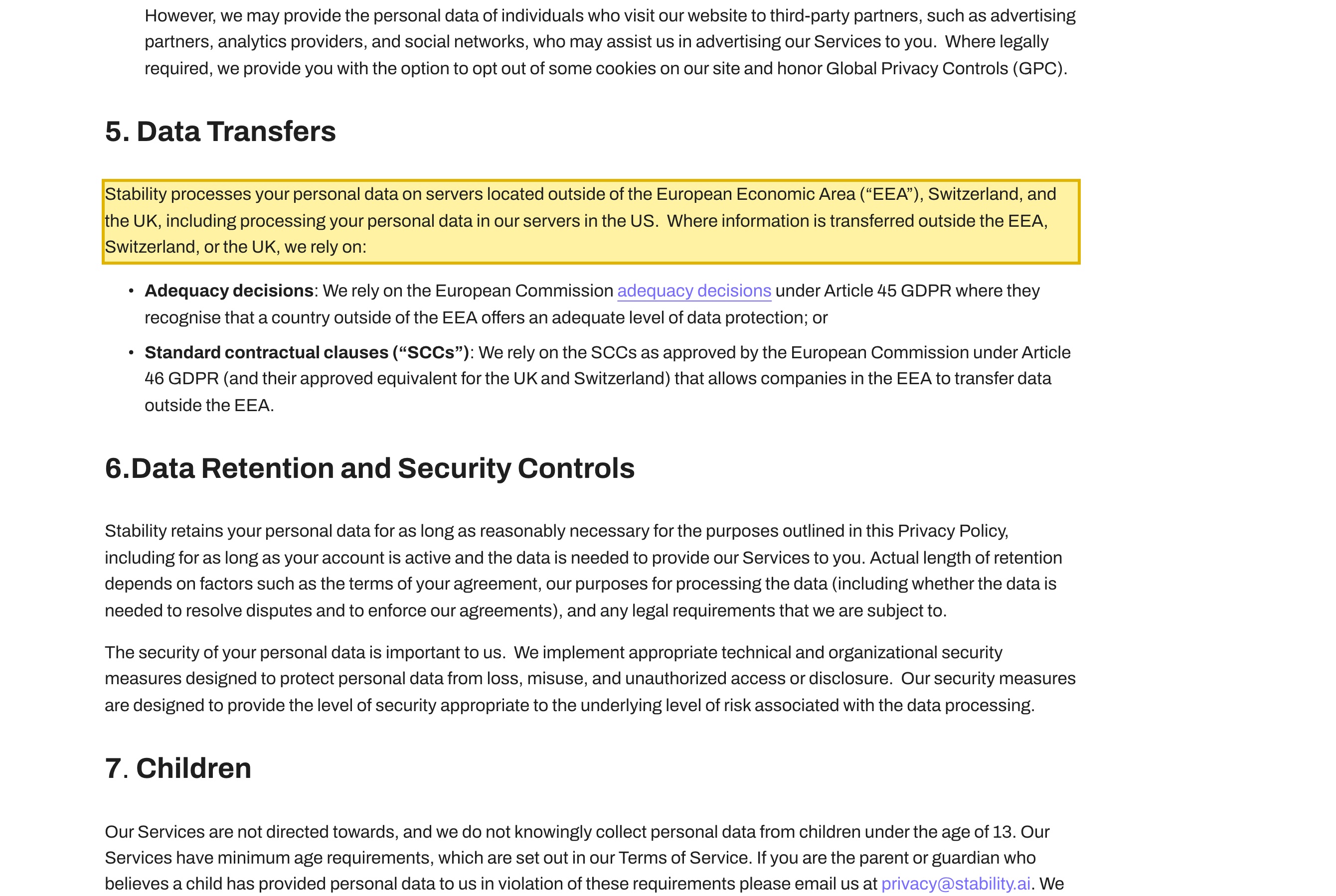
Stability's privacy policy says it processes personal data on servers outside the EEA, Switzerland, and the UK, “including processing your personal data in our servers in the US,” and that your Inputs and Outputs are used “to train, fine-tune, and evaluate machine learning models” unless you opt out. Each prompt, uploaded reference image, and generated image or video sent from a mainland user to that offshore API is a PIPL cross-border transfer (Articles 38–40), and faces in uploaded images can be sensitive personal information under PIPL Article 28. Putting a public image or video generator in front of mainland users also turns on the CAC Interim Measures for the Management of Generative AI Services filing — and, distinctively for a media generator, the duty to label the AI-generated images and videos it produces.
Zero-retention or an opt-out changes what crosses, not that it crosses — residency, the filing, and the labeling duty are unaffected; treat the specifics as a risk to settle with counsel. Our China team can map your exposure →
What Stability AI's own documentation says about China
| Fact | Primary source |
|---|---|
| Stability AI's Developer Platform runs offshore, with no mainland-China region. Stability's privacy policy states that Stability “processes your personal data on servers located outside of the European Economic Area” and, specifically, “processing your personal data in our servers in the US,” naming Stability AI US Services Corporation as the controller for users outside Europe. Every prompt or image a China user sends to that API is therefore a PIPL cross-border transfer. | Stability AI, Privacy Policy, “5. Data Transfers” (stability.ai), effective September 30, 2026, retrieved 2026-10-10 |
| By default, your inputs and generated outputs are used to train Stability's models. The privacy policy lists Inputs and Outputs among the data used “to train, fine-tune, and evaluate machine learning models,” adding that “When we use your Inputs and Outputs to train our models, you can opt-out” — an opt-out you must actively set. Until you do, a mainland user's prompts and the images they generate feed model training offshore. | Stability AI, Privacy Policy, data-use and training sections (stability.ai), retrieved 2026-10-10 |
| A public generative-AI image or video service in the mainland must complete a CAC filing. China's Interim Measures for the Management of Generative AI Services (生成式人工智能服务管理暂行办法, CAC Order No. 15, in force since August 15, 2023) govern generative AI that produces content “to the public” within China's territory (Article 2), with a security assessment and algorithm filing for services able to shape public opinion (Article 17). A foreign provider that does not serve China holds none of these filings. | Interim Measures for the Management of Generative AI Services, CAC Order No. 15, Arts. 2 and 17 (cac.gov.cn), retrieved 2026-10-10 |
| Output must be labeled as AI-generated — a duty aimed squarely at image and video generators. Article 12 of the Generative-AI Measures requires providers to label generated content “such as images and videos” under the Deep Synthesis Provisions, and from September 1, 2025 the Measures for Labeling of AI-Generated Synthetic Content (人工智能生成合成内容标识办法) and the mandatory standard GB 45438-2025 require both a visible label and an embedded metadata marker on AI-generated images, video, and audio. | CAC et al., Measures for Labeling of AI-Generated Synthetic Content; GB 45438-2025 (effective Sept 1, 2025) (cac.gov.cn), retrieved 2026-10-10 |
Sources verified by the 21YunBox compliance team on 2026-10-10.
Whether api.stability.ai answers a request from Shanghai is not what decides this. Stability AI’s image, video, and audio models — Stable Diffusion, Stable Video, Stable Audio, and the rest of the Developer Platform API — run offshore, and Stability’s own privacy policy says it processes personal data on servers outside the European Economic Area, Switzerland, and the UK, “including processing your personal data in our servers in the US.” There is no mainland-China region to select. So the question moves off the speed axis and onto a compliance one: whether your users’ prompts, the reference images you upload, and the images or videos the model generates may lawfully leave the mainland at all — each is personal information, and it often carries the faces of real people and brand assets you would call trade secrets — and whether putting a public image or video generator in front of mainland users turns on a filing with the Cyberspace Administration of China.
Stability AI in China at a glance
| What decides it | In Stability's own terms — and China's law |
|---|---|
| Where inference runs | Offshore. Stability's privacy policy processes personal data on servers outside the EEA, Switzerland, and the UK, "including processing your personal data in our servers in the US." There is no Stability region, entity, or data center inside mainland China. The open-weight models are separately downloadable, which makes self-hosting inside China possible. |
| What you send it & why it's PI | Text prompts, uploaded reference images, and the images or videos the model returns. These are personal information under PIPL; an uploaded reference image with an identifiable face is sensitive personal information (PIPL Article 28), and brand assets or unreleased artwork are trade secrets. |
| Your China users' prompts & output | Each call a mainland user makes to the offshore API is a cross-border transfer of personal information under PIPL (Articles 38–40): notice, a separate consent, and one transfer mechanism. By default Inputs and Outputs are used "to train, fine-tune, and evaluate machine learning models" unless you opt out. |
| The filing & labeling gate | A public image or video generator for mainland users turns on China's Interim Measures for the Management of Generative AI Services (生成式人工智能服务管理暂行办法, CAC Order No. 15) — a security assessment and algorithm filing — and, distinctively for a media generator, the duty to label generated images and videos (Article 12; the 2025 AI-content labeling Measures and GB 45438-2025). A foreign vendor files none of this for you. |
| The lawful path | Keep generative media, but on a lawful footing: a CAC-filed domestic model, an in-China sovereign-cloud model run by a licensed local operator, or the open Stability weights self-hosted on a filed domestic deployment — surfaced through an ICP-filed, in-country delivery layer. 21YunBox maps that path, localizes your feature onto a compliant option, and delivers it in-country — it is not a route to the offshore API. |
No mainland region, so your prompts and generated images leave the country
Stability sets this in its own policy, not in a load-time test. Its privacy policy states that Stability “processes your personal data on servers located outside of the European Economic Area (“EEA”), Switzerland, and the UK, including processing your personal data in our servers in the US,” and that for anyone outside Europe the data controller is Stability AI US Services Corporation. There is no Stability region, entity, or data center inside mainland China. So whether a generation request happens to complete from Beijing on a given afternoon is beside the point: the Developer Platform runs offshore, and every call a mainland user makes reaches it across the border. That reframes “does it work in China?” as two compliance questions — may that data lawfully cross, and may you offer the feature at all — neither of which is counted in milliseconds. Stability’s open-weight models are a separate matter we return to below: because the weights are downloadable, the model itself can be run inside China rather than called across the border.
What you send it — and what it sends back — is personal information
A prompt to an image model is rarely just a line of text. It arrives with the reference images a user uploads, the photographs of real people a designer drops in, the brand assets and unreleased artwork a team wants restyled — and it leaves with the images or videos the model generates from them. Sent from a user in China to a model hosted in the US, all of it is a cross-border transfer of personal information under the Personal Information Protection Law, and the obligation sits on you, the operator of the feature, not on the model vendor: PIPL Articles 38–40 require notice, a separate consent distinct from the user’s agreement to use the feature, and one lawful transfer mechanism — a CAC security assessment, the CAC standard contract, or certification. Where an uploaded reference image carries an identifiable face, that is sensitive personal information under PIPL Article 28, and the bar rises again. And by default the data does more than pass through: Stability’s policy says Inputs and Outputs are used “to train, fine-tune, and evaluate machine learning models,” with an opt-out you must actively set — so unless you turn it off, your users’ prompts and the images they generate feed model training offshore.
The filing gate, the labeling duty, and why trimming retention doesn’t close the door
Suppose you still want a “generate an image” button in a product aimed at mainland users. The first gate is not which model sits behind it — it is whether you may offer a public-facing generative-AI service in China at all. China’s Interim Measures for the Management of Generative AI Services (生成式人工智能服务管理暂行办法, CAC Order No. 15, in force since August 15, 2023) govern the use of generative AI “to provide services for generating text, images, audio, video, and other content to the public” within China’s territory (Article 2), with a security assessment and an algorithm filing for services able to shape public opinion (Article 17). A provider that does not serve the mainland holds none of those filings — the upstream model vendor does not file for you.
For an image or video generator there is a second, specific duty that a text chatbot can nearly overlook: labeling. Article 12 of the Measures requires providers to label generated content “such as images and videos” in line with the Deep Synthesis Provisions, and from September 1, 2025 the Measures for Labeling of AI-Generated Synthetic Content (人工智能生成合成内容标识办法), together with the mandatory national standard GB 45438-2025, require both a conspicuous visible label and an embedded marker written into the file’s metadata on AI-generated images, video, and audio. A generator that hands a mainland user an unmarked file does not meet that standard. Where your feature also ranks or recommends what it shows users, the Algorithm Recommendation Provisions add a filing of their own.
None of this is cured by tightening retention. Choosing a zero-retention setting or opting out of training changes what Stability keeps and what it does with your data — it does not change that the prompt and the generated image crossed the border to reach an offshore model, that the model has no mainland region, or that a public mainland feature must be filed and its output labeled. A critical information infrastructure operator or a high-volume handler also faces an in-country storage duty — PIPL Article 40, read with Cybersecurity Law Article 39 (formerly Article 37); the 2025 Cybersecurity Law amendment, in force January 1, 2026, renumbered the data-localization article from 37 to 39, with the substance unchanged — which an offshore model structurally cannot satisfy. Exactly how each of these rules applies to the feature you actually ship is a risk to settle with counsel against your entity, your data, and your users; this page maps the exposure, it does not deliver a ruling.
The lawful path — map, localize, deliver
There are lawful ways to put image and video generation in front of Chinese users, and they share one shape: the model runs on a footing that already holds the filings, and the user’s data stays on a lawful basis. We work it in three moves. We map your exposure — the PIPL cross-border and sensitive-PI questions, the generative-AI filing and content-labeling duties, and the ICP filing (备案) that any China-facing app or site carries — against your entity, your data volumes, and who your users are. We localize the generation itself onto a lawful China-legal path: a CAC-filed domestic model, an in-China sovereign-cloud model operated by a licensed local operator, or — because Stability publishes open-weight models — the open Stability model run on a filed domestic or sovereign deployment inside the mainland, integrated in place of the offshore Developer Platform call. And we deliver the China-facing surface — the app, the editor, the generate button — in-country on ICP-filed infrastructure, the 21YunBox Optimizer, in front of the stack you already run, with no rebuild and no second codebase.
That makes 21YunBox a compliant overlay, not a migration, and a partner to Stability rather than a competitor. What we do not do — and what no one lawfully can — is hand you a way to reach the offshore Developer Platform from inside the mainland; we stand up and deliver a lawful equivalent. 21YunBox never uses or suggests circumvention of any kind. The outcome is image and video generation that runs legally and compliantly for your users in China.
Related reading:
- China’s Interim Measures for the Management of Generative AI Services
- Cross-border data transfers under PIPL
- Labeling synthetic media: China’s Deep Synthesis Provisions
- How to get an ICP filing for China