Does Perplexity Work in China? Availability, the Generative-AI Filing & Cross-Border Data
Perplexity is not offered as a dependable, officially supported service in mainland China — the company publishes no supported-countries list and, in its own Terms, makes no guarantee that the service is available in any particular geographic location. But reachability is the wrong axis. Putting an AI answer feature in front of mainland users turns on a CAC filing under the Interim Measures for Generative AI Services, every query sent to an engine hosted offshore is a PIPL cross-border transfer, and critical-infrastructure data must stay in-country under Cybersecurity Law Article 39. A compliance-first look at availability, the filing gate, cross-border data, and the lawful AI-answer paths.
Does Perplexity work in China?
Perplexity is not offered as a dependable, officially supported service in mainland China, so the first answer is that you cannot rely on it there. Perplexity AI, Inc. runs its answer engine from outside the mainland, publishes no supported-countries list, and in its own Terms makes no guarantee that the service is available in any particular geographic location — and there is no Perplexity entity, infrastructure, or ICP filing inside China.
Because you cannot depend on it, the real question for a China-facing product is a compliance one, not a speed one. Standing up a public AI answer feature inside the mainland turns on a filing with the CAC under the Interim Measures for the Management of Generative AI Services, sending your users' queries and documents to an engine hosted offshore is a PIPL cross-border transfer, and critical-infrastructure data must stay in-country under Cybersecurity Law Article 39. The lawful paths run through a CAC-filed domestic model or an in-China sovereign-cloud offering — never around the gap.
21YunBox maps the lawful AI path, localizes your feature onto a compliant China-legal option, and delivers it in-country — so your answer feature runs legally for your users in China. It is not a way to reach Perplexity there, and we never use or suggest a VPN or any other circumvention. Treat the specifics as a risk to confirm with counsel.
What Perplexity's own documentation says about China
| Fact | Primary source |
|---|---|
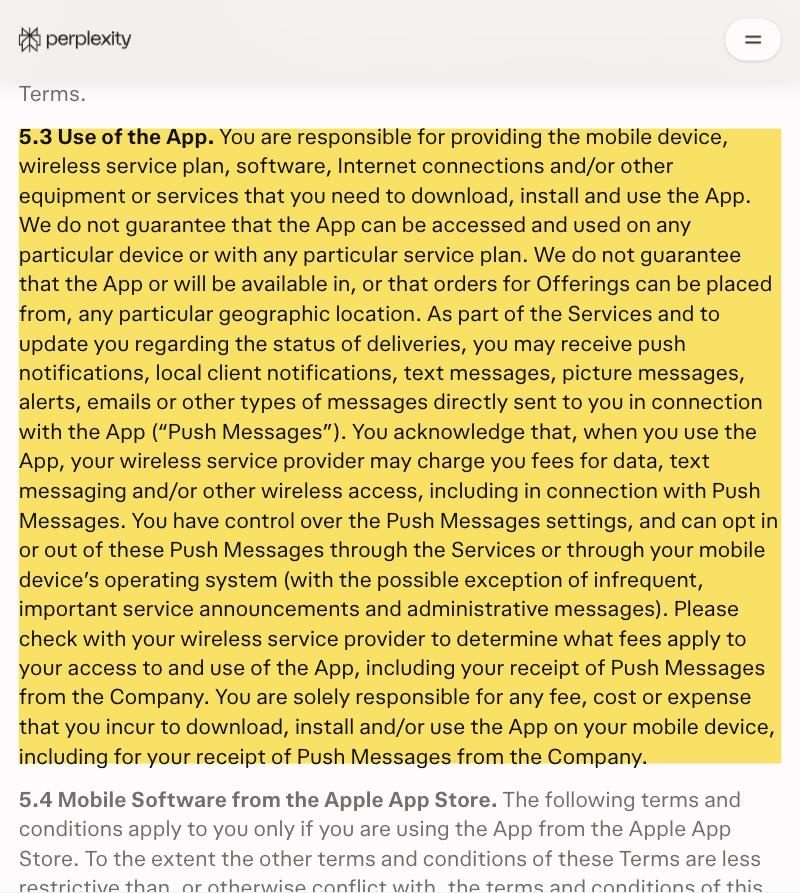
| Perplexity promises no availability in any particular place. Perplexity's Terms of Service state: “We do not guarantee that the App ... will be available in, or that orders for Offerings can be placed from, any particular geographic location.” Perplexity publishes no supported-countries list, and the Service is operated by Perplexity AI, Inc. from outside the mainland. | Perplexity Terms of Service, §5.3 “Use of the App” (perplexity.ai), last updated January 23rd, 2026, retrieved 2026-10-08 |
| A public AI answer feature in the mainland needs a CAC filing. China's Interim Measures for the Management of Generative AI Services (生成式人工智能服务管理暂行办法, CAC Order No. 15, in force since Aug 15, 2023) govern services that generate content for the public within China's territory (Article 2), with a security assessment and algorithm filing for services able to shape public opinion (Article 17). | Interim Measures for the Management of Generative AI Services, CAC Order No. 15, Arts. 2 and 17 (cac.gov.cn), retrieved 2026-10-08 |
| Queries sent offshore are a PIPL cross-border transfer. Sending a Chinese user's queries, uploads, or records to an engine hosted outside the mainland triggers PIPL Articles 38–40: notice, a separate consent, and one transfer mechanism — a CAC security assessment, the CAC standard contract, or certification. | Personal Information Protection Law of the PRC, Articles 38–40 (cac.gov.cn), retrieved 2026-10-08 |
| Critical-infrastructure data must stay in-country. Cybersecurity Law Article 39 (as renumbered by the amendment adopted Oct 28, 2025; formerly Article 37) requires operators of critical information infrastructure to store personal information and important data collected in the mainland within the territory; an offshore engine cannot satisfy that duty, nor the in-country storage duty on large-volume handlers under PIPL Article 40. | Cybersecurity Law of the PRC, Article 39 (amended Oct 28, 2025), data localization for CII operators (cac.gov.cn), retrieved 2026-10-08 |
Sources verified by the 21YunBox compliance team on 2026-10-08.
Before response time ever enters the conversation about Perplexity and a mainland-China audience, a plainer fact has to be settled: Perplexity is not offered as a dependable, officially supported service in the mainland at all. Perplexity AI, Inc. runs its answer engine, apps, and websites from outside China, publishes no list of the countries it supports, and in its own Terms of Service commits to nothing about where the service will be available: “We do not guarantee that the App … will be available in, or that orders for Offerings can be placed from, any particular geographic location.” There is no Perplexity entity, no in-country infrastructure, and no ICP filing inside the mainland. So for a China-facing product the starting point is plain: you cannot treat Perplexity as a service you may rely on for users in China.
Because you cannot count on it being there, the decision for anyone who wants an AI answer feature in a China-facing app shifts onto a wholly different axis — compliance. Three questions settle it, and none is answered in milliseconds. First, are you even permitted to run a public-facing generative-AI service in the mainland — a question that lands at the Cyberspace Administration of China (CAC)? Second, when your users’ queries and documents travel to an engine hosted offshore, is that a lawful cross-border transfer under PIPL? And third, underpinning both, is the China-facing site or app that would carry the feature itself licensed and delivered inside the country? The lawful way to put AI answers in front of Chinese users runs straight through those three questions — never around them, and never through a VPN or any other form of circumvention.
Perplexity in China at a glance
| What decides it | In Perplexity's own terms — and China's law |
|---|---|
| What it is | Perplexity is an AI "answer engine" — a web and mobile product (the Perplexity Engine) that retrieves from the live web and returns generated, cited answers. It is operated by Perplexity AI, Inc. from outside the mainland; there is no Perplexity region, entity, or ICP filing inside China. |
| Is it available in the mainland? | Not as a dependable, officially supported service. Perplexity publishes no supported-countries list and, in its own Terms, makes no guarantee that the service is available in any particular geographic location. There is no lawful route that we provide or endorse to reach it from the mainland — this page is not about circumvention. |
| Serving a generative-AI feature to the public | Standing up a public-facing AI answer feature inside the mainland — an answer box, an "ask" button, an AI chat — turns on China's Interim Measures for the Management of Generative AI Services (生成式人工智能服务管理暂行办法, CAC Order No. 15, in force since Aug 15, 2023): obligations on training data and content, and a security assessment and algorithm filing for services able to shape public opinion. A foreign provider that does not serve China holds none of these. |
| User queries & data | Every query, uploaded file, and user record sent to an engine hosted offshore is a cross-border transfer of personal information under PIPL (Articles 38–40): notice, a separate consent, and one transfer mechanism. Critical-infrastructure operators must also keep personal information and important data in-country under Cybersecurity Law Article 39 (amended 2025) — a duty an offshore engine cannot meet. |
| The lawful path | Keep AI answers, but on a lawful footing: a CAC-filed domestic model, or an in-China sovereign-cloud offering operated by a licensed local operator — served through an ICP-filed, in-country delivery layer. 21YunBox maps that path, localizes your feature onto a compliant China-legal option, and delivers it in-country — it is not a route to Perplexity. |
Availability: Perplexity makes no commitment to the mainland
Where does that leave availability? With Perplexity’s own Terms of Service — not with a stopwatch run from Beijing. The company publishes no supported-countries list, and the Terms are explicit that availability is promised nowhere in particular: Perplexity “do[es] not guarantee that the App … will be available in, or that orders for Offerings can be placed from, any particular geographic location.” The Service is operated by a United States entity, Perplexity AI, Inc., and governed by United States law; there is no Perplexity presence, data center, or ICP filing inside the mainland. Taken together, that means a China-facing product cannot treat Perplexity as a service it may depend on for users in China.
So the familiar “will it open from Shanghai this morning?” question is the wrong one to lead with. A request that happens to go through on some days tells you nothing durable — Perplexity does not stand behind availability in the mainland, and a product built on a dependency the vendor will not commit to is already carrying risk. This page therefore reports no first-party China latency number for Perplexity, because timing a service that is not dependably offered measures the wrong thing. And to be unambiguous — there is no lawful route around that gap, and 21YunBox neither provides nor suggests a VPN, an unblocking service, or circumvention of any kind. The useful question points elsewhere: how do you put AI answers in front of Chinese users lawfully?
The generative-AI filing gate
Suppose you do want an answer box, an “ask AI” feature, or a document-summarizer in a product aimed at mainland users. That first gate has nothing to do with which engine you wire in; it is whether you are allowed to put a public-facing generative-AI service in front of mainland users at all. China’s Interim Measures for the Management of Generative AI Services (生成式人工智能服务管理暂行办法, Cyberspace Administration of China Order No. 15, in force since August 15, 2023) are the country’s first national rules written for exactly this. They apply to the use of generative AI “to provide services for generating text, images, audio, video, and other content to the public within the territory of the People’s Republic of China” (Article 2), and they set obligations on training data, content labeling, and personal-information handling, plus — for services able to shape public opinion — a prior security assessment and an algorithm filing (Article 17).
An answer engine sits squarely inside this. It generates content for the public and surfaces it with citations drawn from the live web, so both the generated output and the retrieved sources fall under the Measures’ content-governance duties. Because a provider that does not serve mainland China holds none of those filings, a feature wired straight to an engine that is itself not offered there clears nothing — what clears the gate is a model and an operator that already carry the filings. How the Measures land on your particular feature is, in the end, a question for counsel measured against what you actually ship.
The cross-border-data story: queries are personal information
The second gate is the data itself. A query to an answer engine is seldom a bare keyword — it carries whatever the user typed, pasted, or uploaded, frequently names, contact details, internal documents, or customer records, and reading all of it is precisely the engine’s job. Sent from a user in China to an engine hosted outside the mainland, that is a cross-border transfer of personal information under China’s Personal Information Protection Law. PIPL puts the duty on the handler — you, not the engine vendor: Articles 38–40 require notice, a separate consent distinct from the user’s agreement to use the feature, and one transfer mechanism — a CAC security assessment, the CAC standard contract, or certification. On top of that, an operator of critical information infrastructure must keep the personal information and important data it collects in the mainland stored in-country under Cybersecurity Law Article 39 (as renumbered by the 2025 amendment, formerly Article 37), and a large-volume handler faces an in-country storage duty under PIPL Article 40 — neither of which an offshore engine can satisfy. Whether any of this is lawful has nothing to do with how quickly an answer comes back — it depends entirely on whether that data had a lawful basis to cross the border in the first place.
The lawful options — and where 21YunBox fits (map, localize, deliver — not access)
Lawful ways to put AI answers in front of Chinese users do exist, and they all share one shape: the model runs inside China under an operator that holds the filings, and the user data never leaves that compliant footing. Two patterns are common. One is a domestic model that already holds the CAC generative-AI filing — for example Baidu Ernie (文心一言) or Alibaba Qwen (通义千问) — powering an answer feature you build and control. The other is a sovereign-cloud offering operated inside the mainland by a licensed local operator, such as Azure OpenAI Service delivered through 21Vianet (世纪互联), subject to that operator’s own availability and compliance, which you confirm directly with them. Which fits depends on your use case, your data, and your entity — settle it with counsel and the operator before you build.
Beneath whichever model you choose sits the work 21YunBox actually does — and it goes well past advice. The China-facing site or app that would surface those AI answers — the answer box, the assistant, the “ask” button — counts as a public service in the mainland in its own right, which means an ICP filing (备案) obligation and compliant, in-country delivery, exactly as any other China-facing property would need. On that footing our China team runs three plays: we map the lawful AI path together with your PIPL and data-residency exposure; we localize the feature onto it — standing up and wiring in a compliant, China-legal option (a CAC-filed domestic model or an in-China sovereign-cloud offering) where the call to an engine that is not dependably offered in the mainland used to be; and we deliver it in-country on ICP-filed infrastructure — the 21YunBox Optimizer — sitting in front of the app you already run, with no rebuild and no re-platform. The result is an AI answer feature that runs legally and compliantly for your users in China. What we will not do — and what no one lawfully does — is hand you a back door to Perplexity from the mainland. We localize and deliver a lawful equivalent; we do not route you around the gap with a VPN or any other circumvention.
Related reading:
- China’s Interim Measures for the Management of Generative AI Services
- Cross-border data transfers under PIPL
- China’s Cybersecurity Law (data localization, Article 39)
- How to get an ICP filing for China
=================================================================