Does Hugging Face Work in China? Reachability of Model Downloads, Public-Model Filing & Data Residency
Hugging Face's hub is reachable from mainland China, but model and dataset downloads route to separate US and EU storage and CDN hosts — Hugging Face's own docs say a pull fails if those aren't reachable — so behind the Great Firewall they are frequently slow or interrupted. The real decision for a China-facing product isn't speed: serving a model to the mainland public turns on a CAC generative-AI filing, and sending training or inference data offshore is a PIPL cross-border transfer. A compliance-first look at reachability, the filing gate, data residency, and the lawful path — localize onto a China-hosted model source and deliver in-country. No VPN, no circumvention.
Does Hugging Face work in China?
Hugging Face's hub is reachable from mainland China, but downloading models and datasets is frequently slow or interrupted — so the honest first answer is “it depends on reaching hosts outside the country.” Hugging Face's own documentation says file contents are served from separate storage and CDN hostnames (it lists hosts labeled US and EU) and that a download fails if those are not reachable, even when huggingface.co itself is allowlisted. Behind the Great Firewall, those pulls are frequently slow or interrupted.
There is no lawful way around the firewall, and 21YunBox neither provides nor suggests a VPN or any other circumvention. Because the real work is putting a model in front of Chinese users lawfully, the decision moves to a compliance axis. Serving a model to the mainland public turns on a CAC filing under the Interim Measures for the Management of Generative AI Services, and sending training or inference data to a model hosted offshore is a PIPL cross-border transfer.
21YunBox maps the lawful AI path, localizes your feature onto a China-hosted model source — commonly ModelScope (魔搭, Alibaba Cloud) — and delivers it in-country, so your AI feature runs legally in the mainland. It is not a way to reach Hugging Face from behind the firewall, and we never use or suggest circumvention. Treat the specifics as a risk to confirm with counsel.
What Hugging Face's own documentation says about China
| Fact | Primary source |
|---|---|
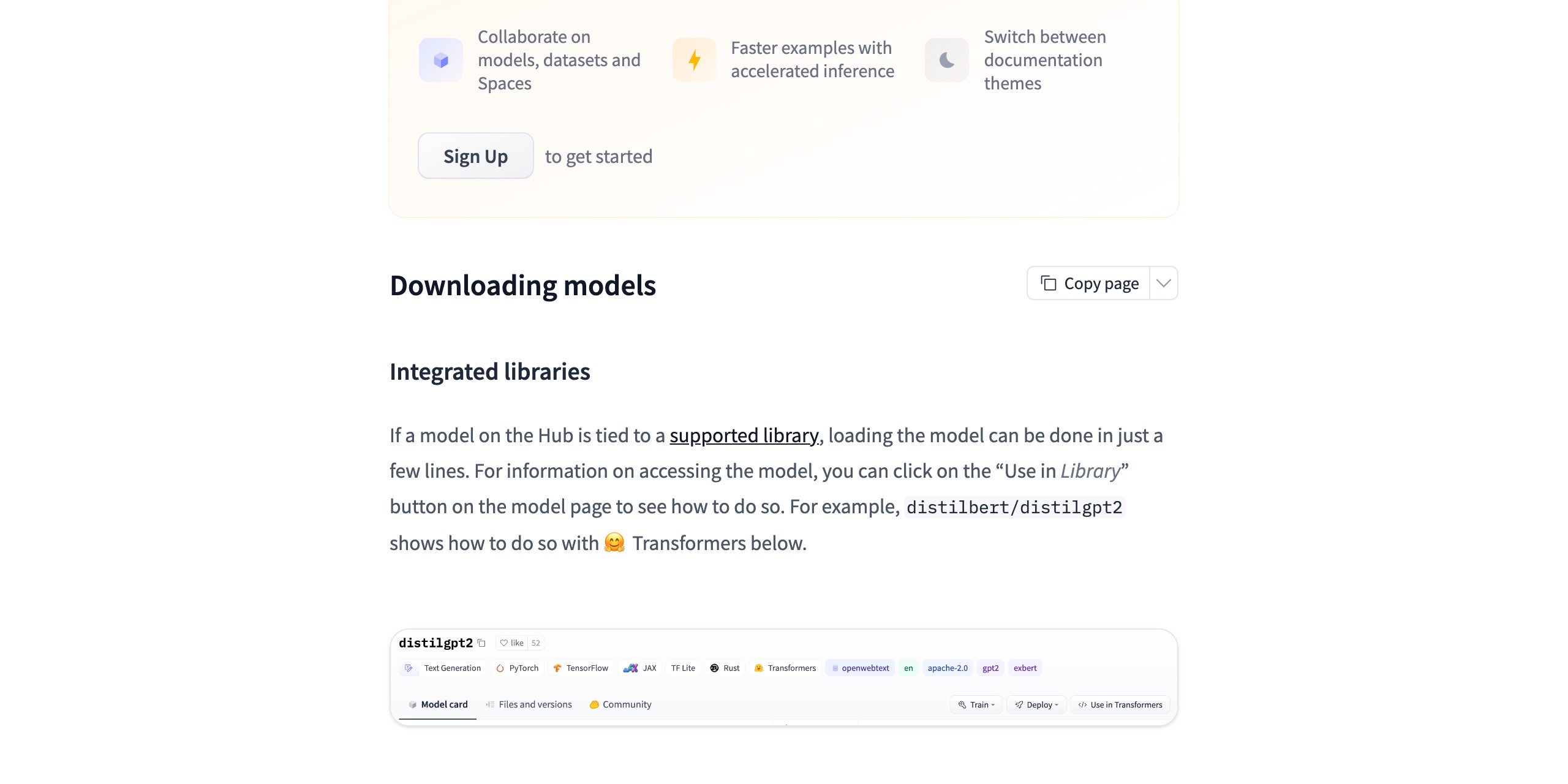
| Model and dataset downloads depend on reaching hosts outside China. Hugging Face's Hub documentation on downloading models states: “File contents are served from separate storage and CDN hostnames, and from_pretrained / hf download will fail if these are not reachable, even when huggingface.co itself is allowlisted.” The hostnames it lists are storage and CDN edges labeled US and EU — all outside the mainland. | Hugging Face Hub documentation, “Downloading models” (huggingface.co), retrieved 2026-10-08 |
| Hugging Face processes data in the United States. Hugging Face's Privacy Policy states: “The Company and its servers are located in the United States,” and “Such information may be transferred to other countries around the world.” Routing a Chinese user's data to Hugging Face is therefore a transfer out of the mainland. | Hugging Face Privacy Policy, Section 6 (huggingface.co), retrieved 2026-10-08 |
| Serving a model to the public in China needs a CAC filing. China's Interim Measures for the Management of Generative AI Services (生成式人工智能服务管理暂行办法, CAC Order No. 15, in force since Aug 15, 2023) govern services that generate content for the public within China's territory (Article 2), with a security assessment and algorithm filing for services able to shape public opinion (Article 17). | Interim Measures for the Management of Generative AI Services, CAC Order No. 15, Arts. 2 and 17 (cac.gov.cn), retrieved 2026-10-08 |
| Data sent offshore is a PIPL cross-border transfer. Sending a Chinese user's prompts, uploads, or records to a model or inference service hosted outside the mainland triggers PIPL Articles 38–40: notice, a separate consent, and one transfer mechanism — a CAC security assessment, the CAC standard contract, or certification. | Personal Information Protection Law of the PRC, Articles 38–40 (cac.gov.cn), retrieved 2026-10-08 |
Sources verified by the 21YunBox compliance team on 2026-10-08.
For a mainland-China audience, the first question about Hugging Face is not how fast a page renders — it is whether you can actually pull what you came for. The hub at huggingface.co is reachable from the mainland, but a model or dataset download is not one request to one host. Hugging Face’s own documentation states that file contents are served from separate storage and CDN hostnames, and that a download fails if those hosts are not reachable, even when huggingface.co itself is allowlisted. The hostnames it lists are storage and CDN edges labeled US and EU — all outside mainland China — so behind the Great Firewall model and dataset pulls are frequently slow or interrupted. This page states that as a reachability fact and nothing more: there is no lawful way around the Great Firewall, and 21YunBox neither provides nor suggests a VPN or any other circumvention.
Because the real work is not reaching Hugging Face but putting a model in front of Chinese users lawfully, the decision moves to a compliance axis — and neither gate on it is about milliseconds. First, if you take a model and serve it to the public in the mainland, you turn on a filing with the Cyberspace Administration of China (CAC) under the Interim Measures for the Management of Generative AI Services. Second, if your training or inference data — prompts, uploads, user records — moves to a model or inference service hosted offshore, that is a cross-border transfer of personal information under PIPL. The lawful way to ship AI to Chinese users runs through those gates, on a China-hosted model source — not around the firewall.
Hugging Face in China at a glance
| What decides it | In Hugging Face's own terms — and China's law |
|---|---|
| What it is | Hugging Face is a hub for machine-learning models, datasets, and Spaces, plus hosted inference. It is operated from outside the mainland; there is no Hugging Face region or entity inside China. |
| Can you reach it from the mainland? | huggingface.co is reachable, but a download is not one request — Hugging Face's docs say file contents come from separate storage and CDN hostnames (labeled US and EU) and fail if those are not reachable. Behind the Great Firewall, model and dataset pulls are frequently slow or interrupted. There is no lawful way around the firewall, and we never use or suggest circumvention. |
| Serving a model to the public | Taking a model and offering a public-facing generative-AI service inside the mainland turns on China's Interim Measures for the Management of Generative AI Services (生成式人工智能服务管理暂行办法, CAC Order No. 15, in force since Aug 15, 2023) — a security assessment and algorithm filing for services able to shape public opinion. An open-weights download carries none of this for you. |
| Training & inference data | Prompts, uploads, and records sent to a model or inference service hosted offshore are a cross-border transfer of personal information under PIPL (Articles 38–40): notice, a separate consent, and one transfer mechanism. Hugging Face's privacy policy states its servers are in the United States. |
| The lawful path | Localize onto a China-hosted model source — commonly ModelScope (魔搭, operated by Alibaba Cloud) — served through an ICP-filed, in-country delivery layer. 21YunBox maps that path, localizes your feature onto a compliant China-legal option, and delivers it in-country — it is not a route around the firewall to Hugging Face. |
Reachability: pulling models and datasets from huggingface.co
Hugging Face’s position here is documented, not guessed. Its Hub documentation on downloading models explains that a pull is not a single request to huggingface.co: “File contents are served from separate storage and CDN hostnames, and from_pretrained / hf download will fail if these are not reachable, even when huggingface.co itself is allowlisted.” The hostnames the docs enumerate are storage and CDN edges labeled US and EU — all outside mainland China. From inside the mainland, that means a model or dataset pull depends on reaching infrastructure on the far side of the Great Firewall, which is why those downloads are frequently slow or interrupted even when the hub page itself loads.
For that reason this page publishes no first-party China throughput figure for Hugging Face downloads: a number captured on one day from one vantage point would say nothing durable, and speed is the wrong axis for a dependency on hosts that sit outside the country. And to be unambiguous — a download that breaks behind the firewall is not something to work around. There is no lawful way around the Great Firewall, and 21YunBox neither provides nor suggests a VPN or any other circumvention. The productive question is a different one: how to get the model you need onto infrastructure inside China, lawfully.
The generative-AI filing gate
Suppose you solve reachability by bringing a model in-country and putting a “generate” button, an assistant, or a chatbot in front of mainland users. The first gate is not which model you picked on Hugging Face — it is whether you may offer a public-facing generative-AI service in China at all. China’s Interim Measures for the Management of Generative AI Services (生成式人工智能服务管理暂行办法, Cyberspace Administration of China Order No. 15, in force since August 15, 2023) are the country’s national rules for exactly this. They apply to the use of generative AI “to provide services for generating text, images, audio, video, and other content to the public within the territory of the People’s Republic of China” (Article 2), and they set obligations on training data, content labeling, personal-information handling, and — for services able to shape public opinion — a prior security assessment and an algorithm filing (Article 17).
An open-weights model downloaded from Hugging Face carries none of that on your behalf; the obligations attach to the operator who actually serves the model to the public in China. So a feature wired to a model that is only reachable offshore does not clear this gate; the lawful route is a model and an operator that are in-country and filed. Whether and how the Measures apply to your specific feature is a risk to confirm with counsel against what you actually ship.
The cross-border-data story: training and inference data leave the country
The second gate is the data. If your feature calls a model or an inference service hosted outside the mainland — a hosted inference endpoint, an inference provider, or any model you kept offshore — then every prompt, upload, and user record that leaves China is a cross-border transfer of personal information under China’s Personal Information Protection Law. This is not hypothetical for Hugging Face: its own privacy policy states that “The Company and its servers are located in the United States,” and that “Such information may be transferred to other countries around the world.” PIPL puts the duty on the handler — you, not the model vendor: Articles 38–40 require notice, a separate consent distinct from the user’s agreement to use the feature, and one transfer mechanism — a CAC security assessment, the CAC standard contract, or certification.
Where personal information or important data must stay in China, there is a further duty. The data-localization requirement in China’s Cybersecurity Law — Article 39 after the 2025 amendment in force January 1, 2026 (formerly Article 37) — applies to critical information infrastructure operators, and a model hosted offshore cannot satisfy it. None of this turns on how fast a completion streams back; it turns on whether the data had a lawful basis to leave the country at all.
The lawful path — localize onto a China-hosted model source (map, localize, deliver — not circumvention)
There is a lawful way to put a Hugging Face–style model in front of Chinese users, and it has a shape: the model runs on infrastructure inside China, and the data stays on a compliant footing. The practical move is to localize — to adopt a China-hosted model source in place of a pull from huggingface.co. The common domestic equivalent is ModelScope (魔搭), a model and dataset hub operated by Alibaba Cloud, where many popular open models are available for in-country hosting — subject to each model’s own license and the operator’s terms, which you confirm with them. Whether a given model is available there, and on what terms, is something to settle with the operator and with counsel before you build.
Underneath that choice sits the part 21YunBox owns, and it is more than advice. The China-facing site or app that surfaces the model — the chat window, the assistant, the generate button — is itself a public service in the mainland, so it carries an ICP filing (备案) duty and needs compliant, in-country delivery like any other China-facing property. Our China team does three things on that footing: we map the lawful AI path and your PIPL and data-residency exposure; we localize your feature onto it — standing up and integrating a China-hosted model source such as ModelScope in place of the huggingface.co pull or offshore inference call that is slow or unlawful in the mainland; and we deliver it in-country on ICP-filed infrastructure — the 21YunBox Optimizer — in front of the app you already run, with no rebuild and no re-platform. The result is an AI feature that runs legally and compliantly for your users in China. What we do not do, and what no one lawfully can, is give you a way around the Great Firewall to reach Hugging Face from the mainland: we localize and deliver a lawful, in-country equivalent — we never route you around the firewall.
Related reading:
- China’s Interim Measures for the Management of Generative AI Services
- Cross-border data transfers under PIPL
- China’s Cybersecurity Law — data localization (Article 39)
- How to get an ICP filing for China