Does Groq Work in China? Prompts, the Generative-AI Filing & Cross-Border Data
GroqCloud serves open models on Groq's US-based LPU hardware, and its own docs place retained data in US Google Cloud buckets with no mainland-China region — so the decision isn't reachability. Every call is a PIPL cross-border transfer, and a public mainland gen-AI feature needs a CAC filing. A compliance-first look at residency, the filing gate, and the lawful China AI path.
Does Groq work in China?
GroqCloud runs on US-based hardware with no mainland-China region, so the question isn't whether the endpoint responds — it's whether your prompts and data may lawfully leave China, and whether your public AI feature needs a CAC filing. GroqCloud serves open models through an OpenAI-compatible API, and its own documentation places retained customer data in US Google Cloud buckets; reaching it from the mainland sends every prompt, RAG document, fine-tuning dataset, and line of code offshore to the United States.
Because the model is hosted in another jurisdiction, the decision is a compliance one, not a speed one. Each call from a China user is a PIPL cross-border transfer of personal information (often sensitive under Article 28), and offering a public generative-AI feature in the mainland turns on a CAC filing under the Interim Measures for the Management of Generative AI Services — a filing you hold, not the upstream API vendor. Groq's Zero Data Retention and no-default-retention controls reduce what is kept, not that the data crossed the border.
This is a risk map, not a ruling — settle the specifics with China counsel. We localize your feature onto a lawful China-legal model and deliver it in-country; 21YunBox never uses or suggests circumvention of any kind. Our China team can map your exposure →
What Groq's own documentation says about China
| Fact | Primary source |
|---|---|
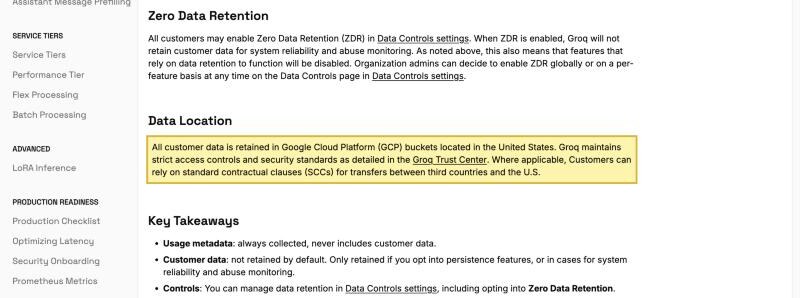
| GroqCloud stores retained customer data in US Google Cloud buckets, and there is no mainland-China region. Groq's data documentation states: “All customer data is retained in Google Cloud Platform (GCP) buckets located in the United States,” and that “By default, Groq does not retain customer data for inference requests.” What Groq does retain sits in the US; reaching the model from China sends your request offshore. | Groq — Your Data in GroqCloud (console.groq.com/docs/your-data), retrieved 2026-10-10 |
| Groq is a US company that processes data in the US and other global jurisdictions — none in mainland China. Its privacy policy (effective November 12, 2025) states Groq “is located in the United States, and maintains processing operations in various global jurisdictions.” Customers can enable Zero Data Retention, but that governs how much is kept, not that the data left China. | Groq Privacy Policy, “Additional Information for International Users” (effective November 12, 2025), retrieved 2026-10-10 |
| Sending a mainland user's prompt to GroqCloud in the US is a cross-border transfer of personal information under PIPL. Articles 38–40 require notice, a separate consent, and one transfer mechanism — a CAC security assessment, the CAC standard contract, or certification — before the data may leave China. See cross-border data transfers under PIPL. | Personal Information Protection Law (PIPL), Articles 38–40 |
| A public-facing generative-AI feature for mainland users turns on a CAC filing. The Interim Measures for the Management of Generative AI Services (生成式人工智能服务管理暂行办法, in force August 15, 2023) require a security assessment and algorithm filing for services able to shape public opinion, plus labeling of AI-generated content. The duty falls on the feature you operate, not the upstream US API. | Interim Measures for the Management of Generative AI Services (CAC, in force 2023-08-15) |
Sources verified by the 21YunBox compliance team on 2026-10-10.
For a product aimed at mainland China, the first question about Groq is not whether GroqCloud’s endpoint answers from Shanghai or how fast its LPU hardware streams tokens back. It is whether the data you hand it may lawfully leave the country, and whether the public AI feature you build on top of it needs a filing before it can face mainland users. GroqCloud serves open models such as Llama through an OpenAI-compatible API, and every call carries real cargo: the user’s prompt, any retrieved documents in your RAG corpus, fine-tuning datasets, the source code and secrets a coding feature pastes in, and the model’s generated output. That payload routinely holds personal information and often trade secrets. Groq’s own documentation places retained customer data in US Google Cloud buckets and names no mainland-China region — so reaching the model from China means sending that payload offshore.
Groq in China at a glance
| What decides it | In Groq's own terms — and China's law |
|---|---|
| Where inference actually runs | GroqCloud runs on Groq's own LPU hardware, and its documentation places retained customer data in “Google Cloud Platform (GCP) buckets located in the United States.” Groq's privacy policy says the company “is located in the United States.” There is no mainland-China region to select — reaching the model from China sends your request to the US. |
| What you send it, and why it's personal information | A prompt is rarely just a question: it carries whatever the user typed, uploaded, or pasted, plus your RAG documents, fine-tuning datasets, and — for a coding feature — source code and the secrets inside it. That is personal information, and often trade secrets. Where a prompt contains ID, financial, health, biometric, or a minor's data, PIPL Article 28 treats it as sensitive personal information. |
| Your China users' prompts or code = a cross-border transfer | Every call from a mainland user to GroqCloud in the US is a cross-border transfer of personal information under PIPL (Articles 38–40): it needs notice, a separate consent distinct from agreeing to use the feature, and one lawful transfer mechanism — a CAC security assessment, the CAC standard contract, or certification. |
| The generative-AI filing gate | Offering a public-facing generative-AI feature to users inside the mainland turns on China's Interim Measures for the Management of Generative AI Services (生成式人工智能服务管理暂行办法, CAC, in force August 15, 2023) — a security assessment and algorithm filing for services able to shape public opinion, plus labeling of AI-generated content. You file for the feature you ship; the upstream API vendor does not file it for you. |
| Reachability is not the axis | Even if the endpoint responds, that is not the decision — the cross-border transfer and the filing gate are. And the China-facing surface that would carry the feature (the app, the chat UI, the API edge your mainland users hit) is itself a public service in the mainland, so it carries an ICP filing (备案) and in-country delivery duty of its own. |
No mainland region, so your prompts and data leave the country
Groq’s position is set by where it runs, not by a load-time test. GroqCloud serves open models on Groq’s own LPU hardware, and the company’s documentation is explicit about residency: retained customer data sits in “Google Cloud Platform (GCP) buckets located in the United States,” and Groq’s privacy policy states the company “is located in the United States, and maintains processing operations in various global jurisdictions.” None of those jurisdictions is mainland China. The developer endpoint is a single global API; reaching it from Shanghai or Shenzhen does not place the model in-country — it sends your request out to US infrastructure.
Groq does sell GroqRack, an on-premises LPU compute cluster aimed at sovereign and regulated buyers, and in principle that hardware can be sited inside a given country. It is worth being honest about what that does and does not solve: putting hardware on local soil is a residency ingredient, not a compliance verdict. A China-legal generative-AI service still has to be a filed service, run by an operator that holds the filings — hardware location alone does not create that. For that reason this page publishes no first-party China latency figure for GroqCloud: speed is the wrong axis for a model hosted in another jurisdiction and offered through a global US endpoint. The productive question is how to put generative AI in front of Chinese users lawfully.
What you send it is personal information
A completion request is not an anonymous ping. Whatever your users type, paste, or upload rides along with it, and so does everything your application attaches: the retrieved passages in a RAG pipeline, the records you inject as context, the datasets behind a fine-tune, and — in an AI coding feature — the source code, API keys, and credentials that code contains. Under China’s Personal Information Protection Law most of that is personal information, and the law puts the duty on the handler — you, the operator of the feature — not on the model vendor. Where a prompt carries an identity-document number, financial or health details, biometric data, or a minor’s information, PIPL Article 28 treats it as sensitive personal information, raising the bar on consent and necessity. Trade secrets in a prompt are not PIPL’s subject, but they are yours to lose the moment they leave the country.
Groq’s data terms actually help on one narrow point, and it is worth stating fairly: its documentation says GroqCloud does not retain customer data for inference requests by default, offers Zero Data Retention that customers can switch on, and retains reliability and abuse logs for up to thirty days. That is a genuine data-minimization posture. But it answers how much is kept and for how long — not whether the data crossed the border in the first place. The transfer happens at the moment the request is sent to the US; retention settings change the residue, not the crossing. For a critical information infrastructure operator, the data-localization duty in Cybersecurity Law Article 39 (formerly Article 37) — the 2025 Cybersecurity Law amendment, in force January 1, 2026, renumbered the data-localization article from 37 to 39, substance unchanged — requires personal information and important data to be stored inside China, a duty US-hosted inference cannot satisfy.
The filing gate — and why trimming retention doesn’t close the door
Suppose the data question is handled and you still want a chatbot, an assistant, or a “generate” button for mainland users. A second gate opens that has nothing to do with retention: whether you may offer a public-facing generative-AI service in China at all. China’s Interim Measures for the Management of Generative AI Services (生成式人工智能服务管理暂行办法, Cyberspace Administration of China, in force since August 15, 2023) govern the use of generative AI to provide text, image, audio, and video content “to the public” within the mainland. They require, among other things, a security assessment and an algorithm filing for services able to shape public opinion, and — under the 2025 labeling rules — clear labeling of AI-generated content. If your feature also ranks or recommends content to users, the Algorithm Recommendation Provisions add a filing of their own. These obligations attach to the public feature you operate; Groq, an upstream US API, files none of them for you.
This is why Zero Data Retention, a thirty-day log cap, or pinning storage to a particular region does not close the door. Those controls reduce what crosses and how long a copy lives — real and worthwhile — but they do not change that a mainland user’s data is sent offshore to be processed, and they do nothing for the filing duty, which is triggered by offering the service to the public, not by how you store its inputs. Residency and the filing gate are unaffected by trimming retention. None of this is a ruling on your particular product: it is a map of where the exposure sits. Settle the specifics — which duties attach, which transfer mechanism fits, whether your feature is in scope — with qualified China counsel against what you actually ship.
The lawful path — map, localize, deliver
There is a lawful way to put generative AI in front of Chinese users, and it does not run around any of the above. It runs through a model that is served from inside China by an operator holding the filings, with the data kept on a compliant footing. Two patterns are common: a domestic large model that already holds the CAC generative-AI filing, or an in-China sovereign-cloud model operated by a licensed local operator. Which fits depends on your use case, your data, and your entity — confirm it with counsel and the operator before you build.
Here is where 21YunBox fits — a compliant overlay and a partner to your stack, never a competitor to Groq. Our China team does three things. We map your exposure — the PIPL cross-border question, whether the Generative-AI Measures reach your feature, the sensitive-PI and ICP filing duties — against your entity, your data, and who your users are. We localize: we stand up a lawful China-legal AI path — a CAC-filed domestic model or an in-China sovereign-cloud model — and integrate it in place of the call that cannot lawfully be served from the US, keeping consented, in-country processing for what must stay on mainland soil (and, where a buyer genuinely pursues sovereign hardware such as GroqRack, pairing it with a filed model and operator so the hardware sits behind a lawful service, not on its own). And we deliver: any China-facing surface — the app, the chat UI, the API edge your mainland users hit — runs over ICP-filed, in-country delivery, the 21YunBox Optimizer, in front of the stack you already run, with no rebuild and no second codebase.
What we do not do, and what no one lawfully can, is turn a US-hosted model into a mainland one. 21YunBox never uses or suggests circumvention of any kind. We localize and deliver a lawful equivalent, so your AI feature runs legally and compliantly for your users in China.
Related reading:
- China’s Interim Measures for the Management of Generative AI Services
- Cross-border data transfers under PIPL
- How to get an ICP filing for China
- China’s Cybersecurity Law and data localization