Does AWS Bedrock Work in China? Region Availability, Data Residency & Cross-Border Transfer
Calling Amazon Bedrock in a global AWS Region from China sends your users' prompts and data offshore — a PIPL cross-border transfer — because Bedrock's global Regions carry no mainland-China Region; those sit in a separate partition operated inside China by Sinnet (Beijing) and NWCD (Ningxia). A compliance-first look at Bedrock's Region availability, the data-residency question, cross-border transfer under PIPL, and the lawful in-country AI paths — not a blocked-service or circumvention story.
Does AWS Bedrock work in China?
Whether AWS Bedrock works in China is a data-residency question before it is a performance one. Bedrock is a managed door to foundation models, and China's law responds to where your prompts, your data, and the inference physically sit — not to how fast a completion streams back. Bedrock is not a service the mainland blocks; the real question is which AWS Region it runs in.
Bedrock's global Region list spans the United States, Europe, and Asia Pacific with no mainland-China Region — those live in a separate partition that AWS states is “separate from Amazon Web Services Global Regions,” operated by Sinnet (Beijing) and NWCD (Ningxia). So calling Bedrock in a global Region from China sends your users' prompts and records offshore — a PIPL cross-border transfer that can also trigger a CAC security assessment. The data-residency-compliant path keeps data and inference inside an AWS China Region where your models are supported (its availability is separate — verify it per-Region), or on a CAC-filed domestic model.
21YunBox maps which models and data can stay in-country, localizes your feature onto a compliant China-legal option, and delivers it in-country on ICP-filed infrastructure — so your AI feature runs lawfully in the mainland. It is not a route around China's rules, and we never use or suggest a VPN or any other circumvention. Treat the specifics as a risk to confirm with counsel.
What AWS Bedrock's own documentation says about China
| Fact | Primary source |
|---|---|
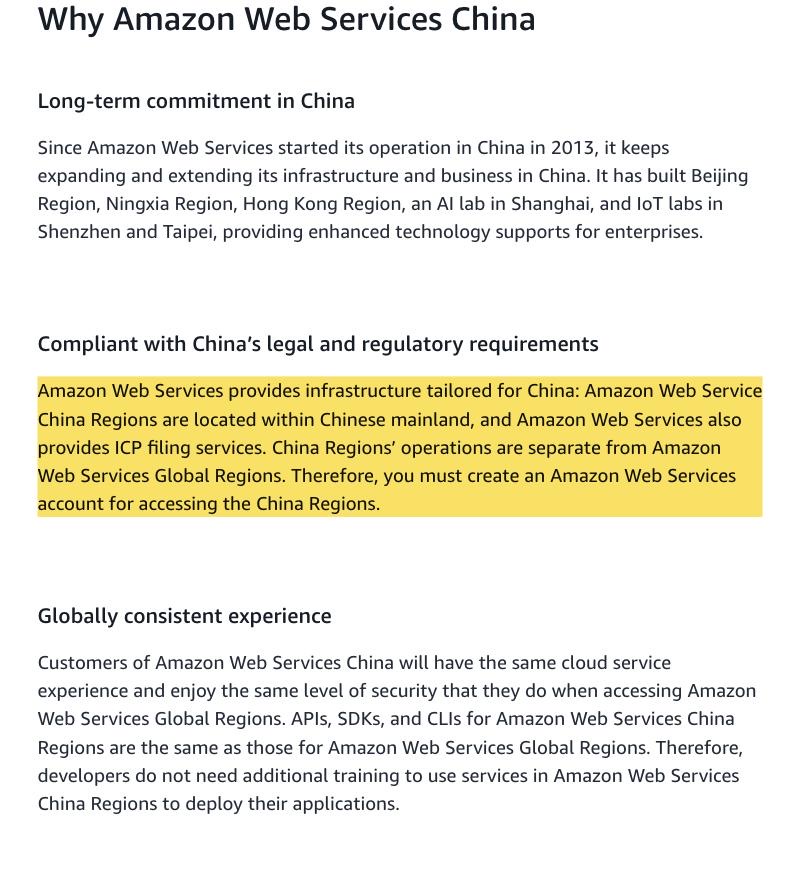
| The AWS China Regions are a separate partition, operated by licensed local operators. AWS's China page states: “Beijing Sinnet Technology Co., Ltd. (Sinnet) operates and provides cloud services in Amazon Web Services China (Beijing) Region,” that “Ningxia Western Cloud Data Technology Co., Ltd. (NWCD) operates and provides cloud services in Amazon Web Services China (Ningxia) Region,” and that “China Regions’ operations are separate from Amazon Web Services Global Regions” — reached with “a set of credentials that are distinct and separate from other Amazon Web Services global Accounts.” | Amazon Web Services in China (amazonaws.cn), retrieved 2026-10-08 |
| Bedrock's global Region list has no mainland-China Region. AWS publishes Bedrock availability under the heading “Regional availability by models,” and that list runs across the United States, Europe, and Asia Pacific (Tokyo, Seoul, Mumbai, Singapore, Sydney, and more) — with no mainland-China Region among them. A model you can call in a global Region is not, by that fact, available inside China; the China partition has its own catalog. | Amazon Bedrock User Guide — “Regional availability by models” (docs.aws.amazon.com), retrieved 2026-10-08 |
| The China partition's Bedrock availability is separate and arrives on its own schedule. AWS's China site announced on September 27, 2026 that “Amazon Bedrock AgentCore is now available in the Amazon Web Services China (Beijing) Region, operated by Sinnet” (and the Ningxia Region, operated by NWCD) — evidence that Bedrock capability does reach the China Regions, but as a separate, differently-scoped catalog you confirm Region by Region, not one you can assume from the global service. | Amazon Web Services China — “Amazon Bedrock AgentCore is now available in Amazon Web Services China Regions,” Sep 27, 2026 (amazonaws.cn) |
| Prompts sent to an offshore Region are a PIPL cross-border transfer. Sending a Chinese user's prompts, uploads, or records to a model running in a global Bedrock Region triggers PIPL Articles 38–40: notice, a separate consent, and one transfer mechanism — a CAC security assessment, the CAC standard contract, or certification. The duty falls on the handler (you, AWS's customer), not on AWS. | Personal Information Protection Law of the PRC, Articles 38–40 (cac.gov.cn), retrieved 2026-10-08 |
| CIIOs and large-volume handlers face in-country storage. Personal information and important data collected in China by a critical information infrastructure operator must be stored in the mainland (Cybersecurity Law Article 39 — renumbered from Article 37 by the 2025 amendment in force Jan 1, 2026; PIPL Article 40), and exporting important data or a large volume of personal information can require a CAC security assessment of the outbound transfer under Order No. 11 — duties an offshore Bedrock Region cannot meet. | PIPL Article 40; Cybersecurity Law Article 39 (cac.gov.cn), retrieved 2026-10-08 |
Sources verified by the 21YunBox compliance team on 2026-10-08.
For a mainland-China audience, the first thing to settle about Amazon Bedrock is not how quickly a model completes a prompt — it is where that prompt, the data inside it, and the inference are allowed to sit. Bedrock is not a service the mainland blocks; it is a managed door to foundation models whose availability is drawn Region by Region, and AWS runs two separate worlds behind that door: its global Regions, and a China partition operated inside the mainland by licensed local operators. Call Bedrock in a global Region from China and your users’ prompts leave the country; keep them in the China partition and a different set of rules — and a different, separately-scoped service catalog — applies. Those are the two doors, and AWS documents both in its own words.
AWS Bedrock in China at a glance
| What decides it | In AWS's own terms — and China's law |
|---|---|
| What it is | Amazon Bedrock is AWS's managed service for calling foundation models — text, image, and agent workloads — through a single API. Which models and features you can call depends entirely on the AWS Region, and AWS runs two separate worlds: its global Regions and a distinct China partition. |
| Where the model runs | Bedrock's global Region list (AWS's “Regional availability by models”) spans the United States, Europe, and Asia Pacific — Tokyo, Seoul, Mumbai, Singapore, Sydney, and more — but shows no mainland-China Region; those belong to the separate China partition. |
| A separate China partition exists | AWS China (Beijing), operated by Sinnet, and AWS China (Ningxia), operated by NWCD, are in AWS's own words “separate from Amazon Web Services Global Regions,” reached with a distinct China account and a Chinese business license. Their Bedrock service and model availability is separate and arrives on its own schedule — you verify it Region by Region (AWS's China site, for example, announced Bedrock AgentCore reaching both Regions on Sep 27, 2026). |
| Your prompts & data on a global Region | Every prompt, upload, and user record sent from a China user to a model in an offshore Region is a cross-border transfer of personal information under PIPL (Articles 38–40): notice, a separate consent, and one transfer mechanism — a CAC security assessment, the CAC standard contract, or certification. |
| The data-residency-compliant path | Keep your data and inference inside an AWS China Region where the models you need are supported, or on a CAC-filed domestic model — served through an ICP-filed, in-country delivery layer. 21YunBox maps that path, localizes your feature onto a compliant China-legal option, and delivers it in-country — it is not a route around China's rules. |
Availability: a separate China partition, not a global Region
AWS publishes Bedrock availability Region by Region — its own heading is “Regional availability by models” — and that list runs across the United States, Europe, and Asia Pacific (Tokyo, Seoul, Mumbai, Singapore, Sydney, and more) without a mainland-China Region among them. Those Regions are not simply missing: they live in a separate partition. On its China site AWS is explicit that “China Regions’ operations are separate from Amazon Web Services Global Regions,” run by Sinnet in Beijing and NWCD in Ningxia, and reached with “a set of credentials that are distinct and separate from other Amazon Web Services global Accounts.”
That makes “does Bedrock load from Shanghai?” the wrong question. Bedrock is not a platform the mainland blocks; it is a service whose Region decides where your data and inference physically sit. The China partition has its own, separately-scoped Bedrock availability that arrives on its own schedule — AWS’s China site, for instance, announced on September 27, 2026 that Bedrock AgentCore had reached the Sinnet-operated Beijing and NWCD-operated Ningxia Regions — so which models and features you can actually call in-country is something to verify Region by Region against AWS’s China documentation, not to assume from the global catalog. For that reason this page publishes no first-party China latency figure: speed is the wrong axis for a service whose real question is residency. And to be unambiguous — 21YunBox neither provides nor suggests a VPN or any other form of circumvention; the productive question is which Region your data is lawfully allowed to sit in.
The cross-border-data story: prompts are personal information
A prompt is rarely just a question — it carries whatever the user typed, pasted, or uploaded: names, contact details, order records, contracts, support transcripts. Sent from a user in China to a model running in an offshore Bedrock Region, that is a cross-border transfer of personal information under China’s Personal Information Protection Law. PIPL puts the duty on the handler — you, AWS’s customer, not AWS: Articles 38–40 require notice, a separate consent distinct from the user’s agreement to use the feature, and one transfer mechanism — a CAC security assessment, the CAC standard contract, or certification. Move important data or a large volume of personal information out of the country and the heavier route — a government security assessment of the outbound transfer under CAC Order No. 11 — can apply. And for a critical information infrastructure operator or a large-volume handler, personal information collected in China must be stored in the mainland (Cybersecurity Law Article 39; PIPL Article 40) — a duty an offshore Bedrock Region cannot satisfy, and an offshore endpoint cannot be ICP-filed. None of this turns on how fast a completion streams back; it turns on whether the data had a lawful basis to leave the country at all.
The data-residency-compliant path — and where 21YunBox fits (map, localize, deliver — not circumvent)
There are lawful ways to put Bedrock-class AI in front of Chinese users, and they share a shape: the data and the inference stay on a compliant footing, and the China-facing app that surfaces them is delivered in-country. Two patterns are common. One is to keep your data and inference inside an AWS China Region — the Sinnet-operated Beijing or NWCD-operated Ningxia Region — where the models and features you need are actually supported, reached through a distinct China AWS account tied to a Chinese business license; because that partition’s catalog is separate, which of your models are available there is something you confirm Region by Region with AWS and the operator before you build. The other is a domestic model that already holds the CAC generative-AI filing. Which fits depends on your use case, your data, and your entity — settle it with counsel and the operator first.
Underneath either choice sits the part 21YunBox owns, and it is more than advice. The China-facing site or app that would surface the AI — the chat window, the assistant, the generate button — is itself a public service in the mainland, so it carries an ICP filing (备案) duty and needs compliant, in-country delivery like any other China-facing property. Our China team does three things on that footing: we map which of your models and data can lawfully stay in-country and your PIPL and data-residency exposure; we localize your feature onto a compliant China-legal option — standing up and integrating an in-China Bedrock Region where your models are supported, or a CAC-filed domestic model, in place of the offshore call; and we deliver it in-country on ICP-filed infrastructure — the 21YunBox Optimizer — in front of the application you already run, with no rebuild and no re-platform. What we do not do, and what no one should, is route your traffic around China’s rules: we localize and deliver a lawful, in-country equivalent, and we never use or suggest a VPN or any other form of circumvention.
Related reading:
- China Measures for the Security Assessment of Outbound Data Transfers
- Cross-border data transfers under PIPL
- China’s Cybersecurity Law (data localization, Article 39)
- How to get an ICP filing for China