Does Tableau Work in China? Cloud Hosting Regions, Self-Hosted Server & Data Residency
Tableau comes in two shapes, and for a China-facing product the deciding question isn't dashboard speed — it's where the data lives. Tableau Cloud is Salesforce-hosted SaaS with no mainland-China region, so loading China-collected personal or important data into it is a cross-border transfer under PIPL, a possible CAC data-export security assessment, and — for critical information infrastructure — a data-localization duty under the Cybersecurity Law Article 39 (formerly Article 37). Tableau Server is self-hosted and can run inside China. A compliance-first look at Tableau Cloud's hosting regions, the self-hosted Server path, the cross-border and residency gates, and how to keep China analytics data in-country.
Does Tableau work in China?
Yes — but only on the right footing, and the deciding question is data residency, not speed. Tableau comes in two shapes. Tableau Cloud is the Salesforce-hosted SaaS, and its sites live only in offshore regions — the United States, Canada, Europe, and Asia-Pacific markets — with no mainland-China region in Tableau's own location list. Tableau Server is self-hosted software you install on infrastructure you control, which can be inside mainland China.
So the real question for a China-facing deployment isn't whether a dashboard loads — it's where the data behind it sits. Loading mainland-China personal or important data into an offshore Tableau Cloud site is a PIPL cross-border transfer, can trigger a CAC data-export security assessment, and — for a critical-information-infrastructure operator — runs into the data-localization duty in the Cybersecurity Law Article 39 (formerly Article 37). The data-resident path keeps the underlying data in the country: a self-hosted Tableau Server inside the mainland, or a China-resident data store, with the dashboards delivered in-country.
21YunBox maps your data flows and cross-border exposure, localizes the footing so the data and extracts stay in the mainland, and delivers the China-facing dashboards in-country — no rebuild, and no moving data across the border to make it work; we never use or suggest circumvention. Treat the specifics as a risk to confirm with counsel.
What Tableau's own documentation says about China
| Fact | Primary source |
|---|---|
| Tableau Cloud is hosted only in offshore regions — none in mainland China. Tableau's documentation states: “The table below lists Hyperforce IP addresses Tableau Cloud uses based on the pod your site resides on.” The table's Location column lists the United States (East and West), Canada, Europe (Germany, Switzerland, UK), and Asia-Pacific markets (Australia, India, Indonesia, Japan, Singapore, South Korea) — mainland China does not appear. | Tableau Help, “Authorize Access to Data Published to Tableau Cloud” (help.tableau.com), retrieved 2026-10-08 |
| Tableau Server is self-hosted — you run it on infrastructure you control. Tableau's documentation states its hardware requirements “apply to all computers running Tableau Server, including physical hardware and virtual machines (VMs),” and that “The computer on which you are installing or upgrading Tableau Server must meet the minimum hardware installation requirements.” Because you choose those computers, Tableau Server can run on infrastructure inside mainland China. | Tableau Help, “Minimum Hardware Requirements and Recommendations for Tableau Server” (help.tableau.com), retrieved 2026-10-08 |
| Sending China-collected personal data offshore is a cross-border transfer under PIPL. PIPL Articles 38–40 require a handler moving personal information outside the mainland to give notice, obtain a separate consent, and satisfy one transfer mechanism — a CAC security assessment, the CAC standard contract, or certification. | Personal Information Protection Law of the PRC, Articles 38–40 (cac.gov.cn), retrieved 2026-10-08 |
| CII data collected in China must be stored in China. China's Cybersecurity Law provides that “Personal information and important data collected and generated by operators of critical information infrastructure in the course of their operations within the territory of the People's Republic of China shall be stored within the territory” — the data-localization duty at Article 39 (formerly Article 37, renumbered by the amendment effective January 1, 2026). | Cybersecurity Law of the PRC, Article 39 (formerly Article 37) (cac.gov.cn), retrieved 2026-10-08 |
Sources verified by the 21YunBox compliance team on 2026-10-08.
For a mainland-China audience, the first thing to settle about Tableau is not how quickly a dashboard renders — it is where the data behind that dashboard is allowed to live. Tableau ships in two shapes, and they sit on opposite sides of that line. Tableau Cloud is the Salesforce-hosted SaaS: your site is assigned to one of Tableau’s geographic “pods,” every one of them offshore, with no mainland-China region. Tableau Server is the self-hosted edition: software you install on infrastructure you control — which can be inside mainland China. So “does Tableau work in China?” is really two questions with two different answers, and both turn on data residency rather than milliseconds.
That matters because a dashboard is rarely just a chart — it is built on rows of underlying data, often personal information collected from users in China. Push that data into a Tableau Cloud site hosted offshore and you have made a cross-border transfer, which China regulates on three fronts: PIPL’s cross-border rules, the CAC’s data-export security assessment for larger or more sensitive flows, and the Cybersecurity Law’s data-localization duty for critical information infrastructure. Keep the data in the country — on a self-hosted Tableau Server inside the mainland, or in a China-resident data store feeding it — and you stay on the resident side of all three. The decision is which of those two footings your China-facing analytics sits on.
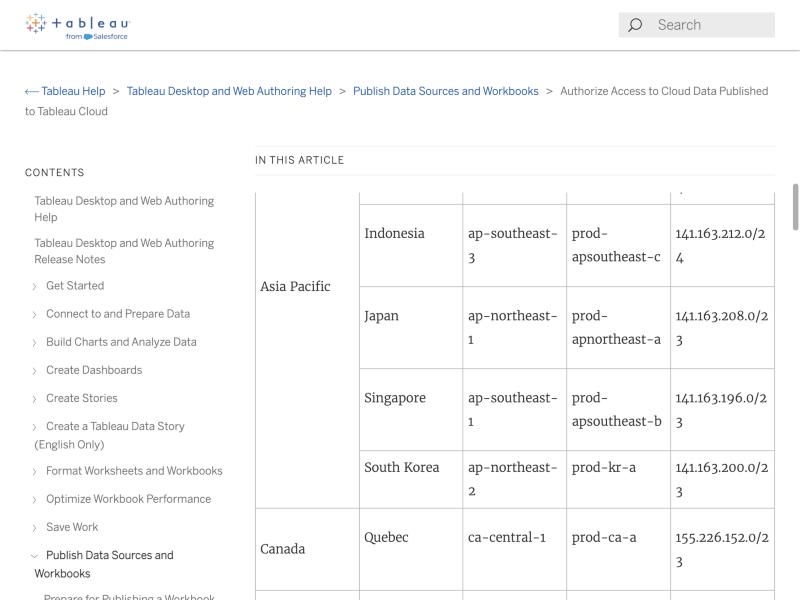
Tableau in China at a glance
| What decides it | In Tableau's own terms — and China's law |
|---|---|
| What it is | Two products under one name. Tableau Cloud is the Salesforce-hosted SaaS — dashboards and the data behind them served from Tableau's offshore pods. Tableau Server is self-managed software you install and run on your own infrastructure (physical hardware or VMs), on-premises or in a cloud you control. |
| Is Tableau Cloud hosted in China? | No. Tableau Cloud sites reside only on offshore pods — the United States, Canada, Europe, and Asia-Pacific markets — with no mainland-China region in Tableau's own location list. |
| Putting China data into Tableau Cloud | A cross-border transfer of personal information under PIPL (Articles 38–40): notice, a separate consent, and one transfer mechanism — a CAC security assessment, the CAC standard contract, or certification. Larger or more sensitive flows can require a CAC data-export security assessment. |
| Residency for CII & important data | The Cybersecurity Law Article 39 (formerly Article 37) requires critical-information-infrastructure operators to store personal information and important data collected in the mainland inside the mainland — a duty an offshore Tableau Cloud site cannot meet. |
| The data-resident path | Run Tableau Server self-hosted inside China (or keep the underlying data in a China-resident store) and deliver the China-facing dashboards in-country. 21YunBox maps the data flows, localizes the footing, and delivers the app in the mainland — it never moves your data across the border. |
Availability: Tableau Cloud is hosted offshore, with no mainland-China region
Tableau Cloud’s hosting is set by Tableau’s own infrastructure, not by a load-time test from Beijing. A Tableau Cloud site is assigned to one of Tableau’s geographic “pods,” and Tableau’s documentation lists them by Location: the United States (East and West), Canada, Europe (Germany, Switzerland, and the UK), and a set of Asia-Pacific markets (Australia, India, Indonesia, Japan, Singapore, and South Korea). As of this review (retrieved October 8, 2026) there is no mainland-China pod on that list; the nearest options are Japan, Singapore, and South Korea — all outside the mainland.
That is why the familiar “does it load from Shanghai?” question misses the point for Tableau. Tableau Cloud is generally reachable from the mainland, so speed is rarely the blocker — and for that reason this page publishes no first-party China latency figure for Tableau: a number without the data-residency context would answer the wrong question. What actually decides whether you can use Tableau for a China-facing audience is where your data is allowed to live, and a Tableau Cloud site puts it offshore by construction. To be unambiguous: 21YunBox neither provides nor suggests any way of circumventing that, and the productive question is a different one — how to run Tableau for Chinese users while keeping the underlying data in the country.
The cross-border-data gate: your dashboards carry personal information
A Tableau dashboard is only as local as the data beneath it. Workbooks, published data sources, and extracts pull in whatever the business collects — customer records, order histories, support tickets, employee data — and a great deal of that is personal information. When the users are in China and the Tableau Cloud site is offshore, moving that data into Tableau is a cross-border transfer of personal information under China’s Personal Information Protection Law. PIPL puts the duty on the handler — you, the business, not Tableau or Salesforce: Articles 38–40 require notice, a separate consent distinct from any general terms, and one transfer mechanism — a CAC security assessment, the CAC standard contract, or certification.
How heavy that duty is tracks your role and your volumes, not the act of switching Tableau on. A smaller flow of non-sensitive personal information by a non-CIIO can be exempt from the three formal mechanisms, while sensitive data, higher volumes, or “important data” can pull in a mandatory data-export security assessment run by the CAC. None of this turns on how fast a view renders; it turns on whether the data had a lawful basis to leave the country at all — a risk to confirm with counsel against what you actually load into Tableau.
The data-residency gate: CII and important data must stay in-country
For some operators the question is not “transfer lawfully” but “do not transfer at all.” China’s Cybersecurity Law provides that “personal information and important data collected and generated by operators of critical information infrastructure in the course of their operations within the territory of the People’s Republic of China shall be stored within the territory” — the data-localization duty at Article 39 (formerly Article 37, renumbered by the amendment effective January 1, 2026). PIPL Article 40 carries an in-country storage duty for CIIOs and large-volume handlers as well. For anyone in that position, an offshore Tableau Cloud site is structurally the wrong place for the underlying data: there is no mainland-China region to localize it in, so the residency duty cannot be met by configuration. Whether your operation is a CIIO, and whether what you hold counts as “important data,” are determinations to settle with counsel — but where those duties apply, they decide the edition of Tableau you can use.
The data-resident path — and where 21YunBox fits (map, localize, deliver)
There is a lawful way to run Tableau for a China-facing audience, and it starts from the second of Tableau’s two shapes. Tableau Server is self-hosted: Tableau’s hardware documentation applies “to all computers running Tableau Server, including physical hardware and virtual machines (VMs),” and because you choose those computers, you can run Tableau Server on infrastructure inside the mainland. Deploy it in-country — with its published data sources and extracts resident there, fed by a China-resident data store — and the analytics layer stops being a cross-border transfer: the data and the dashboards both stay on Chinese soil. Keeping the underlying data in-country is the move an offshore Tableau Cloud site cannot make.
Underneath that choice sits the part 21YunBox owns, and it is more than advice. The China-facing dashboards or embedded views that surface Tableau are themselves a public service in the mainland, so they carry an ICP filing (备案) duty and need compliant, in-country delivery like any other China-facing property. Our China team does three things on that footing: we map your data flows — which Tableau dependency stores what, and your PIPL cross-border and data-residency exposure; we localize the footing — standing up a self-hosted Tableau Server (or a China-resident analytics store) inside the mainland so the underlying data and extracts never leave the country; and we deliver the China-facing dashboards in-country on ICP-filed infrastructure — the 21YunBox Optimizer — set in front of what you already run, with no rebuild and no second codebase. The result is a Tableau deployment that is responsive for users in China and sits on the resident side of the border. What we do not do is move your data across that border to make it work, and we never use or suggest circumvention of any kind.
Related reading:
- Cross-border data transfers under PIPL
- China’s data-export security assessment measures
- China’s Cybersecurity Law — data localization at Article 39 (formerly Article 37)