Does Airbyte Work in China? Data Residency, ICP & Cross-Border Rules
Airbyte is an open-source ELT tool that moves data from sources into destinations — so loading China-origin data into an offshore warehouse makes the pipeline run a PIPL cross-border transfer, not a reachability question. It is self-hostable (run it in-country); Airbyte Cloud has US and EU regions only.
Does Airbyte work in China?
Airbyte opens from China, so the real question is not reachability — it is that Airbyte's whole job is to move data between systems, so when a sync loads China-origin data into an offshore destination the pipeline run itself is a cross-border transfer under PIPL Articles 38–40.
The rows in flight routinely include personal information — customer and user tables, events, CRM exports — so an offshore sync needs a lawful transfer mechanism plus separate consent for sensitive PI, and a critical-infrastructure or high-volume handler owes in-country storage under the Cybersecurity Law's Article 39 (formerly Article 37). Airbyte Cloud is offered only in US and EU regions, with its control plane in the United States.
Because Airbyte is open-source and self-hostable, there is a lever: run the engine on in-country infrastructure and land China-origin data in an in-country destination so the pipeline and the data stay resident — making an offshore destination merely reachable does not.
What Airbyte's own documentation says about China
| Fact | Primary source |
|---|---|
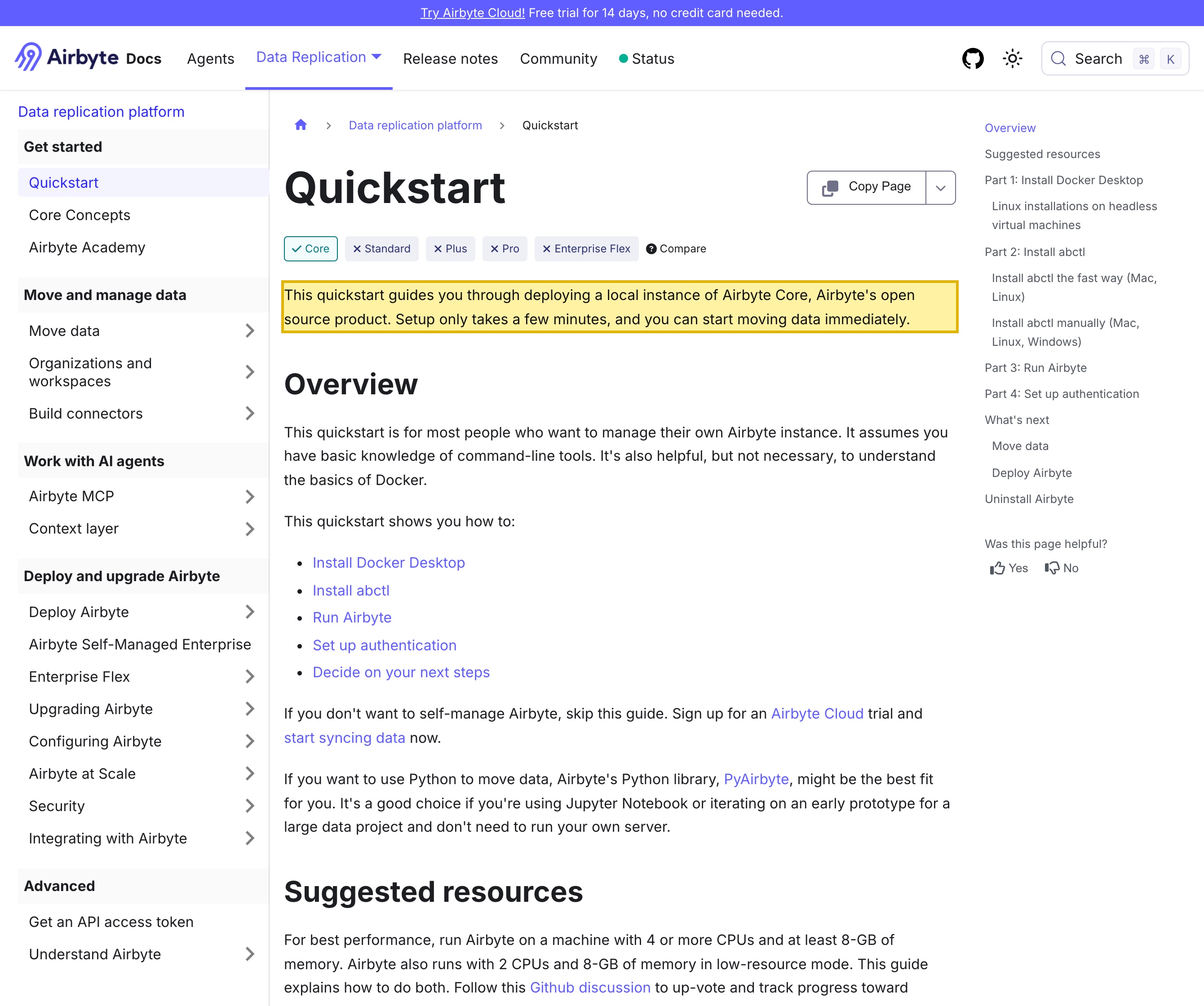
| Airbyte's own OSS Quickstart calls Airbyte Core “Airbyte's open source product” and walks through deploying a local instance yourself — so the engine is open-source and self-hostable and can run on in-country infrastructure. | Airbyte Docs — OSS Quickstart (retrieved 2026-10-12) |
| Airbyte Cloud's managed data-residency regions are US, US-Central and EU, and Airbyte's docs state “Airbyte Cloud's control plane is in the United States” and that cursor and primary-key data runs through that control plane — no mainland-China region is offered. | Airbyte Docs — Manage data residency (retrieved 2026-10-12) |
| Sending personal information out of China is a cross-border transfer requiring one of a CAC security assessment, the CAC standard contract, or certification, plus separate consent — PIPL Articles 38–40. | PIPL — cross-border transfer rules (21YunBox gov-doc, retrieved 2026-10-12) |
| For a critical information infrastructure operator or high-volume handler, personal information and important data generated in China must be stored in the mainland — Cybersecurity Law Article 39 (formerly Article 37). | China Cybersecurity Law — data localization (21YunBox gov-doc, retrieved 2026-10-12) |
Sources verified by the 21YunBox compliance team on 2026-10-12.
For a mainland-China data team, the first thing to settle about Airbyte is that the question is not whether the Airbyte UI paints quickly from Shanghai, or whether an engineer can reach the dashboard. Airbyte is an ELT platform — its entire reason to exist is to extract data from sources and load it into destinations, usually a cloud warehouse or lake, and transform it there. That makes it the sharpest possible data-residency case, because the act the tool performs is the thing the law regulates. When an Airbyte sync reads a customer table, an events stream or a CRM export that originated in China and writes it into a warehouse that sits offshore, the pipeline run itself is a movement of data across the border. Nothing has to “load slowly” for that to matter. The rows in flight routinely include personal information, so where the pipeline runs, and where it lands the data, is a cross-border-transfer and residency question by definition — settled by which Airbyte you run and where, not by a page-load test.
Airbyte in China at a glance
| What decides it | In Airbyte's own terms — and China's law |
|---|---|
| What it does — moves your data across systems | Airbyte is an ELT tool: it extracts from sources (databases, SaaS APIs, files) and loads into destinations (warehouses, lakes), through what Airbyte's own catalog advertises as 600+ connectors. Its purpose is to carry data between systems — so the operation it performs is exactly the operation China's cross-border rules govern. The data in flight is not abstract: customer and user tables, order and event records, CRM exports — personal information by default. |
| Two deployment shapes | Airbyte is open-source: in its own words the OSS Quickstart deploys “a local instance of Airbyte Core, Airbyte's open source product,” which you run on infrastructure you choose. Airbyte Cloud is the SaaS — its managed data-residency regions are US, US-Central and EU, and “Airbyte Cloud's control plane is in the United States.” No region is in mainland China. |
| The pipeline run is the transfer — the distinctive half | The half a reachability check never sees. The question is not “can my engineers open Airbyte from Shanghai.” It is that a sync landing China-origin data in an offshore destination is a cross-border transfer (数据出境). Even Airbyte Cloud's regional data planes still route cursor and primary-key data through the US control plane — by Airbyte's own documentation — so “pick a region” alone does not keep everything in-country. |
| Residency & cross-border | Moving a China team's personal data offshore triggers PIPL Articles 38–40 — notice, a separate consent, and one transfer mechanism (a CAC security assessment, the CAC standard contract, or certification). For a critical information infrastructure operator or high-volume handler, Cybersecurity Law Article 39 (formerly Article 37) requires China-collected personal information and important data to be stored in the mainland — which an offshore destination cannot satisfy. |
| Sensitive PI & the ICP door | Where the tables a pipeline carries hold government IDs, financial or health records, that content can be sensitive personal information under PIPL Articles 28–29 — heightened necessity and separate consent — a risk to confirm against what your sources actually contain. And any public, China-facing surface you stand up in front of the data — a dashboard, a portal — is an internet information service carrying an ICP filing (备案) duty bound to mainland hosting. |
| Reachability is not the axis | Whether the Airbyte UI answers from the mainland is operational, not the compliance question. What decides it is where the pipeline runs and where it lands the data. Because Airbyte is self-hostable, there is a lawful lever: run the engine on in-country infrastructure, land China-origin data in an in-country destination so it stays resident, and deliver any China-facing surface compliantly — the 21YunBox Optimizer — in front of what you already run. |
What it actually moves — your data, across the border
Airbyte is not a brochure site; it is the machine that carries your data from one system to another. An Airbyte connection names a source and a destination and, on a schedule, reads records out of the first and writes them into the second. By Airbyte’s own count its catalog spans 600+ connectors across databases, SaaS APIs, files, warehouses and lakes. The records that travel through it are the ordinary, regulated contents of a business: customer and user tables, order histories, event and clickstream data, CRM and support exports. Wherever those rows name or describe a person, they are personal information under China’s Personal Information Protection Law, and where they include government IDs, financial or health data they may be sensitive personal information.
That is why Airbyte is a cleaner residency case than most tools. With many platforms you argue about whether the data at rest is regulated; with Airbyte the regulated act is the product’s core function. The moment a sync reads China-origin data and writes it to a destination that lives abroad, data has left the country. Which Airbyte you run — the open-source engine on infrastructure you control, or Airbyte Cloud with its control plane in the United States — and where you point its destinations, decides whether that happens.
The doors: residency, cross-border, sensitive PI and ICP
Point an Airbyte pipeline at an offshore destination and the first door opens. The personal data in the records you sync comes to rest abroad, which makes the run a cross-border transfer (数据出境). The duty lands on you, the handler, not on Airbyte: PIPL Articles 13 and 23 require notice and a basis to collect the data, and Articles 38–40 require a transfer mechanism to send it offshore — a CAC security assessment, the CAC standard contract, or certification — with a separate consent for the overseas transfer.
For some handlers, storage is not a matter of mechanism at all — it must stay in-country. If your organization operates critical information infrastructure, or handles personal information at scale, the Cybersecurity Law’s Article 39 (formerly Article 37 — the 2025 Cybersecurity Law amendment, in force January 1, 2026, renumbered the data-localization article from 37 to 39, its substance unchanged) requires personal information and important data generated in China to be stored in the mainland, with a security assessment before any export. A pipeline whose destination is an offshore warehouse, with no mainland-China region available on the managed service, structurally cannot meet that duty.
A quieter, sharper door is the sensitivity of the data. Where the synced tables carry real government IDs, financial records or health data, that content can be sensitive personal information under PIPL Articles 28–29, which demand a specific purpose, heightened necessity and separate consent. And a third door follows from publishing: the moment you expose a public, China-facing surface in front of the data — an analytics dashboard, a customer portal, a reporting tool your mainland users reach — that surface is an internet information service and carries an ICP filing (备案) duty bound to a mainland hosting resource.
Why a reachability check misses this
A probe from inside China can watch the Airbyte dashboard load, or a sync kick off, and conclude “it works.” That answer is beside the point. The compliance exposure is not on the screen — it is in the data the pipeline moves and where it comes to rest: the customer tables, events and exports written into a destination that, on the managed service, sits in the US or the EU, never mainland China. A page-load test measures none of that. It cannot see which region the destination lives in, whether separate consent was taken, whether a transfer mechanism is in place, or that a China-facing dashboard needs an ICP filing.
There is a second trap specific to this kind of platform. Making the offshore pipeline merely reachable — even running Airbyte’s own workers or a self-managed data plane inside China — does not, on its own, keep the regulated data in-country, because a worker that reads China-origin records and writes them to an offshore destination has still carried the data across the border. The reverse trap is Airbyte Cloud’s: even when you choose a non-US region, Airbyte’s documentation states the control plane stays in the United States and cursor and primary-key values run through it. What decides residency is where the engine runs and where the data lands — not whether a screen draws or a runner can connect. That is the competitor-proof second half of the question, and it is why landing the regulated data in-country, not merely making an offshore destination reachable, is the answer.
The lawful path — map, localize, deliver
There is a compliant way to run Airbyte for a mainland-China team, and because Airbyte is open-source and self-hostable it sits on the stack you already use — no rebuild, no migration off Airbyte.
First, map: our China compliance team inventories what your pipelines carry — which sources and destinations each connection links, whether personal information is in flight, and whether any of it is sensitive PI — establishes where the Airbyte engine and control plane run today (a self-hosted instance, or Airbyte Cloud with its US control plane), where each destination lands the data, and the consent and transfer basis each flow relies on. We build the technical picture; the legal conclusions are settled with counsel.
Then localize: run the self-hosted Airbyte engine on in-country infrastructure and point China-origin pipelines at an in-country destination so both the compute and the data come to rest on mainland soil, obtain the Article 13/23 notice and separate consent, treat any government IDs or financial data as sensitive personal information, and use a lawful cross-border mechanism (a CAC security assessment, the standard contract, or certification) only where a transfer is genuinely needed. Localize means standing up a lawful, in-country pipeline — never a route that ships the data offshore anyway, and never any form of circumvention.
Then deliver: any public, China-facing surface in front of the data — an analytics dashboard, a customer portal, or a reporting tool your mainland users reach — is an internet information service, so it carries an ICP filing duty and needs compliant, in-country delivery. 21YunBox delivers it in-country — the 21YunBox Optimizer — in front of what you already run, so it serves your users in China legally and compliantly. 21YunBox never uses or suggests circumvention of any kind — we keep in-country what the law says must stay, deliver the rest compliantly from inside the mainland, and never move personal information across the border by stealth. 21YunBox is a compliance overlay and partner to the Airbyte you already run, not a competitor to it.
None of this is a verdict that Airbyte is “blocked” or “illegal” in China. It is a residency-and-consent map, and which duties bite your case turns on your entity, your role under Chinese law, your data volumes, and what your pipelines actually carry — worth settling the specifics with counsel before your China team’s data starts moving across the border every time a sync runs.
Related reading:
- Cross-border data transfers under PIPL
- China’s Cybersecurity Law (data localization, Article 39)
- China’s Personal Information Protection Law (PIPL)
- How to get an ICP filing for China


