Does MicroStrategy (now Strategy) Work in China? Data Residency, Localization & PIPL Cross-Border
MicroStrategy — renamed Strategy in 2025, with its platform now Strategy One — comes in two shapes, and for a China-facing deployment the deciding question isn't dashboard speed but data residency. The managed cloud (Strategy Cloud Platform and Strategy One Cloud) runs on AWS or Azure with no mainland-China region, so loading China-collected data into it is a PIPL cross-border transfer; a self-managed Strategy One install can run in-country. A compliance-first look at the hosting regions, the self-managed path, the cross-border and residency gates, and how to keep China analytics data in-country.
Does MicroStrategy work in China?
Reachable, yes — but the deciding question is data residency, not speed, and MicroStrategy (renamed Strategy in 2025) comes in two shapes that sit on opposite sides of that line.
The managed cloud — the Strategy Cloud Platform and the fully-managed Strategy One Cloud — runs on AWS or Azure commercial regions, with no mainland-China region, so the data you ingest, extract into in-memory cubes, and cache there rests offshore. Loading China-collected personal or important data into it is a PIPL cross-border transfer (Articles 38–40), can trigger a CAC data-export security assessment, and — for a critical-information-infrastructure operator — runs into the data-localization duty in the Cybersecurity Law Article 39 (formerly Article 37). Because a BI platform concentrates data from every source system, it is often one of the largest single stores of China personal information a company holds, which makes residency acute. The lawful lever is Strategy's other shape: Strategy One is self-managed, so you can install it on infrastructure inside mainland China and keep the data, extracts, and cubes in the country.
21YunBox maps your data flows and cross-border exposure, localizes the footing so the data stays in the mainland, and delivers the China-facing reporting portal in-country on ICP-filed infrastructure — no rebuild, and no moving data across the border to make it work. Settle the specifics with counsel. Our China team can map your exposure →
What MicroStrategy (Strategy)'s own documentation says about China
| Fact | Primary source |
|---|---|
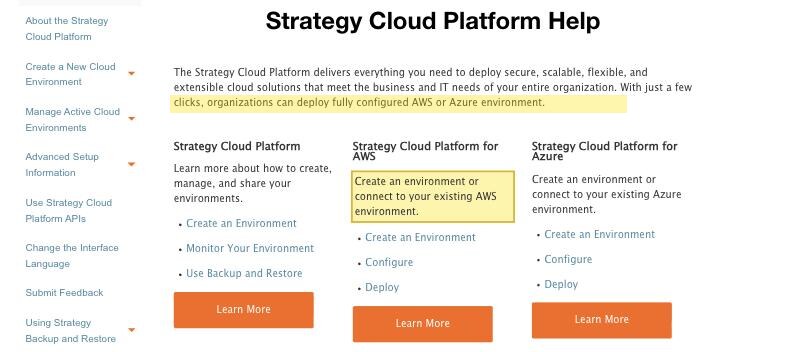
| Strategy's managed cloud deploys on AWS or Azure commercial regions — none in mainland China. Strategy's own cloud documentation says the Strategy Cloud Platform lets organizations “deploy fully configured AWS or Azure environment,” where you “Create an environment or connect to your existing AWS environment” (or Azure). Those are the global commercial clouds; AWS and Azure serve mainland China only through separate, locally operated partitions, and no mainland-China region appears in Strategy's cloud offering, so analytics data loaded, extracted, or cached there rests offshore. | Strategy product documentation — Strategy Cloud Platform (www2.strategy.com), retrieved 2026-10-10 |
| Strategy One is also self-managed — you install it on Windows or Linux infrastructure you control. Strategy's installation guide states it “gets you started using the Linux and Windows versions of the Strategy One platform” and shows how to “Install Strategy One Products on a Windows environment” or Linux environment. Because you choose those servers, a self-managed Strategy One deployment can run on infrastructure inside mainland China, keeping the data, extracts, and in-memory cubes in the country. | Strategy product documentation — Installation and Configuration for Strategy One (www2.strategy.com), retrieved 2026-10-10 |
| Sending China-collected personal data offshore is a cross-border transfer under PIPL. PIPL Articles 38–40 require a handler moving personal information outside the mainland to give notice, obtain a separate consent, and satisfy one transfer mechanism — a CAC security assessment, the CAC standard contract, or certification. Loading China personal information into an offshore Strategy cloud puts that duty on you, the handler. See cross-border data transfers under PIPL. | Personal Information Protection Law of the PRC, Articles 38–40 (cac.gov.cn), retrieved 2026-10-10 |
| CII data collected in China must be stored in China. China's Cybersecurity Law provides that personal information and important data collected and generated by operators of critical information infrastructure within the mainland “shall be stored within the territory” — the data-localization duty at Article 39 (formerly Article 37), renumbered by the 2025 amendment in force January 1, 2026 (substance unchanged). PIPL Article 40 carries an in-country storage duty for CIIOs and large-volume handlers; an offshore analytics cloud cannot meet it. | Cybersecurity Law of the PRC, Article 39 (formerly Article 37) (cac.gov.cn), retrieved 2026-10-10 |
Sources verified by the 21YunBox compliance team on 2026-10-10.
For a mainland-China audience, the first thing to settle about MicroStrategy — renamed Strategy in 2025, with its platform now shipping as Strategy One — is not how fast a dashboard renders. It is where the data behind that dashboard is allowed to come to rest. A MicroStrategy deployment is where business data is ingested, modeled, extracted into in-memory cubes, cached, and reported on, and that data is overwhelmingly your customers’, users’, and employees’ personal information. Strategy comes in two shapes that sit on opposite sides of the residency line. The managed cloud — the Strategy Cloud Platform and the fully-managed Strategy One Cloud — runs on AWS or Azure commercial regions, none of them in mainland China, so the data you load, extract, and cache into it rests offshore. The self-managed edition installs on Windows or Linux infrastructure you control, which can sit inside the mainland. So “does MicroStrategy work in China?” is really two questions with two answers, and both turn on data residency rather than milliseconds.
MicroStrategy (Strategy) in China at a glance
| What decides it | In Strategy's own terms — and China's law |
|---|---|
| Two shapes, one name — where each rests | MicroStrategy is now Strategy, and its platform is Strategy One. The managed cloud — the Strategy Cloud Platform and the vendor-hosted Strategy One Cloud — deploys on AWS or Azure commercial regions, with no mainland-China region, so data loaded into it rests offshore. The self-managed edition installs on Windows or Linux servers you control, which can be inside the mainland. |
| What a MicroStrategy deployment holds | A BI platform concentrates data. Strategy pulls from every source system into published datasets, Intelligence Server metadata, in-memory cubes, extracts, and cached result sets — customer records, order and payment histories, employee data. Much of it is personal information, and the concentration makes a Strategy deployment one of the largest single stores of China PI a company holds. |
| Your China users' data, loaded offshore | Loading personal information collected in China into an offshore managed Strategy cloud is a cross-border transfer under PIPL (Articles 38–40): notice, a separate consent, and one transfer mechanism — a CAC security assessment, the CAC standard contract, or certification. Larger or more sensitive flows can require a CAC data-export security assessment. |
| Residency for CII & important data | PIPL Article 40 and the Cybersecurity Law Article 39 (formerly Article 37) require critical-information-infrastructure operators and large-volume handlers to store personal information and important data collected in the mainland inside the mainland — a duty an offshore analytics cloud cannot meet. |
| Reachability isn't the axis — the data-resident path | The managed cloud is reachable from the mainland, so speed isn't the blocker. The lawful lever is Strategy's self-managed edition: install Strategy One on infrastructure inside China (or keep the underlying data in a China-resident store) and deliver the China-facing portal in-country on ICP-filed infrastructure. 21YunBox maps, localizes, and delivers — it never moves your data across the border. |
Where the data actually rests
Strategy’s hosting is set by the vendor’s own infrastructure, not by a load-time test from Shanghai. The managed cloud comes in two forms, and Strategy’s documentation describes both. The Strategy Cloud Platform deploys into a public-cloud account — Strategy’s docs show you “Create an environment or connect to your existing AWS environment” (and the same for Azure), letting organizations “deploy fully configured AWS or Azure environment” with a few clicks. The fully-managed Strategy One Cloud is the vendor-operated SaaS on the same global clouds. Either way, those are AWS and Azure commercial regions, and mainland China is not among them: AWS and Azure serve the mainland only through separate, locally operated partitions (AWS China through Sinnet and NWCD; Azure China through 21Vianet), which are not part of Strategy’s documented cloud offering. So the data you ingest, extract into in-memory cubes, and cache in the managed cloud comes to rest offshore by construction.
That is why the familiar “does it load from Beijing?” question misses the point here. The managed cloud is generally reachable from the mainland, so speed is rarely the blocker — and for that reason this page publishes no first-party China latency figure for Strategy: a number without the residency context would answer the wrong question. What actually decides whether you can use it for a China-facing audience is where the underlying data is allowed to live, and an offshore managed cloud puts it outside the mainland.
What it holds is personal information
A MicroStrategy report is only as local as the data beneath it, and a BI platform is built to concentrate that data. Strategy pulls from every source system — the data warehouse, CRM, finance, HR, operational databases — and materializes it into published datasets, Intelligence Server metadata, in-memory cubes, extracts, cached result sets, and user dossiers. A great deal of that is personal information: customer names and contacts, order and payment histories, employee records. Because the platform gathers so many sources into one place, a Strategy deployment is frequently one of the largest single concentrations of China personal information a company holds — which both sharpens the residency question and can push a handler over the “large-volume” threshold that triggers the in-country storage duty.
When the users are in China and the managed cloud is offshore, moving that data into Strategy is a cross-border transfer of personal information under China’s Personal Information Protection Law. PIPL puts the duty on the handler — you, the business, not the vendor: Articles 38–40 require notice, a separate consent distinct from any general terms, and one transfer mechanism — a CAC security assessment, the CAC standard contract, or certification. Sensitive data, higher volumes, or “important data” can pull in a mandatory CAC data-export security assessment. None of this turns on how fast a view renders; it turns on whether the data had a lawful basis to leave the country at all — and how heavy the duty is tracks your role and your volumes, not the act of switching Strategy on.
Running it on a no-China-region managed cloud doesn’t meet the residency duty — and what does
For some operators the question is not “transfer lawfully” but “do not transfer at all.” China’s Cybersecurity Law provides that personal information and important data collected and generated by operators of critical information infrastructure within the territory of the People’s Republic of China shall be stored within the territory — the data-localization duty at Article 39 (formerly Article 37, renumbered by the 2025 amendment in force January 1, 2026, with the substance unchanged). PIPL Article 40 carries an in-country storage duty for CIIOs and large-volume handlers as well. For anyone in that position, an offshore managed Strategy cloud is structurally the wrong place for the underlying data: there is no mainland-China region to localize it in, so the residency duty cannot be met by configuration.
The lawful lever is Strategy’s other shape. Strategy One is self-managed: its installation guide “gets you started using the Linux and Windows versions of the Strategy One platform,” and because you choose the servers, you can install it on infrastructure inside the mainland. Deploy it in-country — with its metadata, extracts, and in-memory cubes resident there, fed by China-resident sources — and the analytics layer stops being a cross-border transfer: the data and the dashboards both stay on Chinese soil. No migration to a different product is needed, because it is the same Strategy One software, simply run where the data must live. Whether your operation is a CIIO, and whether what you hold counts as “important data,” are determinations to settle with counsel — this page maps the exposure, it does not give a ruling.
The lawful path — map, localize, deliver
There is a lawful way to run MicroStrategy for a China-facing audience, and it starts from the self-managed edition. Underneath that choice sits the part 21YunBox owns, and it is more than advice. The China-facing reporting portal, intranet, or embedded dashboards that surface Strategy are themselves a public-facing service in the mainland, so they carry an ICP filing (备案) duty and need compliant, in-country delivery like any other China property. Our China team does three things on that footing: we map your data flows — which Strategy component holds what, and your PIPL cross-border and data-residency exposure; we localize the footing — standing up a self-managed Strategy One deployment (or a China-resident analytics store) inside the mainland so the data and extracts never leave the country, rather than tunneling back to an offshore endpoint; and we deliver the China-facing reporting surface in-country on ICP-filed infrastructure — the 21YunBox Optimizer — set in front of what you already run, with no rebuild and no second codebase. The result is a Strategy deployment that runs legally and compliantly for your users in China. 21YunBox is a compliant overlay, not a migration, and a partner to the vendor, not a competitor — and 21YunBox never uses or suggests circumvention of any kind.
Related reading:
- Cross-border data transfers under PIPL
- China’s Cybersecurity Law — data localization at Article 39 (formerly Article 37)
- China’s data-export security assessment measures
- How to get an ICP filing for a website in China