Does Power BI Work in China? The 21Vianet Sovereign-Cloud Tenant, Data Residency & Cross-Border
Power BI is available in mainland China — but through a separate, isolated sovereign cloud, Power BI operated by 21Vianet (世纪互联), with its own endpoints and its own sign-up, not the global service at app.powerbi.com. The real decision for a China-facing analytics deployment isn't speed — it's data residency: running your global Power BI tenant from the mainland puts report data, which routinely includes personal information, on Microsoft's commercial cloud outside China, a PIPL cross-border transfer, while the data-resident lawful path is the 21Vianet-operated China tenant. A compliance-first look at the two clouds, the cross-border-data question, CSL Article 39 (formerly Article 37) residency, and the lawful in-country path.
Does Power BI work in China?
Yes — Power BI is available in mainland China, but through a separate, isolated sovereign cloud: "Power BI operated by 21Vianet" (世纪互联), not the global service you reach at app.powerbi.com. Microsoft documents this as a distinct "Power BI for China cloud" with its own endpoints and its own sign-up, operated inside the mainland by 21Vianet.
Because a lawful in-country option exists, the real decision is data residency, not speed. Power BI is where business data lives — sales, customer, HR and finance tables, much of it personal information under Chinese law. Run that on the global tenant from the mainland and the data sits on Microsoft's commercial cloud outside China, a PIPL cross-border transfer (and, for a CII operator, a residency problem under Cybersecurity Law Article 39 (formerly Article 37)); larger or sensitive transfers can add a CAC data-export security assessment. The data-resident path is the 21Vianet-operated China tenant — subject to availability and feature parity, which you confirm with Microsoft and 21Vianet.
21YunBox maps the tenant choice, localizes your analytics onto the data-resident China path, and delivers the China-facing app or portal that surfaces the dashboards in-country on ICP-filed infrastructure — so it runs legally in the mainland. Treat the specifics as a risk to confirm with counsel.
What Microsoft Power BI's own documentation says about China
| Fact | Primary source |
|---|---|
| Power BI runs in China through a distinct cloud operated by 21Vianet. Microsoft's Power BI clouds page states: “21Vianet independently operates, provides, manages, and supports the delivery of Power BI in China.” It is a separate national/regional cloud, not the global commercial service. | Microsoft — Power BI national clouds (microsoft.com/power-platform), retrieved 2026-10-08 |
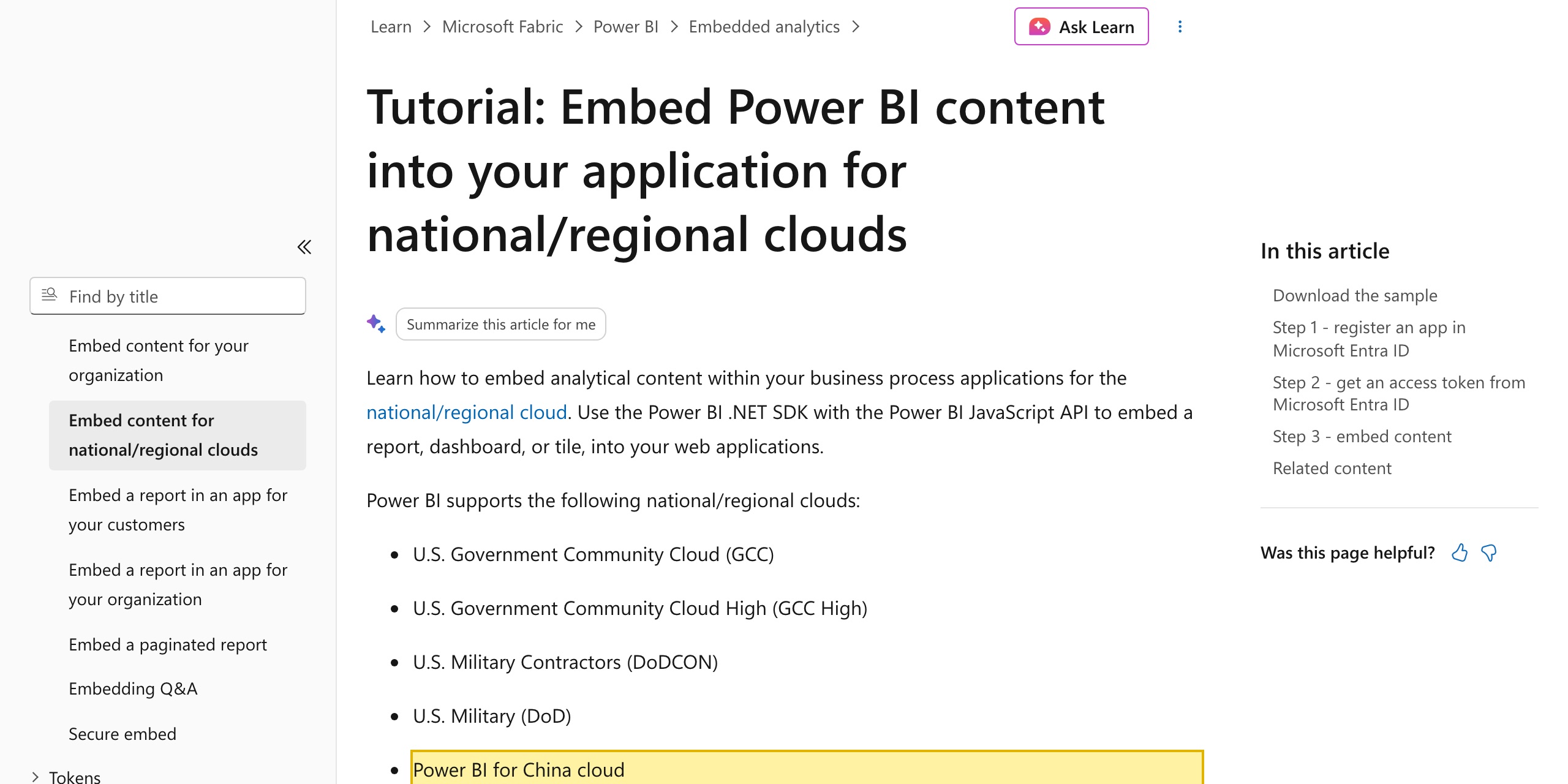
| The China cloud has its own endpoints, separate from global Power BI. Microsoft Learn lists a “Power BI for China cloud” among its national/regional clouds, with its own sign-in authority (login.chinacloudapi.cn) and API root (api.powerbi.cn) — distinct from the global app.powerbi.com service. | Microsoft Learn — Embed content … for government and national/regional clouds (learn.microsoft.com), updated 2025-12-15, retrieved 2026-10-08 |
| Using the global tenant for China data is a cross-border transfer. Sending a Chinese user's or business's personal information to Power BI hosted outside the mainland triggers PIPL Chapter III (Articles 38–43): notice, a separate consent, and one transfer mechanism — a CAC security assessment, the CAC standard contract, or certification — with in-country storage under Article 40 (and Cybersecurity Law Article 39 (formerly Article 37)) for CII operators. | Personal Information Protection Law of the PRC, Chapter III, Articles 38–43 (cac.gov.cn), retrieved 2026-10-08 |
| Larger or sensitive transfers need a CAC data-export security assessment. China's cross-border data rules — the 2024 Regulations on Promoting and Regulating Cross-border Data Flows, which recalibrated the 2022 security-assessment measures — set the thresholds at which a cross-border transfer requires a CAC security assessment, a standard contract, or certification. It is a legal gate, not a speed question. | CAC — Regulations on Promoting and Regulating Cross-border Data Flows, March 2024 (gov.cn), retrieved 2026-10-08 |
Sources verified by the 21YunBox compliance team on 2026-10-08.
For a mainland-China audience, the first thing to settle about Power BI is not how fast a dashboard renders — it is which Power BI you mean. Microsoft runs two separate services that matter here: the global commercial Power BI most teams already use at app.powerbi.com, and a distinct, isolated China cloud — Power BI operated by 21Vianet (世纪互联) — with its own endpoints at app.powerbi.cn, its own sign-up, and data kept inside the mainland. So the honest answer to “does Power BI work in China?” is yes — but through a specific tenant, on a specific footing.
Because a lawful in-country option already exists, the real decision moves off the speed axis and onto a data one. Power BI is where business data lives — sales records, customer lists, HR and finance tables — and much of that is personal information under Chinese law. Run it on the global service from the mainland and the data sits on Microsoft’s commercial cloud outside China, which is a cross-border transfer under PIPL; run it on the 21Vianet-operated China cloud and the data stays in-country. Which tenant you choose, and how you deliver the app that surfaces the dashboards, is the compliance question — not the frame rate.
Microsoft Power BI in China at a glance
| What decides it | In Microsoft's own terms — and China's law |
|---|---|
| What it is | Microsoft Power BI — the Power BI service (app.powerbi.com), Desktop, mobile, and embedded analytics. Two separate clouds matter for China: the global commercial service, and a distinct China cloud, Power BI operated by 21Vianet (世纪互联), run inside the mainland. |
| Is it available in the mainland? | Yes — through the separate, isolated China cloud. Microsoft documents a "Power BI for China cloud" with its own endpoints (app.powerbi.cn, api.powerbi.cn, login.chinacloudapi.cn) and its own sign-up, operated by 21Vianet. The global service at app.powerbi.com is a different tenant and is not connected to it. |
| Where the data lives | On the 21Vianet-operated China cloud, report data is kept in-country. On the global commercial service, that data — sales, customer, HR and finance tables, often personal information — sits on Microsoft's cloud outside the mainland, which is the cross-border question for China users and China data. |
| Cross-border & residency | Pushing China personal information to the global tenant is a cross-border transfer under PIPL (Articles 38–43: notice, a separate consent, one transfer mechanism). For a critical information infrastructure operator, in-country storage is required under PIPL Article 40 and Cybersecurity Law Article 39 (formerly Article 37); larger-volume or sensitive transfers can add a CAC data-export security assessment. |
| The lawful path | Stand up on the 21Vianet-operated China tenant (or otherwise keep the data in-country), and deliver the China-facing app or portal that surfaces the dashboards on ICP-filed, in-country infrastructure. 21YunBox maps the tenant choice, localizes your analytics onto the data-resident path, and delivers it in-country — subject to the China cloud's availability and feature parity, which you confirm with Microsoft and 21Vianet. |
Availability: a distinct China cloud, operated by 21Vianet
Power BI’s presence in the mainland is set in Microsoft’s own documentation, not by a load-time test. Microsoft’s Power BI clouds page states that “21Vianet independently operates, provides, manages, and supports the delivery of Power BI in China,” and Microsoft Learn lists a “Power BI for China cloud” among its national/regional clouds — with its own sign-in authority (login.chinacloudapi.cn) and API root (api.powerbi.cn) that are entirely separate from the global app.powerbi.com service. This is a sovereign cloud, operated inside the mainland by a licensed local operator, with data kept in-country.
Two things follow. First, the China cloud is a separate tenant: it has its own sign-up and is not linked to a global Power BI tenant, so “turning on China” is a deployment decision, not a toggle. Second, availability and feature parity between the China cloud and the global service can differ and can change over time — which capabilities, connectors, and regions are offered inside the China cloud is something you confirm directly with Microsoft and 21Vianet before you build. For that reason this page publishes no first-party China latency figure for Power BI: a lawful in-country cloud already exists, so speed is not the axis the decision turns on.
The cross-border-data story: your reports are personal information
The gate that actually decides a China Power BI deployment is the data. A Power BI report is rarely just a chart — it carries the rows behind it: customer names and contacts, order and payment records, employee tables. Served to a user in China from the global tenant, that data sits on Microsoft’s commercial cloud outside the mainland, and moving it there is a cross-border transfer of personal information under China’s Personal Information Protection Law. PIPL puts the duty on the handler — you, not Microsoft: Chapter III (Articles 38–43) requires notice, a separate consent distinct from the user’s agreement to use the dashboard, and one transfer mechanism — a CAC security assessment, the CAC standard contract, or certification.
Underneath that sits residency. A critical information infrastructure operator or a large-volume handler must store personal information collected in China inside the mainland (PIPL Article 40, with Cybersecurity Law Article 39 (formerly Article 37)) — a duty the global, offshore tenant structurally cannot meet. And where volumes or data sensitivity cross the thresholds, the transfer itself needs a CAC data-export security assessment before it may proceed. How heavy each of these is scales with your data and your role, which is why it belongs with counsel rather than a default assumption — a risk to confirm against what you actually ship.
The data-resident path: the 21Vianet-operated China tenant
The lawful, in-country footing is the one Microsoft already documents: the 21Vianet-operated China cloud, which keeps report data inside the mainland. On that path the cross-border question does not arise in the same way, because the data does not leave. The work is to plan the deployment onto it — the China cloud is a separate tenant, so content, datasets, gateways, and identity are stood up there rather than migrated from a global tenant by a switch — and to confirm, up front, that the capabilities your reporting depends on are available in the China cloud. That availability-and-parity check is not a formality; it is the step that tells you whether the data-resident path carries your use case as-is or needs adjustment.
The lawful path — and where 21YunBox fits (map, localize, deliver)
There is a lawful way to run Power BI for Chinese users, and it has a clear shape: the data stays in-country on the 21Vianet-operated China cloud, and the China-facing app that surfaces the dashboards is itself delivered compliantly inside the mainland. That second half is easy to miss. A portal, intranet, or customer app that embeds Power BI is a public-facing service in China, so it carries an ICP filing (备案) duty and needs compliant in-country delivery like any other China property — a dashboard that renders instantly but hangs off an unfiled, offshore front end has only solved half the problem.
That is the footing 21YunBox owns, and it is more than advice. Our China team does three things on it: we map the tenant choice and your PIPL and data-residency exposure, so you know which Power BI you should be running and what each option obliges; we localize your analytics onto the data-resident path — standing up and integrating the 21Vianet-operated China cloud, or otherwise keeping the data in-country, in place of a global tenant that cannot meet the residency duty; and we deliver the China-facing app that surfaces your dashboards in-country on ICP-filed infrastructure — the 21YunBox Optimizer — in front of what you already run, with no rebuild and no re-platform. The result is a Power BI deployment that runs legally and compliantly for your users in China. What we do not do is route anyone around anyone’s terms: this is a lawful in-country deployment, built on the China cloud Microsoft and 21Vianet already provide.
Related reading:
- Cross-border data transfers under PIPL
- China’s Cybersecurity Law — Article 39 (formerly Article 37) and data localization
- China’s data-export security assessment measures