Does Google BigQuery Work in China? Region Availability, Data Residency & Cross-Border Transfer
Google BigQuery is Google Cloud's data warehouse, and it stores every dataset in a Google Cloud location — but Google Cloud has no mainland-China region (the nearest are Hong Kong and Taiwan, both outside the mainland). So the real question for a China-facing product isn't whether the console loads: it's data residency. Loading personal or important data collected from mainland users into an offshore BigQuery region is a PIPL cross-border transfer and can require the CAC data-export security assessment, while a critical-information-infrastructure operator faces the Cybersecurity Law's in-country storage duty — Article 39 (formerly Article 37) — that an offshore region cannot meet. A compliance-first look at region availability, data residency, cross-border transfer, and the lawful in-country path.
Does Google BigQuery work in China?
Google BigQuery runs, but there is no mainland-China Google Cloud region to run it in — so any dataset holding data collected from mainland users necessarily sits offshore. BigQuery stores datasets only in Google Cloud locations, and the nearest to the mainland are Hong Kong (asia-east2) and Taiwan (asia-east1), both outside the mainland. The deciding axis is therefore data residency, not whether the console loads on a given day.
Loading personal information or important data collected from mainland users into an offshore BigQuery region is a PIPL cross-border transfer and can require the CAC data-export security assessment. For a critical information infrastructure operator, the Cybersecurity Law adds an in-country storage duty — Article 39 (formerly Article 37) — that an offshore region cannot meet.
21YunBox maps your data flows and residency exposure, localizes a China-resident warehouse so mainland-collected data stays in-country, and delivers your China-facing app in-country on ICP-filed infrastructure. We do not route data around China's rules or use any circumvention; treat the specifics as a risk to confirm with counsel.
What Google BigQuery's own documentation says about China
| Fact | Primary source |
|---|---|
| BigQuery stores data only in Google Cloud locations. Google Cloud's BigQuery documentation states, under “Supported locations”: “BigQuery datasets can be stored in the following regions and multi-regions.” Every dataset lives in a Google Cloud region or multi-region you choose — and Google Cloud operates no region inside mainland China. | Google Cloud, “BigQuery locations” (cloud.google.com), retrieved 2026-10-08 |
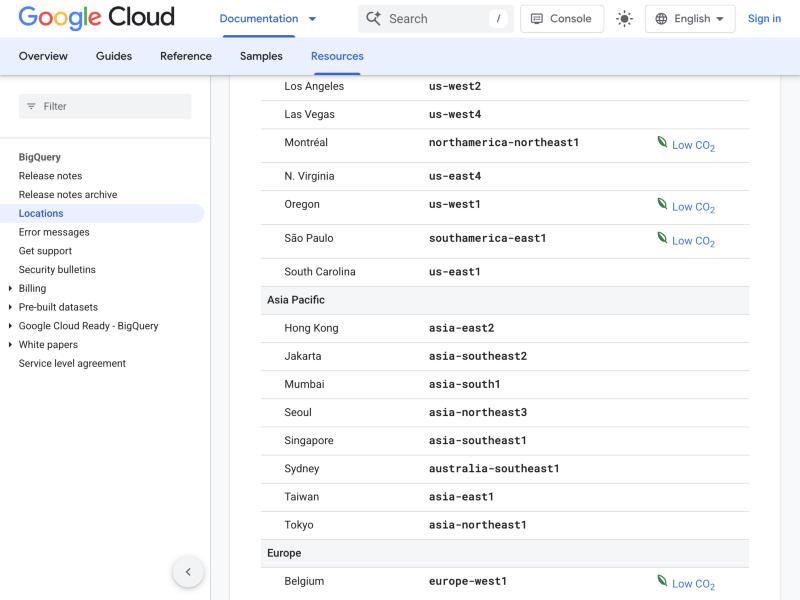
| The nearest Google Cloud regions are offshore. The BigQuery documentation's Asia-Pacific table — introduced by “The following table lists the regions in Asia Pacific where BigQuery is available.” — lists Hong Kong (asia-east2) and Taiwan (asia-east1) as the nearest regions to the mainland, with no Beijing or Shanghai region. Both Hong Kong and Taiwan sit outside the mainland for data-residency purposes. | Google Cloud, “BigQuery locations” (cloud.google.com), retrieved 2026-10-08 |
| Mainland data loaded offshore is a PIPL cross-border transfer. Sending personal information collected from mainland users into a BigQuery region outside the mainland triggers PIPL Articles 38–40: notice, a separate consent, and one transfer mechanism — a CAC security assessment, the CAC standard contract, or certification. | Personal Information Protection Law of the PRC, Articles 38–40 (cac.gov.cn), retrieved 2026-10-08 |
| CII operators must store mainland data in the mainland. China's Cybersecurity Law requires critical information infrastructure operators to store personal information and important data collected and generated in the mainland within the territory — Article 39 in the amended Law effective January 1, 2026 (formerly Article 37 in the 2016 text). An offshore BigQuery region cannot meet that duty. | Cybersecurity Law of the PRC (amended 2025, effective 2026-01-01), Article 39 (cac.gov.cn), retrieved 2026-10-08 |
Sources verified by the 21YunBox compliance team on 2026-10-08.
For a mainland-China audience, the first thing to settle about Google BigQuery is not how fast a query returns — it is where the data lives. BigQuery is Google Cloud’s fully managed, serverless data warehouse, and it stores every dataset in a Google Cloud location you pick. Google Cloud runs no region inside mainland China: the nearest to the mainland are Hong Kong (asia-east2) and Taiwan (asia-east1), and both sit outside the mainland for data-residency purposes. So any BigQuery dataset that holds data collected from users in mainland China necessarily lives offshore.
That turns the usual “does it work in China?” question on its head. Reachability is not the axis that decides it — even if an engineer in Shanghai can open the console and run a query, the question that actually governs a China-facing product is whether the data in that offshore warehouse was allowed to leave the mainland in the first place. Loading personal or important data collected from mainland users into a BigQuery region abroad is a cross-border transfer under China’s data-protection regime, and for some operators it collides with an in-country storage duty that no offshore region can satisfy. Those are the gates this page walks through.
Google BigQuery in China at a glance
| What decides it | In Google Cloud's own terms — and China's law |
|---|---|
| What it is | Google BigQuery is Google Cloud's fully managed, serverless data warehouse. Every dataset is stored in a Google Cloud region or multi-region you choose, and there is no BigQuery region inside mainland China. |
| Is there a mainland-China region? | No. BigQuery stores datasets only in Google Cloud locations, and Google Cloud operates no mainland-China region — the nearest are Hong Kong (asia-east2) and Taiwan (asia-east1), both outside the mainland. So any dataset holding mainland-collected data sits offshore. Reachability from a given office is not the deciding axis; data residency is. |
| Loading mainland personal or important data | Putting personal information or important data collected from mainland users into an offshore BigQuery region is a cross-border transfer under PIPL (Articles 38–40): notice, a separate consent, and one transfer mechanism. An export of important data, or of personal information at regulatory volume, can require the CAC data-export security assessment. |
| In-country storage for CII operators | A critical information infrastructure operator must keep personal information and important data collected in the mainland stored in the mainland — Cybersecurity Law Article 39 (formerly Article 37). An offshore BigQuery region cannot satisfy that duty. |
| The lawful shape | Keep mainland-collected data in a China-resident warehouse in-country, and deliver the China-facing app in-country on ICP-filed infrastructure; let an offshore BigQuery region see only data with a lawful basis to leave. 21YunBox maps the data flows, localizes the China-resident footing, and delivers in-country — treat the specifics as a risk to confirm with counsel. |
Region availability: there is no mainland-China Google Cloud region
Google Cloud publishes the exact list of places a BigQuery dataset can live, and that documentation — not a load-time test — is the authority here. It states, under “Supported locations,” that “BigQuery datasets can be stored in the following regions and multi-regions,” and the Asia-Pacific table that follows — “The following table lists the regions in Asia Pacific where BigQuery is available.” — runs from Bangkok and Delhi through Hong Kong (asia-east2), Tokyo, Seoul, Singapore, Sydney, and Taiwan (asia-east1). There is no Beijing region and no Shanghai region; mainland China does not appear at all.
That matters because a BigQuery region is where the data physically rests and is processed. With no mainland option, a team serving Chinese users that wants its analytics in BigQuery has to place the dataset in one of those offshore regions — most often Hong Kong or Taiwan as the nearest. Both are outside the mainland, so routing mainland-collected data to either is itself an outbound transfer, not a domestic one — a point worth confirming with counsel for your specific data.
The real axis: data residency, not reachability
Because the service is hosted entirely outside the mainland, the decision for a China-facing product is a data-residency one. Whether the console happens to load from a given office on a given day is beside the point, and this page publishes no first-party China latency figure for BigQuery — speed is the wrong axis for a question about where regulated data is allowed to sit. What counts is the nature of the data flowing into those offshore datasets, and whether it had a lawful basis to leave China.
The cross-border-transfer gate: PIPL and the data-export security assessment
A BigQuery table serving a China-facing product rarely holds anonymous rows only — it carries user identifiers, order records, device and behavioral data, often names and contact details. Moved from users in the mainland into a dataset in an offshore region, that is a cross-border transfer of personal information under China’s Personal Information Protection Law. PIPL puts the duty on the handler — you, not Google: Articles 38–40 require notice, a separate consent distinct from the user’s agreement to use the product, and one transfer mechanism — a CAC security assessment, the CAC standard contract, or certification.
Above certain thresholds the lightest mechanisms fall away. An export of “important data,” or of personal information at regulatory volume, can require a government-reviewed data-export security assessment organized by the Cyberspace Administration of China before the data may leave. Which mechanism your transfer needs — and whether any applies at all — is a risk to confirm with counsel against the data you actually load.
In-country storage for CII operators (CSL Article 39, formerly Article 37)
For one class of operator the offshore warehouse is not merely a transfer to be papered — it is a conflict. China’s Cybersecurity Law requires a critical information infrastructure operator to store personal information and important data collected and generated in the course of operations within the mainland inside the territory, exporting it only after a security assessment. That duty is Article 39 (formerly Article 37) — renumbered by the amendment effective January 1, 2026, though older commentary still cites Article 37. A BigQuery dataset in Hong Kong, Taiwan, or any other Google Cloud region sits outside the territory by definition, so it cannot satisfy an in-country storage duty. Whether your organization is a CII operator is a determination for counsel — but if it is, an offshore BigQuery region is not an option for the data the duty covers.
The lawful shape — and where 21YunBox fits (map, localize, deliver)
There is a lawful way to do analytics for a China-facing product, and it does not involve routing mainland data abroad or any circumvention. The shape is simple: keep the regulated China data in the mainland, and let only data with a lawful basis to leave feed an offshore warehouse. That means a China-resident warehouse inside the mainland for personal and important data collected there, and a China-facing app that is itself licensed and delivered in-country — because the app that surfaces those insights is a public service in the mainland, carrying an ICP filing (备案) duty like any other China-facing property.
Our China team does three things on that footing. We map your data flows and residency exposure — which datasets hold personal information or important data collected from mainland users, and where those datasets physically live today. We localize the storage — standing up a China-resident warehouse inside the mainland so mainland-collected data stays in-country, with only lawfully transferable data feeding an offshore BigQuery region for global analytics. And we deliver the China-facing app that presents the results in-country on ICP-filed infrastructure — the 21YunBox Optimizer — in front of the app you already run, with no rebuild and no re-platform. What we do not do, and what no one lawfully can, is move mainland data offshore for you or route around China’s rules: we localize a compliant, in-country footing and deliver it.
Related reading:
- China Cross-Border Data Transfer: What the Regulation Actually Says
- China Measures for the Security Assessment of Outbound Data Transfers
- China Cybersecurity Law