Does Talend Work in China? Data Integration, PIPL & Data Residency
Talend — now Qlik Talend Cloud since Qlik's 2023 acquisition — runs its control plane and managed runtime on AWS and Azure across the US, Europe, APAC and the Middle East, with no mainland-China region, so the data estate its pipelines move comes to rest offshore: a PIPL cross-border transfer. A compliance-first look at where your integration data is allowed to live.
Does Talend work in China?
Whether Talend works in China is a data-residency question, not a speed one. The console loads fine from the mainland; the risk is legal — where the records its pipelines move are allowed to come to rest.
Talend — now sold as Qlik Talend Cloud since Qlik's 2023 acquisition — runs its control plane and managed runtime on AWS, with one US tenant on Azure, across the US, Europe, the Asia-Pacific and the Middle East. By Qlik's own regions page, "we host your data only in the region you select" — and none of the selectable regions is in mainland China. Because a data-integration tool moves your whole data estate, the customer and employee records, transaction logs and Article 28 sensitive fields its jobs carry are processed offshore: a cross-border transfer of personal information PIPL governs, needing notice, separate consent, a transfer mechanism, and for a CIIO or large-volume handler, in-country storage (PIPL Article 40; Cybersecurity Law Article 39, formerly Article 37). A self-managed Remote Engine keeps job execution in-country, but the console, metadata and logs stay offshore — so in-country runtime is not automatic compliance.
This is a risk map, not a ruling — your obligations turn on your entity, your data volumes and who your users are. Our China team can map your Talend data exposure with you →
What Talend (now Qlik Talend Cloud)'s own documentation says about China
| Fact | Primary source |
|---|---|
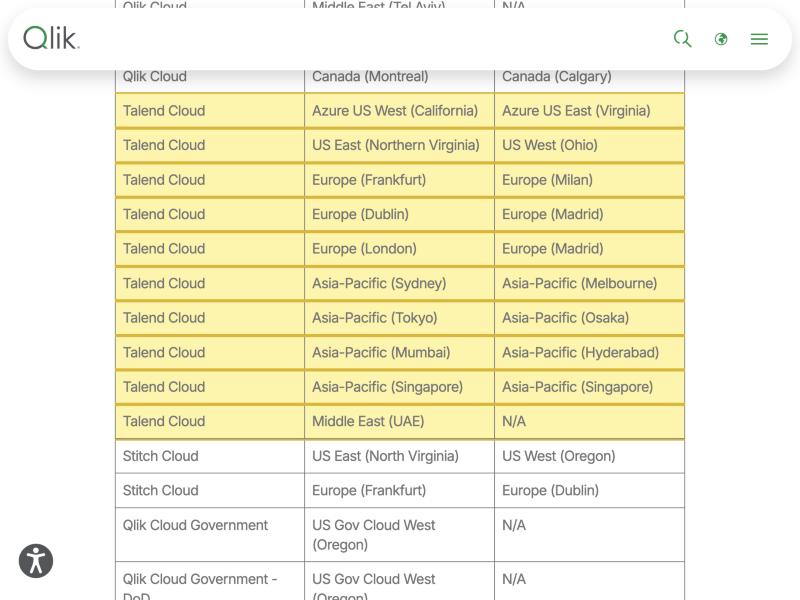
| Talend Cloud has no mainland-China region. On its own regions page, Qlik lists the Talend Cloud data regions as AWS US East (Northern Virginia), an Azure US tenant (California), Europe (Frankfurt, Dublin, London), the Asia-Pacific (Tokyo, Sydney, Mumbai, Singapore) and the Middle East (UAE), and answers the residency question with "we host your data only in the region you select." None of those selectable regions is in mainland China. | Qlik Cloud Regions page (lists Talend Cloud data regions), retrieved 2026-10-10 |
| In-country execution does not make the platform in-country. Talend's own documentation says a self-managed Remote Engine is "within your data center" and lets you "run tasks that use on-premises applications and databases," with "communication between Talend Management Console and Remote Engines is fully secured as data is not staged." But the Management Console — the offshore control plane — still holds your tenant config, pipeline and task definitions, schedules and run logs, and the managed Cloud Engine moves the records themselves offshore. | Qlik Talend Help — Working with Talend Remote Engines, retrieved 2026-10-10 |
| Routing mainland data through an offshore region is a cross-border transfer. Because a data-integration platform moves customer and employee personal information, transaction logs and Article 28 sensitive fields across systems, records sourced in China and processed in Talend's offshore region are an export PIPL governs — requiring notice, a separate consent, and one transfer mechanism (PIPL Articles 38–40), with a possible CAC security assessment above volume or sensitivity thresholds. | Personal Information Protection Law of the PRC, Articles 28 and 38–40 |
| CIIOs and large-volume handlers owe an in-country storage duty the hosted platform cannot meet. Personal information and important data collected in the mainland must be stored in the mainland (PIPL Article 40; Cybersecurity Law Article 39, formerly Article 37). The 2025 Cybersecurity Law amendment, in force January 1, 2026, renumbered the data-localization article from 37 to 39, substance unchanged. | PIPL Article 40; PRC Cybersecurity Law Article 39 (formerly Article 37) |
Sources verified by the 21YunBox compliance team on 2026-10-10.
For a team serving mainland China, the question about Talend — the data-integration platform now sold as Qlik Talend Cloud since Qlik completed its acquisition in May 2023 — was never whether the console loads. It usually does. The question is where the records it moves are allowed to come to rest. A data-integration tool exists to pull data out of one system and write it into another, so its pipelines touch your whole estate: customer and employee PII, transaction and event logs, and whatever each source and destination holds. Talend runs its control plane and managed runtime on AWS — with one US tenant on Microsoft Azure — across regions in the US, Europe, the Asia-Pacific and the Middle East. None is in mainland China. Reaching the console is the delivery half; where the data it carries is stored is the exposure.
Talend in China at a glance
| What decides it | In Talend's own terms — and China's law |
|---|---|
| Where the records live | Talend Cloud's control plane and managed runtime run on AWS, with one US tenant on Azure, across the US, Europe, the Asia-Pacific (Tokyo, Sydney, Mumbai, Singapore) and the Middle East. Qlik's own answer on residency is "we host your data only in the region you select" — and none of those selectable regions is in mainland China. |
| What it holds, and why it's personal information | A data-integration tool moves and transforms your whole data estate between systems — customer and employee PII, transaction and event logs, and whatever each source and destination holds. A single pipeline can carry Article 28 sensitive personal information: financial, government-ID, location or health fields. The exposure is unusually broad. |
| Your mainland data on the platform | Records sourced in China and routed through an offshore Talend Cloud region — or executed on its managed Cloud Engine — are a cross-border transfer PIPL governs: notice, a separate consent, and one transfer mechanism (PIPL Articles 38–40). |
| In-country storage duty | A critical information infrastructure operator or large-volume handler owes an in-country storage duty the hosted control plane cannot meet — mainland personal information must stay in the mainland (PIPL Article 40; Cybersecurity Law Article 39 (formerly Article 37)) — the 2025 Cybersecurity Law amendment, in force January 1, 2026, renumbered the data-localization article from 37 to 39. |
| Is it reachable? | Treat reachability as the delivery half, not the question. A China-facing surface — an operational dashboard, a data portal, an intake form — also needs an ICP filing tied to a mainland hosting resource (State Council Order No. 292; MIIT Order No. 33). |
No mainland region, so the data your pipelines move leaves the country
Talend is explicit about where it runs. Its regions page lists the Talend Cloud data regions one by one — AWS US East (Northern Virginia), an Azure US tenant in California, Europe (Frankfurt, Dublin, London), the Asia-Pacific (Tokyo, Sydney, Mumbai, Singapore) and the Middle East (UAE) — and answers the residency question plainly: “we host your data only in the region you select.” Not one of those regions is in mainland China; Singapore and Tokyo are the nearest, and both sit outside the border. The region is chosen once, when your tenant is provisioned, from that offshore list. So when a pipeline reads a mainland source — a transactional database, an application, a file drop — and writes it into Talend Cloud’s managed runtime or an offshore destination, that data is processed and stored in whichever offshore region your tenant was created in. Under China’s Personal Information Protection Law, sending personal information collected in the mainland to one of those regions is a cross-border transfer — and the handler on the hook is you, the customer, not the vendor.
A data-integration tool touches your whole data estate — and most of it is personal information
Most tools hold one slice of your data. An integration platform, by design, moves all of it: it is the pipe between your CRM, your ERP, your data warehouse, your event streams and your partners’ systems. That breadth is the point of the risk. The rows flowing through a Talend pipeline carry the names, emails, account numbers, order histories and device identifiers of your China customers, and the payroll, identity and HR fields of your China employees — personal information the moment it describes an identifiable person, and governed by PIPL on export. The exposure sharpens because a single mapping can move Article 28 sensitive personal information — financial records, government-issued IDs, precise location, or health data — out of the country in one job. That category carries a higher bar under PIPL: a specific purpose, strict necessity, and separate consent. For a handler that crosses the data-export security assessment threshold on volume or sensitivity, the whole export may need a CAC-led review before any of it lawfully leaves. One tool can quietly become the widest cross-border channel you operate.
Narrowing the exposure doesn’t close the door
There are real levers here, and Talend offers one of the better ones. A self-managed Remote Engine runs “within your data center” and lets you “run tasks that use on-premises applications and databases,” so the records a job touches can stay inside your network rather than transit the managed cloud — the vendor notes that “communication between Talend Management Console and Remote Engines is fully secured as data is not staged.” You can also scope which pipelines carry mainland data, redact or tokenize sensitive fields before they move, and pick the provisioning region nearest your users. Pull these levers — they genuinely reduce what crosses. But be precise about what they do not touch. The Talend Management Console is the control plane, and it lives in your offshore region: it holds your tenant configuration, your pipeline and task definitions, your schedules, your run logs and your orchestration metadata, whichever engine actually runs the job. Any pipeline you point at the managed Cloud Engine instead of a Remote Engine still moves the records themselves offshore, and the cloud-side preparation and stewardship apps sample data in the cloud as well. In-country execution is not automatic compliance; it changes the contents of the transfer, not the residency of the platform that directs it. This is a risk map, not a verdict — whether you owe a transfer mechanism, a separate consent, in-country storage, an ICP filing, or some combination turns on your entity, your data volumes, how much of what moves is personal or sensitive, and who your users are, and is worth settling with counsel before you route a single mainland record through the platform.
The lawful path — map, localize, deliver
You do not have to drop Talend to run it lawfully for mainland China. 21YunBox is a compliant overlay, not a migration — and for a platform like this, a partner that sits alongside the tool you already run, not a competitor to it. There are three moves, and they fit together.
Map. Our China compliance team reads your PIPL cross-border, data-residency and sensitive-PI obligations against your actual entity, your data volumes, and who your mainland users and employees are — so the exposure across the data estate Talend touches is written down before anything is rewired.
Localize. Because the hosted platform has no mainland region, we stand up consented, in-country storage and processing for the records that must stay on mainland soil — paired with Talend’s own self-managed, in-country execution where it fits — so the personal information China requires to remain in-country does, while only the minimized, lawfully transferable subset ever reaches your offshore tenant.
Deliver. For any China-facing surface — an operational dashboard, a data portal, an intake or request form — the 21YunBox Optimizer provides ICP-filed, in-country delivery, in front of the stack you already run. No rebuild, no second codebase, no move off the platform. 21YunBox never uses or suggests circumvention of any kind; the entire point is a lawful, filed, in-country path.
The goal is plain: your data-integration program runs legally and compliantly for your users in China.
Related reading:
- How to get an ICP filing for China
- Cross-border data transfers under PIPL
- China’s Cybersecurity Law and data localization
- China’s data-export security assessment measures