Does Celonis Work in China? Process Mining, Event Logs, PIPL & Data Residency
Celonis sets platform hosting by your billing entity across AWS, Microsoft and Google regions — US, EU, Switzerland, India, Brazil, South Korea, UK and UAE — with no mainland-China region, so the ERP transaction and event logs it ingests from China come to rest offshore: a PIPL cross-border transfer. A compliance-first look at where your process-mining data is allowed to live.
Does Celonis work in China?
Whether you can use Celonis in China is a data-residency question, not a speed one. The process-intelligence platform is reachable from the mainland; the exposure is legal, and it turns on where the data Celonis ingests is allowed to come to rest.
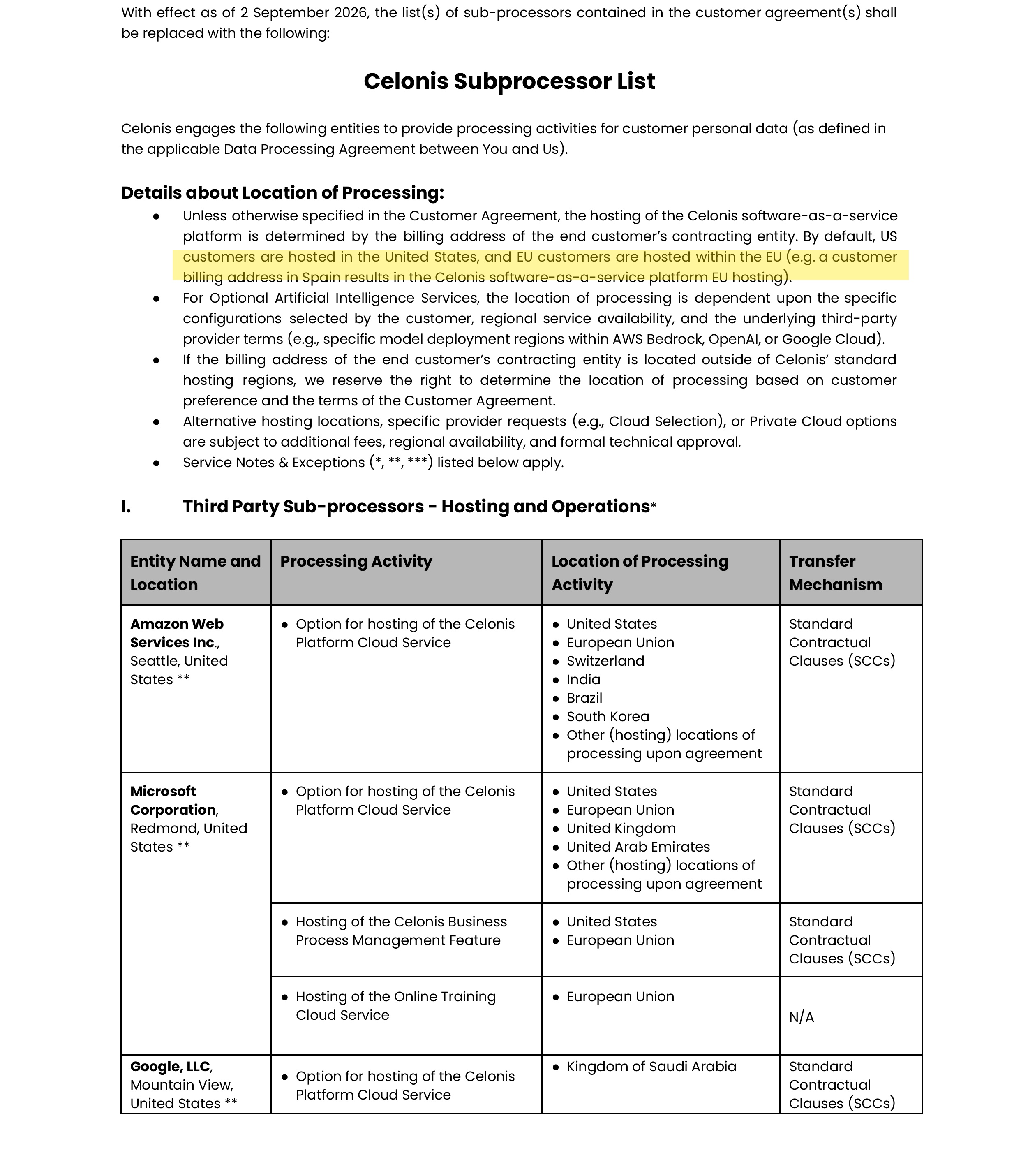
By Celonis’s own sub-processor list, platform hosting follows your billing entity — "customers are hosted in the United States, and EU customers are hosted within the EU" — on AWS, Microsoft and Google regions spanning the US, EU, Switzerland, India, Brazil, South Korea, the UK and the UAE. None is in mainland China. Yet Celonis reconstructs processes by ingesting whole transaction and event logs out of your ERP, so a broad, people-dense slice of your data estate — potentially including Article 28 sensitive fields — lands offshore. That is a cross-border transfer PIPL governs, with an in-country storage duty under PIPL Article 40 and Cybersecurity Law Article 39 (formerly Article 37).
This is a risk map, not a verdict — your obligations turn on your entity, your data volumes and who your users are. Our China team can map your Celonis exposure with you →
What Celonis's own documentation says about China
| Fact | Primary source |
|---|---|
| Celonis sets platform hosting by your billing entity, and none of its regions is in mainland China. Its own sub-processor list, effective 2 September 2026, states that "customers are hosted in the United States, and EU customers are hosted within the EU," with AWS, Microsoft and Google hosting the platform across the US, EU, Switzerland, India, Brazil, South Korea, the UK and the UAE. No mainland-China region appears, so China-sourced records resolve to an offshore region — a cross-border transfer under PIPL. | Celonis Subprocessor List (August 2026), celonis.com, retrieved 2026-10-10 |
| Celonis works by ingesting your source systems’ transaction and event data into its platform. Its product description states the System Extractor "extracts data from the source system and sends it to the Celonis platform," and that the platform "automatically generates event logs" and lets you "create custom event logs." Reconstructing a process pulls a broad, people-dense slice of ERP data — a far wider export surface than a single app’s records. | Celonis Product Description (September 2026), celonis.com, retrieved 2026-10-10 |
| Personal information collected in mainland China and sent to an offshore region is a cross-border transfer PIPL governs. It requires notice, a separate consent, and one of the Article 38 transfer mechanisms, plus an in-country storage duty for a critical-information-infrastructure operator or large-volume handler (PIPL Article 40; Cybersecurity Law Article 39 (formerly Article 37)) — the 2025 Cybersecurity Law amendment, in force January 1, 2026, renumbered the data-localization article from 37 to 39. | PIPL Articles 38–40; Cybersecurity Law Article 39 (formerly Article 37) |
| A full transaction log can carry Article 28 sensitive personal information. Financial-account, government-ID, location and similar fields swept into an event log meet PIPL’s definition of sensitive personal information, which raises the bar to a specific purpose, strict necessity and a separate consent — and can push a large export into a CAC security assessment before it may leave the country. | PIPL Article 28; Measures for the Security Assessment of Data Exports |
Sources verified by the 21YunBox compliance team on 2026-10-10.
For a team serving mainland China, the question about Celonis was never whether the dashboard loads — the process-intelligence platform is reachable. The question is where the records behind it are allowed to come to rest, and Celonis answers that in its own sub-processor list. Hosting is set by the billing address of your contracting entity: in its own words, US customers are hosted in the United States and EU customers within the EU, on AWS, Microsoft and Google regions across the US, EU, Switzerland, India, Brazil, South Korea, the UK and the UAE. None is in mainland China. Yet Celonis works by ingesting whole transaction and event logs out of your source systems, such as SAP and Oracle — so a broad, people-dense slice of your data estate lands in whichever offshore region your entity resolves to. Reaching the platform is the delivery half; where that event log is stored is the exposure.
Celonis in China at a glance
| What decides it | In Celonis's own terms — and China's law |
|---|---|
| Where the records live | Hosting is set by billing entity: "customers are hosted in the United States, and EU customers are hosted within the EU," on AWS, Microsoft and Google regions across the US, EU, Switzerland, India, Brazil, South Korea, the UK and the UAE. None is in mainland China. |
| What it holds, and why it's personal information | The System Extractor "extracts data from the source system and sends it to the Celonis platform," which then generates event logs. A reconstructed process carries employee IDs, customer records and financial transactions — personal information, and where financial, ID or location fields appear, Article 28 sensitive personal information. |
| Your mainland data on the platform | Collected in China and written to an offshore region, it is a cross-border transfer PIPL governs — notice, a separate consent, and one transfer mechanism (PIPL Articles 38–40). |
| In-country storage duty | A critical-information-infrastructure operator or large-volume handler owes an in-country storage duty the hosted platform cannot meet — mainland personal information must stay in the mainland (PIPL Article 40; Cybersecurity Law Article 39 (formerly Article 37)) — the 2025 Cybersecurity Law amendment, in force January 1, 2026, renumbered the data-localization article from 37 to 39. |
| Is it reachable? | Treat reachability as the delivery half, not the question. A China-facing surface — a shared dashboard, an App or an Action Flow intake served to mainland staff — also needs an ICP filing tied to a mainland hosting resource (State Council Order No. 292; MIIT Order No. 33). |
No mainland region, so the event logs leave the country
Celonis’s sub-processor list, effective 2 September 2026, is explicit about where the platform runs. Hosting is determined by the billing address of your contracting entity, and “customers are hosted in the United States, and EU customers are hosted within the EU.” The hosting providers named are AWS, Microsoft and Google, and their listed locations are the United States, the EU, Switzerland, India, Brazil, South Korea, the United Kingdom and the United Arab Emirates. Not one of those regions is in mainland China; the nearest, South Korea and India on AWS, still sit outside the border. If your contracting entity is a mainland-China company, its billing address falls outside that standard region set, so the platform resolves to one of the offshore regions above — there is no in-region option to select. Alternative or private-cloud hosting is still drawn from the same offshore list, subject to regional availability and formal technical approval; none of it puts a region on mainland soil. So when your China teams build a data model and the platform ingests the underlying logs, that data is written to an offshore region. Under China’s Personal Information Protection Law, sending personal information collected in the mainland to one of those regions is a cross-border transfer — and the handler on the hook is you, not the vendor.
A whole transaction log is personal information — and often sensitive
Process mining is, by design, a wide net. To reconstruct how an order-to-cash or procure-to-pay process actually runs, Celonis pulls the transaction and event records out of your source systems and, in its own words, “automatically generates event logs” and lets you “create custom event logs.” Those logs are dense with people: the employee who approved a purchase order, the customer on an invoice, the vendor on a payment, the user ID and timestamp on every step. Names, staff and customer IDs, reporting lines and the financial amounts attached to them are personal information the moment they describe an identifiable person — and a mainland employee’s or customer’s personal information sent to an offshore region is governed by PIPL on export. The exposure sharpens where the log carries financial-account numbers, government IDs, precise location or similar fields: that is sensitive personal information under PIPL Article 28, which demands a specific purpose, strict necessity and a separate consent. For a handler that crosses the data-export security assessment threshold, the whole export may need a CAC review before any of it lawfully leaves. Because a process-mining pipeline sweeps across the entire data estate rather than one application’s table, its cross-border surface is unusually broad — a single pipeline can carry far more personal, and more sensitive, information out of the country than a buyer expects.
Narrowing the exposure doesn’t close the door
There are real levers to reduce what crosses the border. You can run the System Extractor or Data Integration inside your own network, scope which source systems and columns feed the model, redact or pseudonymize person fields before load, and pick the region nearest your users. They are worth pulling — but be clear about what they do. An in-country extractor is the honest-sounding lever, and it is not automatic compliance: by design it “extracts data from the source system and sends it to the Celonis platform,” which has no mainland-China region, so the event log still crosses the border and the control plane, metadata and job logs sit offshore regardless of where the extractor runs. These moves change the contents and the destination of the transfer; they do not change the fact of it. Residency is untouched. And a China-facing surface — a shared dashboard, a published App, an Action Flow intake pointed at mainland staff — additionally needs an ICP filing tied to a mainland hosting resource before it may be served, whatever you do about the data behind it. This is a risk map, not a verdict: whether you owe a transfer mechanism, a separate consent, in-country storage, an ICP filing, or some combination turns on your entity, your data volumes, how much of the log is personal or sensitive, and who your users are — worth settling with counsel before you point a single mainland source system at the platform.
The lawful path — map, localize, deliver
You do not have to drop Celonis to run it lawfully for mainland China. 21YunBox is a compliant overlay, not a migration — and for a platform like this, a partner that sits alongside the tool you already run, not a competitor to it. There are three moves, and they fit together.
Map. Our China compliance team reads your PIPL cross-border, data-residency and sensitive-PI obligations against your actual entity, your data volumes, and who your mainland users and employees are — so the exposure in the transaction and event logs you feed Celonis is written down before anything is rewired.
Localize. Because the hosted platform has no mainland region, we stand up consented, in-country storage and processing for the records that must stay on mainland soil — including the self-managed, in-network extraction the tool supports — so the data China requires to remain in-country does, while only the minimized, lawfully transferable subset ever reaches your offshore tenant.
Deliver. For any China-facing surface — a dashboard, a published App, an intake served to mainland staff — the 21YunBox Optimizer provides ICP-filed, in-country delivery, in front of the stack you already run. No rebuild, no second codebase, no move off the platform. 21YunBox never uses or suggests circumvention of any kind; the entire point is a lawful, filed, in-country path.
The goal is plain: your process-intelligence program runs legally and compliantly for your users in China.
Related reading:
- How to get an ICP filing for China
- Cross-border data transfers under PIPL
- China’s Cybersecurity Law and data localization
- China’s data-export security assessment measures